India now blends high-value spices instead of merely exporting them. The Spice Annual Report 2023-2024 claimed processed spice exports exceeded ₹1.25 trillion. Exported processed spices soared rapidly.
There are lower barriers to entry than many downstream spice export products. Export markets can profit from exported blended fortified spices. High-value spice products are increasingly in demand along with growing health awareness.
The focus of this report is on providing solutions to entrepreneurs in this entrepreneurial market with relevant data, insights, government support and relevant policies.
There is a growing appetite for Spice Blending Businesses which cover the gap for Blended and Steam-Processed Spices.
India has maintained its spice production and export leadership for a long time. During 2023-2024, India exported spices in excess of ₹1.25 trillion, which amounts to over 15 million tons.
The demand for available spices has not yet reached its peak, and sales continue to grow. The specially blended vitamins and minerals along with spices, provide an additional boost to the spices and seasonings while opening up a new high-end market for spice use, thus reinforcing the quality of the seasonings.
Read More: Profitable Spice Blend Business Ideas for Entrepreneurs
Why Should Startups Target Blended and Fortified Spice Products?
Blended and fortified spice products take advantage of India’s agricultural productivity and global emerging consumption trends. These startups not only command significantly higher margin over blended fortified spices as compared to raw spices, they enjoy positive brand equity with cross border exports and low/no tariff barriers.
Moreover, they reduce per unit logistics, enhance unit economics, expand the portfolio of fortified dietary products (shelf-stable, low sodium, vegan) and thus, improves per unit economics.
Blended & fortified spice products exports and scaled export potential are weaker.
Read More: Spice Processing Business Opportunities For Entrepreneurs
Blended & Fortified Spice Space Key Opportunities
Ready-To-Cook Spice Blends
The ready to cook spice blends biriyani masalas, curry mixes, and other global seasoning kits are of rising importance. They are gaining recognition across the world.
Startups should target the more promising mixtures and take charge of the sieving, sterilizing, and quality controlled (FSSAI, ISO) packaging automation processes. They should source their raw materials from farmer cooperatives to lower operational costs.
Moreover, the authentic tastes are now appreciated in the large markets of the, U.S. And in Europe. And also for the Middle East along with their diaspora and mainstream consumers.
Health Fortified Seasonings
The level of intensity is very low in this category, but rather has great importance in the functional enhancement of simply adding some vitamins, minerals, and herbal extracts to the existing spices.
More specifically, better control over blood pressure can be complemented with turmeric and vitamin D or potassium fortified salt substitutes. Developing schemes under MoFPI and MSME promotes tech savvy entrepreneurial behavior.
Gourmet & Premium Spice Mixes
Truffle infused premium masalas and organic barbecue rubs are classified under premium products and sold at a premium.
Startups have the potential to collaborate with luxury retail and e-commerce channels. Membership with IndGAP and organic certification boosts reputation on global platforms.
Read More: Spices Industry. Spices and Condiments Processing Business
Custom Blends for Foodservice & Industry
Focusing on proprietary blends would also enhance relevance of the startups to restaurants, QSRs, and producers of packaged food.
The model is build on principles of cost and operational effectiveness, along with growth in compliance with food safety standards. It also paves the way for private label manufacturing for international companies.
Insights on Imports, Exports, and Global Demand
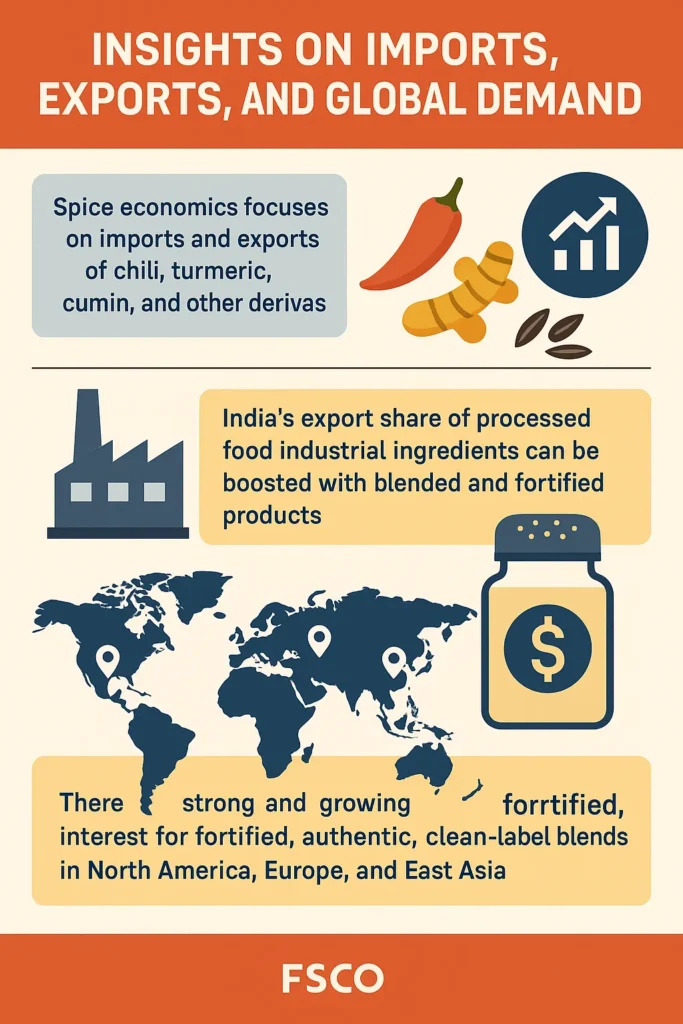
Spice Economic worries themselves with the boasting metrics concerning the imports and exports, especially with the spices-chili, turmeric, and cumin, along with the other derivatives.
India’s share of exports in processed food industrial ingredients can be enhanced with blended and fortified products. Startups successfully delivering functional seasoning at a price lower than the imported specialty blends, are bound to a lucrative deal.
There remains a steady, and growing, stream of interest in North America, and steadily growing interest in Europe and East Asia, for these fortified, authentic, clean-label blends. They are popular with the diaspora as well as the mainstream.
MSME Success Stories, and the Business Model
For the spice manufacturing MSMEs in India, this is as much a challenge as it is an opportunity.
Numerous small manufacturing units in the spice hubs of Kerala, Gujarat, and Rajasthan have transitioned from regional blending to international exporting brands.
These companies offer the finest blends made from organic ingredients, unique masalas made for certain health diets, and customized options to large wholesale kitchens.
Startups can now work at a gradual pace from contract blending to the development of a full-fledged branding strategy with the right combination of skills.
Such transitions are facilitated by the government incentive schemes from the MSME and the MoFPI, and the incentives from APEDA.
Read Our Project Report: Click Here
New Entry Action Plan
Research international market for blended or fortified spice type products with the highest profit potential.
Complete the necessary forms, as provided, to gain the PMKSY (MoFPI) & MSME funded governmental grants and subsidies.
The blending, sterilization, and packing systems should be integrated and mechanically compliant to the uniform export quality standards.
Purchases from FPOs are encouraged because of guaranteed traceability and market leading prices.
FSSAI, HACCP, IndGAP and Organic certifications are crucial for the international market.
Establish connections with distributors and e-commerce to develop a direct international market.
Read Our Book: Click Here
Bringing to the Global Stage the Spice Heritage of India
The next frontier of the spice industry in the country will be the resulting opportunities from blended and fortified spice products.
In fact, international market demand for genuine and functional food products is a direction in which government assistance and raw materials will be channeled.
With appropriate supply chains, branding, and support, emerging companies will propel the country’s spice legacy to a position of competitive branding in the global market.
Find the Best Idea for Yourself With our Startup Selector Tool
How NPCS Can Help You
Niir Project Consultancy Services (NPCS) prepares Market Survey cum Detailed Techno Economic Feasibility Report (DPRs) to assist entrepreneurs in establishing a spice-based business, offering a comprehensive range of consultancy services.
Entrepreneurs are able to carry out assessments thanks to defining proprietary rights documents that incorporate the profit forecasts along with the attached mechanism for the finances, industry, demand, available process, primary materials, equipment, production-mix, capacity, and workflows comprehensively and capably.
Consequently, the feasibility, scalability and long-term viability can thus be assessed confidently.
FAQs
1) Why are blended spice products usually more profitable than raw spices?
A. For detached raw spices, blended spice products integrations definitive more profits owing to lower import barriers, easier export readiness, better branding, and more value addition.
2) Which are the strongest markets in demand for Indian spice blends?
A. Strongest markets in demand for Indian spice blends are the USA, Europe and Middle Eastern countries.
3) What certifications enhance acceptance in export?
A. FSSAI, HACCP, IndGAP, and Organic are some certifications which improve acceptance for export.
4) What are the unique features of fortified spice blends?
A. Fortified spice blends preserve the functional health benefits by adding them with vitamins, minerals, and herbal extracts.
5) How can startups acquire raw spices efficiently?
A. Startups can source raw spices more easily via Farmer Producer Organizations (FPOs) in a bid to better control cost and traceability.