Processed Food Export Business Ideas India
India’s processed food exports industry has surreptitiously emerged as one of the most lucrative business investment avenues of this decade for the entrepreneurs who are looking for high return business ideas in India for manufacturing and agri-processing businesses. Global demand for ethnic and health foods, government support and India’s natural raw material benefits have led to a rare convergence. This sector is a regular feature on the priority lists of seasoned consultants working in the MSME space, from startups to mid-sized businesses.
These business ideas are particularly appealing because of more than just the top-line export figures. The bottom-line dynamics are really transformative. The manufacturing value-add of processed food products is also a strong pathway to project viability: two to five times higher export realisation than for raw agricultural products.
Why the Processed Food Export Sector Merits Serious Investment Attention
The processed food market has definitely moved beyond its previous status as a raw material supplier in India. The nation has now secured a viable position in the international specialty food sectors, especially in the spice, ready-to-feed, fruits derivatives and marine segments.
The case for a structural entry into this sector is based on three pillars, all reinforcing each other:
- Diaspora markets in North America, the Gulf, the United Kingdom and Southeast Asia are all growing, and consumers in these regions have well-entrenched buying habits and are surprisingly loyal to the brands they love.
- India’s farm-to-factory cost economics remain structurally advantageous versus competing origins. Whether it is mango pulp in Maharashtra, spice procurement in Rajasthan or Kerala, or seafood in Andhra Pradesh and Gujarat, raw material availability gives Indian processors a margin buffer that exporters from other origins simply cannot replicate.
- The processed food export market is not a winner-takes-all space. Dozens of verticals remain fragmented, under-branded, and largely unorganised — meaning a disciplined, quality-compliant mid-scale manufacturer can gain market share without competing head-on with listed conglomerates.
The three factors of demand growth, cost advantage and market fragmentation are unusual. It highlights why feasibility consultants are increasingly considering this a first choice for serious entrepreneurs to venture into.
Related Article: Top High-Profit Food Manufacturing Businesses in India (Guide for MSMEs & Entrepreneurs)
Government Policies and Incentive Architecture for Food Processing Exporters
The policy framework for this sector is likely the most robust ever. There are a number of well-documented schemes which explicitly lower the capital risk and market-entry cost for manufacturers with export sales.(Processed Food Export Business Ideas India)
The Production Linked Incentive (PLI) Scheme of Ministry of Food Processing Industries (MoFPI) offers financial incentives for the financial lives of the manufacturers meeting the sales criteria over a multi-year period. This is especially advantageous for the exporters that are expanding their production volume, since it allows to lower the break-even point and therefore to shorten the payback time of the investments. Qualifications and instructions on how to apply are available at
In addition to PLI, the Ministry of Commerce has Agricultural & Processed Food Products Export Development Authority (APEDA) which conducts continuous market development and infrastructure assistance programmes. APEDA schemes cover:
- Funding for export promotion and market development.
- Support for developing cold chain infrastructure
- Promoting in international trade fairs
- Quality certification assistance
These efforts together offer a considerable reduction in the cost of market entry for first time exporters. In addition, APEDA’s resources can be accessed on
apeda.gov.in.
The MSME Ministry’s Credit Guarantee Fund Trust (CGTMSE) offers collateral-free credits to MSMEs – and most food processing export businesses fall under the MSME category, and thus are eligible. In addition, there are duty drawback benefits, GST input benefits for export units and RoDTEP benefits that enhance the net realisation on exports. Make in India and One District One Product (ODOP) provide further opportunity for linkage for regional speciality food manufacturers in terms of branding and procurement.
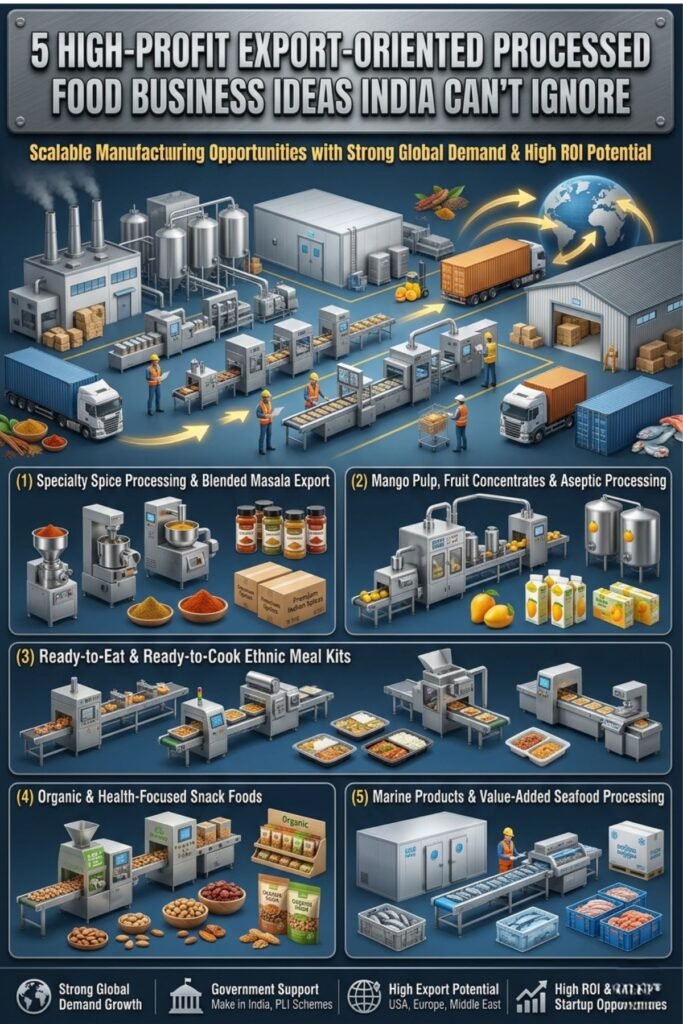
5 High-Potential Business Ideas Within Processed Food Exports
1. Specialty Spice Processing and Blended Masala Export
India accounts for almost 75% of the global consumption of spices. But an unequal proportion of trade leaves in unprocessed form (and the processing value added in destination markets by importers). This margin is captured at home by an entrepreneur who comes to the processed spice space, from cleaning, grinding and blending masala formulations and packages them for export.
The business logic is of high interest. The gross sales value of a kg of raw turmeric may be perhaps one-third of a kg of turmeric exported as a consumer pack of standardised powder. The investment in the project ranges from ₹80 lakh to ₹2.5 crore which depending on the size and automation, will enable the development of a spice processing plant which is export ready with hygienic packaging lines, FSSAI and USFDA compliant infrastructure.(Processed Food Export Business Ideas India
The main strategic idea is segmentation of markets. European food-service clients are looking for different heat profiles and packaging types to their Gulf region buyers. Market intelligence investment can help the entrepreneur position product formulations that have a true edge over the generic exporters, and charge premium prices.
Download the Full Guide: Handbook on Spices, Seasonings and Condiments Processing, Extraction with Kitchen Spices Manufacturing
2. Mango Pulp, Tropical Fruit Concentrates, and Aseptic Processing
India is producing the largest number of mangoes in the world. However, the volume of exports to the top tier of processors, the beverage industry, and the food-service distributors that produce value-added mango products for export to foreign markets continues to be controlled by a small number of processors. This geographical concentration means that there is a genuine entry opportunity.
Project cost of an aseptic fruit processing plant (pulp, pasteurise, Brix standardises and cold store) falls in the mid-scale range of ₹1.5 crore to ₹4 crore. Well-connected operators having APEDA registration and buyer connections can earn ₹8-15 crore per year at 100% utilization.
The aseptic packaging has its basis in the margin story as no preservatives are required. This method will therefore make the certified Indian fruit derivatives accessible to high-end buyers in the food industry of Europe, Japan and USA who are facing trouble in getting certified Indian fruit derivatives on regular basis.
3. Ready-to-Eat and Ready-to-Cook Ethnic Meal Kits
India’s processed food exports to foreign markets have been expanding at a rapid pace compared to any other sub-segment and this is the case with shelf-stable ready-to-eat and ready-to-cook Indian meal formats. The driver is the global Indian diaspora: over 32,000,000 people who have willingly paid premium prices for the reproductions of home-cooked food – preservative-free and made with the same spices.
Retort-pouch and Tetra Pak format dal makhani, palak paneer, biryani base sauces, idli-dosa mixes and chutney accompaniments are gaining shelf space from Indian grocery stores to mainstream supermarkets in the UK, USA, Australia and Canada.
A new player in this field should have a retort processing line, a clean room filling facility and quality control capabilities. The total cost of the project is in between ₹2 crore to ₹6 crore for an export grade unit. Further, this concept has a distinct and unique ‘brand building aspect’ – while the commodity export depends on the export brand, the RTE and RTC products can be marketed under brand name; which can then be stacked on the margin as the brand equity grows over time in the diaspora markets.
4. Organic and Certified Health-Positioned Snack Foods
The global organic food market is rapidly increasing and Indian business leaders are well-qualified to meet the demand, especially for roasted chickpeas, multigrain snacks, fox nut (makhana) products and moringa functional foods.(Processed Food Export Business Ideas India)
The certification process: NPOP for Indian organic, NOP for USA and EU Organic for European markets is challenging yet manageable. Typically, the price premium for certified organic Indian snacks in export markets is 35–60% higher than the price of conventional snacks.
A low-cost investment. The cost of setting up a credible facility is between ₹75 lakh and ₹2 crore. In addition, the investment in intellectual capital to get certified and in buyers creates a moat that scale-based competitors can’t easily breach at a rapid pace.
Access Complete Business Plan: Food Processing and Agriculture-Based Projects
5. Marine Products and Value-Added Seafood Processing
India has always been in the top five exporters of seafood in the world and the value addition potential in this segment is still large. The raw shrimp and semi-processed shrimp is the biggest export volume, but the breaded shrimp, marinated fish fillets, canned shrimp and IQF (individually quick frozen) value-added shrimp, makes for significantly better realisations for entrepreneurs. A few specialty preparations can be three to four times as expensive per kilogram as their raw counterparts.
For access to value added seafood processing, it is essential to access the Marine Products Export Development Authority (MPEDA) for marine products export licensing, to have cold chain facilities and be able to meet the strict food safety standards required for entering the EU and USA markets. The estimated cost of a mid-scale value added seafood unit is between ₹3 crore and ₹8 crore depending on the complexity of the seafood and the cold storage capacity.
What gives the Indian operators their edge is the availability of raw materials along the country’s coastline of 7,500 km, which is something that competing nations on the other side of the world can’t compete with.
Import–Export Opportunity Analysis for Entrepreneurs
The trade flow analysis of processed food exports from India indicates a structurally undersupplied processed food market in comparison to the global market. This is a real first-mover advantage for well-capitalized, high-quality participants. The export earnings of Indian processed food industry have increased over time, at a compound rate higher than the world agriculture trade average.
The four cornerstone markets are:
- The fastest growing demand for branded ethnic meals would be from the Gulf Cooperation Council (GCC) countries.
- European Union — strong appetite for organic products, ethnic sauces
- Surging demand for organic and functional foods in the United States.
- Japan – steady demand for seafood and high quality fruit concentrates.
The import-substitution argument on packaging and food processing machinery is one aspect of this trade opportunity, which has been overlooked. There is high level of import of aseptic packaging materials and specialised food-processing machines in India. Vertical integration into these inputs (or strong relationships with suppliers in the beginning) provides a cost advantage to entrepreneurs.
The The Export Import Bank of India (Exim Bank) offers trade finance facilities especially designed to address the needs of export-oriented manufacturers, such as pre-shipment credit and buyer’s credit facilities, which relieve the working capital pressures during the order fulfilment process.
Entrepreneurs must also keep a track of trade data via the DGCI&S (Directorate General of Commercial Intelligence and Statistics) are used to detect demand signals at track category level at destination markets. This intelligence has a direct impact on product development and pricing.
Indian MSME Success Stories in Processed Food Exports
Prataap Snacks — The RTE Model
The story of Prataap Snacks by Arvind Mehta is the example of a regional snack manufacturer, who with dedicated manufacturing discipline and distribution intelligence, got the brand recognised nationwide and is on the verge to become a global brand. The decision-making framework was straightforward and repeatable: target an unrealized combination of price and quality, and then invest in manufacturing quality consistency first, invest in marketing second, and let product performance build brand credibility. So the message for the new entrepreneur is evident: quality and reliability of supply are for export buyers the most important factors in choosing a supplier, rather than price.(Processed Food Export Business Ideas India)
Synthite Industries — Spice Value Chain Integration
For the most part, the transformation of a MSME to a conglomerate is best illustrated in the case of Synthite Industries from Kerala. From its humble beginnings as an oleoresin extraction company, Synthite gradually expanded backward into spice procurement, forward into value added extracts and essential oil production, and geographically expanded to export markets. The company now sells to more than 85 countries and dominates the global market in natural spice extract supply chains. What Synthite’s path teaches us is the multiplicative effect of technical differentiation: their investment in the technology for product extraction and research and development in the use of their technology gave them a portfolio of products which they were able to sell at a premium price with very little competition.
Jain Farm Fresh — Fruit Processing at Scale
This is the Jain Farm Fresh Foods (JFF), a part of Jain Irrigation group, which is a textbook example of having agri-input supply chains combined with downstream food process industries for food export advantage. Controlling the entire value chain, from supply of drip irrigation equipment to contracted farming to processing and export, Jain Farm Fresh enabled them to get input cost predictability and quality consistency which can be achieved only by a pure trade-oriented exporter. They have an export business for fruit concentrate and dehydrated vegetables to food manufacturers all over Europe and North America. The message for MSME entrepreneurs is real: When full vertical integration is not an option, the quality and security of supply can be achieved at a much lower capital investment through formalised contract farming and/or supplier-partnership models.(Processed Food Export Business Ideas India)
Discover business ideas that actually make money
India’s Key Processed Food Export Categories — At a Glance
| Product Category | Key Export Markets | Approx. Export Value (USD Mn) | YoY Growth Trend | PLI Available |
| Processed Spices & Masalas | USA, UK, UAE, Germany | 1,200+ | 12–15% | Yes |
| Ready-to-Eat (RTE) Meals | USA, Canada, Australia, Gulf | 650+ | 18–22% | Yes |
| Processed Basmati & Rice Products | Middle East, Europe, USA | 4,800+ | 8–10% | No |
| Fruit Pulps & Concentrates | UAE, Netherlands, USA, Japan | 420+ | 14–17% | Yes |
| Marine & Seafood Products | USA, EU, Japan, SE Asia | 7,000+ | 6–9% | Yes |
| Organic & Health Snack Foods | USA, UK, Australia, Germany | 310+ | 25–30% | Yes |
| Pickles, Chutneys & Condiments | UK, USA, Middle East, Canada | 280+ | 10–13% | No |
Source: Compiled from APEDA, MoFPI, and DGCI&S trade data. Growth trends are indicative and reflect multi-year directional patterns.
How NPCS Supports Entrepreneurs Entering Processed Food Export Businesses
Here at Niir Project Consultancy Services (NPCS), we assist both entrepreneurs and investors facing such capital allocation dilemmas, like described in this article. Our service of compiling a Market Survey cum Detailed Techno-Economic Feasibility Reports (DPRs) for establishing new processing plants and export-oriented food industries is based on exactly this decision making process.
Each report covers the full evaluation spectrum:
- Manufacturing process design and technology selection
- Demand analysis and market sizing for target export geographies
- Raw material availability and sourcing strategy
- Machinery specifications and supplier identification
- Project cost estimation with capital expenditure and working capital breakdowns
- Multi-year financial projections including revenue modelling, profitability analysis, and return-on-investment scenarios
Our goal is simple; to make entrepreneurs analytically sound to determine feasibility, profitability, and sustainability prior to investing funds. Regardless of the project, whether it is a spice processing unit, a fruit concentrate plant or a ready-to-eat export unit, a professionally crafted DPR turns the business assumption into a bankable, investable project plan.(Processed Food Export Business Ideas India)
Frequently Asked Questions
Q1. What’s the minimum investment needed to start processed food export business in India?
The entry thresholds can be substantially different across categories. Small scale spiced food processing units and organic snack businesses are possible in the 75 lakh-1.5 crore bracket. Ready-to-eat retort processing units and fruit concentrate plants require between 2-6 crore. Marine value-added processing demands higher capital investment of 3-8 crore. However, collateral-free lending from CGTMSE backed loans and benefits from PLI scheme greatly reduce effective promoter equity outlay for each category.
Q2. What’s the mandatory certifications for processing food for export from India?
Core compliance frameworks generally include a FSSAI manufacturing license, EIC/APEDA registration based on product category, destination specific certifications such as USFDA facility registration & FDA food safety modernization compliance for the US and ISO 22000 or FSSC 22000 based food safety management systems (mandatory for retailer listing) for the EU, organic certification under NPOP (India)/NOP (US)/EU Organic for exports, etc.
Q3. How can exporters find export buyers for their processed foods in India?
APEDA organised buyer-seller meets, international food trade shows (Gulfood at Dubai, Anuga at Germany, SIAL at Paris), India Trade Promotion Organisation (ITPO) networks are the standard first-buyer connects. E-commerce platforms and food specific B2B platforms are also emerging as important lead generators for export ready manufacturers. Membership of APEDA also provides access to market intelligence reports and buyer databases to considerably cut down the cost of cold outreach.
Q4. What is the PLI Scheme for Food Processing & who is eligible?
Administered by MoFPI, the PLI Scheme for Food Processing Industries provides sales-linked financial incentives to manufacturers across defined product categories including marine products, processed fruit & vegetables, ready-to-eat products and innovative food products. To avail the benefits, a certain minimum threshold of investment is required depending on the product segment and type of applicant, while the incentive is linked to incremental sales of these specified products.
Q5. Can a small manufacturing unit compete with the large food conglomerates in exporting Indian processed foods?
Yes – and the successful Indian food export businesses prove this in ample measure. Export markets for Indian processed food are not monolithic and a quality compliant and delivery-reliable MSME exporter can build lasting competitive advantages in niche categories, regional specialties and private label supplying relationships. Technical product quality, compliance credibility, supply reliability and responsiveness to customisation requests constitute a strong moat for MSME exporters, in these areas mid-sized manufacturing units can significantly outsmart large conglomerates.
Q6. How should a founder decide which product category to enter into export business first?
A systematic approach to feasibility is absolutely necessary prior to investing capital. Key decision points should include analysis of raw material availability & its procurement costs in the founder’s location, access to required technical expertise or processing knowledge, market regulatory entry barriers, competitive intensity, and funding versus cost requirements. A feasibility report or DPR for the proposed segment, including market demand estimates, processing costs and machinery inputs required and 5-year projection would be an important guide; this could cost fraction of the sum that it saves by avoiding costly mistakes.
Final Thoughts
The processed food export segment in India provides a really interesting mix of surging global demand, inherent cost efficiencies, significant government backing and a fragmented market in which discipline mid-scale entrepreneurs can carve out long-term sustainable competitive positions. The 5 business concepts detailed in this article range from varied capital requirements and market dynamics to technical intricacies but at the root lie the elements which translate India’s processing capabilities into high-margin, export-oriented businesses.(Processed Food Export Business Ideas India)
For entrepreneurs moving from an idea to an executable business plan, the next step is a thorough feasibility analysis. An excellent business concept is differentiated from a valuable investment proposal by nothing else if not by the quality of that analysis. The DPR can’t be a confirmation that an opportunity exists; it can be a demonstration of the steps to get there.
Visit www.niir.org for detailed project reports, feasibility studies and consultation on all major segments of processed food exports.