

India Steel Business Ideas
There was a key development in India’s industrial policy in early July 2026. This was a focused stakeholder consultation with the Union Ministers Piyush Goyal and H.D. Kumaraswamy and the top leaders from the steel, stainless steel and metcoke industry. The message was clear and loud: Government is fully dedicated towards building a stronger steel industry and creating new opportunities for all stakeholders in the steel value chain.
This high-level meeting was covered in detail in Economic Times Manufacturing Desk. The numbers sent a clear message: India’s steel consumption increased 8.3% year-on-year to 41.6 MT in the April–June 2026 quarter, according to provisional data from the Ministry of Steel. No, that type of growth that isn’t silent. It is a sign of a structural change – and a change in structure means a business opportunity to the touchy entrepreneurs and MSMEs.
This article decodes the latest Economic Times market signal to the startups, first generation entrepreneurs and MSMEs looking to scale-up a business within the rapidly growing steel market of India.
What Recent Economic Times Reporting Means
The Economic Times Manufacturing Desk report described a ministerial meeting that gave industry a clear message that the Modi Government is no longer just propping up an “industry friendly” language but engaging with the industry specifically in different areas. The discussions covered the improvement of competitiveness, the access to the market, the input-cost challenges, and the development of new growth opportunities in the steel, stainless steel, and metcoke sector.(India Steel Business Ideas)
Three implications come to mind right away for MSME owners and start-up entrepreneurs:
- Incentives, PLI expansions, QCO protections and new loan windows are almost always designed to reward early movers, and will often be introduced only after government attention has been drawn to a sector.
- An 8.3% increase in finished steel use in one quarter indicates an upcoming demand crunch in the downstream parts of the value chain. Lacking in niche product categories are widening at a quicker pace than mainstream producers can fill.
- The risk-taking of the entrepreneurs entering into the stainless steel and metcoke sub-segments is low because there is a ministerial-level engagement in these sub-segments, which indicates that they will be supported through special policy.
Economic Times is always the first to pick up on sector-level signals, before they hit the mainstream news. When someone reads ET Manufacturing Desk early, they are likely to enter in windows before competition rises up. That’s what this article is going to provide you with.
Get Detailed Insights from This Book: Steel and Iron Handbook
Why India’s Steel Industry Is Growing Right Now
It’s not a single engine that powers India’s steel demand. It is being driven by several strong forces together — and it is that alignment of forces that makes this time a bit unusual.
Infrastructure Spending
Steel is utilized on a massive scale across railways, highways, metros, ports, and airports. This pipeline will be directly fed by the government’s consistently high capital spending of over ₹10 lakh crore a year.
Housing and Real Estate
The demand for steel in urban construction in Tier 1, Tier 2 and Tier 3 cities is on the rise owing to urbanisation and Pradhan Mantri Awas Yojana programme.
Renewable Energy Expansion
Fabricated steel is used for solar mounting structures, wind turbine parts and transmission towers. This alone accounts for steel demand of 500 GW as India aims at 500 GW of clean energy by 2030, giving a decade-long runway for steel demand.
Industrial Self-Reliance Push
The drive of Make in India, PLI Schemes and the DMI&SP Policy is creating domestic demand for specialty and value-added steel products which India imports. This import substitution trend directly supports new MSMEs.
The Economic Times has consistently revealed through its market tracking that a confluence of multiple factors in a given sector creates far more downstream business opportunities than the available supply can meet. This is the state of steel today.
Government Policies and Incentives Supporting Steel Entrepreneurs
The government is not just saying they will; they must. It has established a solid policy system to reduce the risk of business entrants to the steel system:
PLI Scheme for Specialty Steel
Provides direct financial support for producing value added steel products, which makes the niche products with higher margins commercially available for the small players.
DMI&SP Policy
The Domestically Manufactured Iron and Steel Products policy ensures that the Government’s procurement projects will give preference to Indian steel, thereby ensuring a steady demand for the domestic producers and MSMEs.
CGTMSE Credit Support
MSMEs can avail of collateral-free loans of up to ₹2 crore with SIDBI and CGTMSE and reduce the hassle for first-time entrepreneurs.
National Steel Policy 2017
The Indian steel policy aims to reach 300 MTPA production capacity till 2030, which involves huge expansion in the downstream manufacturing segment, providing continuous opportunity to MSMEs in all the segments of the value chain.
Green Steel Mission
The government is finalising the proposed ₹5,000 crore Green Steel Scheme to incentivise clean technologies in secondary steel production while creating opportunities for scrap recyclers, technology vendors, and ESG consultants.
MSMEs can visit the MSME portal to learn about MSME registration and credit linkage. Startup India has an option for early-stage founders to register for tax benefits. Updates and official notifications related to industrial policies of steel and manufacturing entrepreneurs are tracked on the DPIIT website.
Access Complete Business Plan: Iron & Steel Manufacturing Projects
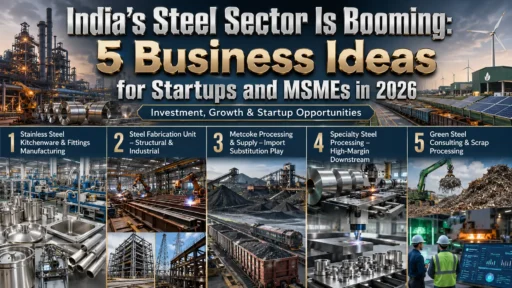
5 Business Ideas for Startups and MSMEs Emerging from This Market Signal
These ideas are not universal. They come directly from the market signals conveyed by the Economic Times and the specific sectors—the steel, stainless steel and metcoke sectors—that the government has now focussed on as matters for policy action.
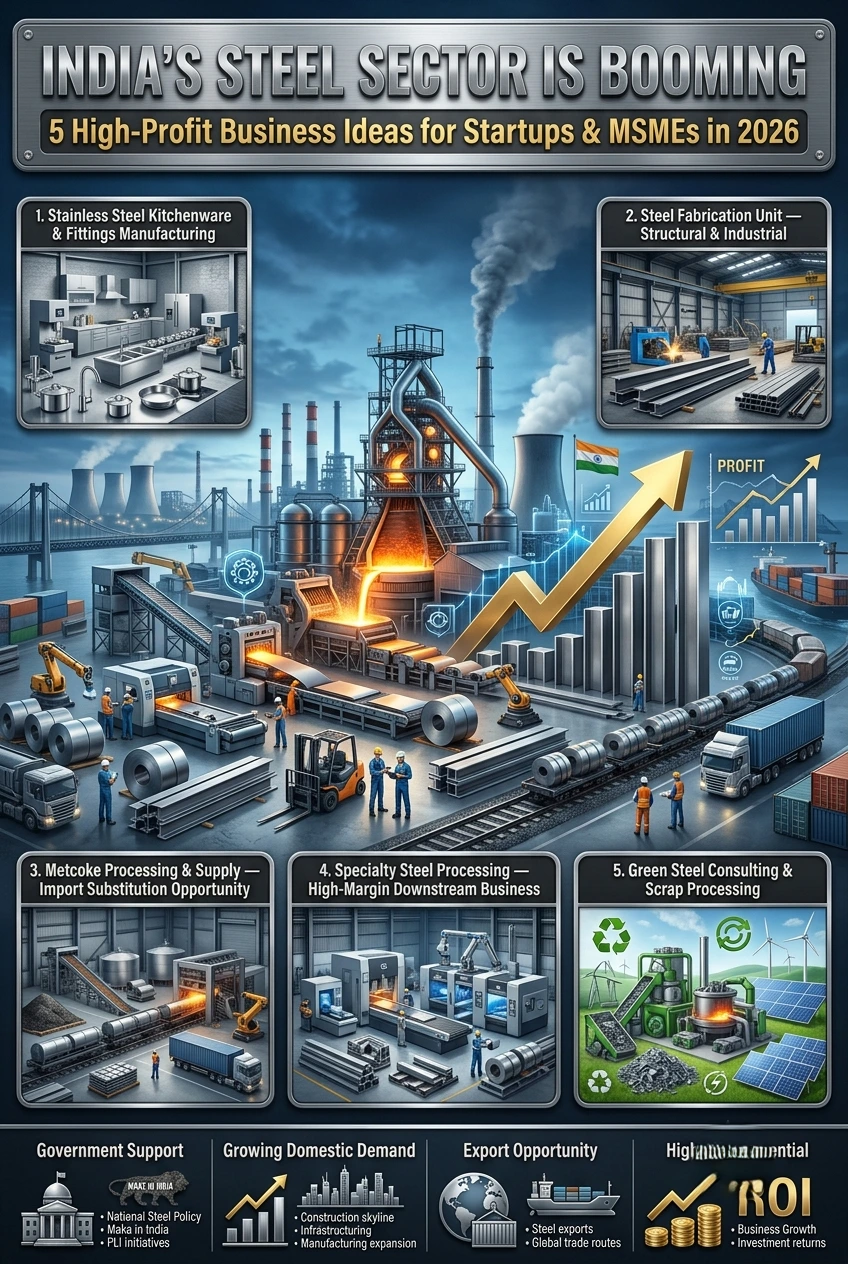
1. Stainless Steel Kitchenware and Fittings Manufacturing
Rising disposable incomes and growing export interest are driving demand for stainless steel domestic products. MSMEs can make kitchen utensils, cookware, modular kitchen accessories, sinks and bathroom fittings. India has opened export avenues for stainless steel products, creating a clear monetisation opportunity beyond the domestic market.(India Steel Business Ideas)
The segment is low to medium in terms of technology complexity and the hotel chains, hospitals, and canteen operators have stable institutional demand. For entrepreneurs having an initial investment of ₹25–50 lakh, the setting up of a fabrication unit is eligible for MSME credit support and priority sector lending.
Investment Range: ₹25–75 Lakh | Net Margin: 18–28% | Export Potential: High
2. Steel Fabrication Unit — Structural and Industrial
Infrastructure demand for TMT Bars, Angles, Channels and Pre-engineered Building products is making an assured pipeline for Structural Fabrication MSMEs. New buildings, warehouses and solar park companies are actively looking for locally-produced parts.
A steel fabrication company that serves B2B industrial customers has recurring order cycles, fairly stable cash flow and known quality parameters. Entrepreneurs must register with Udyam, comply with the Factories Act, obtain GST registration, and secure a Pollution Control Board NOC—all within the reach of a disciplined first-time entrepreneur.
Related Article: How to Start a Steel Fabrication Unit in India: Investment, Machinery & Export Potential
Investment Range: ₹50 Lakh – ₹3 Crore | Net Margin: 12–22% | Export Potential: Moderate to High
3. Metcoke Processing and Supply — Import Substitution Play
The ministerial stakeholder meeting was held recently, and metcoke industry stakeholders were a part of the meeting. Domestic steel producers have been advocating for increased import quotas, due to supply shortages. This is an evident business proposition for domestic metcoke processing, blending and logistics.(India Steel Business Ideas)
India’s demand for met coke is high with a corresponding opportunity for new entrants to be able to access coal sourcing networks for import substitution. The segment is ideal for industrial procurement or logistics experts who can establish trusted connections with secondary steel producers.
Investment Range: ₹75 Lakh – ₹2 Crore | Net Margin: 10–18% | Export Potential: Moderate
4. Specialty Steel Processing — High-Margin Downstream
India still imports high-precision cold-rolled steel, electrical steel (CRGO/CRNO), and high-tensile alloys to meet demand from the automotive, defence, and engineering sectors. The PLI Scheme for Specialty Steel has been specifically developed to promote domestically produced grades.
MSMEs can participate in specialty-grade rolling, annealing, and finishing processes with lower investment costs than primary steelmaking while earning higher margins and facing less competition. Orders continue to increase from both the EV and transformer industries as well as the defence component sector.
Investment Range: ₹1–5 Crore | Net Margin: 20–32% | Export Potential: Very High
5. Green Steel Consulting and Scrap Processing
India’s proposed ₹5,000 crore Green Steel Scheme will cause a frenzy of secondary steel producers looking for technical guidance, support for carbon accounting and sourcing of scrap feedstock. Environmental, engineering, or financial consulting professionals can start service-based businesses that support steel MSMEs by offering energy-efficiency audits, carbon compliance record keeping, and matchmaking with technology vendors.
At the same time, the growing number of scrap collection, sorting and shredding companies supplying to electric arc furnaces are experiencing sales increases as larger steel facilities become less reliant on virgin raw materials.
Investment Range: ₹10–75 Lakh (Consulting) / ₹50L–₹2 Cr (Scrap Processing) | Net Margin: 15–30%
Import–Export Opportunity Analysis
The steel trade scenario is changing in India. The country has become a net importer of specialty grades and metcoke but it is a net exporter of finished steel. These are commercial opportunities to both.
Export Opportunities
Exporters are witnessing rising demand in the Middle East, Southeast Asia, and Africa for BIS-standard stainless steel kitchenware, fabricated structural steel, specialty alloy components, and processed steel products. EU Carbon Border Adjustment Mechanism (CBAM) is starting to provide a competitive advantage to verified LEE Indian producers in international markets.(India Steel Business Ideas)
Import Substitution Opportunities
Specialty steels such as CRGO electrical steel, high chrome alloys and precision cold rolled grades are imported extensively. The DMI&SP procurement requirements and the growing defence indigenisation drive will support domestic producers that meet the required quality specifications. In April–December 2024 finished steel imports increased 38.2% YoY indicating a continued shortage in value added categories.
Information on licensing can be accessed by entrepreneurs who wish to venture in export markets at DGFT (Directorate General of Foreign Trade).
Indian MSME Success Stories in the Steel Sector
The steel MSME ecosystem in India is not a theoretical one. Primary steel availability and the rising demand of the industry have created profitable downstream businesses in thousands in different parts of Punjab, Maharashtra, Gujarat and West Bengal.
- The steel service centres have grown from small slitting and cutting centres into full processing centres for automotive and agricultural equipment manufacturers in North India, in Ludhiana (Punjab).
- Fabrication MSMEs in Pune and Nashik have been generating regular orders from large EPC companies involved in infrastructure projects and have been able to develop reliable order books due to their good quality standards.
- Stainless steel kitchenware manufacturers from Jagadhri (Haryana) have grown from the domestic market to cater to export markets in the Middle East and Southeast Asia region after gaining recognition from both the BIS and export markets.
- The secondary steel producers under electric arc-furnace (EAF), who are based in West Bengal and Odisha, and who use scrap feedstock, have proven that production with low emission even at MSME level can be commercially viable.
All of these stories share one common factor: disciplined planning, quality certification, and entering target sub-segments before competitors did. The government’s current push does just that – it provides an early-entry window for those who are paying attention these days.
Discover business ideas that actually make money
How NPCS Can Help You Launch Your Steel Business
The first step is to find an opportunity. To take an idea to a working unit involves detailed feasibility studies, project costing, machinery selection, sourcing maps for raw materials and documentation which meets the criteria of the bank loan and government scheme applications.(India Steel Business Ideas)
For decades Niir Project Consultancy Services (NPCS) has been serving the entrepreneurs and MSMEs in all manufacturing sectors of India. For founders coming into the Steel space, NPCS offers:
- Full feasibility reports including market, technical and financial.
- Specific plant layout design and machinery selection advice for each sub-segment.
- Raw material sourcing strategies and raw materials supply chain planning.
- Profitability analysis based on actual input costs and market price ranges.
- Documentation assistance for credit linkage for MSMEs and application for Government Schemes.
A well-prepared NPCS project report fills the gap between the business idea and a bankable, scheme ready industrial venture for first generation entrepreneurs. It helps lower the risk as well as expedites the approval process for founders entering the steel industry before making any capital investment; it is advisable to conduct a proper feasibility study.
Steel Sector Opportunity: Key Data Snapshot
| Business Opportunity | Investment Range | Net Margin | Export Potential |
| Stainless Steel Kitchenware | ₹25–75 Lakh | 18–28% | High |
| Steel Fabrication Unit | ₹50L – ₹3 Cr | 12–22% | Moderate–High |
| Metcoke Processing | ₹75L – ₹2 Cr | 10–18% | Moderate |
| Specialty Steel Processing | ₹1–5 Crore | 20–32% | Very High |
| Green Steel / Scrap | ₹10L – ₹2 Cr | 15–30% | Moderate |
FAQ: Founder Questions About Entering the Steel Sector
Q1. Is a steel business viable for first-generation entrepreneurs?
Yes, especially in downstream fabrication, processing, and specialty product segments, capital requirements and technology complexity remain relatively low. Government support for MSMEs, including credit guarantees, financing schemes, and assured demand under the DMI&SP policy, further reduces early-stage business risks.
Q2. What is the minimum investment needed to start a steel MSME in 2026?
Steel Fabrication The fabrication sector is divided into large units and small units that use steel. A small-scale steel fabrication unit or workshop can be established for a sum ranging between 25 lakh and 50 lakhs. Specialty Steel Manufacturing A specialty steel processing or metcoke business might cost from 75 lakh to 2 crores, based on the type and scale of production.
Q3. How do I access government schemes for a steel startup?
Udyam Registration through the MSME Ministry portal is the first step for any manufacturing MSME. After which you can also avail CGTMSE credit guarantees, CLCSS technology support and the facilities provided under PLI scheme. With the help of Startup India registration, you can avail various tax related advantages as well.
Q4. What are the biggest risks in starting a steel business right now?
The four biggest failure areas are fluctuations in steel prices, cash conversion cycle, disciplined raw material purchasing and being “loan ready.” Commissioning a proper feasibility study before investing capital mitigates each of these risks significantly.
Q5. Can a steel MSME export products from India?
Absolutely. Stainless steel kitchenware, fabricated structural products, and specialty alloy components have growing export markets in the Middle East, Southeast Asia, Africa, and increasingly in Europe. Achieving BIS certification and relevant quality standards is the primary prerequisite.
Q6. Why is now the right time to enter the steel sector?
Multiple demand drivers align simultaneously, including infrastructure spending, housing programmes, renewable energy expansion, and the push for industrial self-reliance. Government attention at ministerial level has just been confirmed by Economic Times reporting. Early movers who enter strategically defined niches before competition builds will capture the best margins and buyer relationships.
Conclusion: The Steel Window Is Open — For How Long?
The Economic Times market signal from early July 2026 is clear. Two senior Cabinet ministers sat down with steel, stainless steel, and metcoke industry leaders. Finished steel consumption jumped 8.3% in a single quarter. India’s National Steel Policy targets 300 MTPA by 2030. The Green Steel Scheme is being finalised. PLI and DMI&SP policies are already live and active.(India Steel Business Ideas)
These signals do not repeat forever. Business opportunity windows in manufacturing sectors typically stay open for 18–36 months before competition normalises margins and entry costs rise. Entrepreneurs who research, prepare feasibility studies, and invest wisely today will write their own MSME success stories within three years.
Timing is a competitive advantage. Use it.
Additional resources: Make in India | Invest India | SIDBI