

Paper Water Bottle Business in India
A ₹20,000 Crore Market at a Packaging Crossroads
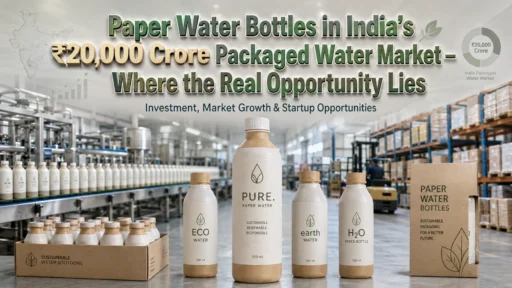
The packaged water market is at the turning point in India. The sector has been steadily expanding over the last 20 years, driven by the increasing urbanisation, growing demand of the HORECA industry, and lack of drinking water supply in Tier-2 and Tier-3 cities. Today the market is worth around ₹20,000 crore and is growing at double digit rates. Packaging and FMCG has long been synonymous with PET bottles for entrepreneurs looking for business ideas. But that’s starting to change. Following the international trend, paper water bottles are making their way into the conversations of some of the most luxurious hotels, the galley of the planes and the ESG (environmental, social and governance) conscious boardrooms in India. This article is designed to demystify this format and more importantly, how entrepreneurs can access this early.
Why the Packaged Water Sector Is Ripe for Disruption
India produces around 3.90 million tonnes of plastic waste every year or around 10,700 tonnes per day, according to data released by Central Pollution Control Board (CPCB). Unfortunately, packaging is the number one driver, using almost 59% of all plastic. Single use PET bottles are heavily represented in this waste, and are mainly used to package water. This is no marginal issue. It is a structural one and that’s why the government of India has recently issued notification regarding Plastic Waste Management Amendment Rules, 2021, to ban the identified single-use plastic items from 01 July 2022 and to introduce the mandatory Extended Producer Responsibility (EPR) framework for plastic packaging waste.
As well as this regulatory pressure, there is real demand from large corporations and global hotel chains for alternative packaging formats, due to the increasing ESG requirements. Paper water bottles are NOT a ‘gimmick’. Companies such as Paboco, Choose Water, and Pulpex have already generated a lot of capital and secured distribution deals for FMCG giants at a global level. The discussion is still in its infancy in India, which is just the time it creates opportunity. The brands and the manufacturers that build their credibility now, won’t be running to get up to speed once the market turns.(Paper Water Bottle Business in India)
Get Detailed Insights from This Book: Bioplastic Packaging and Sustainable Products Handbook
Moreover, there is the export quality as an additional benefit. The European Union’s Packaging and Packaging Waste Regulation (PPWR 2025/40), which will be implemented from August 2026, will require 30%+ by 2030, 65%+ by 2040 minimum recycled content for plastic beverage packaging, and will introduce deposit-return schemes for all EU member countries by 2029. This puts a compliance push on EU importers and brand owners to move towards alternative packaging solutions, including paper bottles from non-EU suppliers. This presents an opportunity to Indian entrepreneurs in two ways – premium positioning at home and volumes for exports.
Government Policies & Incentives Supporting Sustainable Packaging
India’s entrepreneurship policy landscape has gained a distinct positive tilt towards entrepreneurs in the sustainable packaging sector. A FICCI study on plastic waste compliance has highlighted some schemes which are directly benefitting the paper bottle manufacturers and packaging innovators in the sustainable materials space.
MSME Credit Guarantee Fund Trust (CGTMSE)
The Credit Guarantee Fund Trust for Micro and Small Enterprises (CGTMSE) offer collateral-free credit guarantees for MSMEs, which includes manufacturing and packaging. A crucial advantage of this scheme is that it enables a paper bottle manufacturing unit classified as a Micro or Small Enterprise to avail term loans without pledging any fixed asset, which is particularly helpful for the first-generation entrepreneurs who do not have any significant fixed assets.
Production Linked Incentive (PLI) for Food Processing
A PLI scheme for the food processing sector is being administered by the Ministry of Food Processing Industries (MoFPI). Paper water bottles combined with packaged beverage companies may find out what they are eligible for, especially if the water is treated, mineralised or bottled in a brand name.(Paper Water Bottle Business in India)
SIDBI’s MSE-GIFT Scheme — Green Finance for Packaging Startups
Small Industries Development Bank of India (SIDBI) has announced the introduction of a new scheme called MSE-GIFT (Green Investment and Financing for Transformation) in the context of the RAMP Programme. This scheme offers the concessional interest rates and risk sharing facility for the micro and small enterprises who are adopting clean/green technology. The paper water bottle making plant is a green technology application that is directly eligible. Additionally, the scheme also provides 10% concession in units built in the aspirational district, thereby further alleviating the burden on the entrepreneur in Tier-2 areas.
Startup India & DPIIT Recognition
Startups identified by the DPIIT under Startup India are eligible for income tax exemptions for 3 years, ease in filing IP and preference in Government procurement. This recognition offers a bit of peace of mind as well as market credibility for a paper bottle startup in a cleantech or sustainable materials segment.
Make in India — Industrial Parks & Infrastructure
The government’s Make in India campaign remains to encourage focused development of industrial clusters in the packaging and food processing sector. Some governments provide subsidized land, waiver of stamp duty, and capex subsidies for a packaging unit established in specific industrial parks in their respective states, such as Maharashtra, Gujarat, Tamil Nadu and Telangana.(Paper Water Bottle Business in India)
Get Detailed Project Report (DPR): Paper, Pulp & Packaging Industry Guide
India’s Packaged Water Market — Segment Breakdown
Table: Estimated market composition by packaging format
| Segment | Market Share (%) | Growth Rate | Key Trend |
| Bulk/Jarred Water (≥20L) | 42% | 8–10% p.a. | B2B, offices, hospitality |
| PET Bottles (≤1L) | 34% | 11–13% p.a. | Retail, travel, impulse |
| HDPE Pouches / Cups | 14% | 5–6% p.a. | Price-sensitive segments |
| Paper Water Bottles (Emerging) | <1% | Pilot stage | ESG-led, premium brands |
| Multi-layer Cartons | 9% | 7–9% p.a. | Niche, export-oriented |
Source: NPCS analysis; BIS IS 14543 certification data, IBEF Paper & Packaging Sector Report, APEDA trade data
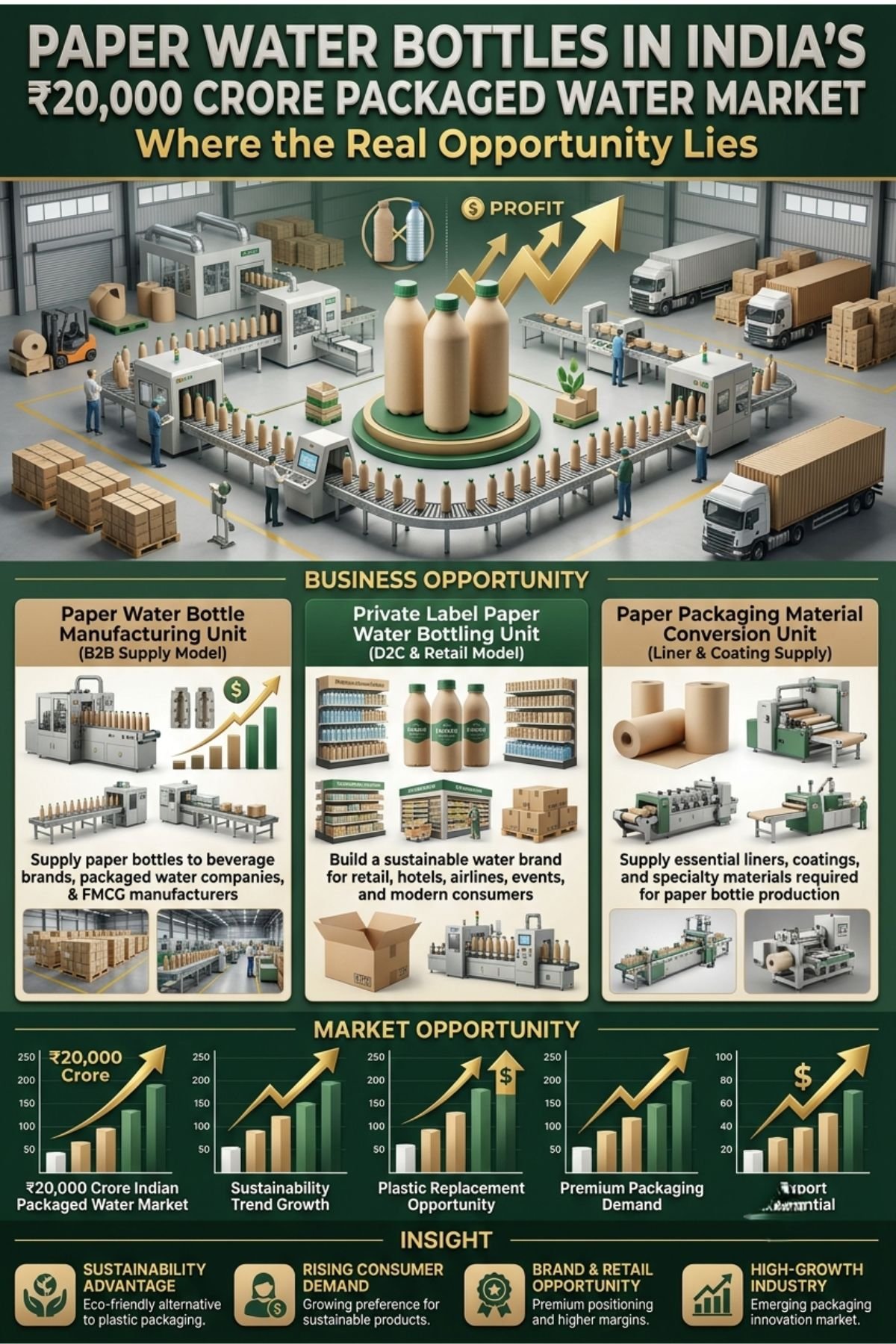
Business Ideas in the Paper Water Bottle Space
1. Paper Water Bottle Manufacturing Unit (B2B Supply Model)
The capital investment is the highest, but the return is the greatest. An entrepreneur installs a semi-automated or fully automated paper bottle forming and lining machine to provide finished paper bottles to top FMCG brands, hotel chains, airline caterers and event management companies. The main production processes include: forming, applying food-grade PE or bio-based liner, neck and cap assembly, and quality testing of kraft paper or FSC certified paperboard. The Bureau of Indian Standards (BIS) has prescribed IS 14543:2016 for all packaged drinking water sold in India, which includes specifications for water quality, water treatment processes, packaging and labelling.
Most importantly, the Food Safety and Standards (Prohibition and Restriction on Sales) Regulations, made by FSSAI, require BIS (IS 14543) certification for all water manufacturers in paper containers. A unit with an output capacity of 5–10 lakh bottles per month will be profitable with three to five anchor clients. The major competitive edge is the quality of the lining that is consistent and full BIS-FSSAI dual compliance.(Paper Water Bottle Business in India)
2. Private Label Paper Water Bottling Unit (D2C and Retail Model)
Instead of providing blank bottles to other brands, this model is to buy or produce bottles and then fill, brand and sell water under a proprietary brand name. Moreover, Premium retail shelf is the target segment of the product, that includes organic stores, airport kiosks, luxury hotels, and e-commerce platforms. Furthermore, In this model, margins are much higher. Specifically, The prices of a 500ml paper bottle at ₹80-100 vs a similar PET bottle at ₹20 is the premium that consumers with an environmental conscience are willing to pay. The business idea demands investment on filling lines, food safety certification (FSSAI) and branding. But the time to payback is not as long as manufacturing alone because you are in control of both production and retail margins.
Identify high-growth industries before others do
3. Paper Packaging Material Conversion Unit (Liner & Coating Supply)
However, This isn’t a thing that’s obvious, but it’s a very strategic business concept. Moreover, To be used for food packaging, paper water bottles must be provided with food grade moisture resistant liners, barrier coatings and possibly an aluminium oxide layer. Additionally, Nowadays, most paper bottle manufacturers in India are importing these materials. Furthermore, IBEF India Paper & Packaging sector data indicates that the domestic paper market in India is estimated to be 23.84 million tonnes, which is increasing by almost 6% per year and packaging paper and paperboard comprise 15.54 MT of the market. However, But in India, there still exists a gap in the supply of specialty paper and high grade board, which a domestic conversion unit can fill.
Moreover, An entrepreneur establishing a conversion unit to provide pre-coated paperboard rolls, pouching materials or liner films for bottle manufacturers fills in a much-needed gap. Additionally, This model has fewer regulatory complexities as compared to food processing, demands moderate investment (₹60 lakh to ₹1.5 crore) for a starter unit and is enjoying the advantage of the push towards raw material substitution as part of Make in India initiative. Furthermore, This is a business with a growing paper bottle bottom, with no marketing risks associated with a paper bottle consumer brand name.
Import–Export Opportunity Analysis
There is a strong two-way argument to be made for the trade of paper water bottles. Currently, India imports most of its paper bottle grade machines and special Liner materials from Germany, China and Japan. Therefore, Entrepreneurs who locate the right quality machinery suppliers and arrange for agents or distribution, are able to support a captive market of growing domestic manufacturers. Moreover, The opportunity is more immediate and lucrative on the export side. The EU Packaging and Packaging Waste Regulation (PPWR 2025/40) will introduce minimum recycled content and recyclability requirements for beverage packaging from 2026. Consequently, This imposes a buying deadline that EU buyers cannot wait for — and Indian manufacturers who produce certified paper bottles are in a great position to meet it.(Paper Water Bottle Business in India)
Export promotion support is provided by Agricultural and Processed Food Products Export Development Authority (APEDA) for processed foods packaging and by EEPC India (Engineering Export Promotion Council) for machinery and engineering goods including paper bottles manufacturing machine. Moreover, markets in the Middle East, especially the UAE, Saudi Arabia, and Qatar are active buyers of high-quality water products and willing to consider luxury paper bottle formats for the hospitality industry. Therefore, The export data available from IBEF and APEDA databases are practical starting points for the founders to find first export clients.
Indian MSME Lessons — Who Is Already Moving in Sustainable Packaging
Manjushree Technopack — Packaging Adaptability
Manjushree Technopack, promoted by the Parekh family, is one of the biggest rigid packaging manufacturers in India, headquartered in Bengaluru. The company has grown from its PET preforms business to its custom rigid packaging business for the FMCG, Pharma and Food sectors. Their decision-making process was instructive as they expanded into new packaging formats ahead of market demand, entered into long-term packaging supply contracts and then ramped up production. The answer to paper bottle businessmen is: First get the anchor client, then manufacture or expand the capacity.
Uflex Limited — Diversification into Sustainable Films
Based at Noida, Uflex is led by Ashok Chaturvedi and is among the most vertically-integrated flexible packaging firms in Asia. One of the key aspects of Uflex’s sustainability transformation is the investment in bio-based/ compostable film lines. They do this by investing in R&D of new materials and keeping a solid product portfolio of the traditional ones, which is something paper bottle startups can learn from. Sustainable packaging doesn’t mean you need to give up existing revenue – you can pilot and scale with.
Related Article: Paper Bottle Manufacturing in India: A New Sustainable Packaging Opportunity After ITC–Frugalpac Partnership
Huhtamaki India — Fibre-Based Foodservice Packaging
Huhtamaki India has been a constant in paper based foodservice packaging. They expanded their business through large size institutional clients, such as QSR chain restaurants, airlines and institutional caterers, then into retail. Significantly, Huhtamaki India has also joined CII (Confederation of Indian Industry) to create design for recycling guidelines for flexible packaging. New players in the paper water bottle market can follow in the footsteps of this B2b-first, standards-based approach, as the institutional contracts will provide the funding needed to get on to the scale before launching into the retail market.(Paper Water Bottle Business in India
About Niir Project Consultancy Services (NPCS)
Niir Project Consultancy Services (NPCS) can prepare Market Survey cum Detailed Techno-Economic Feasibility Reports (DPRs) for entrepreneurs, MSME promoters and investors considering new industries, such as sustainable packaging sector, food processing industry, specialty materials industry. Our reports include details on manufacturing process, demand and market research, process flow diagrams, product mix and capacity planning, sourcing of machinery, raw materials, and profitability analysis, and complete financial projections. For those considering investing in a paper water bottle factory or any packaging company upstream, our feasibility reports offer a comprehensive due diligence process that banks, investors, and promoters can rely on before investing. We help you understand feasibility and profitability, and long-term scalability before you invest a single rupee!
Frequently Asked Questions (FAQs)
Q1. Are paper water bottles commercially viable in India right now?
Not at scale — not yet. However, they are viable as a premium, limited-run, or B2B product for hotels, airlines, and event organisers. Entrepreneurs entering early can build first-mover advantage before the category scales. The regulatory tide, driven by both MoEFCC rules and ESG mandates, is clearly moving in their favour.
Q2. What is the minimum investment to set up a paper bottle manufacturing unit?
Small scale unit with semi-automated lining and Forming machine: can begin with 80 lakhs to 1.5cr. 2. Full commercial scale on automated lines: this comes from 5cr to 10cr depending on scale of operations and source of machinery (home produced or imported). We do have access to a scheme like SEbi MSEGIFT loan on soft loan.
Q3. What government schemes support this kind of packaging startup?
Some examples of schemes currently active are CGTMSE for collateral-free loans to MSME Credit Guarantee Fund Trust; PLI on food processing by way of MoFPI, if related to beverages; MSE-GIFT green finance schemes by SIDBI and Startup India seed fund by DPIIT, besides the industrial parks being created by individual states under ‘Make-In-India’ for subsidised land, stamp duty waivers and infrastructure assistance.
Q4. Is there export demand for paper water bottles from India?
Definitely – most of the consumers are also under tremendous amount of regulation, to reduce PET consumption. From 2026, all consumers are to meet at least the minimum recycled and recycle able requirements laid by the EU’s Packaging and Packaging Waste Regulation (PPWR 2025/40). By ensuring the compostable or the forest management FSC certified paper bottle we can directly export the product with assistance of Export Promotion Councils such as APEDA, EEPC India, to these countries.
Q5. What are the main technical challenges in making paper water bottles?
Overcoming moisture is the fundamental aspect. Paper, due to its porous nature, gets soaked in water. This is overcome by application of ultra thin Food Grade PE lining on both surfaces, applying a layer of bioplastic coatings or use of Aluminium Oxide coating. The packaging needs to conform to BIS IS 14543 standards to use packaged drinking water and needs FSSAI Central Licence prior to marketing for Sale.
Q6. How do paper bottles compare in cost versus PET bottles?
Currently, paper water bottles cost 4–7x more per unit than comparable PET bottles. However, at scale and with domestic raw material sourcing, this gap is expected to narrow. According to IBEF’s paper and packaging industry data, India’s domestic paperboard production is growing at nearly 6% annually — a positive signal for input cost reduction over time.
Conclusion: Early Entry Is the Real Advantage
When will paper bottles catch up with a paper water war in India, by which time the window for the business will have closed anyway? There are two sources of pressure-from the top down, the regulatory route led by MoEFCC’s Plastic Waste Management Rules, CPCB’sEPR enforcement, EU’sPPWR mandates, and from global brands through their ESG pressures, and they are now adding up to a very real business opportunity. Whoever amongst these will invest in developing a robust manufacturing practice, get the dual certification from BIS and FSSAI, and then clinch some institutional clients, the first movers on segment-inflection, are the most likely beneficiaries.
The ideas-making paper bottles, private-label bottling, and supplying the liner materials-are not shots in the dark but measured moves into an industry that’s truly disrupted. To succeed, they must all involve diligent planning, disciplined capital deployment, and a deep understanding of industry dynamics and regulations. Preparation yields rewards.
References & Citations
All links verified as active authoritative sources. Sources include government portals, statutory bodies, EU official journal, industry bodies, and institutional databases.
[1] MoEFCC — Plastic Waste Management Amendment Rules, 2021
[2] Central Pollution Control Board (CPCB) — Plastic Waste Management Rules Implementation
[3] FSSAI & BIS — IS 14543 Packaged Drinking Water Standard
[4] SIDBI — Green Finance & MSE-GIFT Scheme for Sustainable MSMEs
[5] EU PPWR (Regulation 2025/40) — Packaging and Packaging Waste Regulation
[6] IBEF — India Paper & Packaging Industry Overview
[7] CGTMSE — Credit Guarantee Fund Trust for MSEs
[8] Ministry of Food Processing Industries — PLI Scheme
[9] Startup India — DPIIT Recognition & Tax Benefits
[10] APEDA — Agricultural & Processed Food Export Authority
[11] EEPC India — Engineering Export Promotion Council
[12] Ministry of MSME — Schemes & Incentives