Ultra Pure Water Plant Setup in India
Even as India moves toward becoming an electronics manufacturing hub, it is running straight into a supply problem which most planners don’t pay attention – water. Not regular water.
The unseen workhorse at every semiconductor fabric, every injectable pharmaceutical line and every advanced battery plant is ultra-pure water (UPW), water with a resistivity greater than 18 cm and less than 1 ppb dissolved solids. It helps prevent chips from delaminating, help parenteral drugs pass QC, and prevent premature corrosion of fuel cells. This is not a topic for the market to be discussing loudly, but each capacity addition in these sectors quietly gets added to the procurement list as UPW.
Now CSIR-CSMCRI (Central Salt and Marine Chemicals Research Institute, Bhavnagar) has published a scalable (up to 1 lakh litre/day) modular UPW production technology through a RO-EDI (Reverse Osmosis — Electrode ionisation) configuration. The Chemical Weekly May’26 special feature highlighted this and captured the attention of process engineers and industrial investors from across Gujarat, Pune and the National Capital Region. It is a signal that needs to be taken into consideration for first generation entrepreneurs looking for manufacturing entries that require less capital.
Why This Sector Represents a Strong Startup Opportunity
The need signal is clear. The India Semiconductor Mission, under the aegis of MeitY, is bringing in fab capacity in Dholera, Morigaon, and Sanand in India. Even for relatively small-scale fabs (e.g. 10,000 wafers per month), 200–400 cubic metres of UPW per day are needed at each of these fabs. Hosur chip packaging unit of Tata Electronics and Sanand assembly plant of CG Power are live/near commissioning. Every such project has a UPW infrastructure need behind it, most promoters outsource by default – due to limited domestic supply.
The pharmaceutical angle is also very interesting. Water-for-injection (WFI) and UPW (ultrapure water) are required for the critical stages in the manufacturing of bulk drugs in India by the clusters like Pharma City of Visakhapatnam, Genome Valley of Hyderabad and Pharma clusters notified under PLI Scheme 2.0 by the Department of Pharmaceuticals. Imported UPW systems from Siemens (Germany or from the USA by Veolia) have a 40-60% cost premium compared to a locally manufactured alternative. Import substitution is instant and apparent.
In terms of policy, MSME units establishing UPW production can avail credit-linked capital subsidy under the Credit Guarantee Fund Trust for Micro and Small Enterprises (CGTMSE) and funding for technology up-gradation from SIDBI. The indirect positive impact of the Production Linked Incentive (PLI) scheme for specialty chemicals and pharma on UPW demand is positive each quarter. There are entry barriers, the technology has precision requirements, feed water chemistry varies by location and regulatory approvals as per the Bureau of Indian Standards (BIS IS 1069) take time to enter in early.
Get Detailed Insights from This Book: The Complete Book on Water Soluble Polymers
Business Selection Logic: Margins, Scalability and Risk
First, A UPW plant is not a business of commodities. It is a special utility service and that makes the overall margin arithmetic completely different. In addition, Techno-economic appraisals carried out for similar specialty water projects in Pune and Hyderabad MIDC clusters, indicate that EBITDA margins of UPW for semiconductor and pharma application are in the range of 30-42% as compared to bottled water (EBITDA margins of 8-12%) or RO drinking water (EBITDA margins of 15-20%). Furthermore, the company generates revenue from bulk supply (kilolitre-rate) contracts, operation and maintenance service contracts, and resin/membrane replacement services.(Ultra Pure Water Plant Setup in India)
Scalability is linear and manageable. A 5 KLD (kilolitres per day) pilot unit can help to validate local demand, to work out the local feed-water treatment chemistry and develop one or two anchor client relationships, usually a pharmaceutical formulation unit or a PCB manufacturer. The cost of scaling to 50 KLD is primarily through additional membrane and EDI stack investment, not through a rebuild. CSIR-CSMCRI specifically designed the modular concept for this staged scaling, which MSME promoters need to carefully monitor while deploying cash.
But realising your risks are fundamental. Water fluctuations, such as changes in TDS and/or hardness of the MIDC water supply throughout the monsoon season, can negatively affect the quality of the products and can also cause damage to membranes early. The Central Pollution Control Board (CPCB) also has the disposal of reject water (brine concentrate) regulated and adequate effluent handling infrastructure needs to be developed in the DPR. The commissioning period can be extended by 3-5 months due to state pollution control board approval for the reject discharge stream.
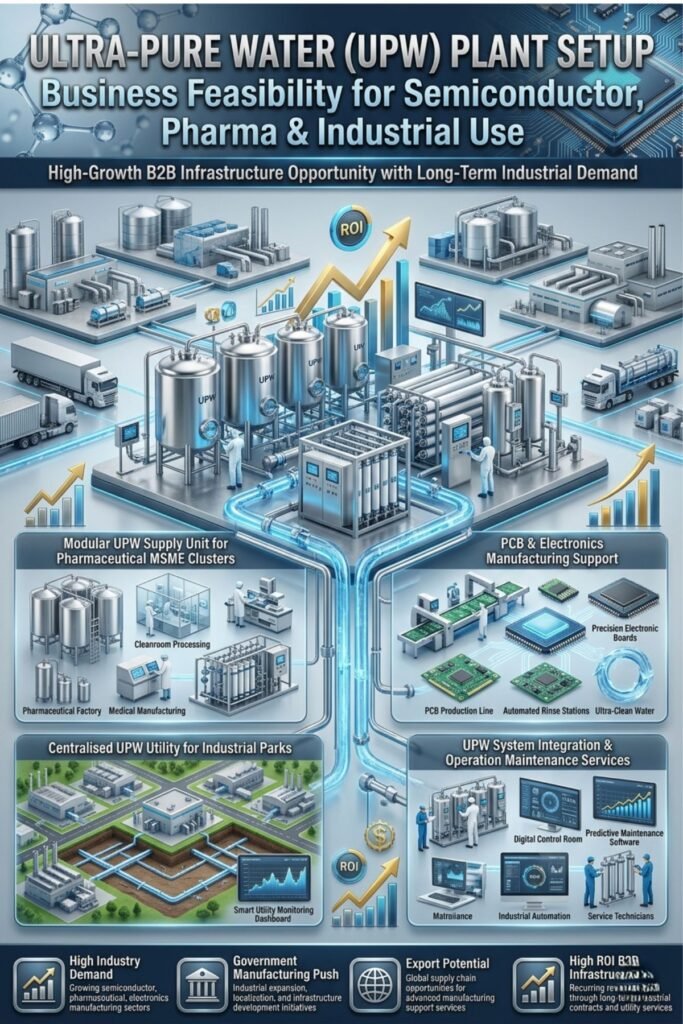
Project and Product Opportunities: Four Concrete Entries
1. Modular UPW Supply Unit for Pharmaceutical MSME Clusters
Firstly, Production scale: 10–25 KLD. Moreover, Target Buyers: MSMEs in pharma parks (Baddi, Aurangabad (MIDC), Kalyani) and bulk drug API manufacturers. Additionally, we estimate the capex at ₹1.2–1.8 crore for a fully automated RO-EDI skid that includes pre-treatment, online resistivity monitoring, and a sanitisation loop. Furthermore, we expect a margin outlook of ₹18–24 per litre at the contracted supply rate. Furthermore, the margin outlook stands at ₹18–24 per litre at the contracted supply rate. Small margins become possible only when a large pharma company installs in-house systems, and this applies only to units with KLD above 250. In this case, the MSME operator provides a non-core utility service that larger buyers prefer to outsource.
2. PCB and Electronics Manufacturing Support — UPW Rinse Water Service
Moreover, Production scale: 5–15 KLD. Target buyers: Printed circuit board etching units, different manufacturers of LED components, Surat, Bengaluru Electronic City, Noida Phase II solar cell manufacturers. Furthermore, Capex range: ₹80 lakh to ₹1.2 crore. Margin outlook: 28–35% EBITDA. However, This segment remains underserved because most PCB SMEs are unwilling to spend ₹50 lakh on setting up an in-house UPW system for small production runs. Therefore, An outsourced supply model addresses this challenge: the UPW operator delivers supplies through dedicated tankers or a pipeline connection within the cluster. Additionally, Compact skid footprint of the CSIR-CSMCRI technology makes cluster-based deployment possible.
3. Centralised UPW Utility for Industrial Parks (B2B Infrastructure Model)
Moreover, Production scale: 100–300 KLD. Additionally, Target buyers: state industrial development corporations (GIDC, MIDC, TIDCO) or private industrial park developers who want to provide unique utility facilities. Furthermore, Capex Indication: ₹6 – 12 crores based on feed water quality and park area. Moreover, Margin guidance: 22-28% EBITDA on long-term utility contracts (5-10 years) subject to annual rate escalation clauses based on electricity and membrane replacement costs. Additionally, This model is appropriate for promoters who have access to land within notified industrial zones and connections with park management. Furthermore, It is also a viable option to the existing ETP (Effluent Treatment Plant) operators who are seeking to introduce an additional revenue stream with a higher margin.
4. UPW System Integration and O&M Services
A scale of production that involves a service and has no quantity produced. Target buyers: hospitals, research labs, semiconductor packaging units and FMCG manufacturers; with older UPW systems that require upgrading. Capex indication: Working capital and tools – ₹25–60 lakh (no plant construction). Margin expectation: 35-45% gross margin on membrane replacement, resin exchange and on system audits.
Moreover, it is perhaps the lowest-barrier entry point: import the validated membrane configuration that CSIR-CSMCRI developed, train two engineers, and start offering an annual maintenance contract. Furthermore, Some MSME instrument service companies in Pimpri-Chinchwad, Pune have managed to shift their business model from general RO maintenance to this one.
Get Detailed Project Report (DPR): Complete Guide to Water Industry Projects
Indian Entrepreneur Benchmarks: Decision Logic and Applicable Lessons
Founded in 2016, AquaPure Technologies (Vadodara), started a 20 KLD industrial water treatment unit mainly for pharma and textile companies in the Ankleshwar chemical belt. His scaling logic was the following: treat the water, use standard RO, gain the clients’ trust with consistent water quality and advance to UPW-grade output as the client climbed the pharmaceutical regulatory ladder. His bottom line is that the quality contract, rather than the equipment, creates pricing power in the long run. A client hooked into your quality certification procedure seldom changes only for the price.
Ravi Shankar Jain, of Jain Water Solutions (Indore) chose a different route. He has also transferred technology with a mid-size German membrane supplier and established a 50 KLD UPW plant for 3 automotive component manufacturing plants at Pithampur and expanded it to a second plant for a new pharma park at Dewas. His model demonstrates the potential of a ₹3–4 crore investment in the right tech partner to overcome the quality assurance hurdle that can be a death knell for first generation promoters in specialty water. The lesson: Entry-level technology partnerships are not a cost, they’re risk insurance.(Ultra Pure Water Plant Setup in India)
Padmaja Krishnan, of AquaTech Enviro Solutions, Chennai, founded the UPW business with a focus on hospital and diagnostics clients, which are not a priority for larger water treatment firms. A unit 8 KLD is supplying private hospital groups in Tamil Nādu with Water for Injection (WFI) grade water. She financed the setup with the SIDBI Direct Credit Scheme, and paid back her capex in 34 months. Her research focuses on niche end-user targeting—specifically hospitals and semiconductors—which can generate faster returns and reduce collection risk.
Import-Export Opportunity: Where Indian Startups Can Plug In
The UPW systems imported into the country are full turnkey systems, estimated to be worth of ₹400-600 crore per year, mostly from Germany, USA and Japan. The Ministry of Commerce and Industry has reduced its policy interest to promote import substitution in capital goods and thereby, the manufacturing capability of UPW systems in the domestic market is being given policy attention. A local manufacturer assembles this type of water treatment unit, a domestic laboratory validates it, and it holds ISO 3696 (Water Analytical Reagent Grade) certification. As a result, it offers a competitive price advantage: domestic water treatment units cost 35–45% less than comparable units from other parts of the world after accounting for freight, customs duties (12–18% on assembled water treatment units), and installation costs.
From the export market, Bangladesh pharmaceutical boom and the recovering specialty chemical market from Sri Lanka are near-term markets that offer the Indian UPW system suppliers. In the longer-term, export opportunities are available in ASEAN markets, and specifically Vietnam and Indonesia, where investments in semiconductor fabs are ramping up. Indian exporters stand to gain from CEPA (Comprehensive Economic Partnership Agreement) tariff concessions for exports of capital equipment to UAE, and expected benefits from the expected India-UK CEPA deal.(Ultra Pure Water Plant Setup in India)
According to the data released by DPIIT, specialty water treatment is included in the top 5 gaps of the proposed new chemical investment clusters in Rajasthan, Andhra Pradesh and Odisha, among the ancillary services. Because the clusters are not in full operation until early 2019, the promoters will have two to three years to become the UPW industry of choice for the anchor industries that will move in.
Choose the right startup backed by real market demand
Pre-Investment Feasibility: What Founders Need Before Committing Capital
A feasibility study report is a ‘must have’, not an ‘option’, for any promoter before they agree to any UPW plant project. It is the manufacturing process for UPW that differs widely depending on feed water chemistry, output specification (Semiconductor Grade versus Pharma Grade) which sets different purity requirement, and the end-use sector.
One of the established names of Niir Project Consultancy Services (NPCS), which offers the preparation of Market Survey cum Detailed Techno-Economic Feasibility Reports for industrial feasibility studies in India that include details of the manufacturing process, demand analysis, process flow diagram, product mix options, specification of the required machinery, raw material specifications, complete financial calculations including working capital requirements and expected returns. Founders who use these reports often call them “reality-check” documents because they bring tough decisions—such as site selection, regulatory timelines, and break-even sensitivity—to the forefront before anyone spends money.(Ultra Pure Water Plant Setup in India)
UPW Plant: Indicative Capex vs Margin Table by Segment
| Segment | Scale (KLD) | Capex (₹ Cr) | EBITDA Margin | Key Buyer Type |
| Pharma MSME Supply | 10–25 | 1.2–1.8 | 30–38% | API/Formulation Units |
| PCB/Electronics | 5–15 | 0.8–1.2 | 28–35% | PCB, LED, Solar Mfrs |
| Industrial Park Utility | 100–300 | 6–12 | 22–28% | GIDC/MIDC Park Mgmt |
| O&M Service Model | Service | 0.25–0.6 | 35–45% | Hospitals, Labs, Fabs |
| System Integration/Export | Variable | 1–3 | 25–32% | Pharma, ASEAN Exporters |
Source: CSIR-CSMCRI Technical Report; MSME project appraisals (Pune, Vadodara, Hyderabad MIDC); Chemical Weekly, May 2026
Related Article: How to Start a Bottled Water or Mineral Water Plant in India (2026): Complete Business Plan, Cost, Profit & Loan Guide
Why This Is a Decision Worth Making Now
UPW plant setup as a business idea has shifted from the niche to the need in the industrial supply chain of India. Five years ago, it would simply be a matter of importing the UPW system as a part of a main project package for the typical semiconductor or pharma customer. However, The economics have clearly shifted in favor of local supply due to higher import duties, the government’s focus on local manufacturing in India, domestic manufacturing policy requirements for local content, and the rapid expansion of India’s specialty manufacturing base, which the existing UPW supply chain cannot adequately support.(Ultra Pure Water Plant Setup in India)
CSIR-CSMCRI developed the RO-EDI technology, successfully pilot-tested it, and detailed it in the Chemical Weekly May 2026 report. This achievement addresses a key gap among first-generation Indian entrepreneurs: access to a process route developed and independently validated in India, without the need for costly technology licensing from foreign suppliers. That alters the capex equation significantly.
Both the MSME Ministry’s Technology Upgradation Fund Scheme (TUFS) and the SIDBI Make in India Soft Loan Fund for MSMEs (SMILE) offer concessional rates of debt financing for projects in this category. The technology has proven itself, policy remains conducive, and the semiconductor, pharma, and clean energy segments are clearly driving strong demand—creating a good opportunity for a capital goods specialty utility startup to enter at the right time with a reasonably well de-risked offering.
FAQ: Questions asked by promoters are answered below
Q1. What is the minimum capex required for setting up UPW plant for Pharma supply?
A 10 KLD plant can reliably produce pharma-grade UPW with a capex of Rs 1.2–1.8 crore, including pre-treatment stages, RO membrane skids, an EDI stack, instrumentation, and a sanitisation loop. Working capital requirement to run the plant for six months will be an additional Rs 20-30 lakhs. It will be difficult to maintain quality and regulatory compliance under Rs 80 lakhs investment.
Q2. What is the time period required to recover the project cost?
At a contracted rate of Rs 18-22 per litre, a 10 KLD unit operating at 70% efficiency will generate revenues in the range of Rs 45-55 lakhs a year. We expect the business to reach break-even within 36 to 48 months after accounting for fixed costs and depreciation. Service contract revenues will shorten the break-even by 6-10 months with clients same as in supply contract.
Q3. What are the licensing and regulatory clearances that are required?
Following are the requirements: (a) NOC from State Pollution Control Board for reject discharge; (b) BIS certification if supply is to a pharmaceutical concern under Schedule M; (c) ISO 3696 documentation is necessary if the target market is electronics; (d) local municipal/MIDC water supply connection NOC. Allow a time of 4-7 months for getting clearances in most of the MIDC regions in Maharashtra and Gujarat.
Q4. Can we set up such plants at more than one location?
Yes, CSIR-CSMCRI provides modular designs that organizations can replicate at multiple locations with relatively few modifications. Existing operators often add parallel membrane skids instead of building an entirely new plant, each additional 10 KLD costing Rs 30-45 lakhs. An entrepreneur can realistically aim for 60-80 KLD of combined capacity across two to three sites within four to five years.
Q5. What are the key business risks and their mitigants?
The major risks are: (a) variation in feed water quality (increase in hardness to 200+ppm is harmful to RO membranes and spikes the O&M costs), (b) delay on reject discharge approval by the regulatory bodies and (c) concentration risk-losing a large pharmaceutical client may bring down the revenue by 30-40% on a yearly basis. Mitigate risks by providing adequate feed water treatment buffers, timely submission of reject disposal documents and expanding the client base to 4-5 different companies before year two.