HDPE PP Plastic Recycling Plant in India
Inspired by the Recover’s Rs. An opportunity for green manufacturing with good demand-pull: 500-crore HDPE/PP recycling network in Maharashtra.
Annually, India produces more than 3.5 million tonnes of plastic waste. Of these, HDPE and PP (the mainstay of packaging, auto parts and consumer goods) are recovered at under 30%, according to Chemical Weekly May 19, 2026. It is not a statistic that gap. It’s a business opportunity. Recove Ventures, a Bengaluru-based B2B company, has signed a 10-year MoU with the Maharashtra government to build a Rs. 500 crore plastic recycling network – investing in 5,000 tonnes per month capacity in Phase 1, which will be scaled up to 1,00,000 tonnes per year. Today, there are already government regulations put in place that require companies to incorporate 30% recycled plastic content in their products, and in two to three years, this will rise to 60%. Demand is mandated.
The supply of infrastructure is lacking. For a first-generation entrepreneur who has Rs. This one of the most immediate manufacturing opportunities in India, and a very concrete one at that — if you know what to build, and know how to get started and how the margins actually work.
Why This Sector Is a Strong Startup Opportunity
Start with the demand signal. The ministry of environment, forest and climate change (MoEFCC) has issued the Plastic Waste Management Rules, 2016 (amended 2022) which require EPR compliance for all plastic packaging producers. So, all FMCG companies, all auto OEMs, all packaging converters have to buy recycled plastic that is certified — or face penalties. This gives a captive and forced purchasing base which no startup in any other business can have.
The digits allow entry. Indian plastics recycling industry is booming with a growth rate of more than 15% CAGR, as per the data tracked by Indian Plastics Federation. The PET recycling market is fully saturated at around 95% recovery rate. The market is structurally under-supplied, as only less than 30% of HDPE and PP is recycled. Before the machine is commissioned, there will be buyers for any plant which can produce quality industrial grade granules with consistency from post-consumer HDPE and PP waste.
At EU level, the European Green Deal will require a minimum of 30% recycled content in plastic packaging by 2030. European customers are already requesting traceability and recycled content papers from Indian exporters of packaging materials. This makes the recycled HDPE granules market a ready market for exporting high purity granules which fetch Rs. – $1200/tone FOB while home market rates are Rs. 500–$800/tone FOB. 55–75 per kg.
Get Detailed Insights from This Book: The Complete Technology Book on Plastic Films, HDPE and Thermoset Plastics
The government’s support is genuine. MSME Ministry’s Credit Guarantee Fund Trust (CGTMSE) offers collateral free credit facility up to Rs. 2 crores. Maharashtra’s MIDC provides subsidised land and one-stop clearance for plastic recycling units in its industrial zones. As per the IBEF (India Brand Equity Foundation), currently 14 states have provided a capital subsidy of 15–25% for plastic processing units under MSME promotion schemes. Although not immediately relevant to recycling, PLI benefits would act as an incentive to the biggest recycled plastic buyers in packaging to buy locally.
Entry barriers are significant but not impenetrable. The cost of a simple HDPE/PP washing and granulation plant begins at Rs. 25–40 lakh for a 200–300 kg/hour unit. A medium scale plant with an processing capacity of 500–800 kg/hour would cost Rs. 80–150 lakh in capex. Requirements at this level: Pollution control board (PCB) consent-to-establish and consent-to-operate, factory licence, GST registration and EPR registration with MoEFCC. If submitted to a competent consultant the licensing process takes 60-90 days.
Business Selection Logic: Margins, Risk, and Scalability
The plastic recycling business for the HDPE/PP plastic recycling plant is not a “high-risk, high-reward” type of business. It is a mid-margin, high volume and a steady demand business which will be suitable for the MSME promoters with a capital discipline. The gross margins for recycled HDPE granules vary from 18–28%, depending on the cost of the feedstock, energy efficiency and output quality. Net margins of 12-18% can be obtained after 60-70% capacity utilisation of a plant.(HDPE PP Plastic Recycling Plant in India)
Feedstock is the principle variable cost. The post-consumer HDPE waste (drums, jerrycans, crates, pipes) is sold at Rs. 18–28 per kg depending to grade and cleanliness. The price of output granules is Rs. Rs 55-75 per kg for general purpose grades. 80-110 per kg for food contact or automotive grade material. The spread is the amount charged for the processing, power (usually Rs.) If the feedstock sourcing is good, it is 4 to 7 per kg, plus labour overheads, and margin.
The scalability roadmap is clear. A pilot unit with a capacity of 300 kg/hour (about Rs. 30-40 lakh investment — can support 3-5 converters in the same area and earn a monthly income of Rs. 20–30 lakh. Improvement of cash flow after stabilisation, as soon as the second extruder line comes into play (Rs. Throughput increases by 2X the incremental capex (15–20 lakh). The economics of the unit start to support optical sorting and deep-vacuum deodorisation (the technology Recove used at Jalgaon MIDC) to access premium markets for automotive and food contact applications by the 800 kg/hr mark.
Get Detailed Project Report (DPR): Recycling of Polythene and Other Plastic Products
The EPR requirement provides low demand-side risk. But the risk from the feedstock is a very real one. Post-consumer plastics waste collection is disorganized and unformalized. Severe promoters develop back-integration – aggregator partnerships, scrap dealer networks, and in some situations, direct collection agreements with municipal corporations. The Central Pollution Control Board (CPCB) EPR portal now calls for brands to make verified recycled content claims, thereby increasing the demand for the registered and quality-assured recyclers (MSMEs) as compared to the informal ones.
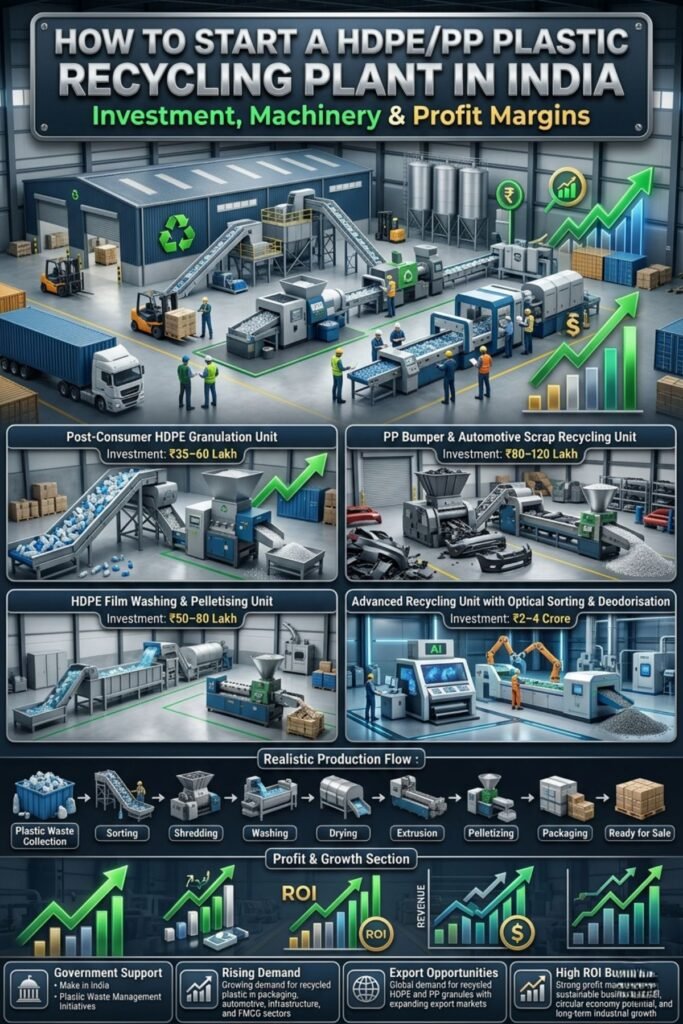
Four Project Opportunities Worth Building
1. Post-Consumer HDPE Granulation Unit (Rs. 35–60 Lakh)
It’s the starting level of entry. The washing-shredding-granulation line with a capacity of 300 kg/h hour is suitable for post-consumer HDPE waste (drums, pipes, crates) to manufacture general-purpose recycled HDPE granules for use by injection moulders, pipe manufacturers and crates fabricators. The targeted buyers include local converters, plastic furniture makers, construction fitting manufacturers. Monthly income at 80% capacity: Rs. 22–28 lakh. Gross margin: 20–26%. Capex payback: 24–36 months.
2. PP Bumper and Automotive Scrap Recycling Unit (Rs. 80–120 Lakh)
3. HDPE Film Washing and Pelletising Unit for Woven Sack Manufacturers (Rs. 50–80 Lakh)
Agricultural films, silage wraps, HDPE mulch films and woven sack scrap is a high-volume low-cost feedstock which is difficult to recycle because of contamination issues. A unit equipped with a friction washer, centrifugal dryer, and vented extruder can process it into pellets and supply them to woven sack and FIBC bag manufacturers in Ahmedabad, Surat, and Rajkot. This is a volume play with thin margins (16-20%) but with plenty of feedstock and sticky buyer relationships. Throughput of 150-200 tonnes per month at 60-70% capacity level translates to a revenue value of Rs. 30–40 lakh. Perfect for the promoter who lives close to the agriculture area of Gujarat, Rajasthan or Punjab.
4. Advanced Recycling Unit with Optical Sorting and Deodorisation (Rs. 2–4 Crore)
This is play that can be reproduced at a smaller scale: the Recover play. They use near-infrared (NIR) optical sorting to sort HDPE from PP and other contaminants in combination with a deep-vacuum deodorisation process to generate food-contact-grade or industrial-specification recycled granules. These sell at Rs. FMCG packaging manufacturers who must achieve certified recycled content for EPR will pay 40-60% premium for 90-130 per kg. Target buyers: Hindustan Unilever, Godrej Consumer Products, Packaging suppliers. The monthly incomes can amount to Rs. per hour with this technology at 800 kg/hour capacity. 60–90 lakh. Net margins: 18–24%. Must have NABL-certified quality testing facilities in addition to the plant.(HDPE PP Plastic Recycling Plant in India)
Find the most profitable startup for your investment range
Indian Entrepreneurs Who Have Built This Business
The latest reference point would be the co-founders of the company Recover Ventures, Kunal Kumar and Viral Chhajer. Their approach is instructive – they did not begin with a large plant. They have been operating at their Bengaluru unit since late-2025, handling in excess of 415 tonnes per month and growing revenues by 12x in 6 months with over 30 recyclers having a repeat order rate of ~90%. The lesson is not to begin with a big bang, it’s to begin with quality and repeatability. We raised $25,000 to invest in Jalgaon. We validated the model at a smaller scale of ₹35 crore, producing 1,100 tonnes per month.
A case in point is that of Gemini Edibles who are moving towards procurement of recycled plastic packaging (not recycling themselves) but are an example of a large FMCG company in India building backward supply agreements with certified HDPE recyclers. The moral for an MSME promoter: If you can get certified as a quality consistent supplier to just one large FMCG firm you will alter the risk profile for finance. It is noteworthy that several Pune-based MSME plastic recyclers have signed 12-month offtake agreements with FMCG packaging converters because EPR compliance will require brand owners to provide certification of plastic recyclers.
On the raw material side, Gujarat-based reclaimers in Sarigam and Vapi industrial clusters have developed successful raw material businesses sourcing post-consumer HDPE drums from the chemical industry, from which Rajdeep Plastic Containers (with MIDC presence, Taloja) is sourcing virgin raw material. Circular economy thinking firmly connects the two ends of the same value chain: virgin HDPE drum manufacturers and recycled HDPE granule producers.(HDPE PP Plastic Recycling Plant in India)
Import–Export Opportunity Analysis
Currently, India imports the recycled granules particularly food grade – HDPE and engineering grade – PP from South Korea, Taiwan and China at $1,000-$1,400 per tonne. The quality and quantity of local production is not enough to satisfy the demand of large-scale packaging factories. An Indian MSME producing certified food contact grade HDPE granules can directly replace this import, at competitive price — without paying a customs duty of 18% on import of recycled material.
EU buyers are actively looking for chemical composition certificates, traceability and ISO 9001 quality from verified exporters in India for recycled HDPE and PP. A EU packaging law, which will come into effect in 2025, sets demand for recycled content in packaging entering the European market. As Indian exporters, they can export recycled HDPE pellets to European converters at $900–$1100 per tonne, creating an opportunity that a medium-sized Indian recycler can capture, provided it has proper quality systems in place. CII and PLEXCONCIL members are already receiving export enquiries from Germany, Netherlands and Poland.
Plastics Export Promotion Council (PLEXCONCIL) has included recycled plastic raw material as a focus export category in its action plan for FY2025-26. Any MSME unit registered with PLEXCONCIL and already EPR registered with MoEFCC can avail export market development support, buyer-seller meets and buyer verification services which in a significant way would reduce the cost of identifying the international customers.
Related Article: Start a Plastic Waste Recycling Unit and Build a Sustainable, Eco-Friendly Future
Government Push and Feasibility Planning
With plastic recycling gaining ground from the compliance headache to the industrial priority, the Maharashtra government has displayed its willingness to give land priority, single window clearances and state industrial policy incentives to the plastic recycling industry through Recove MoU. The draft National Chemicals Policy has identified plastic waste utilisation as one of the priorities of circular economy for the Ministry of Chemicals and Petrochemicals. Capital subsidies are provided by the state MSME departments in the State of Maharashtra, Gujarat, Tamil Nadu and Rajasthan at 15-25% to registered plastic recycling units.
No serious promoter would risk his capital until and unless the project is technically analysed for viability. In a detailed techno-economic feasibility report it becomes the promoter’s mandate to examine the project from every possible financial angle prior to signing lease deeds, or even ordering any equipment. Niir Project Consultancy Services (NPCS) which is a Delhi-based consultancy, with long experience in industrial project appraisals, provides Market Survey cum Detailed Techno-Economic Feasibility Report, which involves analyses on the manufacturing processes chosen, quality of raw material required, layouts and design of the process flow, product-mix, assessment of the market and total project finance, including a P&L, cash flow and a break-even analysis. For a first-generation entrepreneur whether the amount at stake is Rs. 50 lakh or Rs. 2 crore this kind of analytical exercise becomes imperative and not a privilege.
The plastic recycling plant business in India has moved out of the early-adopter stage. There’s a floor under demand created by EPR mandates, government infrastructure development in industrial estates mitigate the risk of setup and the technology is mature and available with documentation. Discipline on feedstock sourcing, consistency of output quality and the initial correct product-market fit will be what differentiate a successful from an unsuccessful unit.
Conclusion: The Numbers Don’t Lie
This isn’t the place for the fiscally imprudent. But for an entrepreneur that does their homework – studies the feedstock supply chain, maps the buyer network, gets the plant size right and commits to a minimum quality infrastructure – HDPE/PP plastic recycling offers one of India’s most promising manufacturing plays today. The regulatory tailwind is systemic, not cyclical. The market deficit is real and tangible. The technology is readily available at various capex thresholds.
Recove’s Rs. 500 crore commitment and the 10-year Maharashtra framework aren’t just PR statements. They demonstrate capital and policy alignment. Large institutional investors are creating buying ecosystems through large-scale infrastructure investments which will be fed by smaller, quality-consistent MSME recyclers. This presents an opportunity. A 300 kg/hr HDPE granulation unit, well-located and well-managed, can be a Rs. 22-28 lakh monthly revenue generator at 20-26% gross margins. A committed promoter securing EPR registration, implementing a quality system, and executing on feedstock sourcing can expect to break even within 28-36 months.
India produces annually more plastic waste than its current recycling capacity can absorb. This gap will not disappear on its own. Entrepreneurs must address it as a business opportunity, not just an environmental mantra. Begin by selecting the right plant size, securing the right feedstock and commissioning a credible feasibility study.
HDPE/PP Recycling Plant — Capex vs. Margin vs. Capacity Overview
| Plant Type | Capex (Rs.) | Capacity (kg/hr) | Monthly Revenue | Gross Margin | Payback |
| Basic HDPE Granulation | Rs. 25–40 L | 200–300 | Rs. 22–28 L | 20–26% | 24–36 mo |
| PP Automotive Scrap Unit | Rs. 80–120 L | 400–500 | Rs. 40–55 L | 14–18% | 28–36 mo |
| HDPE Film Pelletising | Rs. 50–80 L | 300–400 | Rs. 30–40 L | 16–20% | 30–40 mo |
| Advanced NIR+Deodorisation | Rs. 200–400 L | 700–900 | Rs. 60–90 L | 18–24% | 36–48 mo |
| Recove Jalgaon Reference | Rs. 35 Cr | 1,100 TPM | Undisclosed | Institutional | MoU-backed |
Source: Chemical Weekly May 19, 2026 issue (Recove MoU reference); MSME sector estimates; industry averages.
FAQ – Answer to Founder’s Questions
Q1. What is the initial investment required for a HDPE/PP plastic recycling plant in India?
You can establish a basic 200-300 kg/hr washing & granulating unit within 25-40 lakh for machinery, plus 5-10 lakh for shed, electrical and working capital. A cost-effective, pilot HDPE recycling plant is thus available at 35-50 lakh all-in. MSME capital subsidy of 15-25% in most states, further reduces the net outlay.
Q2. What is the payback period for a plastic recycling plant?
With a capacity utilization of 70-80%, a well-managed HDPE granulation unit with input material cost <Rs. 28 per kg & selling price >Rs. 60 per kg can achieve payback within 24-36 months. Faster payback is possible with a pre-commissioning offtake agreement with a large end-buyer. (EPR-compliant Brands are increasingly willing to sign these)
Q3. What are the mandatory licenses required to set up this business?
The permissions/ licenses required would be Consent to Establish & Consent to Operate from Pollution Control Board, Factories Act License, GST registration and EPR registration from MoEFCC portal. If your plant is near an MIDC plot, you must obtain allotment from MIDC along with a zoning certificate. Overall, licensing timeline can range from 60-90 days. Estimated fees of local environmental consultant would be between Rs. 50,000 – Rs. 1.5 lakh.
Q4. Can a small HDPE recycler export to Europe or USA?
Yes, but need a certification of ISO 9001, a test report of material in MFI and tensile strength and traceability of the materials. At present, the recycle HDPE granules from India can be sold in Europe about US 900-1200/ton. A membership in PLEXCONCIL can help you to find buyers. You should plan for export operations during the second or third year of operations, once you stabilize quality on domestic orders.
Q5. What is the biggest operational risk and how can it be mitigated?
The largest operational risk is security of supply of feedstock. Post-consumer plastic collection is a fragmented supply chain. To overcome this risk, it is essential to build 4-6 strong relationships with aggregators before your plant is operational. It would be ideal to enter into long-term, volume-committed agreements based on quality rather than price-only contracts. The second biggest risk is quality consistency in output. The purchase of basic quality-testing equipment for Rs. 2-4 lakh from Day 1 is a critical step.