
Nigeria Startup Business Opportunities
Nigeria just recorded its best performance as a startup ecosystem since 2022. Nairametrics reported on 15th August 2026 that the country moved up four positions to rank 62nd in the world in the StartupBlink Global Startup Ecosystem Index 2026. This is not an isolated statistic; it’s a sign to the market.
Nigeria leads the world with 31.8% ecosystem growth, almost twice the global average of 17.5%. It has the highest ecosystem value of $20 billion in the country, which is the highest in Africa. Although Lagos continues to be the powerhouse, with 78.2% of the nation’s total start-up score, other cities like Abeokuta, Benin City, Port Harcourt and Abuja are waxing rapidly, with each city developing its own unique strength in a particular sector.
This is the time for businessmen, manufacturers, MSME business owners, and investors to become familiar with the business opportunities arising out of this urban start-up boom and make timely decisions before the markets get ready.
Get Detailed Project Report (DPR): Investment Opportunities & Business Ideas in Nigeria
What Recent Reporting Means for Business Builders
According to the Nairametrics report on the top startup cities in Nigeria, the nation has 10 cities in the top 1,500 cities worldwide as startups ecosystems but five of these cities are in the top 1,100 cities globally. Four of them improved their world rankings this year. That much geographic movement is new.
The Nigerian startup narrative used to be a Lagos narrative, and that was the case for a long time until recently. As Nairametrics reports, the 2026 StartupBlink data supports this, establishing decentralisation as the reality of the ecosystem. The founders in Owerri, Kano, Enugu, and Abeokuta are creating genuine business ventures, gaining the backing of state governments and vying for global talent.
The decentralisation is significant to the business builders because of three reasons:
- The secondary city will have lower operational expenses, less competition for skilled people and an increasing demand for skilled people.
- Government at all levels are actively investing in infrastructure required for startups, ranging from digital innovation parks to multi-million-dollar start-up funds.
- Federal policy through the implementation of the Nigeria Startup Act by the NITDA is facilitating the establishment of a more structured environment for startups and MSME-tech integration.
Another structural shortfall Nairametrics mentions is the positioning of Nigeria at 95th place in the StartupBlink Innovators Business Environment Index amongst 125 countries. What’s missing between the robust startups and the weak business environment is itself a business opportunity. Those who create the tools, services and infrastructure required to fill that void will have customers waiting.
Why This Ecosystem Is Growing
The essence of Nigeria’s start-up growth is structural, not cyclical. Nigeria has 220 million+ people, the largest in Africa, a young population, and increasing digital adoption in banking, digital commerce, and streaming.
According to Naira metrics’ StartupBlink index, the country is ranked as the top country in Africa for online banking and cryptocurrency adoption, coming in at 13th place and 17th place respectively on the global rankings. This digital financial activity drives a need for related services, such as compliance tools, payment platforms, SME lending platforms and digital identity solutions.
Meanwhile, state governments are competing to build their local ecosystems. Imo State has teamed up with UC Berkeley to create ImoTalentHub.com, which aims to connect 100,000 jobs worldwide with Imo-trained candidates. Enugu invested $10 million in Startup Seed Fund and also started a blockchain hub. The Nigerian Communications Commission launched a Digital Innovation Park in Abeokuta.
This ecosystem investment by the government opens doors to new businesses in related areas of training and workspace management, software tools and services for startups that are getting funding.
Government Policies, Incentives & Official Resources
Policy is influencing the geography of startups in Nigeria at both federal and State levels. It is important for entrepreneurs and investors to familiarise themselves with and interact with the following official bodies and portals before investing.
Official Government Portals and Agencies
The table below lists nine verified government websites relevant to entrepreneurs, MSMEs, and investors targeting Nigeria’s startup ecosystem cities. All links have been verified as of August 2026.
| Government Body / Portal | Relevance for Entrepreneurs |
| NITDA — National IT Development Agency | Implements Nigeria Startup Act; digital infrastructure policy; startup labelling |
| Nigeria Startup Portal (startup.gov.ng) | Official portal for startup registration, labelling, incentives & regulatory sandbox |
| Nigeria Startup Act — NITDA | Full text of the 2022 Act; eligibility, labelling criteria, and tax incentives |
| SMEDAN — Small & Medium Enterprises Agency | Business development services, grants, and market access for MSMEs nationwide |
| Bank of Industry (BOI) | Nigeria’s largest DFI; term loans, SME financing, manufacturing & tech fund support |
| BOI Intervention Funds Portal (iProgrammes) | Unified gateway for BOI intervention fund programmes; youth, MSME & sectoral funds |
| NEXIM — Nigerian Export-Import Bank | Export finance, trade facilitation, and cross-border market access for Nigerian businesses |
| LSETF — Lagos State Employment Trust Fund | MSME loans, skill development & entrepreneurship finance for Lagos-based businesses |
| NCC — Nigerian Communications Commission | Telecoms regulator; licenses Digital Innovation Parks; spectrum & broadband policy |
Federal-Level Policy Overview
Under the Nigeria Startup Act (2022), established by the NITDA, there is a formal mechanism for registering startups, regulatory sandboxes and access to government procurement. The official Startup Portal of Nigeria (startup.gov.ng) is a one-stop platform for tech entrepreneurs to apply for a startup label, raise seed capital and interact with the regulatory bodies.
The Bank of Industry (BOI) is the oldest and biggest development finance bank in Nigeria. It provides for term loan, working capital facilities and sector specific funds for the manufacturing, agritech, engineering and technology and creative industries sectors. The BOI iProgrammes portal is an integrated online platform for all BOI intervention fund programmes, MSME and youth targeted funds.
SMEDAN (Small and Medium Enterprises Development Agency of Nigeria) offers business development services, grants and market access support to MSMEs in all sectors (tech adjacent manufacturing and services).
State-Level Programmes
- Enugu State: $10m Startup Seed Fund, Turing Tech Training Program, hackathon in Enugu campus and Startup Bill at the State level.
- The Skill Up Imo programme (40,000+ graduates), ImoTalentHub.com (in partnership with UC Berkeley), and the Imo State University of Innovation, Science and Technology.
- Ogun State: NCC commissioned Digital Innovation Park in Abeokuta; Window on America’ innovation space in partnership with Ogun State government and GFA Technologies in partnership with the US Consulate.
- In year one, Kwara State’s largest tech facility — Ilorin Innovation Hub — was launched with IHS Nigeria and Co-Creation Hub; trained 171 AI engineers.
- Lagos State: Lagos State Employment Trust Fund (LSETF) — The most active SME funding mechanism at the state level in Nigeria, running a number of loan and skills programmes simultaneously.
The LSETF website is available directly for MSME loan application, skill development and entrepreneurship support for Lagos-based entrepreneurs.
The Nigerian Communications commission (NCC) is the telecoms sector’s regulator and has also awarded Digital Innovation Parks that fall within the parameters of the startup infrastructure development reported by Nairametrics.
Those who want to do export business are provided export finance, trade facilitation and cross-border market access support by the Nigerian Export-Import Bank (NEXIM), which is of particular significance to digital service exporters and manufacturers to West Africa
Manufacturing Business Opportunities Emerging from the Startup Boom
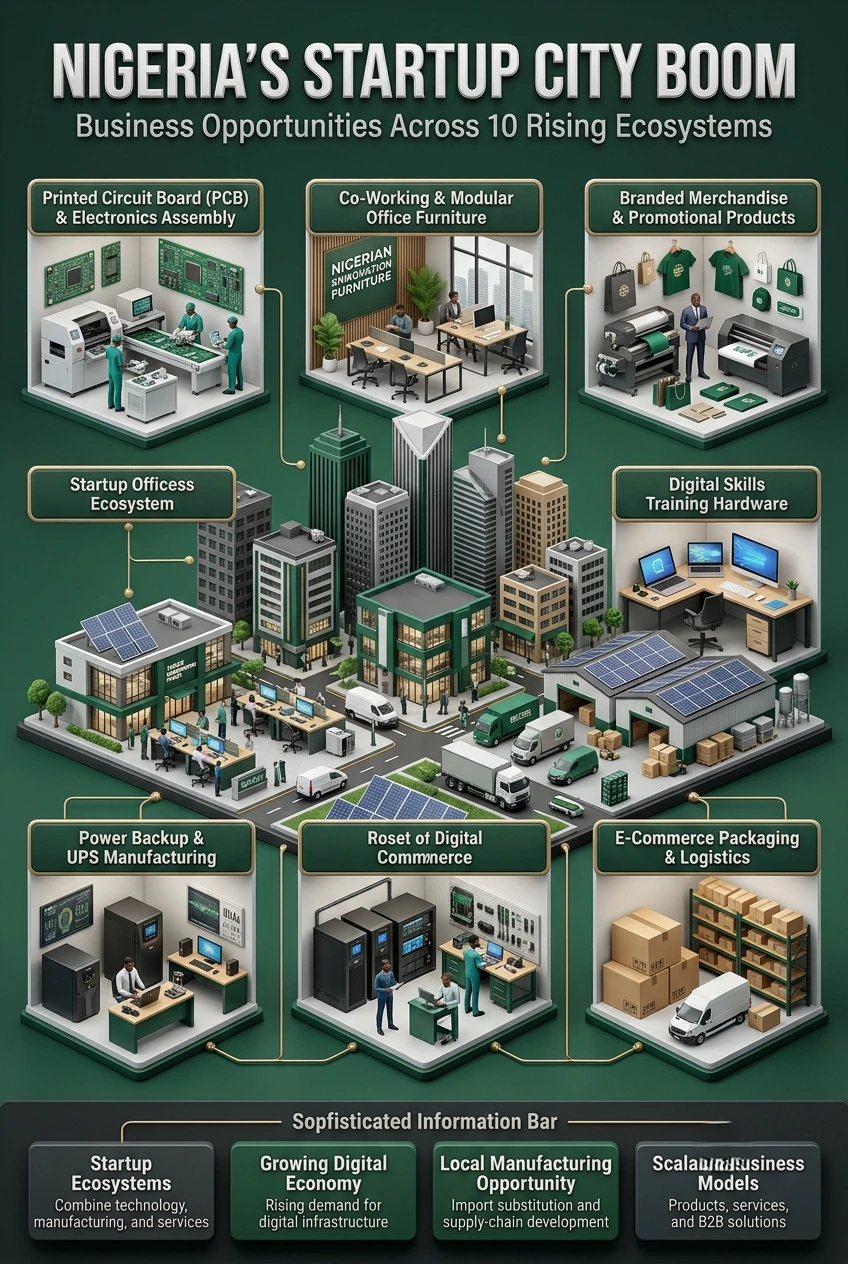
The emerging start-up culture in Nigeria demands manufactured goods and physical space. Below are six manufacturing business opportunities with commercial logic that have a direct correlation with the trends that Nairametrics reported.
1. Printed Circuit Board (PCB) and Electronics Assembly Units
The local manufacturing of point-of-sale terminals, smart cards, IoT sensors and simple computing peripherals are gaining traction as demand for these devices increases in the face of the growing number of Nigerian startups and SMEs scaling. At present almost all this equipment is imported. There is a clear customer base for PCB assembly/electronics finishing company that caters for B2B local market, particularly in Lagos (987 startups) and Abuja, in the fintech hardware firms and government linked digital projects.
- Target customers: Fintech hardware companies, POS networks, digital identity programmes.
- Why now: Four fintech unicorns (Interswitch, Flutterwave, Moniepoint, Moove) are based in Lagos; each runs thousands of hardware endpoint.
View Full Project Details: Printed Circuit Board Manufacturing Project Report
2. Co-Working Space Fit-Out and Modular Office Furniture Manufacturing
There are ten startup cities, and the Nairametrics report highlights the growth of their hub infrastructure. More than 1,000 users are present in Ilorin’s innovation hub. The Digital Innovation Park in Abeokuta, the blockchain hub in Enugu and the Ken Saro-Wiwa Innovation Hub in Port Harcourt are all in demand for local furniture, partitions, acoustic panels and modular workstations. A Nigerian manufacturer in this category is able to serve dozens of the upcoming hub projects.
- Target customers: State governments, private hub operators, co-working chains expanding to secondary cities.
- The range of investment: ₦15–80 million for a mid-size modular furniture manufacturing unit.
3. Branded Merchandise and Promotional Products Manufacturing
Nigeria’s startup events are growing — The Convergence (an investor day) in Ilorin is scheduled for November 2026, Ibadan Tech Expo (returning November 2026) and Enugu Tech Festival. Branded Merchandise is created for each event – custom lanyards, branded bags, printed t-shirts, notebooks, and promotional tech accessories. A locally owned promotional merchandise manufacturing company with a business-to-business sales team directed at event organizers and startup accelerators has a high level of repeat business.
- Target customers: Startup Accelerators, Innovation Hubs, Corporate Event Companies.
- Why now: Year-round event activity in 10 cities.
4. Digital Skills Training Hardware — Tablets and Refurbished Device Assembly
A total of 40,000 people has been trained under the Skill Up programme of Imo State. Turing Tech Training Program and Campus Hackathons are growing in Enugu. Low-cost training devices in bulk are required for these programmes. A refurbishment and light assembly unit for Certified Tablets and Laptops with imported parts, but finished and branded locally, can tender for state government contracts as a local manufacturer.
- Target Customers: State Government Skill Programmes, Private Training Institutions.
- Regulatory Entry Point: NITDA’s local content procurement preferences; BOI’s engineering and technology fund.
Related Article: Digital Supply Chain Opportunities for Indian MSMEs: AI, IoT & Government Support
5. Power Backup and UPS Manufacturing for Tech Offices
The ongoing power crisis in Nigeria has a negative impact on startup and MSME productivity. In a market full of imported products subject to FX risk and long lead times, a local assembler of Uninterruptible Power Supplies (UPS), inverter systems and battery management solutions is entering the picture, with a focus on startup offices, innovation hubs and digital service businesses. These risks are reduced significantly at the local level.
- Target customers: Tech hubs, digital SMEs, co-working spaces, government innovation parks.
- Investment range; Assembly of Inverter/UPS; ₦20 million – ₦100 million.
6. Packaging and Logistics Solutions for E-Commerce Fulfilment
As digital commerce expands, driven by logistics costs and e-commerce’s share of Nigeria’s GDP, there is increased demand for last-mile packaging solutions, which include brand boxes, mailer bags, protective foam inserts and tamper-evident seals, all manufactured and distributed in Lagos, with new centers opening in Abuja and secondary cities across the country. In most secondary cities, startups and ecommerce businesses struggle to find a supplier that provides the packaging solutions they require.One of the main problem areas in most secondary cities is finding a packaging provider that can fulfill a startup or ecommerce company’s needs in terms of custom branding and minimum order quantities.
- Target customers: Ecommerce Startups, FMCG SMEs, Digital marketplace sellers.
- Packaging manufacturing: The N75 billion MSME Intervention Programme of the Bank of Industry can support packaging manufacturing units. Apply via boi.ng.
Get Detailed Insights from This Book: Handbook on Modern Packaging Industries
Import–Export Opportunity Analysis
Export Markets
Nigeria’s growing startup brand remains the top ranked among African nations for the ecosystem value as per StartupBlink index; thus, making it a promising exporter of digital services. There are potential export opportunities for software development, fintech API services, data analytics, and digital content for African and diaspora markets. With a 100,000 paid, global service jobs being pursued by Imo-trained professionals, service exports are proving to be a viable business at scale already on ImoTalentHub.com.
Import Substitution
Almost all of the hardware used by Nigeria’s 1,500+ monitored startups (POS terminals, servers, network equipment, UPS units, tablets, etc.) is imported. Manufacturers and assembler of such products have a structural cost and regulatory advantage as Nigeria’s SMEDAN and Startup Act start favouring local procurement.
International Demand and Trade Opportunities
West Africa has a population of 400 million, and the penetration of digital is increasing. Ghana’s service providers and startups already cater to the markets of Nigeria, Kenyan and Francophone markets. A business that began in Nigeria’s start-up towns has a good regional export potential. NEXIM Bank is proactively supporting export business with cross-border growth model with export finance and TF instruments.
Nigerian MSME and Startup Success Stories
Moniepoint — Lagos
Moniepoint, headquartered in Lagos is now one of Nigeria’s four unicorns with valuation of $1 billion. It provides business banking, payment infrastructure and credit services to SMEs in Nigeria. Its growth is indicative of the size of the informal and formal SME sector which is still largely unserviced in Nigeria.
Zainpay — Kano
Zainpay is a payment infrastructure company headquartered in Kano, a top 10 startup city in Nigeria. It’s in the north, proving that there’s opportunity in fintech beyond Lagos. The volume of Kano’s informal trade and the trade with neighbouring countries, Niger, Chad and Cameroon, provide a unique customer base for payments, logistics and trade finance start-ups.
Wennovation Hub — Ibadan
Founded in 2010 and based in Ibadan, Wennovation Hub has helped over 450 startup teams launch successfully. Over 15 years, it has become one of Nigeria’s oldest innovation hubs. It also pioneered revenue-generating accelerator and co-working spaces outside Lagos. Its long-lasting success shows that ecosystem support businesses can thrive in secondary cities. These include accelerators, incubators, and training institutes.
Identify high-growth industries before others do
How NPCS Can Help You Enter This Market
With more than 21 years of experience, Niir Project Consultancy Services (NPCS) is a premier industrial consultancy and project feasibility study provider for entrepreneurs, MSMEs and investors from Africa, South Asia and the Middle East region.
NPCS offers Nigeria businesses who want to join the country’s skyrocketing start-up economy the following:
For businesses seeking to enter Nigeria’s growing startup-driven economy, NPCS provides:
- Detailed Project Reports (DPRs): Bankable, investor-ready feasibility reports for manufacturing, digital services, and infrastructure projects.
- Market Research: Primary and secondary research on sector-specific opportunities in Nigeria and West Africa.
- Technology Consultancy: Guidance on production processes, equipment sourcing, and operational setup for manufacturing units.
- Business Plan Preparation: Structured business plans aligned with SMEDAN, Bank of Industry, and state government grant requirements.
- Export Strategy: Market entry and export feasibility assessments for businesses targeting African and international markets.
Contact NPCS for a consultation tailored to Nigeria’s startup-driven manufacturing and services opportunity.
Industry Intelligence Snapshot
| Parameter | Details |
| Industry | Nigerian Startup & Digital Services Ecosystem |
| Market Driver | Nigeria’s rise to 62nd globally (StartupBlink 2026); $20B ecosystem value; 31.8% growth |
| Investment Range | From $5,000 (micro SaaS/service) to $500,000+ (hub infrastructure, B2B platforms) |
| MSME Opportunity | High — across fintech, agritech, edtech, logistics, digital commerce, regtech |
| Export Potential | High — remote tech services, fintech APIs, digital content to African & global markets |
| Government Support | Nigeria Startup Act; NITDA; BOI; SMEDAN; LSETF; State seed funds; Digital Innovation Parks |
| Risk Level | Medium — improving regulatory environment; FX volatility; infrastructure gaps remain |
| Growth Outlook | Strong — 31.8% ecosystem growth vs 17.5% global average; 10 cities now in global top 1,500 |
Conclusion: The Window Is Open — But It Will Not Stay Open Indefinitely
Nigeria’s startup ecosystem is at an inflection point. The country’s 31.8% growth rate, $20 billion ecosystem value, and expanding geographic footprint — from Lagos to Owerri, from Abeokuta to Kano — signal that this is no longer a single-city story.
The Nairametrics report on Nigeria’s top startup cities confirms what market watchers have been tracking for two years: the ecosystem is decentralising, state governments are investing, and the regulatory environment is improving. Use the Nigeria Startup Portal, engage SMEDAN and BOI for financing, and commission a project report to validate your entry point before the markets fully mature.
Commission a detailed project report from NPCS today to identify the most viable entry point for your business in Nigeria’s rising startup cities.