
Parliament passed the Micro, Small and Medium Enterprises Development (Amendment) Bill, 2026, on August 7. Twenty years after the original MSMED Act, India has finally given small manufacturers the legal teeth to collect what they are owed. According to the PIB press release on the MSMED Amendment Bill, the amendment overhauls delayed payment enforcement, dispute resolution timelines, Udyam registration permanence, and compliance penalties. For the MSME entrepreneur who has watched ₹20–50 lakh in receivables age beyond 90 days while your working capital bleeds out — this is the most consequential piece of legislation for your business in two decades.
The buyers who have relied on delay as a business strategy are on notice.
The Problem This Bill Solves: Delayed Payments Are Killing MSMEs Silently
There are many reasons why MSME businesses fail, and most of the failures do not stem from a poor product. They begin with a buyer who doesn’t pay.
As per data from Ministry of MSME on delayed payment complaints, delayed payments by large buyers and CPSEs are on number 1 spot in consistently being blamed for MSME business failure. The MSME Samadhaan portal receives applications worth hundreds of crores in disputed receivables every year. In the pre-revolutionary days, it would take 18-36 months to get a resolution — time by then when cash-strapped MSMEs would either close their businesses or get a loan at 18-24% to fill the void.
The TReDS volume has increased from ₹40,000 crore to ₹3.47 lakh crore in 3 years, representing an 8.7-fold rise, which is an indicator of how MSMEs have been financing the sale of invoices on an expensive mode – TReDS invoice discounting — instead of getting timely payment. The average MSME in India is getting paid 73 days after invoice, which is 28 days after the legal maximum of 45 days as per the existing MSMED Act, according to Livemint analysis of MSME working capital trends.
Explore proven business ideas with high success potential
The amendment now makes the procurement of MSMEs by CPSEs subject to TReDS, introduces hard timelines of 90+90 days (90 days for mediation and 90 days for arbitration) and provides for recovery of the awards as land revenue (the fastest process in the Indian legal system).
| State | Key MSME Cluster | Top Delayed Payment Sectors | Old MSEFC Status |
| Maharashtra | Pune, Mumbai, Nashik, Kolhapur | Auto components, chemicals, engineering | 1 MSEFC; severe backlog |
| Tamil Nadu | Coimbatore, Chennai, Tirupur | Textiles, auto parts, pharma | 1 MSEFC; multi-year queues |
| Gujarat | Surat, Ahmedabad, Rajkot, Vadodara | Textiles, chemicals, plastics | 1 MSEFC; court overlap |
| Rajasthan | Jaipur, Jodhpur, Bhilwara | Textiles, handicrafts, marble | 1 MSEFC; limited capacity |
| Uttar Pradesh | Agra, Kanpur, Noida, Varanasi | Leather, textiles, IT hardware | 1 MSEFC; severe delays |
| West Bengal | Kolkata, Howrah, Durgapur | Engineering, steel, jute | 1 MSEFC |
Five Changes That Directly Affect Your Business
These provisions address individual failure modes in the existing system.
Change 1: Mandatory CPSE Payments Through TReDS
All Central PSEs have to now settle their invoices for MSME procurement through TReDS. For suppliers supplying to BHEL, ONGC or SAIL, this means they receive payment within 3–5 days after the buyer accepts the invoice, compared with the earlier 60–90 day period. No negotiation required. It is required by law.
Change 2 — Hard Dispute Resolution Timeline
Mediation was completed in 90 days from the first appearance. Within 30 days of unsuccessful mediation, referral to arbitration. An arbitral award made within 90 days of the pleadings. Total max: Around 8 months as compared to 18–36 months earlier. With a disputed receivable of ₹25 lakh, 8 months is the difference between surviving and closure for an MSME.
Change 3 — District Collector Recovery
The District Collector can now recover any mediated settlement or arbitral award as ‘arrear of land revenue’, providing the most effective enforcement avenue outside of criminal law. Those who were okay with not worrying about MSEFC awards have now got a real reason to worry about asset attachment.
Change 4 — Multiple MSEFCs Per State
States no longer have limits on the number of MSEFCs that they can establish. The States with the highest number of cases will experience significantly shorter per-case resolutions in Maharashtra, Gujarat and Tamil Nadu, with each having one case per state.
Change 5 — Decriminalised Non-Compliance
Non-filing of Udyam registration now carries graded civil penalties rather than criminal prosecution. First offence: warning. Second: civil penalty. Third: escalated penalty. This removes the chilling effect that kept sub-contractors outside the formal system.
What You Must Do Right Now — Practical Steps
For New Entrepreneurs: Register on Udyam. Connect to TReDS platform (M1xchange, RXIL or A.). TREDS). Ensure all supply contracts have clear 45-day payment terms and reference to MSMED Act Section 15. Generate e-invoices for filing tax bills. If any buyer is already delayed, register on MSME Samadhaan.
For Existing MSMEs: Re-classification under the new investment/turnover criteria for MSMEs. Make sure that all buyer contracts include reference to Section 15. Force CPSE buyers to onboard and accept TReDS — it has now become a legal obligation. Expand your TReDS eligible supplier base by using provisions for decriminalisation to incorporate sub-contractors.
| Compliance Upgrade Item | Estimated Cost (INR) |
| Udyam Registration | Free |
| TReDS Platform Onboarding | ₹0–5,000 |
| Legal Review of Existing Buyer Contracts | ₹15,000–40,000 |
| MSME Samadhaan Filing (if delayed payment) | Free |
| CA for Reclassification Assessment | ₹5,000–15,000 |
| ISO 9001 Certification (recommended for CPSE supply) | ₹1,50,000–3,00,000 |
| E-Invoicing System Setup | ₹10,000–30,000 |
| Total Compliance Upgrade Cost | ₹1,80,000–3,90,000 |
The Hard Numbers: What the Amendment Saves You
If the CPSE receivables for an MSME are ₹60 lakh and the average delay in getting these paid is 75 days:
The annual saving on ₹60 lakh CPSE receivables comes to ₹86,000 and the margin improvement for CPSE supply of ₹1 crore would be directly to the net profit of ₹1.5–2%.
For a manufacturer, settling these ₹25 lakh disputes in 8 months instead of 30 months frees up capital 22 months earlier and can save ₹3.5–4 lakh in interest at a 16% cost of funds.
| Scheme | Ministry | Eligibility | Max Benefit | Apply At |
| TReDS Invoice Discounting | RBI / Finance Ministry | Udyam-registered MSMEs | Based on invoice value | M1xchange, RXIL, A.TREDS |
| CGTMSE | MoMSME / SIDBI | MSME loans up to ₹5 crore | 75–85% credit guarantee | cgtmse.in |
| PMEGP | MoMSME / KVIC | New manufacturing MSME | ₹25 lakh + 25–35% subsidy | pmegp.kvic.org.in |
| ZED Certification | MoMSME | Manufacturing MSMEs | Up to ₹5 lakh subsidy | zed.msme.gov.in |
| MUDRA Yojana | Finance Ministry | Existing micro-enterprises | ₹50,000–₹10 lakh | mudra.org.in |
| Stand-Up India | DPIIT | SC/ST, women entrepreneurs | ₹10 lakh–₹1 crore greenfield | standupmitra.in |
Mahesh Gupta, Kanpur, Uttar Pradesh, is an entrepreneur of a leather goods shop with 35 workers, who has been supplying leather goods to government organisations and CPSEs for 15 years. The greatest difficulty in his operations was payment delay, never demand. At one time, I had ₹28 lakh with government as a receivable and had borrowed it at 18% to pay my labourers. By joining TReDS, the time to payment was reduced from 83 days to 6 days. The annual interest savings is nearly ₹3.2 lakh. This will benefit thousands of CPSE suppliers who were unable to force onboarding by their buyers previously, with the mandatory CPSE-TReDS requirement under the MSMED Amendment. Source: SIDBI MSME Pulse Report
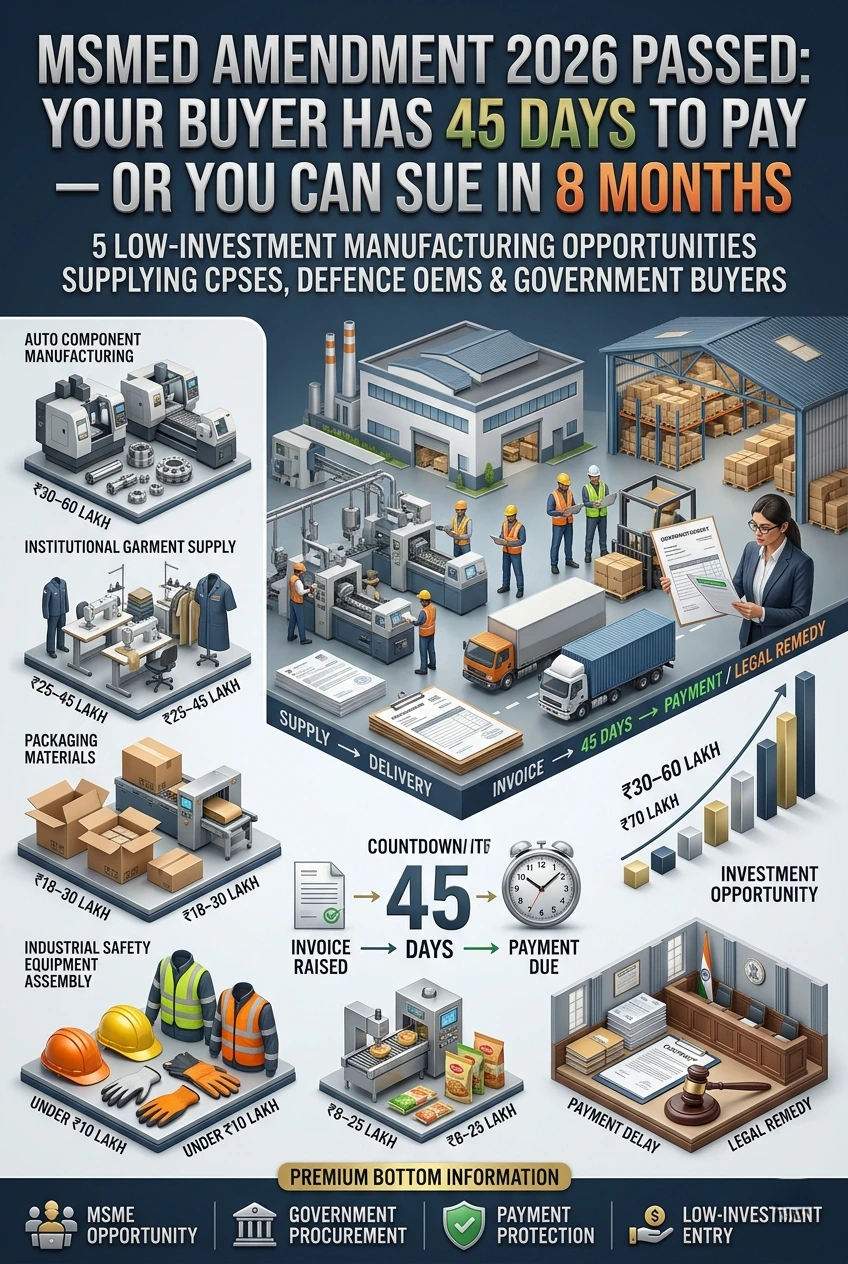
5 Manufacturing Businesses That Benefit Most From This Law
Auto Component Manufacturing for CPSE and Defence OEMs (₹30–60 Lakh)
Auto component manufacturers supplying BHEL, BEML, HAL, and defence OEMs are among the biggest beneficiaries of the MSMED Amendment’s TReDS mandate. With mandatory TReDS, working capital cycles compress from 90+ days to under 10 days — directly improving effective return on capital from 14–18% to 22–28% for well-run units. Investment: ₹30–60 lakh. Net margin at full capacity: 16–22%.
Institutional Garment Supply to Government Bodies (₹25–45 Lakh)
Police uniforms, school uniforms, hospital linen, defence apparel — the government is one of India’s largest textile buyers. MSME garment units supplying government tenders have historically suffered 90–120-day payment delays. The mandatory TReDS routing for all CPSE procurement brings this category directly into the liquidity network. First delivery to TReDS discounting: as fast as 7 days. A 30–50 machine RMG unit targeting government institutional buyers can be set up for ₹25–45 lakh.
View Full Project Details: Textile & Garment Industry Handbook
Packaging Materials for CPSE Supply Chains (₹18–30 Lakh)
A corrugated box or flexible packaging unit with ₹18–30 lakh in investment can build a reliable CPSE supply relationship at 14–20% net margin. The MSMED Amendment makes payment collection more predictable, enabling better procurement planning and bulk raw material buying — itself cutting costs by 5–8%.
Related Article: Biodegradable Packaging Manufacturing Business in India: Cost, Profit & Project Report
Food Processing for Government Canteens and Mid-Day Meal Programmes (₹8–25 Lakh)
CPSE canteens, school mid-day meal programmes, and defence mess facilities collectively consume vast quantities of food products. An FSSAI-licensed food processing unit supplying government canteens via GeM (Government e-Marketplace) benefits from GeM + TReDS integration — among the fastest B2G payment cycles available. Investment: ₹8–25 lakh. Net margin: 12–20%.
Get Detailed Insights from This Book: Handbook on Fruits, Vegetables & Food Processing with Canning & Preservation
Industrial Safety Equipment Assembly for CPSEs (Under ₹10 Lakh)
CPSEs consume enormous quantities of BIS-certified safety equipment — helmets, safety shoes, gloves, goggles, harnesses. A safety equipment assembly unit using BIS-certified components, assembled and branded locally, can enter this market for ₹7–10 lakh. List on GeM and bid on CPO tenders. The MSMED Amendment makes collecting CPSE receivables faster and more certain than at any previous point.
NPCS: Structure Your MSME for the New Legal Environment
The MSMED Amendment changes the financial environment for MSME manufacturing. But a sound business model and credible project plan remain the foundation. Niir Project Consultancy Services (NPCS) helps entrepreneurs structure projects that qualify for MSME financing, government tenders, GeM listing, and bank term loans. Their detailed project reports and feasibility studies are available through niir.org and entrepreneurindia.co — formatted for DIC submissions, PMEGP applications, and bank presentations.
Register Today — The Law Now Works in Your Favour
The MSMED Amendment is the most significant legislative upgrade for Indian small manufacturers in 20 years. It helps only those who are registered, formal, and correctly structured. The entrepreneur who formalises today — on Udyam, on TReDS, on GeM — operates in a world where buyers face real consequences for late payment. Registration takes 10 minutes at udyamregistration.gov.in. There is no reason to wait.