Sodium Percarbonate is a biodegradable, beneficial chemical compound used in many industries. It has a chemical formula which is 2Na₂CO₃ · 3H₂O₂, which is an adduct of sodium carbonate (commonly called soda ash or washing soda) and hydrogen peroxide. This combination has created an adduct that, in its solid form, is a concentrated, crystalline powder that will allow for powerful cleaning and bleaching action. It is colorless, crystalline, highly hygroscopic, and water-soluble, which makes it ideal for cleaning and treatment processes.
Sodium percarbonate releases oxygen immediately in solution when the solid is dissolved in water (it is stable in its solid form). This oxygen release allows Sodium Percarbonate a superior oxidizing and cleaning ability with no harmful residue. Its eco-friendly profile, too, has made it a popular choice for manufacturers and customers who want to use a sustainable alternative to chlorine-based products.
Manufacturing Process of Sodium Percarbonate
Traditionally, manufacturers will produce Sodium Percarbonate via a crystallization process. They prepare an aqueous solution of hydrogen peroxide and immediately react it with sodium carbonate under controlled conditions. During the process, they introduce a salting-out agent, typically sodium chloride, to facilitate the nucleation of sodium percarbonate crystals. They then cool and crystallize the solution to yield sodium percarbonate in the form they are aiming for.
In current industrial practice, manufacturers use coating technology to stabilize sodium percarbonate. For applications that require a longer shelf life, they will gravitate towards coated alternatives in order to obtain better resistance to moisture. Depending on their intended applications, they will process the sodium percarbonate into three forms: coated, uncoated, or tablet. Each of these forms has advantages in terms of storing, handling, and performing.
Detail project report on Sodium percarbonate
Benefits and Applications of Sodium Percarbonate
It complements the alkaline nature of sodium carbonate by also utilizing mechanisms associated with hydrogen peroxide anaerobic oxidation (increasing dissolved oxygen levels to destroy organic matter). This enables it to physically remove organic stains and also disinfect and brighten fabrics.
The applications of Sodium Percarbonate are extensive, from household products to commercial and agricultural uses. In laundry, it is commonly used as a pre-soak treatment for heavily soiled fabrics to return them to their original whiteness and freshness. As a household cleaning agent, it is commonly used for cleaning stubborn stains from coffee cups, cleaning utensils, and bathrooms, and is often preferred as a cleaning agents for carpets, pet bedding, and outdoor decks.
Some specific known uses include Sodium Percarbonate’s role in algae controls in water features. It will also help eliminated moss from surfaces and sterility of tools in hairdressing. In the textile and paper industries, it acts a non-chlorine bleaching agent and can provide high quality results without damaging fibres or pulp. Given its consumption in the form of water, oxygen, and sodium carbonate, and the number of socially responsible industries that use it – Sodium Percarbonate is appealing because of its plethora of sustainable options in their fundamental practices.
Market Outlook
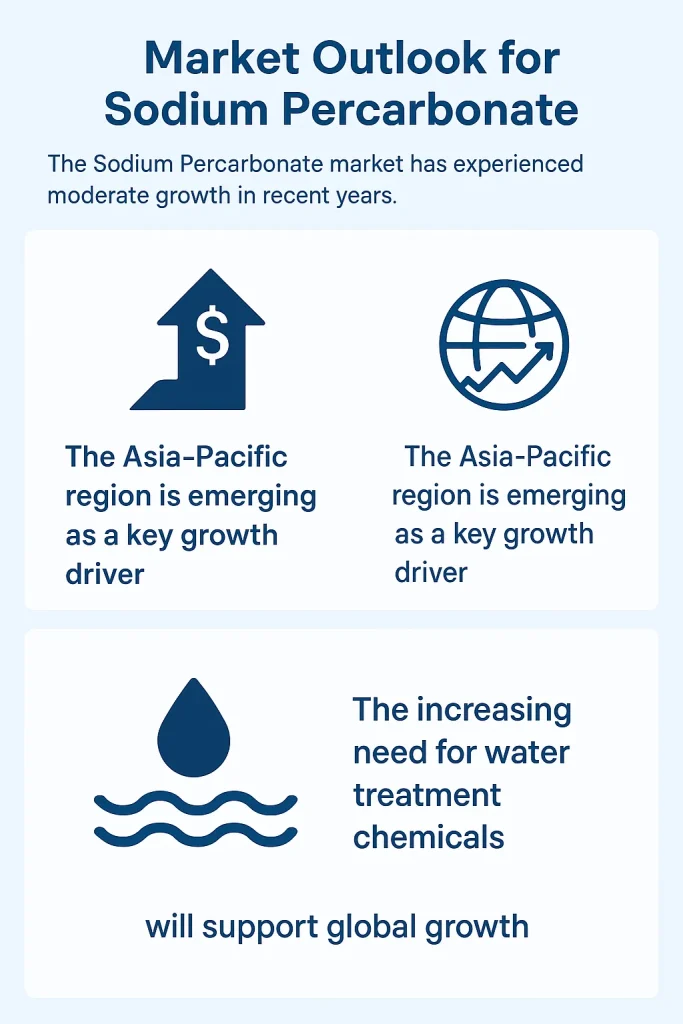
In recent years, factors impacting raw material price fluctuations and demand patterns have both impacted raw material inputs and supply. Supply dynamics over the past decade have fluctuated, while demand has steadily increased along the demand curve as buyers are becoming more aware of eco-friendly cleaning agents. This steady demand has exerted upward pressure on prices in certain areas.
As is indicated in the non-chlorine generation of eco-friendly cleaning products, the Asia-Pacific region presents a unique growth dynamic, supported by rising urbanization, capacity growth in detergent manufacturing, and consumer preference for sustainable cleaning products. Europe and North America play an important role as well, particularly in household and industrial cleaning, as non-chlorine bleaches to address environmental regulations.
The ever-increasing demand for water treatment chemicals, especially in water-scarce regions, will support continued global growth.
For more such ideas and details, visit
Market Segmentation
We can understand the Sodium Percarbonate market by examining its segmentation based on type, application, and end-user industries.
By Type
In terms of type, the market includes coated, uncoated, and tablet forms. Uncoated Sodium Percarbonate currently dominates usage because it is cost-effective and well-suited for applications that require immediate use. However, coated variants are gaining ground in industries where extended storage and controlled release are essential.
Related articles:- Future Opportunities in Production of Sodium Percarbonate
By Application
Uses are very varied and range from cleaning and detergent uses to bleaching and water treatment. Even with all of these uses, the largest segment is household cleaning as consumers have opted for effective cleaning that is also eco-friendly. Also, right behind this category are industrial cleaning and textile bleaching uses.
Both the cleaning and textile sector prefer sodium percarbonate because of its powerful oxidation action, with better safety characteristics than other oxidizing and bleaching agents. The bleaching agent category continues to grow, as greater demand from laundry and textiles is driven by the increased uptake of sustainable and non-chlorine bleaching alternatives.
From an end-user prospective, the compound has end-users in papermaking, laundry, industrial cleaning, textiles, chemicals (for other uses), household care and the food industry. The papermaking sector is using the material for non-chlorine bleaching, while in the textile industry, it is used for brightening textiles without weakening the textile.
Key Market Drivers
The Sodium Percarbonate market is being driven by several factors. The laundry industry remains a stable and key consumer – demand is expected to correlate with population growth and increased usage of environmentally-friendly laundry detergents. The textile industry’s demand for bleaching agents that are more sustainable also adds to the total market growth.
Water scarcity is an issue that will only become more serious over time, and more investment is being made in wastewater treatment infrastructure. Sodium percarbonate has disinfectant and oxidizing properties towards organics, which will soon make it an ingredient in water treatment products. Its recent acceptance by the aquaculture industries – including organic fish farming – is also a strong driver.
While the uncoated form continues to have the largest market share, the growth of coated forms, as is also clear, is indicative of there being a requirement for stable and moisture-resistant formulations both for uses in industrial, and for household applications.
Related articles:- Manufacturing of Sodium Carbonate by Solvay Process
Sustainability and Environmental Impact
One of Sodium Percarbonate’s strongest advantages is its environmentally friendly profile. Unlike chlorine-based bleaching agents, it breaks down into non-toxic substances—oxygen, water, and sodium carbonate—after use. This minimizes harmful discharges into water systems and aligns with global environmental regulations.
Sustainability trends in consumer goods, particularly in detergents and cleaning products, have encouraged manufacturers to adopt Sodium Percarbonate as a safer, greener alternative. Its compatibility with biodegradable surfactants and plant-based cleaning agents further supports eco-label certifications.
Future Opportunities and Challenges
The future of Sodium Percarbonate will largely depend on innovation in detergent formulations and much-improved coating technologies. The growth in non-traditional applications will only help solidify its place in the market. Also, there are significant opportunities in the developing countries, where rapid development and urbanization are contributing to the demand for effective cleaning and water treatment. As these markets develop, the versatility, as well as the environmentally-friendly aspects of Sodium Percarbonate, should secure its spot as a chemical of choice.
However, issues remain regarding competitive pricing in the face of the fluctuating prices of hydrogen peroxide and sodium carbonate. The stability of the supply chain and production efficiency will determine how competitive the price can be kept. In addition, with competition for alternative oxidizing agents, such as sodium perborate, or chlorine-based products and product innovation, a marketing strategy remain key.
Conclusion
Sodium Percarbonate is a highly effective, versatile, and sustainable cleaning and bleaching compound. It is used in applications from home laundry to commercial bleaching, water treatment, and specialized applications in aquaculture and food safety. With greater global focus on sustainability and regulatory compliance, it is a positive trend.
Manufacturers that commit to quality control, creative formulations, and environmentally friendly branding should gain a competitive advantage. This shift in the marketplace, when combined with growing consumer interest and choice of eco-friendly cleaning products, will have positive impacts.
Find best business ideas for yourself using our startup selector tool
About Niir Project Consultancy Services (NPCS)
Niir Project Consultancy Services (NPCS) prepares comprehensive Market Survey cum Detailed Techno Economic Feasibility Reports. These reports cover essential aspects such as manufacturing processes, raw materials, plant layouts, and financials, providing entrepreneurs with practical tools for planning. NPCS supports startups and businesses in assessing feasibility and confidently establishing new industrial ventures.
Frequently Asked Questions
Q1. Is Sodium Percarbonate safe for the environment?
Yes, it breaks down into water, oxygen, and sodium carbonate, leaving no harmful residues.
Q2. Can Sodium Percarbonate replace bleach?
Yes, it acts as a non-chlorine bleaching agent, making it a safer and eco-friendly alternative to traditional chlorine bleach.
Q3. How should Sodium Percarbonate be stored?
Store in a cool, dry place in an airtight container to prevent moisture absorption and loss of potency.
Q4. Does it have a strong smell like bleach?
No, Sodium Percarbonate is odorless, making it suitable for users sensitive to strong chemical smells.
Q5. Can it be used in cold water?
It works best in warm to hot water, but it can still function in cold water with a longer activation time.