
Manufacturing incentives in India
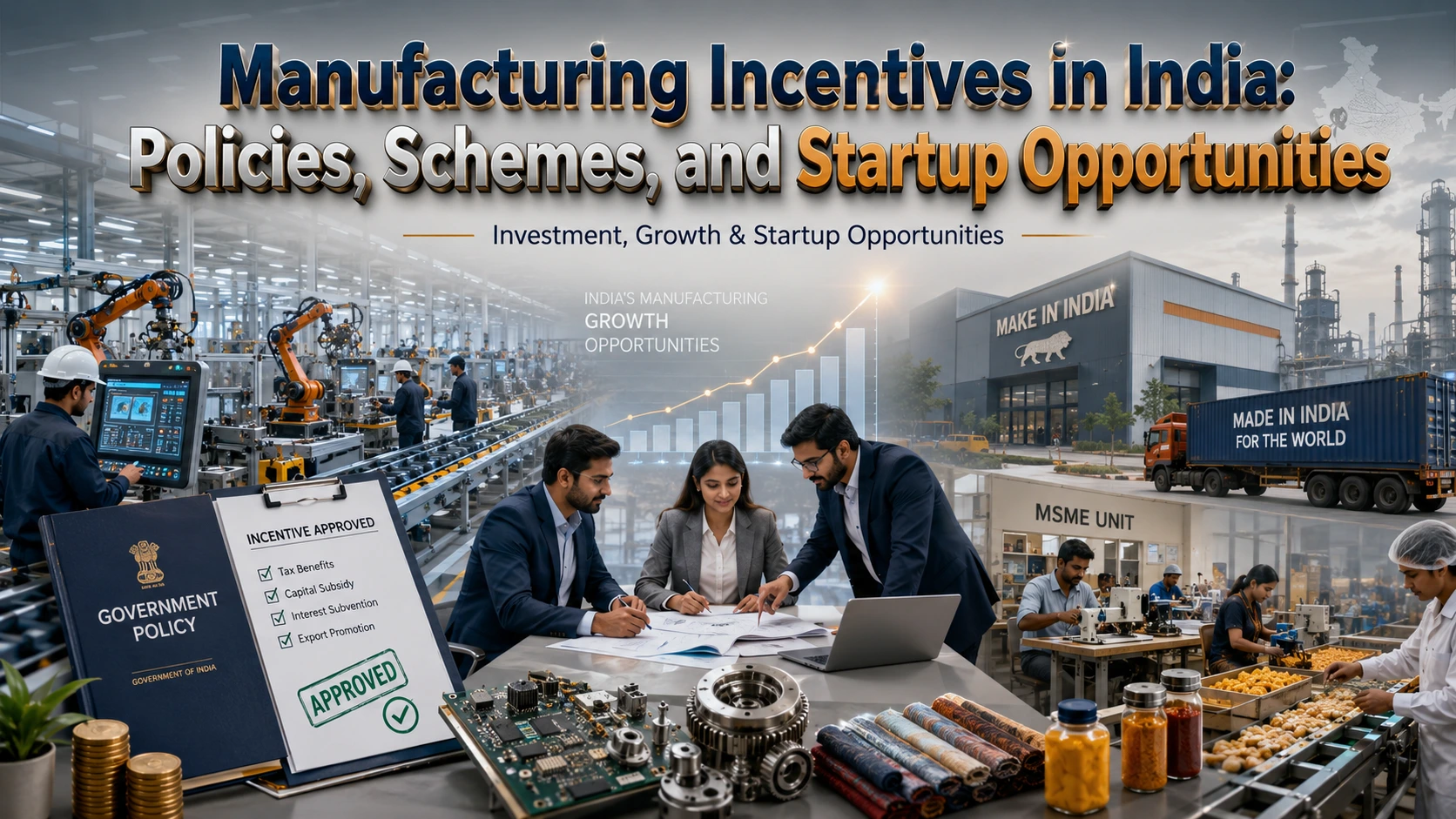
The industrial landscape in India is undergoing rapid changes. The Government has implemented some of the most stringent manufacturing policies in India that have been witnessed in decades. Time is ripe for startup founders and MSME investors to consider the practical business ideas in the production sector. Today, subsidies, capital-linked grants, tax deferrals and credit guarantees are available in almost all manufacturing sectors. But most founders do not actually enjoy these benefits either because they are not aware or because they don’t understand the interlocking nature of schemes to the extent that they should. This article cuts through all the headlines and provides you with a working, consultant-level dissection of where the real cash is and how you can get your business in the game and to capture it.
Why the Manufacturing Sector Deserves Your Full Attention
India’s manufacturing contribution to the world has been steadily rising. Today it is among the top five countries worldwide to invest in manufacturing due to its strong export growth, growing domestic consumer market and competitive labour costs. Committed investments in electronics, chemicals, defence, pharmaceuticals, textiles, food processing, and other sectors have swelled to hundreds of billions of dollars to a single initiative of the government, Make in India.(Manufacturing incentives in India)
In addition, the government’s drive to cut imports will leave nongray markets for local producers to profitably fill in, particularly those in electronics and specialty chemicals. Make in India portal has more than 25 priority sectors, each having an investment facilitation desk. This policy momentum is directly reflected as reduced costs of entry and clearances for the first-generation entrepreneurs.
Choose the right startup backed by real market demand
Key Government Policies and Manufacturing Incentives in India
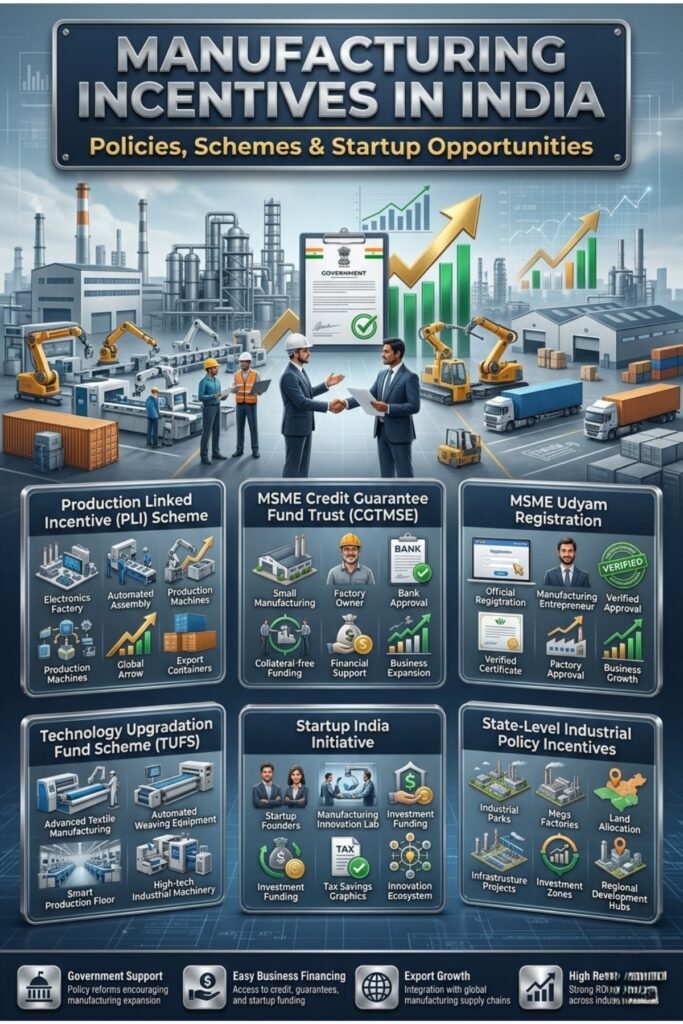
1. Production Linked Incentive (PLI) Scheme
The PLI scheme is one of the most impactful manufacturing policies in the last two decades that India has implemented. It provides direct cash rewards that are tied to incremental sales of domestic manufacturing. The scheme is active in 14 sectors such as mobile electronics, pharmaceuticals, automobiles, textiles, food processing and advanced chemistry with an outlay of more than ₹1.97 lakh crore. Importantly, the scheme is intended to reward growth, rather than just registration. Manufacturers get a percentage of their incremental revenue as “incentive” for 5 to 7 years. It is a complete paradigm shift in business model math for anyone who’s trying to use a mid-scale manufacturing unit.
You can review eligible sectors and application guidelines on the DPIIT website.
2. MSME Credit Guarantee Fund Trust (CGTMSE)
Collateral-free credit is one of the greatest challenges for manufacturing startups. The CGTMSE scheme of the Ministry of MSME does just that. It offers credit guarantees to eligible MSMEs of up to ₹5 crore without the promoter having to put any physical assets up. All banks and NBFCs are involved as the lending institutions under this trust. It can make the difference between having a working capital line and being on the verge of being stuck at the concept stage if you are a first-generation founder and a person with limited personal assets.
3. MSME Udyam Registration and Its Downstream Benefits
The first step towards accessing almost all manufacturing incentives in India is Udyam Registration. After registration, MSMEs can avail priority sector loan facility at lower interest rates, benefits from delayed payments from big buyers under MSMED Act, subsidy on patent and ISO certification, and can get preference for procurement facility from the Government e-Marketplace (GeM). The full registration process is self-certified, online, and without visitation by an inspector or any upload of documents for initial registration.
4. Technology Upgradation Fund Scheme (TUFS) — Textile Sector
TUFS offers capital subsidy based on the capital invested in the machinery for the entrepreneurs in the textile and apparel industry. The scheme is on Power loom weaving, Knitting, Garmenting and Technical textiles. Capital subsidy for machines up to 15% of the cost of the machinery is available based on technology and employment criteria. This is coupled with PLI for man-made fibres, with the result that a textile start-up now has multiple layers of incentive structures which can greatly shorten its payback period.(Manufacturing incentives in India)
5. Startup India: Tax Holiday and Fund of Funds
The Startup Indi a programme offers startups recognised by DPIIT income tax holiday benefits for three years. This is especially important for those manufacturing companies with high capital requirements where profit becomes apparent in years 2-4. Further, the Fund of Funds for Startups provides equity financing to fund projects through the SEBI-registered Alternative Investment Funds for eligible manufacturing enterprises through it.
6. State-Level Industrial Policy Incentives
In addition to central schemes, there are parallel schemes at state level. Other states, such as Gujarat, Tamil Nadu, Telangana, Rajasthan and Maharashtra have further capital subsidies of 10–25%, interest subventions of 3–7% and electricity duty exemptions of 5–10 years. These savvy entrepreneurs stack central and state incentives and lower their project’s effective cost by 30-45% (on an NPV basis). Before choosing your project site, it is crucial to check with the appropriate state industrial development corporation.
High-Potential Business Ideas for Startup Manufacturers in India
Food Processing and Agri-Value Addition
The current incentive regime in India is one of the biggest beneficiaries of food processing. The sector is also be eligible for PLI as well as MSME credit schemes and State agro industrial park subsidy. All three layers can be useful to a new company that’s hitting the market with new spice grinding, ready-to-eat food, fruit pulp processing or dairy product manufacturing. Furthermore, the base of domestic demand is enormous, and is increasing.
The organised food processing industry in India is still small and has very poor penetration as compared to its counterparts in the rest of the world, thus creating a huge potential for new players with consistent quality and branding. A second revenue comes from the Indian expatriates in North America, Middle East and Europe who send money back to India almost with every day. Starting a food processing unit in an MSME cluster or agro park remains one of the best business ideas for entrepreneurs with ₹50 lakh to ₹2 crore in investible funds today.
Get Detailed Insights from This Book: Handbook on Fruits, Vegetables & Food Processing with Canning & Preservation (3rd Edition)
Specialty Chemical Manufacturing
The specialty chemicals market in India is witnessing a structural demand growth. The global supply chain restructuring after COVID-19 has compelled European and American buyers to make strong efforts to shift sourcing from China to India. On the volume side, segments such as agrochemical intermediates, pharmaceutical APIs, dyes & pigments or performance chemicals are experiencing growth, while price has improved across the board.
A start up with access to basic chemistry talent and ₹1-3 crore can setup a B2B specialty chemical business with domestic formulators and export buyers as their customers. The PLI scheme for Pharma products has a 10-20% incentive for incremental sales of APIs, making it even more economics. In addition, the government has also put in place dedicated ‘chemical parks’ in Gujarat and Maharashtra, where the effluent treatment plant is common to all the units, thereby significantly lowering the environmental compliance cost for a new unit.(Manufacturing incentives in India)
Electronics and PCB Assembly
The largest absolute spending under the PLI scheme has come from the electronics industry. But there is ample potential for smaller electronics assembly firms in the domestic demand for contract manufacturing. Localisation of production by large brands leads to a supply chain of smaller vendors specializing in assembling the components. A new company that enters the PCB assembly, cable harness or enclosure production industry can become a Tier-2 company for PLI beneficiaries. The investment is moderate – ₹75 lakhs to ₹2.5 crores, depending on the level of automation – and the working capital cycle is short as big OEM buyers usually provide confirmed purchase orders before production commences.
Green Energy Components
One of the fastest-growing manufacturing segments in present-day India is the solar module manufacturing segment, lithium battery manufacturing segment, and EV charging equipment manufacturing segment. The government has respectively reserved certain PLI incentives for solar PV modules and advanced chemistry cells. For MSMEs, it is not the manufacture of a module but the supply of the component: EVASheets, backsheets, aluminium frames, junction boxes and mounting structures. A medium-scale manufacturer can profitably produce these inexpensive, simple-to-manufacture, and relatively low-value items. Additionally, the Pradhan Mantri Surya Ghar scheme and PM-KUSUM are promoting rooftop and agricultural solar installation at a steady rate and are creating some momentum in the country for the components.(Manufacturing incentives in India)
Get Detailed Project Report (DPR): Green Power and Renewable Energy Projects
Import-Export Opportunity Analysis for New Manufacturing Startups
The aspiration to export is a key component of the industrial policy in India at present. The government has ambitious plans to achieve merchandise exports exceeding USD 1 trillion by 2030. The India Trade Portal offers up-to-the-minute information for every product category on tariff preferences, trade agreements, export promotion schemes, and more.
The primary export opportunity for manufacturing startups is replacing the Chinese suppliers of price-sensitive industrial buyers in Southeast Asia, Africa and the Middle East. Some of the other areas where India is already competitive are engineering goods, pharmaceuticals, processed foods, textiles and chemicals. The Remission of Duties and Taxes on Exported Products (RoDTEP) scheme makes export pricing competitive for exporters without any subsidy.
Certain categories on the import side are still highly dependent, such as specialty chemicals, semiconductor components and precision machinery. These are a risk and an opportunity. Entrepreneurs who set up their domestic production in import-intensive categories enjoy natural protection of prices and their own base of domestic buyers. The government’s phased manufacturing programme (PMP) actively encourages such import substitution by providing duty structures over the phases.
Indian MSME Leaders: Lessons for New Entrepreneurs
Deepak Nitrite – Specialty Chemicals Executed Right
Deepak Nitrite, a product of the Deepak Group, is the textbook example of an Indian chemical company gaining a competitive advantage from the strategy of import substitution. The company began as a small nitrite producer, continually investing in new technology, downstream derivatives and developing strong relationships with domestic and export customers. The takeaway for new MSMEs is to focus on one category of chemicals, build deep process expertise, and use every incentive cycle—from state support to PLI—to drive the next chemical revolution. Today it’s a multi-thousand crore company, but the early days were based on precisely what kind of focused MSME manufacturing method that the first-generation founders could have.
Parag Milk Foods – Food Processing at Scale
With government backing for cold chain infrastructure, agro-processing subsidies, and expansion of organised retail markets, Devendra Shah’s Parag Milk Foods has built a fascinating journey, emerging as a national dairy brand from a processing firm he started. With just a single processing plant in Maharashtra, Parag went on to grab government support at every step — from MSME credit to market development assistance for exports. Thus, the takeaway: Quality certifications and cold chain investments early on by the food processing MSMEs can result in much higher realisations and open the door to export markets.(Manufacturing incentives in India)
Sharda Motor Industries – Auto Component Excellence
Sharda Motor Industries is an auto component manufacturer, which is consistent in meeting the requirements of OEMs, and has expanded its product range from a small size MSME base to a listed company. The company’s founder foresaw that the auto component industry would grow in India, driven both by domestic expansion and by rising export demand from international OEMs setting up manufacturing facilities in the country. Sharda’s investment in quality systems, establishing long-term OEM relationships and leveraging scheme-linked capital effectively ensured that it created a defensible business and had recurring revenue. It is a model that is most replicable growth path for MSMEs in the engineering components space, with quality being the primary consideration, certification second and exports third.
Related Article: 10 Profitable Manufacturing Business Ideas You Need to Know Right Now — From Entrepreneur India April 2026
How NPCS Supports Manufacturing Entrepreneurs
Niir Project Consultancy Services (NPCS) makes available professional looking for Market Survey cum Detailed Techno-Economic Feasibility Reports (DPRs) for establishing a brand-new industry or business. We develop detailed reports covering the complete manufacturing process, market research, and demand analysis, process flow diagram, product mix, and capacity planning, raw material sourcing and machinery specification, and complete project financials with profitability analysis. Our goal is to assist entrepreneurs with feasibility, profitability and long-term scalability analysis before investing money into a business.
Whether you’re considering a food processing facility, specialty chemical plant or an electronics assembly plant, our DPRs provide the financial transparency needed to confidently present to lenders, incentive portals and investors. Also, leverage on sector level demand information from the Ministry of MSME and the SIDBI MSME Pulse report to aid business planning.
Key Manufacturing Incentive Schemes at a Glance
| Scheme | Nodal Authority | Key Benefit | Eligible Sectors |
| PLI Scheme | DPIIT / MoC&I | 4–20% incentive on incremental sales | 14 sectors including electronics, pharma, food |
| CGTMSE | Ministry of MSME | Collateral-free credit up to ₹5 crore | All MSMEs |
| Startup India Tax Holiday | DPIIT | 3-year income tax exemption | DPIIT-recognised startups |
| TUFS | Ministry of Textiles | 15% capital subsidy on machinery | Textile and apparel manufacturers |
| RoDTEP | DGFT / Ministry of Commerce | Rebate on embedded taxes for exports | All export-oriented manufacturers |
| State Industrial Policy | State IDCs / DICS | 10–25% additional capital subsidy | Varies by state |
FAQ
Q1. Can first-time manufacturing entrepreneur avail PLI scheme?
Yes, on a few conditions. While you have to meet the minimum investment limits and increase domestic production (the criteria across most PLI verticals are tilted towards the experienced and well-funded companies or highly promising startups) the scheme still has entry points for MSMEs. The idea is that MSMEs can become Tier-2 or Tier-3 suppliers to an existing or planned Tier-1 applicant to a specific PLI vertical. In addition, many states have their own parallel “PLI-like” state-level scheme with low entry thresholds targeted to MSMEs.
Q2. How do I stack central and state benefits without legal risk?
Stacking is both legal and desired; it’s the intent of most policies to encourage this to the maximum. The only condition is that you can’t claim the same incentive for the same item of expenditure from two different government schemes with similar criteria. For example, a capital subsidy can’t be simultaneously claimed from state and central governments if it’s for the same asset and meets both criteria. But a state electricity duty exemption can definitely be stacked with a central PLI for sales; an existing subsidy to a capital good can be taken under state scheme and the subsequent output benefit through central PLI. It is always prudent to consult a project consultant or chartered accountant with experience in industrial scheme implementation.
Q3. What is the usual time lag to get benefits in CGTMSE?
CGTMSE doesn’t give any money directly to the entrepreneur; instead, it provides a guarantee to a lending agency, ie banks and NBFCs. The moment a lender has granted you a loan and applied for a guarantee cover to CGTMSE, then the credit effectively becomes risk-free to the bank. It’s seamless thereafter from the borrower’s perspective. Usually, loan disbursal happens within four to eight weeks in the case of new MSMEs with all documents properly submitted.
Q4. Is Udyam Registration mandatory for manufacturing schemes?
While Udyam Registration is necessary to avail of MSME-specific schemes such as the CGTMSE, MSME subsidy on quality certifications, preference to GeM procurement etc, it is a separate process and must not be confused with Startup India Recognition by DPIIT which opens a completely different set of benefits and has separate criteria and process. You can and must get both registrations if eligible, because each one is distinct and complements the other.
Q5. Which sector offers quickest ROI to a new manufacturing entrepreneur?
Based on current market trends, food processing, specialty chemicals and agro-based products offer quicker payback to moderately capitalized newcomers. Strong domestic demand with export potential along with huge incentive packages for the above sectors are attractive. Electronics manufacturing (assembly) and EV component manufacturing sector, while highly attractive growth sectors need technically qualified resources and high investment, they would deliver higher returns in long run. The most profitable sector would greatly depend on your capital, expertise and access to inputs and sources.
Q6. Where do I find reliable Indian data for manufacturing demand?
The RBI Annual Report on Industry and the CII Manufacturing Outlook Survey among the most trustworthy available information that you would need, sector-wise, for understanding domestic and global demand trends. DPIIT also annually puts out industrial performance data to help you get a feel for market.
Conclusion: The Window Is Open — But It Won’t Stay That Way
The Indian manufacturing incentive structure is, in reality, a very benevolent structure compared to global counterparts. Through a mix of PLI cash incentives, MSME credit guarantees, startup tax holidays, state capital subsidies and export rebates, the “effective cost” of setting up a manufacturing business could stand to be reduced by as much as 30%-50% versus a self-funded project. But incentive structures usually have cycles of application, caps on budgets, policy review period and the most patient of founders lose the optimal period for incentivized setup.(Manufacturing incentives in India)
The correct process is to decide the manufacturing business concept first. Then create a realistic feasibility report. After that, register yourself on Udyam and Startup India. Only after identifying and mapping the available incentive schemes should you invest. This order of, plan, register, apply, then invest, has been the formula for India’s top MSME manufacturers and how they’ve created lasting businesses over the last 10 years. The opportunities are real, the incentives are funded, it depends on you, if you grab them.