Despite India being one of the largest producers of tobacco, there is a large amount of underutilized tobacco waste, particularly stems, stalks, and leftover waste.
This waste is often neglected and placed into landfills. However, there is an entrepreneurial opportunity to sustainably profit by converting this waste into nicotine and other derivatives.
This notion of waste to wealth not only addresses the circular economy but also meets the increasing demand for pharma-grade and other niche specialty chemicals. With sustainable and consistent low-cost raw materials, new businesses can be easily established.
Market Trends and Growth Potential
As more individuals utilize smoking cessation aides and nicotine-infusion pouches, the demand for nicotine and its derivatives is increasing. There is also a considerable advantage in entrepreneurial supply given that India produces more than 800 million kg of tobacco annually.
Although there is a relative stagnation in the consumption of tobacco in the form of cigarettes, there is a growing international demand for high-purity nicotine. This allows for the targeting of the domestic and the international market. This sector will provide sustainable long-term potential for businesses.
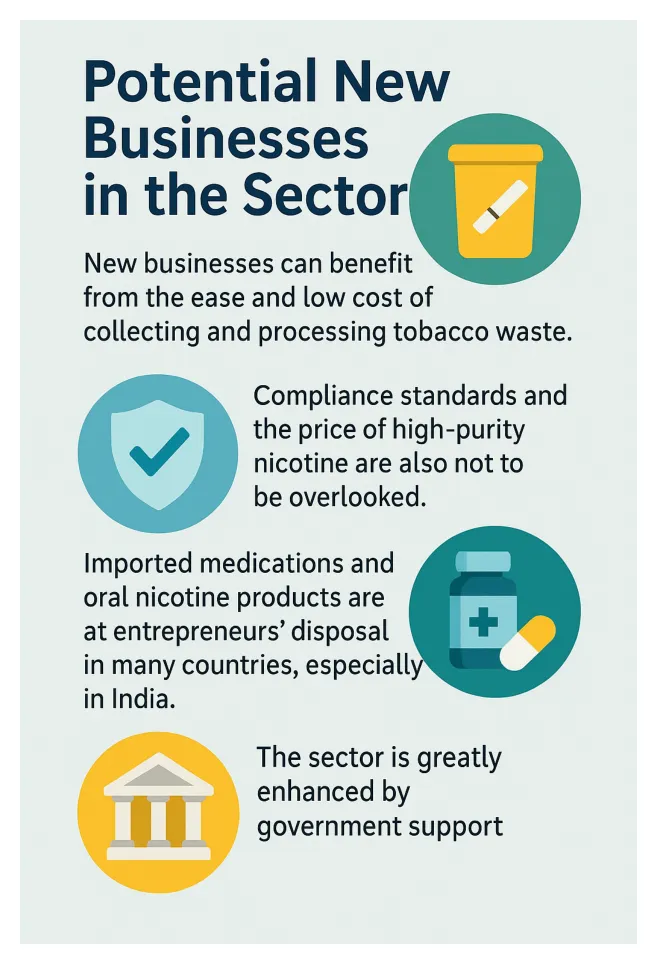
Potential New Businesses in the Sector
New businesses can benefit from the ease and low cost of collecting and processing tobacco waste stream. Furthermore, compliance standards of high-purity nicotine and its price cost are not to be overlooked.
Additionally, imported medications and oral nicotine products available in many countries are at the entrepreneurs’ disposal, especially those in India in view of their cost and export privileges. Therefore, this sector is greatly enhanced by the government support.
Main Derivatives of Waste Tobacco
With the tobacco waste stream, entrepreneurs can extract and sell nicotine sulphate, nicotine salts, nicotine polacrilex, nicotine bitartrate, high-purity nicotine and a number of other products, realizing value from agri-business, pharma, and other research oriented markets.
Most of these nicotine derivative products are agri-business oriented and pharma, which can dovetail risk in the business. Thus, the choice is available to the startups to come up with a product at a particular level of their investment and their objectives of short term related to the product and investment. This way, the startups derive a higher level of long term stability.
Read More: India’s $1.25 Trillion Engineering Export Vision 2047
General Processing Journey (General Overview)
The first step involves gathering and treating the tobacco by relieving it of certain components to allow for the flow of useful components. Moreover, it enables the targeted separation of nicotine during controlled processing.
In addition, an increased number of purification steps are required for the higher quality the pharma and export market demands. Consequently, based on the industry, derivatives are designed for agro and pharma industries. To comply with safety and quality regulations, final derivatives are inspected, and all batches are dedicated to one industry.
Advantage of Raw Material Availability and Pricing
The tobacco-producing states of India, such as Andhra Pradesh, Karnataka, Gujarat, Uttar Pradesh, and West Bengal, have as a collective unit large quantities of waste. Moreover, processing tobacco partnerships allows for consistent supply.
Local agro and industrial clusters allow for fast procurement. Hence, entrepreneurs are able to easily lower costs and access raw materials with little delay leading to a simplified and dependable raw material planning.
Read Our Book: Click Here
General Overview on Technology and Equipment
Standard industrial machinery is used throughout this sector for extraction, cleaning, and purification. Laboratory analyzers, as an example of quality control step equipment, are used to identify and quantify constituents of a tested sample, thus determining its purity.
Both domestic and international firms supply the needed components for the machinery, therefore, as markets expand, startup businesses have unrestricted options on how to scale their facility. Investments on equipment for such setups become very adaptable and well designed.
Regulatory and Compliance Considerations
Safety requirements, environmental and sustainability consideration, and product quality are essential regulations that must be considered. In addition, product approval can also depend on whether the item is for the agriculture, pharmaceuticals, or is for export.
Also, proper documentation guarantees smooth shipping and distribution. Hence, compliant units get faster acceptance from global buyers. Hence, the export operations become more secure and dependable.
Read More: Profitable Nicotine Manufacturing from Tobacco Waste
Emerging Niches and Future Uses
There is a growing global demand for nicotine pouches, research chemicals, and natural bio-pesticides. Additionally, there is a need for high-purity inputs, which india can easily produce at a lower cost. Also, first-movers are the only ones that can develop such products.
Hence, branching out on these growing segments can also improve the long-term sustainability. Thus, startups will undoubtedly be able to stay ahead of the global trends.
Import–Export Opportunity Analysis
Over US$ 1.4 billion worth of tobacco-related products is already exported from india. Moreover, the nicotine derivative market, albeit small, provides high revenue potential. In addition, the top export markets are the eastern, southeastern, and, US, and EU countries.
Hence, india’s cost advantage allows these start-ups to compete on a global scale. Therefore, a rapid growth of export-oriented business models will follow.
Read Our Project Report: Click Here
Success Stories from MSMEs
Some of these MSMEs in India have transitioned from traditional kinds of tobacco work to more sophisticated nicotine products. Additionally, companies in Andhra Pradesh and Gujarat have started exporting more expensive products.
Others, too, have branched out into supplying nicotine pouches to international markets. Such cases illustrate how small units can increase in size and scale with proper technological upgrades. Thus, these examples can be followed by aspiring entrepreneurs.
How NPCS Can Help You
NPCS has also been instrumental in helping entrepreneurs by preparing simple and concise feasibility reports, which analyse the market for the products, the cash flow and profitability, the operational aspects of production and capacity, the machinery and equipment to be used, and the overall production flow.
Besides these, NPCS also advises on policy compliance, how to plan the investments to maximise government support, and other economic benefits. Furthermore, NPCS helps entrepreneurs to select the potential business model most suited to their financial and organisational aspirations.
Thus, NPCS has been instrumental in reducing the risks in business startups, increasing the speed of project feasibility and planning, and supporting the seamless transition from concept to operational production.
Read More: From Waste to Wealth: The Profitable Extraction of Nicotine from Tobacco Waste
Business Models for New Startups
Business Models such as integrated facilities, toll processing, export oriented units, and niche products have also been used by many entrepreneurs. Furthermore, all of them provide ample leeway in investment and growth.
Additionally, the right choice maximises business opportunities and reduces overall business risk. This helps businesses to align their capital with long term objectives more effectively, facilitating easier scalability.
Financial Viability Indicators
The low cost of raw materials, high product value, and strong export demand create a good financial outlook, which leads to a stable return from investments. These units also report short payback periods. This modular also makes plant expansion financial outlook for this sector attractive, as well. Therefore, expansion of this sector is financially attractive.
Government Schemes and Support
The Commerce Ministry, Tobacco Board, Ministry of MSME, and export councils staff assist with data, subsidization, and coordination of trade events. These programs also help reduce costs and enhance visibility. These programs also assist in obtaining quality certifications and marketing products internationally. Hence, market access for entrepreneurs is eased.
Marketing and Sales Strategy
Obtaining sustainable global clients is achievable through strong, quality certifications, endorsements, and partnerships. Online B2B platforms are excellent marketing tools to exhibit products and services. Brand reputation is built through participation in trade fairs. Good transparent communication is key to obtaining long-term contracts.
Human Resource and Skill Development
Operational efficiency and quality are enhanced when skilled staff are available. Local inactive staff can undergo MSME skill programs to acquire sector relevant training. Mistakes are reduced, which decreases wastages, when good training is available. Therefore, strong teams support with sustained growth. Productivity is further advanced.
Sustainability and ESG Angle
Transforming waste into useful products aligns with goals of the circular economy. Further, solvent recovery and eco-friendly systems boost a firm’s ESG score. Green operational practices also appeal to international customers and investors, meaning that the firm’s brand equity is strengthened even more. This provides a firm with a significant competitive edge.
Find the Best Idea for Yourself With our Startup Selector Tool
Conclusion
Transforming tobacco waste into nicotine derivatives gives a low-cost, high-value, and exportable product to entrepreneurs. Moreover, India’s raw materials and government support makes this sector more lucrative.
Furthermore, with proper planning and support from NPCS, startups can create scalable, adaptable businesses. This means that this opportunity can create significant wealth from waste.
FAQs
1. Is using tobacco waste for nicotine products profitable?
A.Absolutely, the raw material is inexpensive, while the final product can be sold for a reasonable amount.
2. Can small startups enter this sector?
A.Certainly, many MSMEs have successfully scaled with modular units.
3. Is there a strong export market for nicotine derivatives?
A.Yes, the demand for specialty nicotine products for the pharma industry is growing.
4. Do I need special certifications to export?
A.Most international markets require ISO and GMP, as well as specific purity certifications.
5. How to identify an optimal business model?
A.Your financial plan and targets should align. NPCS is happy to teach you how to plan for the practicalities.