Manufacturing MSMEs in India : Viksit Bharat 2047 Business
It was a clear message that came out loud and clear from the pages of Economic Times Manufacturing this week. Viksit Bharat will be created with the strength of manufacturing MSMEs: India’s MSME Minister Vinamra Mishra in exclusive interview.
This is no ceremonial statement. This is a directive of the Government of India. For the founders, first generation industrialists and MSME owners who were on the fence on starting or expanding a manufacturing unit, this signal changes the scenario all in all.
This change is being closely monitored by the Economic Times of India. The concept of Viksit Bharat, which is India’s vision for a developed country by 2047, has now become tangible policy statements. It is now manifesting as actual budgetary allocations, increased credit guarantees, new export treaties and digital procurement highways that manufacturing MSMEs can avail of now.
An opportunity window is open. Who’s up for the walk-through?
What Recent Economic Times Reporting Means
This is not an isolated headline.This is not an isolated Economic Times Manufacturing interview with Vinamra Mishra. It is at the hub of a trend that has been developing since the beginning of 2025 and has gained considerable momentum in mid-2026. Combined, these cues indicate a clear trend – the Indian government is investing in MSMEs as their execution arm for the Viksit Bharat mission.
Read the Economic Times Manufacturing interview here: Viksit Bharat will be the result of manufacturing MSMEs — Vinamra Mishra
In practice how might this be realised? The MSME Ministry put its rhetoric into action. As of June 2026, over 8.7 crore Udyam registrations have been accomplished. The collateral-free loan guarantee limit was raised from Rs 5 crore to Rs 10 crore by CGTMSE. The Budget 2026-27 had Rs 12,000 crore dedicated for growth capital of MSME, which is not working capital. And globally, Indian trade is expanding — India-Oman CEPA, which was signed in June 2026, will grant duty-free access to 99% of Indian exports to the Gulf.
The economic times for an MSME founder reading the paper today is clear – the infrastructure of support is more ready than ever before. The market revolution is happening. The chance for a startup it presents is huge.
Related Article: EV Auto Component Manufacturing in India: A Profitable Startup Opportunity (2026 Guide)
Why India’s Manufacturing MSME Sector Is Growing Now
This growth is being fuelled by three structural forces. Being familiar with them helps a founder understand more than just the headline – it helps them understand how and why this moment is unique compared to previous cycles.
1. Policy Momentum at an Unprecedented Scale
The Indian government has never provided that much support to MSMEs in terms of resources, depth, and breadth. The Rs 23,168 crore budget allocated by the Ministry of MSME for FY26 is just the tip of the iceberg. It is supported by a series of programmes that reach every district in India and are operational such as skill development, export promotion, digital procurement, cluster development and credit guarantees.
2. Structural Demand Signals
India is in a capex super cycle. There is regular, predictable and financially viable demand for manufactured components and inputs arising from infrastructure projects, defence indigenisation, healthcare expansion and deepening of the FMCG supply chain. It is not a speculative demand, it is reflected in the purchase order, GeM portal contract worth Rs 5.4 Lakh crore, OEM sourcing needs etc.
3. Formalisation Creating Financial Access
Today, 8.7 crore enterprises have registered on the Udyam Portal, bringing MSMEs to the attention of banks and institutional buyers.
. MSME loan delinquency has come down to a five-year low of 1.8%. Banks are keen on borrowing good quality MSMEs in manufacturing category. This is the meaning of Mishra’s words in the Economic Times, that the base is now solid enough to stand on.(Manufacturing MSMEs in India)
Government Policies and Incentives for Manufacturing MSMEs
In 2026, the manufacturing MSMEs policy framework is multi-layered. Highlights of the programmes and their benefits should be known to the founders.
The Ministry of MSME (msme.gov.in) has launched a scheme called RAMP (Raising and Accelerating MSME Performance) to benefit a massive cohort of more than 51 lakh MSMEs and distributed Rs 3,351 crore as grants sanctioned. RAMP’s areas of interest include access to market, technology upgrading, and formalisation.
Startups can avail tax exemption, quick IPR processing and access to the Fund of Funds for manufacturing startups under Startup India (www.startupindia.gov.in).
DPIIT’s Make in India mission (www.makeinindia.com) is further promoting PLI schemes in 14 sectors, which translates to a strong demand signal for ancillary manufacturers of MSMEs.
- Micro and small manufacturers can now also get guarantee for collateral-free loans of up to Rs 10 crore through CGTMSE.
- On this International MSME Day 2026, the PMEGP 2.0 portal was launched by the government for aspiring entrepreneurs, especially for first-time entrepreneurs.
- NSIC, which was recently given A classification, broadens raw material and tender assistance.
- GeM 2.0 allows the direct digital government procurement from MSMEs in all states.
- The PM Vishwakarma scheme is for artisanal manufacturing support to the traditional craftsmen.
5 Manufacturing Business Ideas Directly Inspired by This Market Signal
These concepts are not from trend lists, but from the specific development reported by Economic Times. Both address a structural demand deficit which is being created by the manufacturing push of Viksit Bharat today.
Idea 1: Precision-Machined Auto & Industrial Components
India’s automobile Original Equipment Manufacturers (OEMs) are beefing up their Tier-2 and Tier-3 value chains. Demand for precision-machined brackets, housings, fasteners and wiring accessories is steady and increasing. A well-equipped CNC machining unit that is selling to 3-4 institutional customers can make the money with a minimum of inventory risk. Investment: Rs 80-150 lakh. Bankability: Good under CGTMSE.
Explore This Book: The Complete Technology Book on Electroplating, Phosphating, Powder Coating and Metal Finishing
Idea 2: Medical Consumables and Disposable Devices
The healthcare system in India is growing at all levels. Public health procurement and private hospital expansion are the drivers of demand for disposable syringes, IV sets, surgical drapes, wound care products and diagnostic consumables. This is an important protected market because of import substitution dynamics. Investment: Rs 60-180 lakh. Opportunity: Out of the box export ready.(Manufacturing MSMEs in India)
Idea 3: Agricultural Processing and Cold Chain Ancillaries
The government’s PM Kisan Sampada Yojana has budgeted Rs 10,900 crore for the development of cold chain, food processing and packaging facilities. Metal fabricated shelving, metal insulated panels, temperature controllers and processing equipment are all required in every cold chain facility. The unnoticed winners of India’s agri-processing revolution are the MSMEs that produce these inputs. Investment: Rs 40-120 lakh.
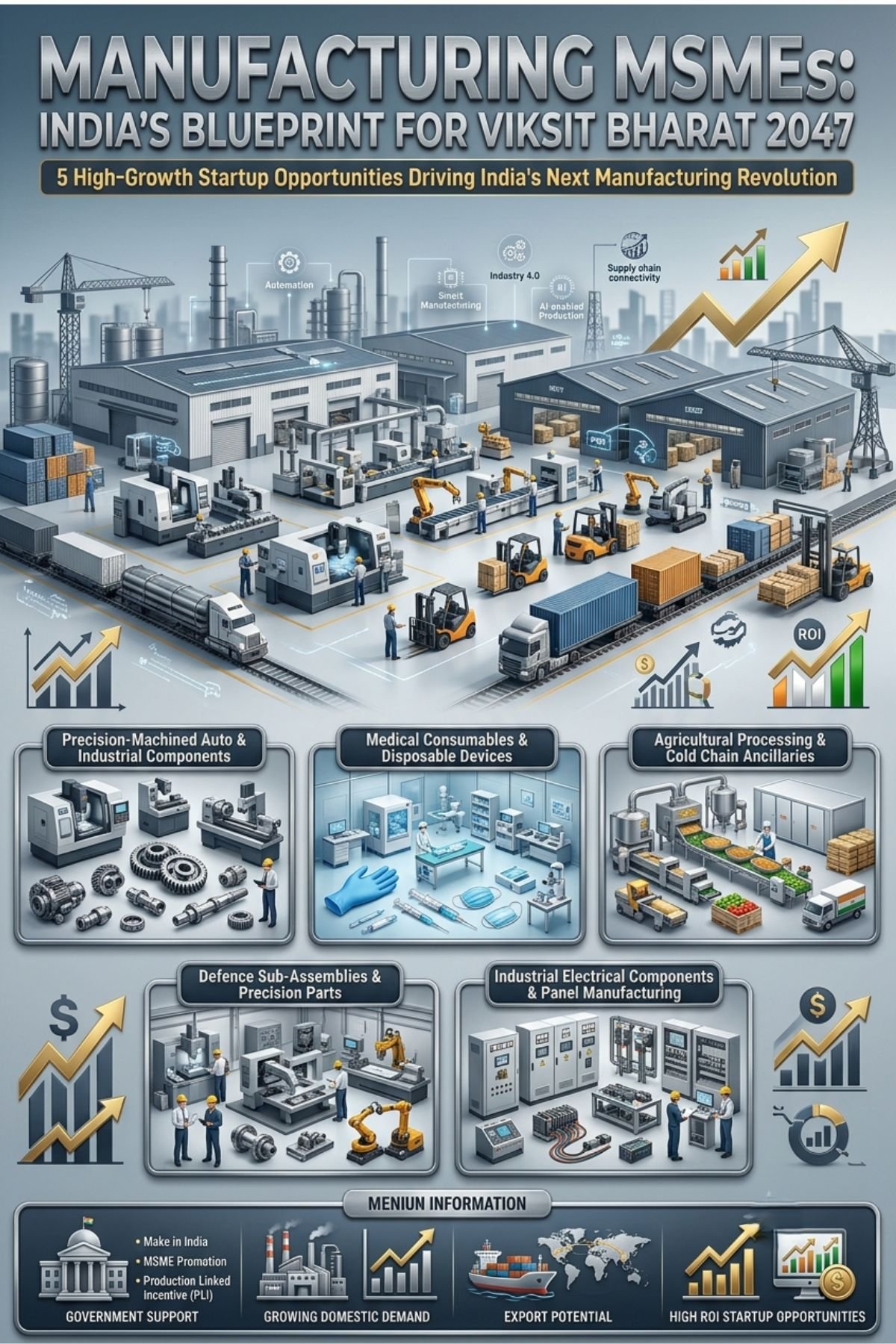
Idea 4: Defence Sub-Assemblies and Precision Parts
Defence indigenisation roadmap under iDEX and the Department of Defence Production has established long-term and stable order pipeline for MSMEs. Sheet metal enclosures, machined brackets, electronic sub-assemblies and fasteners for defence have quality premiums and provide multi-year contracts. Investment: Rs 100-250 lakh. Recommended training: DGQA standards.
Idea 5: Industrial Electrical Components and Panel Manufacturing
Electrical panels, junction boxes, cable management systems and control enclosures are essential for every new factory, infrastructure project, and data centre. Demand is structurally and repeatedly recurring. MSMEs can expand their business and become a part of the institutional tendering process on GeM in order to take the business growth initiative. Investment: Rs 50-120 lakh. Margin driver: standardised skus approach.(Manufacturing MSMEs in India)
Access Complete Business Plan: Electrical, Electronic Industries and Power Projects
Import-Export Opportunity Analysis for Manufacturing MSMEs
The export journey of manufacturing MSMEs in India is one of the most interesting stories of the recent times. The MSME exports increased from Rs 3.95 lakh crore in 2021 to Rs 12.39 lakh crore in 2025, which is three times the value in 4 years. This resulted in 1,73,350 MSMEs who were exporting in 2025. Not a small-scale activity. A mainstream growth engine.
There are three trade developments in 2026 that are opening new doors. Firstly, the India-Oman CEPA (which will include duty-free access for 99% of Indian exports to Oman – to be effective from June 1, 2026 – with gateway access into the Gulf, African and Asian markets). Second, the BRICS SME Working Group Meeting in May 2026 discussed technology access and digital inclusion for boosting MSME export competitiveness. Thirdly, the India-UK FTA, which will be under way in 2026, is likely to bring down restrictions on manufactured goods in a high-value consumer market.
DGFT export promotion schemes should be availed by the exporters for advance authorisation, export credit and duty drawback benefits. Exporters of agricultural and processed food products should sign up with APEDA for certification and market assistance.
The opportunity is just as tangible on the import side. India continues to import a large quantity of precision components, specialty chemicals and medical equipment. The manufacturing of MSMEs with quality that are competitive in cost is directly helping to tackle the import substitution gap of several lakh crore rupees per annum.(Manufacturing MSMEs in India)
Indian MSME Manufacturing Success Stories
It’s good to do abstract policy discussion. Evidence in the form of concrete examples is convincing. What Vinamra Mishra told ET is not a new idea for the manufacturing MSME landscape in India; there are several examples to prove it.
Bharat Forge — From Workshop to Global Forging Leader
Started as a small forgings factory in Pune, Bharat Forge has grown through judicious investments in technology, quality systems and global customer relationships. It is today one of the largest forging firms in the world and a direct supplier to automotive OEMs around the world. It’s a journey that shows that discipline in manufacturing, rather than market glitz, is what creates enduring value in an enterprise.
Suprajit Engineering — Auto Components at Scale
Suprajit Engineering had its humble beginnings as a small cable company in Bengaluru and expanded to become the largest mechanical cable company in the world. Its success was largely based on product focus, institutional client relationships and on an incremental rollout of its geographic presence. The case study clearly demonstrates that an MSME producing a commodity component can rise to be a global market leader.(Manufacturing MSMEs in India)
Women-Led MSMEs Rising
The share of women entrepreneurs in MSMEs has now increased to 20.5% of all MSMEs registered under the Udyam portal and they account for 18.73% of MSME employment. Women have been playing a major role in manufacturing ventures across various sectors such as food processing clusters, textile manufacturing in Tirupur and much more with government support under Stand up India and CGTMSE windows that are women-centric. This is one of the most under-reported growth stories in the Indian business today.
Identify high-growth industries before others do
How NPCS Helps Manufacturing Entrepreneurs Turn This Opportunity into a Funded Business
Reading the market signal is the first step. It needs professional preparation to become a funded and operational manufacturing business, and that is where Niir Project Consultancy Services (NPCS) can be a key partner to serious founders.
NPCS generates in-depth Market Survey cum Detailed Techno-Economic Feasibility Reports for hundreds of manufacturing industries. These reports are not theoretical documents. These are bankable instruments which include:
- Sourcing & Demand Analysis (Market Demand)
- How the plant is laid out, what the machinery specification is and where raw materials are sourced from. The layout of the plant, specification of the machinery and where raw materials are coming from.
- Comprehensive financial forecasts and IRR, NPV, break even analysis.
- All licensing, compliance and environmental clearance requirements are met
- Eligibility mapping for the Project in terms of Government Schemes. Eligibility mapping of the specific project in terms of Government Schemes.
A well-drafted NPCS report greatly enhances loan sanctioning and lessens execution risk. For entrepreneurs who are fresh to the manufacturing world and have to deal with intricate schemes and sector-specific regulations, NPCS acts as not only a report provider, but an experienced industrial advisor too.(Manufacturing MSMEs in India)
The current market – banks are actively looking for good MSME manufacturing borrowers, the government has the schemes completely funded and Economic Times is highlighting the importance of the manufacturing sector for India’s industrial future – makes a well-prepared DPR the best investment a new manufacturing entrepreneur can make.
Data Table: Manufacturing Sector Snapshot for MSME Founders (2026)
| Manufacturing Sector | Est. Investment | Demand Outlook | Key Support Scheme |
| Precision Engineering & Auto Components | ₹50–150 lakh | High — OEM & export demand | PLI, CGTMSE |
| Industrial Chemicals & Specialty Coatings | ₹80–200 lakh | High — import substitution | MSME Cluster Dev. |
| Agricultural Processing & Cold Chain | ₹40–120 lakh | Very High — domestic + export | PM Kisan Sampada |
| Medical Consumables & Surgical Devices | ₹60–180 lakh | Very High — healthcare boom | MSME-DFO support |
| Steel Fabrication & Infrastructure Parts | ₹70–160 lakh | High — capex supercycle | NSIC subsidies |
| Defence Components & Sub-Assemblies | ₹100–250 lakh | Rising — iDEX, Make in India | DDP incentives |
Source: Ministry of MSME, IBEF, Budget 2026-27, NPCS sector analysis. All investment figures are indicative entry-level ranges.
Frequently Asked Questions (FAQs)
Founder-focused answers to the most critical questions about manufacturing MSMEs and the Viksit Bharat opportunity.
Q1. What did Vinamra Mishra say about MSMEs and Viksit Bharat at Economic Times Manufacturing?
In a recent Economic Times Manufacturing interview, Vinamra Mishra, Joint Secretary at the Ministry of MSME, emphasised that the productive strength of manufacturing MSMEs will drive the vision of Viksit Bharat 2047. He stressed that small manufacturers are no longer support players — they are the primary engine of India’s industrial growth story.
Q2. Which manufacturing sectors offer the best startup opportunity for MSMEs in 2026?
Policy signals and market requirements predict precision engineering, consumables for the medical sector, agri-processing, defense components, and industrial fabrication will be the most vibrant segments. These align with policy initiatives such as the Production Linked Incentive (PLI) scheme, Make in India, and the PM Kisan Sampada Yojana.
Q3. What government funding is available for manufacturing MSMEs today?
The SME Growth Fund and the Atmanirbhar Bharat Fund allocated as much as ₹12,000 crore towards MSME growth capital. The CGTMSE, on the other hand, provide loans that extend a 10-crore collateral guarantee free loan. To help, there are additional loans through MUDRA loans, CGTMSE funds, the RAMP Scheme which provides further funding options and has already helped 51 lakh MSME in many regards
Q4. How can an MSME prepare a strong project report to access institutional loans?
Factors important for a successful application are – a sound and realistic demand forecast, reasonable assumption on costs, capital and future operating expenses, estimated working capital requirement, the contribution required from promoters, eligibility for various Govt. Scheme, a bankable DPR (Detailed Project Report) of the unit. Various organizations specializing in techno-economic viability reports and Detailed Project Reports (DPRs), such as firms under NPCS, offer expertise that helps banks evaluate entrepreneurs’ applications effectively.
Q5. What is the export opportunity for manufacturing MSMEs in 2026?
MSME exports are at $3.95 lakh crore on fiscal 2021 and projected to be $12.39 lakh crore on fiscal 2025. The bilateral trade and investment CEPA between the India and Oman will further bring in duty free access to theGulf on almost 99 per cent of exported goods and products for India from June, 2026. The Indian exporters can use services APEDA for agriculture goods and scheme like DGFT for other general merchandise.
Q6. What is NPCS and how can it help a first-generation manufacturing entrepreneur?
Niir Project Consultancy Services (NPCS) provides comprehensive Market Survey cum Techno-Economic Feasibility Reports for hundreds of manufacturing sectors. Their reports cover market outlook, plant layout, raw material sourcing, financial projections, and licensing requirements — making it easier for first-generation entrepreneurs to make informed investment decisions and secure bank funding.
Conclusion: The Signal Is Clear. The Window Is Open.
Economic Times Manufacturing carried a message this week that deserves far more attention than it has received. When a senior Ministry of MSME official publicly states that manufacturing MSMEs will build Viksit Bharat, he is not merely delivering a speech. He is describing a policy architecture that has already been constructed and funded.
The numbers support the claim. Eight-point-seven crore enterprises on the Udyam Portal. Rs 12,000 crore in fresh MSME growth capital. Loan delinquency at a five-year low. MSME exports tripling in four years. A new CEPA opening Gulf markets. New digital portals for procurement, dispute resolution, and market access. This is not a promise. It is an operating environment.
For manufacturing entrepreneurs, this is the rare convergence that textbooks describe but markets rarely deliver: strong demand, available capital, supportive policy, and a government publicly committed to sector success. The founders who act on this signal early — with a well-prepared project, a focused sector strategy, and professional feasibility backing — will build enterprises that are not just viable, but nationally significant.(Manufacturing MSMEs in India)
India’s Viksit Bharat journey has many chapters to write. As Economic Times continues to track its progress, the manufacturing MSME sector will appear again and again — not as a footnote, but as the foundation. The question for every founder reading this is simple: will your enterprise be part of that foundation?