


Introduction: Machine Tools Business India
India’s machine tools industry, which is sometimes referred to as the mother industry of manufacturing, is going through one of its strongest growth phases in decades. With a rapid growth in the automotive, electric vehicles (EVs), aerospace, defence manufacturing, medical devices, electronics, renewable energy, and heavy engineering, the requirement for advanced precision machineries has increased tremendously.
Machine tools like cnc machines, vertical machining centres (vmc), turning centres, grinding machines, edm systems, gear cutting machines, plastic processing equipment, special purpose machinery are now the backbone of modern manufacturing ecosystem of India. The capital goods sector contributes only 2% of India’s GDP yet it serves as an important driver for industrial productivity and industrial automation.
Unlike many heavy industries being dominated by large conglomerates, India’s machine tools industry is dominated by SMEs with an annual turnover range of between Rs 300-500 crore. This structure provides extraordinary opportunities for startups and new entrepreneurs to get into specialized manufacturing niches.
With 100% FDI allowed under the automatic route, no industrial licensing requirement and free technology imports and exports, India has designed one of the most entrepreneur-friendly environments for industrial manufacturing startups.
Read More: Modern Printing Technology
Why Machine Tools Market in India is Growing Rapidly
1. Manufacturing Modernization Across Industries
Indian manufacturing is fast moving towards precision engineering and automation. The automotive, defence, electronics and capital goods industries require advanced machining solutions which creates a high demand for machine tools that deliver exceptional performance.
2. Strong Support from Government Policies
India Policies promoting innovation and investment in manufacturing:
- No industrial licensing of machine tools production
- 100% FDI allowed automatically
- Free import of designs and drawings and advanced technologies
- No export restrictions
These policies lower the barriers to entry and promote both domestic and international collaborations.
3. Growth in High-Growth Industrial Sectors
Demand for machine tools is increasing on the basis of growth in:
- Components used in electric vehicles
- Plastic processing and packaging
- Defence manufacturing
- Earthmoving equipment
- Textile machinery
- Food processing equipment
- Heavy engineering
Each of these sectors requires precision machinery in their production.
Read More: Carbide Tips Inserts & Indexiable – Manufacturing Plant, Detailed Project Report, Profile, Business Plan, Industry Trends, Market Research, Survey, Manufacturing Process, Machinery, Raw Materials, Feasibility Study, Investment Opportunities, Plant Layout
4. Import Substitution Opportunity
India is still importing many high-precision CNC machines, gear cutting systems, EDM machines, and heavy-duty milling machines. Domestic startups that have the capacity to manufacture advanced machines have a great chance to reduce import dependency and tap local markets.(Machine Tools Business India)
5. Strengthening Domestic R&D
India has advanced engineering capabilities including:
- Lathes double column vertical turning CNC
- Die & mould machining centres
- Drilling machines, boring machines with deep hole drilling machines
- Horizontal bed-type milling machines
- VMCs with pallet changers
This increasing technological capacity gives start-ups the ability to produce globally competitive machinery within their own borders.
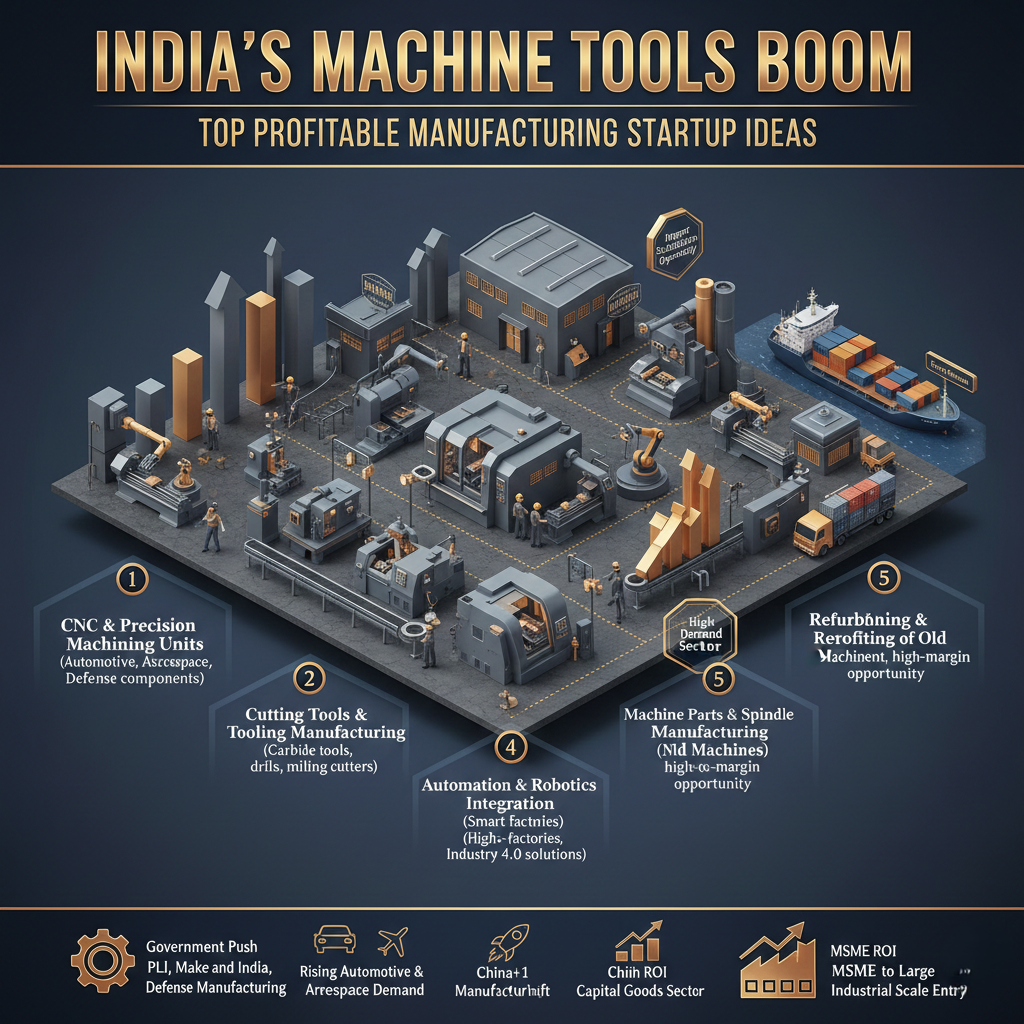
Best Profitable Machine tool & Precision Engineering Startup Ideas
1. Vertical Machining Centres (VMCs)
VMCs are indispensable in industries such as automotive, EV manufacturing, aerospace, defence, and medical devices. The need for inexpensive yet accurate machines is rapidly increasing in case of the SMEs.
Startups can begin their operations with 3-axis VMCs and then proceed to implement advanced capabilities which include automatic tool changers and pallet systems and high-speed spindles. The emerging markets of Africa and Southeast Asia present excellent opportunities for export development.
Read More: The Complete Technology Book on Textile Processing with Effluent Treatment
2. CNC Turning Centres & Vertical Turning Lathes (VTLs)
CNC lathes and VTLs have found many applications in the heavy engineering, railways, oil & gas and energy sectors manufacturing. Large turning machines have high margins and there is less competition in the domestic market.
Entrepreneurs can begin from the medium size CNC lathe machines and work their way up to special-purpose machines tuned for niche industrial applications.
3. Deep Hole Drilling & Boring Machines (CNC)
Industries such as aerospace, defence, nuclear engineering and hydraulic cylinders manufacture are dependent on deep hole drilling technology. Since there is relatively low competition and machines are highly specialized, startups can charge high prices and are able to focus on export markets.
4. Manufacturing of dies, moulds and press tools
India has a huge tool room ecosystem catering to the automotive moulding, electronics casings, plastic products and packaging industries. The production of injection moulds and die casting dies and sheet metal press tools serves as a profitable entry point into the precision engineering industry.
High-quality tooling made locally contributes to a relief from costly imports from Europe and East Asia.
5. Plastic Processing Machinery Production
With good growth in FMCG, packaging and household goods demand for injection moulding machines, blow moulding systems and extrusion equipment is also increasing.
Startups can first make auxiliary equipment such as material loaders, chillers and dryers, before progressing to full moulding machines through technology partnerships.
6. Grinding Machines & Gear Cutting Machinery
Precision grinding and gear cutting machines are essential for EV components, robotics and advanced automation. Indian startups can focus on the small and mid-size component manufacturers by creating cost-effective but high-precision solutions.
Automation-ready designs and integration with CNC will increase competitiveness in domestic as well as exports.
Read More: Opportunity: Large Startup Opportunity in the Emerging Indian Automotive Supplies Chain
7. Machines for EDM (Electrical Discharge Machining)
EDM Machines are used in tool & die industry, aerospace, defence components, medical implants etc. are the fields where EDM machines are commonly seen. There is a good opportunity for starting a business with wire-cut EDM machines for SMEs due to increasing demand for hardened alloys machining.
8. Food Processing Machinery Manufacturing
Startups that operate in mechanical engineering can develop food processing machinery which includes equipment for mixers and grinders and packaging systems and sorting systems. India’s rapidly growing food processing industry ensures a good domestic demand.(Machine Tools Business India)
Export Potential for Indian Machine Tools Manufacturers
India is becoming a global supplier of industrial machinery because of cheap prices, talented engineers and sound manufacturing capability.
Key Export Markets
- Africa
- Middle East
- Southeast Asia
- CIS countries
- Latin America
High-Demand Export Products
- CNC Lathes and Turning Centres
- Gear cutting machines
- Hydraulic presses
- Rolling mills, Bending: Bending machine
- Shearing machines, pressing brakes
India’s geopolitical location and emerging research and development capabilities make it an attractive industrial equipment manufacturing base for exports.
Read More: Top 3 Profitable Manufacturing Opportunities in 2026: Ferrosilicon, Vedic Paint & Bamboo Wood Pellets
Strategic Benefits of Machine Tools Startups in India
- Lower production costs compared with the Western countries
- Highly skilled engineering workforce
- Government incentives for manufacturing
- Growing domestic industrial demand
- Increasing global trust in Indian engineering products
Startups that are coming up in specialized niches with designs that are ready for automation and with good after-sales service can grow huge in both domestic and international markets.
Conclusion: Why Now Is the Best Time to Start a Machine Tools Business in India
The manufacturing revolution in India creates an extraordinary need for precision engineering solutions. The machine tools sector presents industrial entrepreneurs with one of the best business opportunities because of strong policy backing and growing technological capabilities and increasing global demand for cost-effective industrial machinery.(Machine Tools Business India)
Startups that operate in niche markets while developing new products and delivering top-quality engineering services will achieve substantial profit margins and sustained business growth and access to both domestic and export markets. Machine tools function as essential manufacturing machinery which enables India’s industrial expansion into the future.
Frequently Asked Questions (FAQs)
- Is machine tools manufacturing suitable for new entrepreneurs?
Yes. Most companies in this sector are SMEs, making it accessible for startups with technical expertise and strong planning. - What are the best startup products in machine tools manufacturing?
CNC lathes, VMCs, EDM machines, dies & moulds, grinding machines, and plastic processing equipment are highly profitable entry points. - How much investment is required to start a machine tools business?
Entry-level manufacturing setups can start around ₹1.5–3 crore, while advanced CNC manufacturing requires higher capital investment. - Are Indian machine tools exportable?
Yes. Many developing countries rely heavily on Indian industrial machinery due to its cost-effectiveness and reliability. - Does India allow foreign technology collaboration?
Yes. Technology transfer, foreign partnerships, and design imports are freely allowed in this sector. - Which industries create the highest demand for machine tools?
Automotive, EV manufacturing, defence, aerospace, electronics, heavy engineering, and plastic processing industries are the largest consumers.


