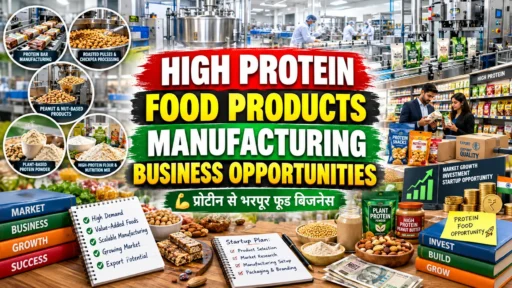
Low investment manufacturing business in India is rapidly gaining popularity as the manufacturing industry undergoes a major transformation. Today, entrepreneurs are shifting towards specialized manufacturing of agricultural, wellness, and plant-based products instead of traditional high-volume commodity businesses. With rising demand for natural products, strong government MSME support, and expanding export markets, low investment manufacturing businesses offer significant opportunities for small and medium manufacturers in India.
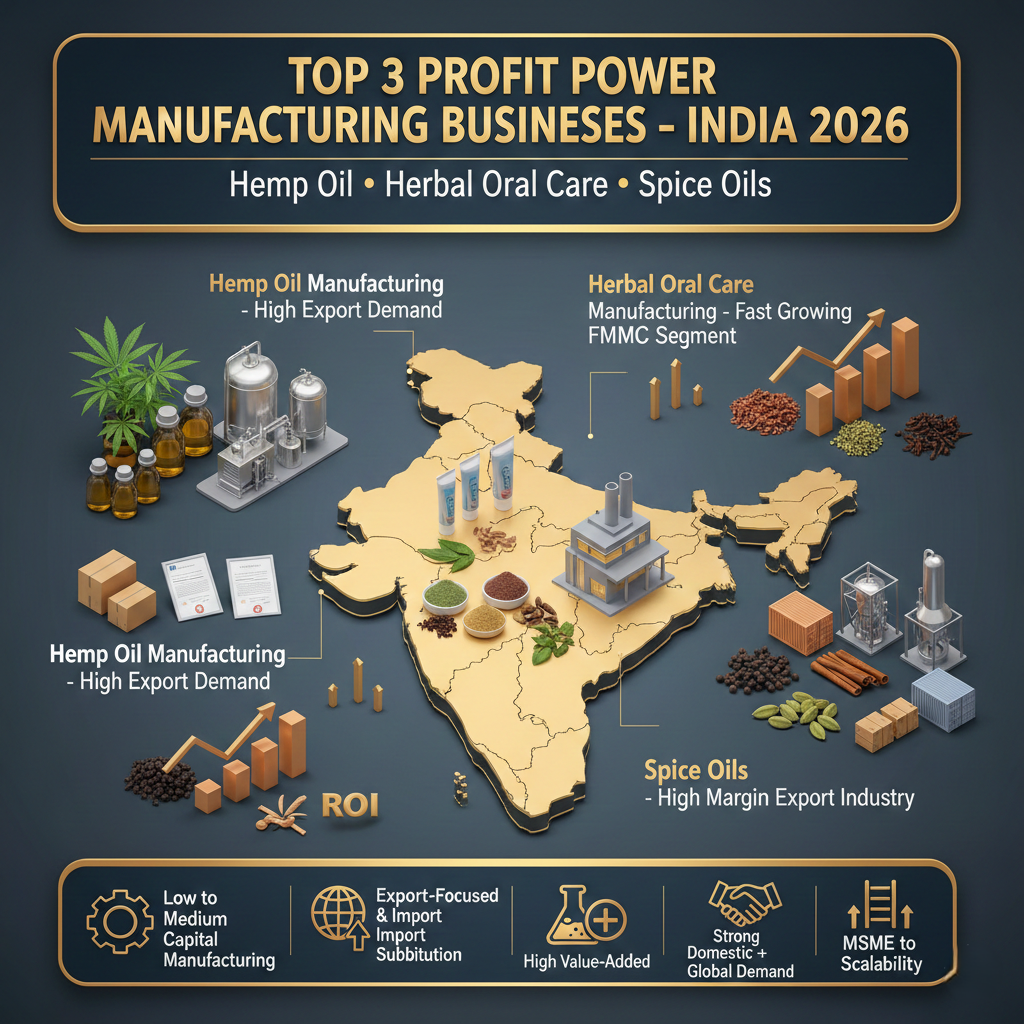
Among emerging segments, three categories of manufacturing stand out because of their high demand, the prospect of scalability and their profitability: hemp oil and extracts, herbal oral care products, and spice oils such as turmeric, paprika, and oil of onion. Every segment provides its unique advantages which help entrepreneurs who want to achieve long-term business expansion.
This article examines these manufacturing opportunities from a business perspective, including production processes, market demand, profitability, and entry strategies.
Read More: Handbook on Herbal Medicines (Ayurveda Cream, Oil, Pain Balm, Tablet, Herbal Capsules, Churna, Syrup, Medicines with Composition, Rasa Preparations with Production Process, Machinery, Equipment Details and Factory Layout) 2nd edition
1. Hemp Oil and Hemp Extract Manufacturing Business Opportunity.
Market Overview
Hemp oil and plant extracts are also becoming increasingly popular worldwide as consumers are making a shift towards plant-based nutrition as well as clean-label cosmetics and functional wellness products. Cold-pressed hemp seed oil is a common ingredient used in skincare and health supplements; hemp extracts are used in herbal wellness formulas and personal care products.
India’s hemp industry is yet in the early stages and this presents a first-mover advantage for those manufacturers who are interested in quality, compliance and export readiness.
Manufacturing Process
The production process usually starts with obtaining hemp seeds from licensed cultivators. Cold pressing is used for premium edible or cosmetic oils and advanced methods like CO2 extraction are used to extract concentrated extracts.
Important stages of key production include:
- Cleaning and sorting seeds
- Oil pressing or extraction
- filtration and purification
- Quality testing and compliance checks
- Packaging under controlled conditions
The organization needs to maintain three critical components for its future development THC limits and proper storage and regulatory compliance requirements.
Read More: Herbs and Herbal Based Products, Ayurvedic Medicines, Cosmetics, Herbs, Medicinal Plants Cultivation, Processing, Herbal Extract, Natural Plant Extracts, Ayurvedic Pharma, Ayurvedic Products, Herbal Medicine, Herbal Cosmetics, Ayurvedic Formulations
Demand Drivers
- Increasing consumer interest in natural wellness products
- Increasing numbers of vegan and plant-based nutrition
- Increasing use of hemp for cosmetics and skincare
- Strong export demand from Europe and South East Asia
Profitability Potential
Hemp oil manufacturing provides good margins because of the position of premiums. Cold pressed oil tends to have good returns, whereas extracts and value added formulations have the potential for much higher profitability from branding or B2B supply.
2. Herbal Oral Care Manufacturing: Coconut – Mint Toothpaste & Disclosing Tablets
Market Overview
India’s oral care market is more than 25,000 crore and is growing steadily. However, the quickest growth is occurring in herbal toothpaste and preventive dental products, due to growing health awareness and the preference for natural ingredients.(Low Investment Manufacturing Business India)
Coconut-mint is a toothpaste that is compatible with the herbal wellness trend and blueberry flavoured disclosing tablets are becoming popular with dentists, schools and orthodontic clinics for plaque detection.
Read More: Profitable Small Scale Industries- Money making Business Ideas for Startup (when you don’t know what industry to start)-2nd Revised Edition
Manufacturing Process
Toothpaste manufacturing includes the mixing of abrasives, herbal ingredients, natural oils and tastes in controlled blend machines, and then automated filling and packaging of the tubes. Disclosing tablets are manufactured on tablet compression machines that are similar to pharmaceutical equipment.
Typical production stages are:
- Mixing and formulation of ingredients
- Quality and hygiene testing
- Flavor stabilization
- Tube filling or compressing tablets
- Packaging and labeling
Consistency, hygiene standards and taste quality are key to retain consumer trust.
Demand Drivers
- Improving dental awareness programs
- Growth of herbal and fluoride free oral care products
- Institutional buyers such as clinics and schools
- Expansion of D2C Wellness Brands
Profitability Potential
Herbal toothpaste and diagnostic tablets have quite quick break-even compared to many manufacturing sectors. Institutional supply contracts can guarantee recurring revenue and steady cash flow.
3. Paprika, Turmeric, and Onion Oil Manufacturers
Market Overview
Spice oils are high value products for food processing, cosmetics, pharmaceutical, and herbal wellness industries. Turmeric oil provides medicinal advantages to users while paprika oil serves as a natural color and flavoring agent and onion oil appears in various hair care products.
As clean label food trends take off worldwide, spice oils are taking the place of synthetic flavors in premium products.
Read More: The $323 Million Opportunity: How Indian Exporters Can Dominate the Essential Oils Market
Manufacturing Process
Steam distillation is generally employed for the extraction of essential oils of spices and vegetables. For higher yields some manufacturers use solvent extraction.
Production steps include:
- Cleaning and drying raw materials
- Grinding or crushing
- Distillation or solvent extraction
- Filtration and storage
- Quality testing and packaging
The practice of integrating farmer sourcing methods enables businesses to achieve both quality standards and price stability.
Demand Drivers
- Worldwide demand for natural flavouring agents
- Spice oleoresins export markets
- Growth of herbal cosmetics
- Increasing popularity of organic and natural foods
Profitability Potential
Spice oil manufacturing can have very good operating margins (EBITDA margins) if we optimize operations. Export oriented units, especially of turmeric and paprika oil often get better returns because of international pricing advantages.
Policy Support & MSME Opportunity in India
Government initiatives from the Ministry of MSME and the Department for Promotion of Industry and Internal Trade have brought improvements in access to credit, technology upgrade and cluster development programs. These policies lower the entry barriers and assist new manufacturers to scale more quickly.
Entrepreneurs can benefit from:
- Subsidies and Start-Up Incentives
- Upgradation schemes in Technology
- Export promotion programs
- Skills development and training initiatives
Read More: Top 3 Profitable Manufacturing Opportunities in 2026: Ferrosilicon, Vedic Paint & Bamboo Wood Pellets
Important Lessons for Entrepreneurship from Success stories of Indian Manufacturers
Successful Indian FMCG and agro-processing leaders have shown that good control on the supply chain and emphasis on quality are key for long term growth. Organizations need to establish relationships with farmers while they implement production standards and comply with global market regulations before they can develop their operational capabilities.
New MSMEs should focus on:
- Raw material sourcing control
- Consistent product quality
- Market-driven product selection
- Gradual scaling rather than rapid expansion
Practical Advices for Manufacturing Startup Business Owners
- Start with modular equipment to reduce initial investment
- Focus on B2B supply before heavy branding
- Secure long-term raw material contracts
- Maintain strict quality control from day one
- Explore export markets early for higher margins
Conclusion
The future of Indian manufacturing will depend on specialized production methods that create value through product development instead of producing goods at high volumes. The hemp oil industry has strong export potential while herbal oral care products gain market traction due to increasing health awareness and spice oil production utilizes India’s agricultural resources to meet global demand for natural products.(Low Investment Manufacturing Business India)
Businesses in emerging sectors can achieve growth through three main elements: technical quality and dependable sourcing and market-responsive business operations. The opportunity involves establishing a factory but it requires building a production system that uses sustainable methods to meet market demand and adapts to evolving customer requirements.
Frequently Asked Questions (FAQ)
- Is small-scale manufacturing profitable in these segments?
Yes. Modular machinery and niche product demand allow small manufacturers to start lean and scale gradually while maintaining healthy profit margins. - Which manufacturing business has the fastest break-even?
Herbal toothpaste and spice oils typically achieve break-even faster than hemp extract manufacturing due to lower regulatory complexity and consistent domestic demand. - Do I need heavy branding to succeed?
Not necessarily. Many manufacturers begin with B2B supply to cosmetic brands, food companies, or dental institutions, reducing marketing costs. - Are exports necessary for profitability?
Exports are not mandatory but significantly increase margins, especially for hemp extracts and spice oils. - What is the biggest operational risk?
Inconsistent raw material quality. Long-term contracts with farmers or trusted suppliers help maintain product consistency. - Which sector has the highest long-term growth potential?
All three sectors show strong growth, but hemp and herbal oral care products are expanding rapidly due to global wellness trends.(Low Investment Manufacturing Business India)