Khadi business ideas in India MSME (Micro, Small, and Medium Enterprises) sector is full of opportunities but profitability in the long run comes when entrepreneurs concentrate on demand that is validated, the level of entry barriers that are manageable, and growth that is sustainable. Of these, Khadi is a commercially viable and resistant business model. Once thought of as mainly a cultural or social initiative, Khadi has become a market linked, digitally enabled and institutionally enabled ecosystem. Today, it is allowing MSMEs the opportunity to blend tradition with profitability, scalability and growth over time.
Khadi works as MSME opportunity because the welfare of cost efficiency, stability of demand and scalability of growth. Decentralized production and low energy consumption ensures fixed costs are manageable, and low exposure to fluctuating electricity prices. At the same time, Khadi has good institutional as well as retail and export demand. Unlike trend driven industries, Khadi is an industry in a naturally pull-driven market with the support of ethical consumerism, government procurement and acceptance in the global market.
Read More: Oxalic Acid from Molasses – Manufacturing Plant, Detailed Project Report, Profile, Business Plan, Industry Trends, Market Research, Survey, Manufacturing Process, Machinery, Raw Materials, Feasibility Study, Investment Opportunities, Cost and Revenue
Market Reality: The Truth about Khadi
The commercial relevance of Khadi is quite evident from the sectoral data:
- Annual value of production: ₹1.16+ lakh crore
- Total sales turnover :-Rupees 1.45+Lakh crores
- Artisans engaged: 49+ Lakh with ~80% women workforce
- Export footprint: 100+ countries
- Organized retail outlets: ~3,000
- Digital contribution: Growing at a rapid rate
These numbers prove that Khadi is economically important, employment intensive and capable of helping structured MSME growth.
Entry Points within Khadi Value Chain
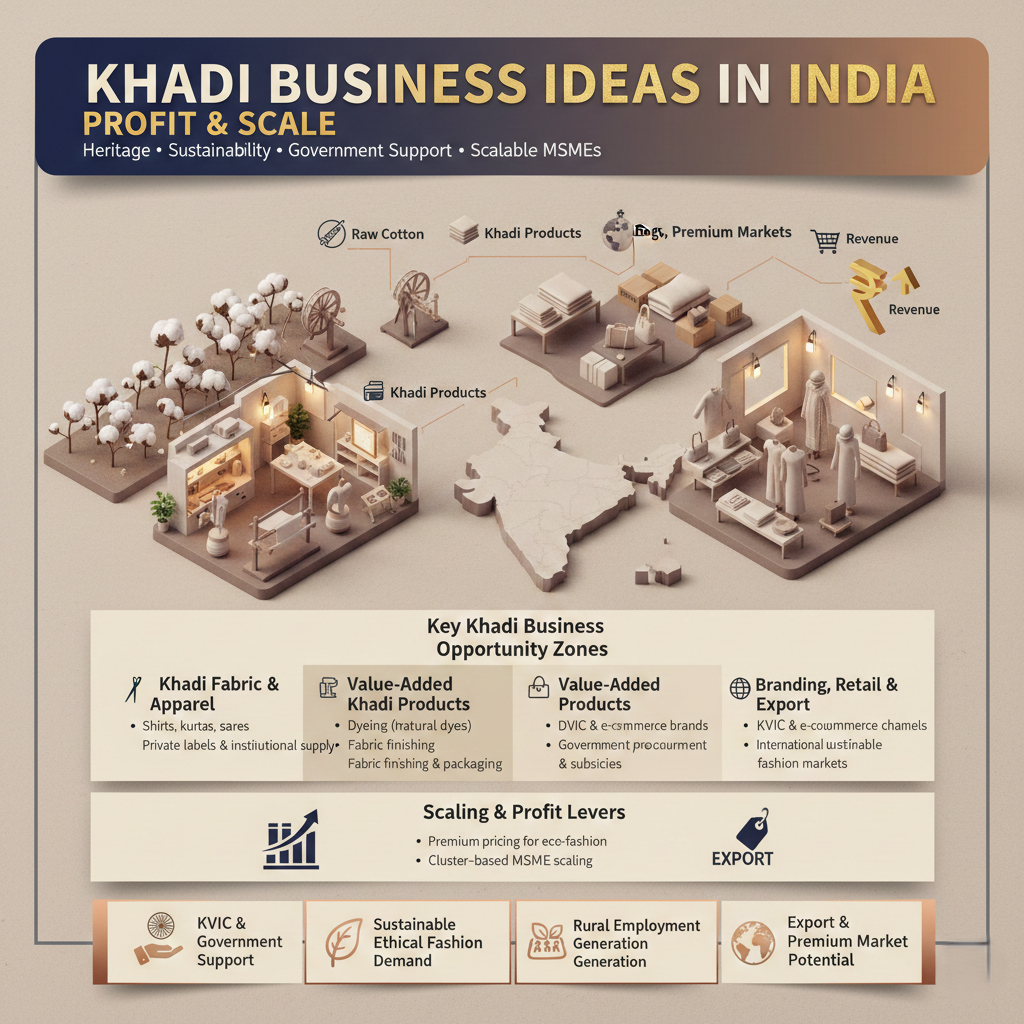
Many entrepreneurs believe mistaken that the manufacturing of Khadi is restricted to spinning or weaving by hand. In fact, MSMEs are able to earn money from several points in the value chain. Units that specialise in stitching, finishing, dyeing, garmenting and customising product often have higher margins than raw fabric production. By capturing value closer to the end consumer, businesses can ensure moderate capital investment with higher returns.(Khadi business ideas in India)
The success in manufacturing khadi depends less on automation and more on process discipline and standardization of the quality and the process optimization – in which small and medium enterprises can compete well without a huge scale.
How Khadi MSMEs Generate Profitability
Profitability is coming more from positioning/value addition than pure volume. Fabric suppliers are stable, but thin margin operations, whereas integrated units that bring together manufacturing and branding, private labels, institutional contracts, or export channels have much higher contribution margins.
Key advantages include:
- Low operational volatility caused by low electricity dependence and import dependency
- Predictable cash flows, particularly where sales are diversified for retail, institutional and digital
- Stronger financial footing than fashion oriented textile startups
Read More: TEXTILE WEAVING MILL – Manufacturing Plant, Detailed Project Report, Profile, Business Plan, Industry Trends, Market Research, Survey, Manufacturing Process, Machinery, Raw Materials, Feasibility Study, Investment Opportunities, Cost and Revenue
Branding: Unlocking Growth Potential
Branding is a factor that is often neglected but is the key to scaling Khadi MSMEs. Modern consumers are attracted by authenticity, sustainability and lifestyle differentiation, not by nostalgia. Enterprises focusing on modern design, professional packaging, regular packaging size and communication story can turn Khadi from a commodity to a high-end commodity.
Some examples from the industry illustrate this principle:
- Ratan Tata – “According to a McKinsey & Company study – ‘Reliability, integrity, trust-based branding, and ethical sourcing'”
- Nandan Nilekani demonstrated how digital infrastructure can help scale decentralized ecosystems
For MSMEs, these lessons teach that manufacturing alone is the way to produce products, but branding builds businesses.
Khadi MSMEs & International Opportunities
Khadi products are in line with the worldwide trends towards ethical sourcing, traceability, and low-carbon manufacturing. This opens up opportunities in:
- Exporting apparel and home furnishing and lifestyle products where pricing is value-driven
- Domestic import substitution through substitution of synthetic or blended substitutes in institutional procurement
This dual advantage provides strength in the long-term growth prospects and stability.(Khadi business ideas in India)
Read More: Integrated and Composite Textile Unit – Manufacturing Plant, Detailed Project Report, Profile, Business Plan, Industry Trends, Market Research, Survey, Manufacturing Process, Machinery, Raw Materials, Feasibility Study, Investment Opportunities
Opportunities for High Potential Khadi MSMEs
Some of the most profitable Khadi based MSME ventures are:
- Apparel & Garment Manufacturing: High-end, branded institutional and private label apparel and garments, as well as for export
- Home Furnishing & Decor, curtains, cushions, upholstery, table linens have higher per-unit margins and less seasonality risks
- Natural Dyeing & Processing Units: Increases a critical gap in sustainable textiles and caters to multiple producers
- Personal Care & Wellness Products: Soaps, cosmetics, footwear, wellness products enjoy consumer confidence and repeat business
- Digital Aggregation & Private-Label Platforms: Asset light models facilitating producer-buyer connectivity on the internet and enabling quick scaling
Risks MSME Founders Should Expect
While the businesses of Khadis are promising, it is not risk-free. Common challenges include:
- Maintaining quality across decentralized production
- Keeping designs market-relevant
- Managing working capital during scale-up
These risks are operational rather than structural in nature and can be mitigated through professional planning, realistic capacity assessment and disciplined financial control.
Read More: Self-Cleaning Clothes: The Nanotechnology That Could End Laundry Forever
Feasibility-Driven Planning
It is necessary to have structured planning for turning the Khadi opportunities into sustainable businesses. Detailed feasibility studies should include:
- Market surveys and demand analysis
- SAP manufacturing process planning software: – 1.Manufacturing process planning and workflow optimization
- The machinery, raw materials and regulatory compliance
- Financial projections including breakeven, ROI
This ensures that cultural value goes alongside commercial logic, risk assessment and scalable business strategy.
Read More: 10 New Manufacturing Business Opportunities in India for Startups and MSMEs
Conclusion
Khadi is no longer just a representative cultural product, it is a commercially viable MSME platform. Entrepreneurs who integrate the discipline of feasibility, good branding and structured scale-up planning can build businesses that are profitable, resilient and scalable. From stitching tiny units to export-oriented lifestyle brands, Khadi provides an unusual chance to combine tradition with modern business strategy, creating companies that have performed well in India’s long-term industrial landscape.(Khadi business ideas in India)
FAQs: Khadi MSMEs
Is Khadi suitable for first generation entrepreneurs?
Yes. Entry barriers are moderate and the institutional frameworks provide stability.
What is the Range of Typical Investment?
Small to mid-scale projects can be kicked off and grown organically based on traction from the market.
Can Khadi MSMEs grow nationally or internationally?
Absolutely. The digital commerce and export demand underpins the domestic and global growth.
How soon can it be made profitable?
Operational breakeven is possible within a reasonable period of time, especially with institutional or export contracts.
Is long-term demand secure?
Yes. Sustainability, ethical consumption, and domestic manufacturing preferences represent structural demand forces.