

A Ksh 2.4 Billion Signal That Entrepreneurs Cannot Afford to Miss
Kenya is betting big on industry for the first time in decades. The government has invested Ksh 2.4 billion so far in the development of County Aggregation and Industrial Parks (CAIPs) in all counties and the first eight are almost ready to open their doors. The counties, among them Kisii, Embu, Migori, Meru, Kirinyaga, Busia, Garissa and Wajir are in the construction process with procurement of common-user facilities already under way, Kenyans.co.ke reported.
It’s not a dream promise by a distant policy. On August 26, 2026, the Deputy President announced the mobilization of raw materials, completion of investor frameworks, and upcoming operationalisation. It is a starting gun, not a press release for entrepreneurs, manufacturers, MSMEs and startup founders.
The parks are meant to achieve one thing: the shift away from the traditional export of raw agricultural produce and towards value addition. Such a change can open a huge and timely business opportunity for early movers.
What Recent Reporting Means for Entrepreneurs and Investors
On August 26, Deputy President Kithure Kindiki personally checked the status of the CAIPs programme and confirmed that the parks in Meru, Embu, Kirinyaga, Kisii, Busia, Migori, Garissa and Wajir are almost completed. Common user facilities (machinery, cold stores, processing lines, shared infrastructure) are being purchased. Private-sector investment mechanisms are also in development.
This is particularly important in reality:
Shared industrial facilities make it far more affordable for entrepreneurs to engage the manufacturing business. No need to invest in a processing plant, as one is available within the park.
For MSMEs, aggregation infrastructure translates to finally being able to gain access to export grade supply chains for your farm/small production unit.
It reduces input logistics expenses for manufacturers, such as the tea producers in Meru and Kirinyaga, fish farmers in Migori, livestock farmers in Garissa and Wajir.
Government financing of infrastructure projects translates to reduced investment risk. You fund operations and not construction.
Value-added processed products fetch much higher international price as compared to raw commodities in the case of the exporters. This is Kenya’s game of shifting to the next level in the global value chain.
Investors who visit these parks before they open will gain the optimum floor space, lease dates, and first-mover benefits.
Why This Industry Is Growing: Kenya’s Structural Shift Toward Value Addition
Kenya’s agriculture accounts for about 33% of GDP and close to 40% of the formal labour force, but over the years, the country has exported the bulk of its agricultural products in their raw form. The leaves are sent to overseas tea factories. Coffee cherries—auctioned green. The poor cold chain management leads to the loss of horticultural produce value.
The government’s most structured approach to redress this structural imbalance is the CAIPs programme. President Ruto said explicitly his government will invest in agro-processing, modern markets and cold rooms to increase farmers’ incomes and open up new markets abroad.
There are three forces driving this trend:
First and foremost, an increase in the home market. The urban middle class in Kenya is now on the rise and the demand for packaged, processed and branded food products has increased compared to raw commodities.
Secondly, export market needs. EU, Middle East and Asian markets are becoming more and more demanding for certified value-added processed products. Barriers to raw commodity exports are increasing in terms of quality and sustainability.
Thirdly, government infrastructure investment. Parks that are shared lower the threshold for SMEs to enter the manufacturing sector, providing a wide entrepreneurial entry point that was not available before.
Government Policies, Incentives, and Support Frameworks
The CAIPs programme sits within Kenya’s broader Bottom-Up Economic Transformation Agenda (BETA). Several government bodies and policy frameworks directly support entrepreneurs entering these parks:
- Kenya Industrial Estates (KIE) — Provides financing, workspace, and business development support for industrial SMEs.
- Kenya Revenue Authority (KRA) — Administers manufacturing incentives including VAT remissions on plant and machinery.
- Export Processing Zones Authority (EPZA) — Facilitates export-oriented manufacturers with tax holidays and streamlined licensing.
- Kenya Export Promotion and Branding Agency (KEPROBA) — Assists Kenyan producers in accessing international markets and building export capacity.
- Kenya National Chambers of Commerce and Industry (KNCCI) — Connects manufacturers and entrepreneurs with trade networks and business facilitation.
- Micro and Small Enterprise Authority (MSEA) — Offers capacity building, registration, and market linkage for micro and small enterprises.
- Kenya Investment Authority (KenInvest) — Guides foreign and domestic investors through registration, incentives, and site selection within Kenya’s industrial zones.
- Kenya Bureau of Standards (KEBS) — Essential for product certification for both domestic retail and export channels.
- Ministry of Investments, Trade and Industry (MITI) — The lead ministry overseeing industrial policy, CAIPs programme management, and private-sector investor frameworks.
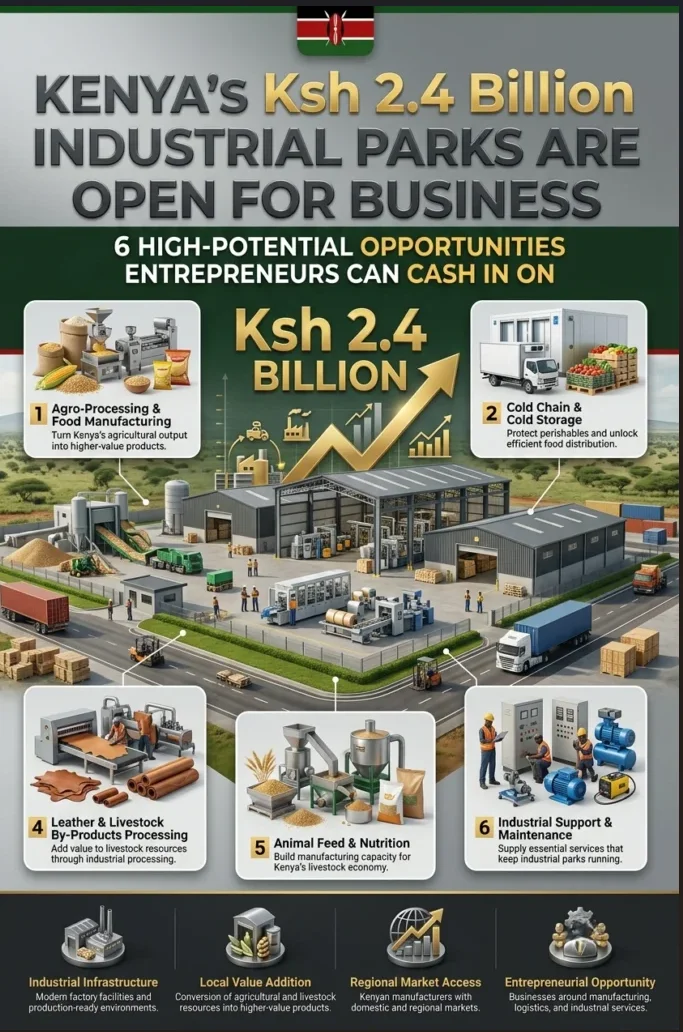
Manufacturing Business Opportunities Directly Unlocked by the CAIPs Programme
All the business opportunities below are directly supported by the infrastructure, locality and aggregation model of the CAIPs reported by Kenyans.co.ke
1. Agro-Processing and Food Manufacturing
Value addition on locally produced raw materials is the basic function of the CAIPs. Kisii is a major banana and avocado growing area. Embu and Meru are in Kenya’s tea and coffee growing areas. Migori is surrounded by a large fishing area. A raw material supply base is effectively underneath each park waiting to be processed.
These are specific opportunities such as banana flour and chips, dried fruit and vegetable processing, coffee grinding and packaging, and fish filleting and smoking. These products are priced 3-10 times higher than their raw products at domestic retail and export markets.
Read the Complete Book Here: Handbook on Fruits, Vegetables & Food Processing with Canning & Preservation
2. Cold Chain Infrastructure and Cold Storage Services
Cold rooms are a priority feature of the government’s CAIPs, both in parks and as part of modern markets. Storage is a constant constraint in the horticulture and dairy value chain in Kenya.
Cold chain service businesses can be developed on or close to the parks providing cold chain facilities to the tenants of the park on pay-per-use or lease basis. This is a supporting services model and therefore does not carry the risk of commodities prices but does benefit from the fact that they are getting a proportional share of each tenants’ production volume.
Related Article: A Comprehensive Analysis of Budget Allocation in Cold Chain Infrastructure: Key Insights
3. Packaging and Contract Packaging Services
Packaging is required for processed products to go to the retail or export market. A contract packaging operation – providing labelling, Tetra Pak alternatives, flexible pouching or rigid container packing – can provide packaging services for several park tenants at the same time, thereby sharing the cost of equipment among a number of clients.
As standards of certification by KEBS get more rigorous and enforced by food exporting market countries, packaging skills are becoming an essential, not optional, element in the commercialization of food.
Check Out This Recommended Book: Handbook on Modern Packaging Industries
4. Leather and Livestock By-Product Processing
Garissa and Wajir are part of Kenya’s livestock belt which is the country’s driest and most arid, and where livestock density is the highest. However, Kenya has a considerable import of finished leather products on an annual basis.
The CAIPs in these counties enable an integrated livestock value chain play: hide collection, tanning, leather processing and finished goods manufacturing (belts, bags, footwear components). The government has organised the activation of raw materials, thus logistics of the supply chain is being addressed at the programme level.
Get Detailed Project Report (DPR): Leather Manufacturing and Leather Products
5. Animal Feed and Nutritional Supplement Manufacturing
Crop residue facilities such as maize stover, bean husks and rice bran can support an animal nutrition manufacturing facility. The demand for quality compound feeds is structurally strong due to high stocking rates in the target counties and the growth of dairy farming activities in Kirinyaga and Embu.
It is a relatively low capital investment business with a steady local market with increasing demand due to better livestock husbandry practices.
Access Complete Business Plan: Animal Feed Manufacturing Using Date Pits
6. Industrial Support and Maintenance Services
All industrial parks require equipment maintenance and calibration, supply of spare parts, electrician contracting and industrial safety compliance services. These B2B services run on stable service contracts instead of on commodity market fluctuations.
Technically inclined entrepreneurs can start a maintenance and industrial services firm within or near a CAIP cluster with the added benefits of a built-in market from the outset of park operations, with few risks involved.
Import–Export Opportunity Analysis
Kenya’s CAIPs are specifically aimed at bringing about a change in the country’s trade landscape from exporting raw commodities to exporting processed commodities. This gives rise to multiple trade opportunities:
Export Markets
The European Union continues to be Kenya’s biggest market for their horticultural produce, while demand for certified organic, traceable and value-added products continues to grow. The Kenyan producers can shift from commodities to premiums in processed avocado oil, specialty coffee blends, freeze dried fruits and packaged chilli products.
Imported processed food, leather goods and packaged food commodities are among the items that are imported to the Middle East, including the UAE, Saudi Arabia and Qatar to a large extent. Kenya’s engaging with and rapidly developing diplomatic trading ties makes the Kenyan CAIP manufacturers more competitive in certain categories.
Import Substitution
Currently, Kenya imports processed tomato products, packaged pulses, refined vegetable oils, and various processed meat products. Local producers could make these products by using raw materials from the CAIP catchment areas. The potential domestic market opportunity for import substitution in these categories alone is multi-billion shillings.
International demand and trade
The African Continental Free Trade Area (AfCFTA) gives Kenyan manufacturers special access to the 54-country market. Manufacturers using the CAIP will have a head start in being able to meet the quality standards that lead to KEBS and international quality certificates and therefore provide goods to buyers in the region of East and Central Africa without tariff obstacles.
African and East African MSME Success Stories in Similar Sectors
There are several examples of MSMEs in East Africa that show that with similar infrastructure and support from the government, it is possible to achieve this:
1. Pwani Oil Products (Kenya)
Pwani Oil was once a small edible oils producer in Mombasa and expanded rapidly to cater for the domestic retail market as well as the export market. It shows how a commodity processing enterprise, when combined with branded and quality certified products can create a substantial industrial enterprise from the East Africa region.
2. Mama Fresh (Ethiopia/East Africa)
Mama Fresh was a local production company that grew into a regional export company that provides Ethiopian flatbreads (injera) to the Ethiopian diaspora in Europe and North America. It shows that culturally-specific processed foods can be exported in large quantities with stable production facilities.
3. Kibo Group / Musim Mas Regional Partners (East Africa)
Partnerships in agri-processing through the use of contract manufacturing, which involves a single processing unit supporting several agricultural co-operatives, have demonstrated the possibility of developing sustainable, bankable businesses in the region. This is exactly the model set to be put in place at the county level in Kenya by CAIPs.
Your investment deserves the right opportunity
About Niir Project Consultancy Services (NPCS)
Niir Project Consultancy Services (NPCS) is one of the most experienced industrial consultancy firms of Asia, specializing in providing support to entrepreneurs, MSMEs, manufacturers and investors of Africa and South Asia countries and emerging markets.
NPCS provides:
Detailed Project Reports (DPRs): These pre-investment reports include information on technology, machinery, raw materials, plant layout, financial estimates, and regulatory requirements, which are crucial for bank financing and investor presentations.
Market-specific analysis to determine the feasibility of a manufacturing project at a site.
Market Research: Primary and secondary data of demand, competition, pricing and growth trends of target product categories.
Technology Consultancy: Selection, sourcing and evaluation of manufacturing technology and process engineering in new plant set up.
Entrepreneurs who want to explore manufacturing opportunities enabled by CAIP will likely find a professionally developed DPR essential for securing bank financing or obtaining approval to lease space in a CAIP park.
Industry Intelligence at a Glance
| Parameter | Details |
| Industry | Agro-processing, Cold Chain Logistics, Light Manufacturing, Industrial Infrastructure |
| Market Driver | Kenya government’s KSh 2.4 billion CAIPs programme targeting 47 counties |
| MSME Opportunity | Shared manufacturing facilities, value addition, agro-processing, cold storage services |
| Export Potential | Processed agricultural produce to EU, Middle East, Asia; tea, coffee, horticulture derivatives |
| Government Support | KSh 2.4B CAIPs funding, common-user facilities, private sector investor frameworks |
| Risk Level | Low–Medium (government-backed infrastructure; commodity price sensitivity) |
| Growth Outlook | Strong — 47 counties targeted; first 8 parks near operational in 2026 |
Conclusion: The Industrial Parks Are Being Built — The Question Is Whether You’ll Be Inside Them
The CAIPs programme in Kenya is a structural shift in industrialisation. KSh 2.4 billion CAIPs programme in Kenya represents a structural shift in industrialisation. The eight parks are on the verge of being operational. Raw materials are brought to life. Private sector mechanisms are being developed. This isn’t a plan; it’s an activation, Kenyans.co.ke reports.
The opportunity for entrepreneurs, manufacturers and investors to get ready ahead of full park operationalisation is limited. First movers will be able to secure the best terms for their tenancy, have established relationships with local farmers before the competition heats up and start to export processed goods while others are still making their arrangements.
The business case is evident that reducing capital costs is possible by leveraging common infrastructure, demand creation through the government, a commodity based raw material base and a programme specifically geared towards inclusion of MSMEs within industrial grade supply chains.
Make a business plan. Have a feasibility study performed. Please register your interest at KenInvest and MITI. Kenya’s future industrial parks are being constructed today — so the question is whether your business is going to be a part of them when the gates open.