Introduction: IV Fluids Manufacturing Plant
The Intravenous (IV) Fluids industry is one of the most imperative parts of the whole healthcare system in the world. IV fluids are used in hospitals and medical facilities to keep the body hydrated, restore the electrolyte balance in the body, and provide life-saving treatments to patients. Because these fluids are administered directly into the bloodstream, they are known as critical medical products and therefore need to be available in any healthcare institution.
Unlike the demand of many pharmaceutical products that depend on the wants of consumers or the passage of certain seasons, IV fluids are considered to be essential medicines. Their demand is constant since they are needed daily by hospitals for emergency treatments, operations, trauma care, dialysis therapy and stabilization of patients in intensive care units.
India’s healthcare sector has been growing at a rapid pace for the last decade. With the rise of hospitals, government healthcare schemes, and private medical institutions has increased the requirement for IV fluids substantially. This has opened up a lucrative industrial opportunity for pharmaceutical entrepreneurs who are interested to enter the field of IV Fluids Manufacturing Plant .
Read More: IV Fluid (Intravenous Fluid) Market (Southern and Eastern African Countries) Growth Rate, COVID Impact, Size, Share, Trend, Drivers, Competitive Landscape, Opportunity, Limitations, Regulatory Framework, PESTEL Analysis, Forecast upto 2030
IV Fluids Market Outlook: Global
The global IV fluids market is anticipated to reach USD 18 – 20 billion by 2026 with a compound annual growth rate of around 6 – 7 percent. The expansion of this market is strongly tied to improvement in healthcare infrastructure and the growing need for hospital-based treatments.
Several major trends are impacting the global requirement for IV fluids.
- The number of surgical procedures is on the rise throughout the world because of the advancement of medical technology.
- Excessive sedentary lifestyle and unhealthy habits: Chronic diseases – Increasing age, diseases like diabetes, kidney disorders, cancer, etc. are increasing.
- Due to aging populations in developed countries, medical care and hospitalization is of a higher need than ever.
- Government in emerging economies investing in healthcare infrastructure is at a high level.
- Dialysis and oncology treatments are on the rise worldwide.
Among all the regions, Asia-Pacific is the fastest growing market and this is mainly attributed to the growth of hospitals and increasing healthcare spending in countries such as India and China.
Indian IV Fluids Market Analysis
India has emerged as one of the major healthcare service providers in the world. As healthcare services expand throughout the country, the need for hospital consumables such as IV fluids keeps growing steadily.
The current Indian IV fluids market is around a market of around Rs 4500 – 5000 crore annual volume, with an estimated year-over-year growth of between 7-9 percent. This growth is being supported by both public and private sector healthcare growth.
Some of the factors contributing to the demand of IV fluids in India are:
- The country has over 70,000 hospitals and nursing homes all over the country.
- Private hospital chains are going big in Tier II and Tier III cities.
- The Government healthcare schemes like Ayushman Bharat have led to more hospital admissions.
- Emergency and trauma care facilities are growing at an exponential rate.
- Due to healthcare reforms, institutional deliveries are taking place in hospitals.
These developments are greatly contributing to the amount of IV fluids used on a daily basis across healthcare facilities.
Read More: IV Fluids, I.V. solutions, Intravenous fluids, Normal Saline (NS, 0.9NaCl, or NSS), Lactated Ringers (LR, Ringers Lactate, or RL), Dextrose 5%, Normal Saline (Half Normal Saline, 0.45NaCl, .45NS), IV Fluids & Dialysis products – LVP/SVP Volume Parenteral
IV Fluids Consumption in India
India consumes around 3.5 to 4 billion bottles or bags of IV fluids annually which makes it one of the largest markets of IV fluids in the world.
IV fluids that are most commonly used include:
- Normal Saline (0.9% Sodium Chloride) Used for hydration and electrolyte balance
- Ringer Lactate – commonly used in surgeries and trauma treatment
- Dextrose Solutions – provides energy and treat low blood sugar
- DNS (Dextrose Normal Saline) – mixture of glucose and saline
- Mannitol Injection – used in neurological treatments, brain injury cases
- Specialized Electrolyte Solutions – used for ICU and critical care treatments
These fluids are used in hospitals, nursing homes, trauma canters, and healthcare clinics located in rural areas.
Import and Export Trends
India has emerged as a major exporter of pharmaceuticals such as IV fluids. Indian manufacturers, then, export these products to several international markets where the demand for affordable healthcare products is rapidly increasing.
Major export destinations are:
- Africa
- Southeast Asia
- Middle East
- Latin America
Indian pharmaceutical companies have been competitive in the global markets due to their ability to provide good quality products at lower manufacturing costs. Many manufacturers also operate under internationally recognized standards such as WHO-GMP certification which improves export opportunities.
Although India produces most of the standard products of IV fluids, certain specialized products and raw materials are still imported. These include large-bore parenteral nutrition fluids, specialized infusion bags and high grade medical plastics. This situation creates opportunities for local manufacturers to develop domestic production capabilities.
Read More: Production of I.V. Fluids (Saline and Dextrose). Intravenous Solution (IV) Manufacturing Business with Blow-Fill-Seal (BFS) Technology.
Production Economics and Industrial Viability
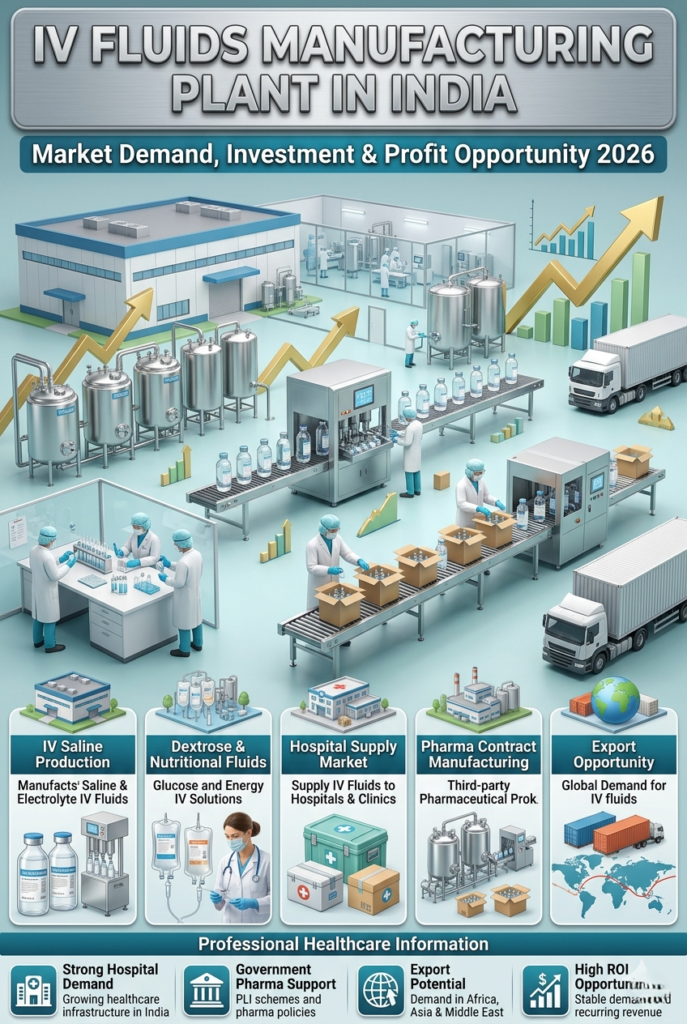
IV Fluids manufacturing is regarded as a high-volume pharmaceutical business. The manufacturing plant needs both operational efficiency and automated systems together with dependable hospital demand to achieve its profit targets.
A typical medium scale IV fluids manufacturing plant has the following features:
- Annual production capacity of 20 – 40 million bottles or bags
- Investment requirement ranging from 18 crores to 35 crores
- Automated filling and sealing lines for sterile packaging
- Cleanroom facilities are GMP compliant
The operating margins of manufacturers at their maximum production capacity with effective production methods reach between 12 to 18 percent.
Institutional supply contracts with hospitals and government healthcare programs play an important role in maintaining consistent production volumes.(IV Fluids Manufacturing Plant )
Major IV Fluids Manufacturers of India
The Indian IV fluids industry comprises multinationals like pharma companies and also domestic manufacturers. These companies provide products to hospitals, healthcare institutions, and the international market.
Some of the top manufacturers of IV fluid in India are:
- Baxter India Pvt. Ltd.
- Fresenius Kabi India Pvt. Ltd.
- Shepherd, A. Stephen, and H. Wendy, eds. Otsuka Pharmaceutical India Pvt. Ltd.
- Amanta Healthcare
- Nirma Group, Aculife Healthcare Pvt. Ltd.
These companies dominate the supply chain of large hospitals and para-exporters. However there is still room for the regional manufacturers who focus on supplying local hospitals and government tenders.
Read More: Drugs and Pharmaceutical Based Manufacturing Business Ideas
Startup Opportunities in Manufacturing IV Fluids
The IV fluids manufacturing industry offers multiple business entry points for entrepreneurs who want to enter the pharmaceutical industry. Since IV fluids are critical healthcare products, the demand for these products is stable and predictable.
Entry strategies can vary depending on the resources available and the focus of the market, available to entrepreneurs.
Some possible startup approaches are:
- Setting up regional manufacturing units to supply the hospitals and healthcare canters in a given region
- Producing special electrolyte or children’s IV fluids
- Offering contract manufacturing services to hospital chains or pharmaceutical companies
- Setting up export-oriented WHO GMP compliant facilities
- Building high margin parenteral nutrition products
The pharmaceutical business of IV fluids manufacturing can establish a profitable business with proper technical knowledge and regulatory compliance.
Read More: Top High-Growth Chemical Manufacturing Businesses New Entrepreneurs Can Start
Challenges and Risk Factors
Although the industry provides great opportunities, entrepreneurs need also to be aware of the challenges associated with IV fluids manufacturing.
Some key risks include:
- Requirements for strict compliance with regulations
- Price controls under the Drug Price Control order (OP CO)
- Working capital requirements because of institutional payment cycles
- Tender based pricing competition
- Sterility control and quality management issues
Because IV fluids are injected directly into the bloodstream, manufacturing facilities have to follow very high standards of hygiene and quality control.
Conclusion
The IV fluids manufacturing industry in India is a stable and growing opportunity in the pharmaceutical world. With yearly consumption multiplying 3.5 billion units and the healthcare infrastructure growing at a rapid pace, the need for IV fluids will keep increasing in the coming years.
Entrepreneurs who invest in modern GMP compliant facilities together with efficient production systems and efficient hospital supply networks can build successful businesses that grow their operations in this industry. Successful business development through GMP compliant facilities and modern production systems together with operational hospital networks enables entrepreneurs to expand their business operations. As India grows in prominence as global pharmaceutical canter, the IV Fluids industry is sure to continue being an integral part of the healthcare supply chain in India.
Frequently Asked Questions (FAQs)
- Is iv fluids manufacturing profitable in India?
Yes, IV fluids manufacturing can be profitable if plants are run at high capacity with the assurance of institutional supply contracts. Typical operating margins are between 12 and 18 percent.
- What license is required to start IV fluids manufacturing?
Entrepreneurs require drug manufacturing license, GMP certification, pollution control approval, and for some export markets, WHO-GMP certification.
- What is the minimum investment needed for an IV fluids manufacturing plant?
A medium-scale plant requires an investment of around (Approx. 18 crores – 35 crores) depending on the production capacity and automation level.
- Which is the most in demand IV fluid in the hospitals?
Normal saline, Ringer lactate, dextrose solutions, DNS, and mannitol injections are some of the most popular IV fluids used in hospitals.
- Does India export IV fluids?
Yes, Indian manufacturers export IV fluids to Africa, Southeast Asia, the Middle East and Latin America because of the competitive production costs and high quality standards.