Blood Bag Manufacturing India
The healthcare system in India relies on uninterrupted supply of safe blood. Hospitals carry out surgeries, treat accident victims, and handle medical emergencies each and every day, which demand blood transfusions. Behind every successful transfusion lies a little but important medical equipment, the blood bag. Hospitals cannot store or transport blood safely without the use of reliable blood bags.
The need of blood bags has grown exponentially in India over the past decade with the growth of hospitals, diagnostic centers and government healthcare schemes. Meanwhile, the local production capacities are low. This supply shortage has paved a good opportunity to entrepreneurs to open blood bag production facilities and cater to an escalating health sector.
The business needs to be planned, receive regulatory approvals, and be invested, although it is not a business that is highly technical. A new business person can start a small production company in a span of one year with proper preparation and create a sustainable, long-term business.
Get Detailed Insights from This Book: Handbook on Medical and Surgical Disposable Products
Why Blood Bag Manufacturing Is a Growing Opportunity
Indian healthcare is growing at a fast rate. Medical consumables are in demand due to the increasing population, increased medical awareness, and enhanced access to medical services. Blood bags are consumed daily in hospitals, blood banks and emergency centers and hence it is a product with a steady demand.(Blood Bag Manufacturing India)
This sector is growing due to a number of factors:
- Increasing number of surgeries and trauma.
- Growth of private and government hospitals.
- Growth of diagnostic laboratories
- The government implements healthcare programmes such as Ayushman Bharat.
- Tourism in India: more medical tourism.
Blood is a life-saving resource and therefore, hospitals cannot run without a constant supply of blood bags. This will guarantee year-round demand.
Investment Required to Start a Blood Bag Manufacturing Plant
The level of automation and the capacity of production primarily determine the amount of investment needed. Smaller units can be used with first-time entrepreneurs and larger units can be used with higher production volumes.
Estimated Investment
Small-scale plant
- Capacity of production: 2-3 lakh bags/month.
- Investment: 1.2 crore- 1.5 crore INR.
Medium-scale plant
- Capacity: 6-8 lakh bags/month.
- Investment: 3 crore to 3.5 crore INR.
Such investment usually involves:
- Machinery and equipment
- Cleanroom construction
- Quality control laboratory
- Sterilization system
- Initial working capital
With good running of the businesses, most businesses recover the investment within three to four years.
Get Detailed Project Report (DPR): Blood Bags Manufacturing Business Plan
Space and Infrastructure Requirements
A laboratory in the production of blood bags needs a controlled environment in order to ensure safety and quality of products. The facility should be well hygienic and clean.
The space requirements are typical:
- The overall factory space: approximately 2,500 square feet.
- Cleanroom area: 800 to 1,200 square feet
- Production, testing, and storage areas.
Good and clean electricity, water purification, and ventilation are essential facilities. These conditions should be maintained to assure the adherence to medical safety regulations.
Machinery Required for Blood Bag Manufacturing
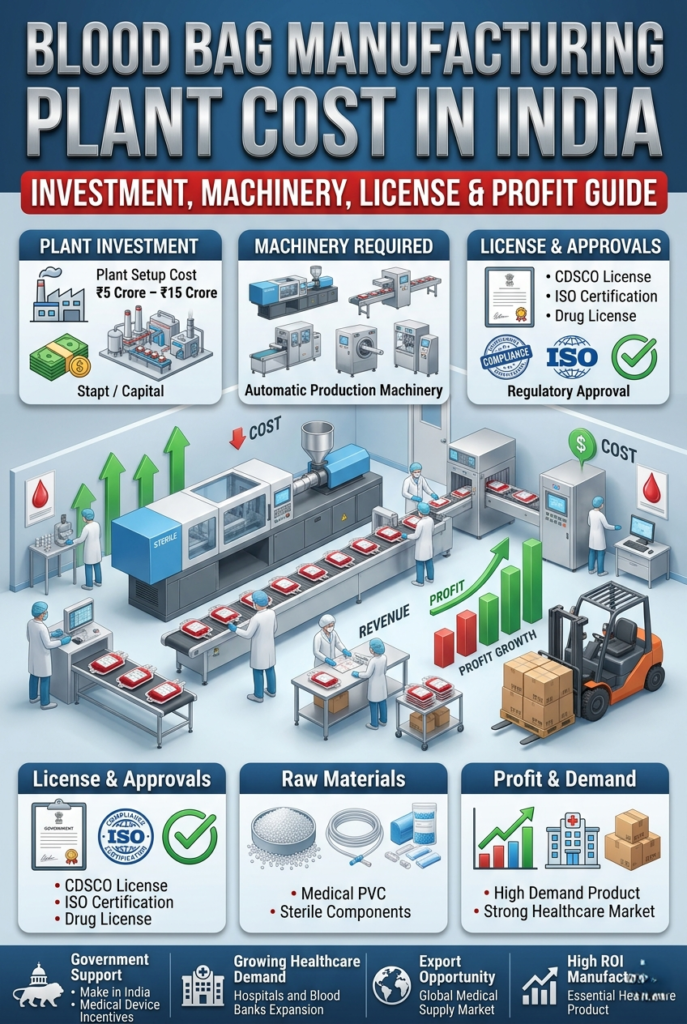
The manufacturing process entails the use of special machinery that is aimed at producing the medical products that are sterile and durable. These machines collaborate to shape, close, fill and sterilize the blood bags.(Blood Bag Manufacturing India)
Typical devices in this industry are:
- PVC tube extrusion machine
- High frequency tube welder.
- Automatic filling and sealing machine.
- ETO sterilization chamber
- Leak testing equipment
- Label printing system
- Cleanroom HVAC system
The modern automated machines are efficient and minimise errors in production and hence are worth a long-term investment.
Raw Materials Used in Blood Bag Production
The safety and performance of the products depend on the quality of the raw materials. The manufacturers will normally obtain their materials through reliable suppliers so that they can be of a consistent quality.
The most important raw materials are:
- Medical-grade PVC resin
- CPDA-1 anticoagulant solution
- Needle connectors and hubs.
- Tubing components
- Packaging materials
Majority of these materials can be obtained in India and this assists in alleviating supply chain risks and cost of production.
Find high-return business ideas based on your budget & ROI
Licenses and Approvals Required
In India, the medical device laws govern the manufacturing of blood bags. Companies should seek an official permission to begin production or marketing of products in the market.
The most essential licenses are:
- CDSCO manufacturing license
- State drug manufacturing license
- Factory license
- GST registration
- Clearance of pollution control board.
- BIS certification
- Export WHO-GMP certification.
The approvals obtained will help make sure that the products are safe and of a good quality in the country.
Profit Potential in Blood Bag Manufacturing
High profitability is one of the key reasons why entrepreneurs are willing to do business in this area. There is no fluctuation in demand, and hospitals buy medical consumables in large quantities on a regular basis.(Blood Bag Manufacturing India)
As an illustration, a small manufacturing unit that produces three lakh blood bags monthly can make about 2.5 crore rupees annually, assuming a price and quantity sold.
The common financial performance within this industry involves:
- Gross profit margin: 38% to 44%
- Net profit margin: 18% to 24%
- Payback period: 3-4 years.
Companies, providing high-quality goods to individual hospitals tend to enjoy higher margins compared to those that rely on government contracts alone.
Government Schemes Supporting Blood Bag Manufacturing
The Indian government has introduced several financial support plans to promote domestic manufacturing. These plans assist entrepreneurs cut down the start-up expenses and raise funds easier.
Popular schemes in government are:
- PMEGP subsidy on new manufacturing establishment.
- CGTMSE collateral-free business loans.
- Working capital MUDRA loans.
- Production Linked Incentive (PLI) scheme
- Startup India tax benefits
New business ventures have a less risky time venturing into the medical manufacturing industry through these programs.
Related Article: Build a Blood Bag Manufacturing Business: Step-by-Step Guide
How Professional Consultants Help in Setting Up the Plant
Most entrepreneurs face challenges whenever they initiate a manufacturing project, especially the first time. We need technical expertise to back up regulatory documentation, financial planning, and equipment selection. Poor guidance may cause delays and cost overruns.
This is the reason why most business owners would prefer to deal with experienced project consultants like NIIR Project Consultancy Services.
NPCS helps entrepreneurs through the provision of:
- Detailed project reports
- Business feasibility analysis
- Plant layout planning
- Machinery selection guidance
- Loan documentation support
- Regulatory compliance assistance
They have professional reports that are widely accepted by banks and other financial institutions thus enhancing the possibility of loan approval and successful implementation of the projects.
Future Scope of the Blood Bag Manufacturing Industry
Blood bag production in India has a bright future as the healthcare infrastructure is steadily growing. A lot of new hospitals, clinics, and diagnostic centers are being built both in urban and rural regions. This growth will create a need to have quality medical consumables over the coming years.
Besides this, there is an increase in awareness of safe blood storage and infection control, which will also make the market stronger. The current entrepreneurs who set up manufacturing facilities are able to enjoy the long-term growth and guaranteed earnings.
Conclusion
A feasible and lucrative venture in the Indian healthcare industry is blood bag manufacturing. It is stable in demand, government backing and good financial returns. Despite regulatory and technical requirements, motivated entrepreneurs can succeed in this industry by investing time and resources.
The success in this sphere lies in careful planning, good equipment and professional guidance. Companies that are oriented on the safety, reliability and efficiency can create the sustainable functioning that helps the healthcare system and brings the stable profits.
Frequently Asked Questions (FAQ)
What is the amount of investment needed to initiate a blood bag production facility in India?
An investment of approximately 1.2 crore to 1.5 crore rupees is required in a small-scale plant whereas a medium-scale unit would need 3 crores to 3.5 crore rupees.
Is blood bag making a lucrative business?
Yes. The industry has a net profit margin of 18-24, and the payback period is three-four years on average.
What is the duration of production time?
The average manufacturing plant starts within 12 to 14 months of registration, construction and equipment setting up.
Is any technical knowledge needed to initiate this business?
Technical knowledge is also beneficial but not obligatory. You are able to employ skilled personnel and seek the advice of professionals in the sector to run the business.
Does NPCS aid in initiating a manufacturing project?
Yes. NIIR Project Consultancy Services offers professional project report, technical planning and regulatory advisory services that enable entrepreneurs to successfully start manufacturing businesses.