Introduction: Profitable Manufacturing Business 2026
The world manufacturing industry is changing rapidly, as driven by sustainability, healthcare needs, and resource efficiency. Entrepreneurs who are entering the manufacturing industry in 2026 are highly focused on those businesses that are a combination of a long-term market need as well as a desirability of environmental and economic value. Among the most promising opportunities today include Phosphate Rich Organic Manure (PROM) manufacturing, Normal Saline IV Fluid manufacturing, and Recycled Cotton Yarn manufacturing from textile waste.
These industries are gaining a hold because they fulfill some basic needs. Farmers need sustainable fertilizers that restore the health of their soil, healthcare facilities need a constant supply of basic medical fluids and the fashion industry is moving towards using eco-friendly materials and circular models of production. For entrepreneurs and investors, these sectors present stable demand, scaling up and high potential for future growth.
This article gives a professional overview of each of the businesses including the manufacturing processes, investments to consider, market demand, and factors entrepreneurs should consider before entering these industries.
Read More: COTTON YARN FROM WASTE YARN – Manufacturing Plant, Detailed Project Report, Profile, Business Plan, Industry Trends, Market Research, Survey, Manufacturing Process, Machinery, Raw Materials, Feasibility Study, Investment Opportunities, Cost and Revenue
1. Phosphate rich organic manure (PROM) Manufacturing Business
Phosphate Rich Organic Manure is an environmental friendly fertilizer that is produced by composting phosphate rock using organic materials such as crop residues, press mud, animal waste or biodegradable industrial by-products. The end product provides phosphorus nutrients needed by plants to grow and enhances soil structure and microbial activity.
Manufacturing Process
The production process usually includes:
- The process of combining Phosphate Rock with Organic Waste Materials.
- The process of composting the mixture requires controlled temperature and moisture conditions.
- The microbial activity converts nutrients into bioavailable forms through its natural process.
- The complete compost undergoes two processes which include drying and grinding to produce either powder or pellet form.
- Packaging for distribution to farmers and agricultural retailer.
The production of PROM requires less technical ability than chemical fertilizer production while showing decreased environmental danger.
Investment and Infrastructure
- Moderate capital investment compared to chemical fertilizer plants.
- Land for composting units and storage.
- The facility includes composting equipment together with shredders and drying equipment and mixing devices.
- The laboratory provides essential testing equipment which enables scientists to perform nutrient analysis testing.
Market Demand and Growth
Demand for organic fertilizers is growing worldwide as there is a rise in awareness on soil degradation and sustainable agriculture practices. Governments and agricultural bodies are encouraging farmers to lessen the dependency on chemical fertilizers. Organic farming growth, soil health initiatives, and environmentally friendly policies are key drivers for growth.(Profitable Manufacturing Business 2026)
Advantages
- Low-cost raw materials such as agricultural waste.
- Expanding adoption by organic farmers.
- Strong environmental branding opportunities.
- Potential government incentives in sustainable agriculture sectors
Read More: Aloevera Gel and Powder – Manufacturing Plant, Detailed Project Report, Profile, Business Plan, Industry Trends, Market Research, Survey, Manufacturing Process, Machinery, Raw Materials, Feasibility Study, Investment Opportunities, Cost and Revenue
Key Considerations
Entrepreneurs should target on developing relationship with local farmers, agricultural cooperative and fertilizer distributors. Consistent quality of the product and effective farmer education are critical for acceptance in the market.
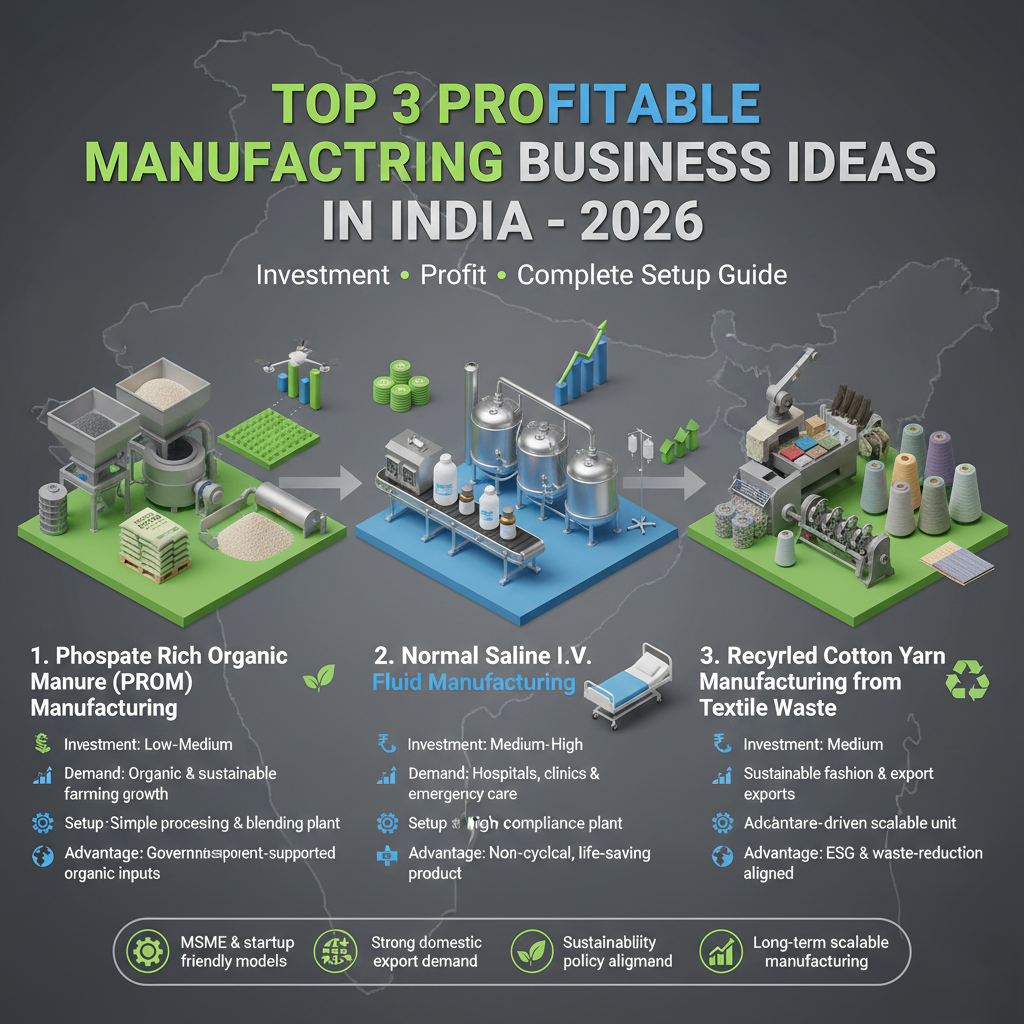
2. Normal Saline I.V Fluid Manufacturing Business
Normal saline (0.9% sodium chloride solution) is one of the most important medical products used by the world. The solution serves multiple medical purposes including hydration therapy medication dilution surgical operations wound cleaning and emergency medical response. Due to its importance in healthcare, there is a steady demand regardless of economic changes.
Read More: Biofertilizer and Phosphate Rich Organic Manure (PROM)
Manufacturing Process
Saline manufacturing is subject to rigorous pharmaceutical standards and consists of:
- The facility produces medical-grade water through its advanced filtration system which works together with reverse osmosis technology.
- The process requires sodium chloride to be mixed at specific concentration levels.
- Sterilizing the Solution with Validated Processes
- Filling of bottles or IV bags under aseptic cleanroom conditions.
- The company needs to conduct complete quality assessments before it starts to package its products for distribution.
Investment and Regulation Requirements
This is a business that requires a higher amount of capital investment and technical knowledge as a result of pharmaceutical regulations:
- Sterile cleanroom facilities.
- Automated Filling & Sealing machines.
- Water purification systems.
- Students use the data to investigate an important issue, known as quality control.
- Items to be included in the district’s inventory include the following:Regulatory approvals and pharmaceutical manufacturing licenses.
Market Demand and Growth
The process of spinning fibers produces yarn which textile manufacturers can use for their products. Hospitals, clinics, and emergency care centers are in need of uninterrupted supplies of IV fluids, which create long-term business stability.(Profitable Manufacturing Business 2026)
Advantages
- Stable and recession-resistant demand.
- High-volume consumption by healthcare institutions.
- Opportunities for long-term contracts with hospitals and distributors.
- Potential expansion into other medical consumables.
Key Considerations
Entrepreneurs should focus on meeting pharmaceutical standards, personnel training, and quality control systems. Partnerships with medical distributors and healthcare providers are critical to achieve regular sales channels.
Read More: Launching a Profitable IV Fluid Manufacturing Venture with BFS Technology
3. Recycled Cotton Yarns Manufacturing From Textiles Waste
Recycled cotton yarn manufacturing is becoming an important opportunity in the circular economy. Textile waste from garment factories, unsold inventory, damaged fabrics and post-consumer clothing can be recycled into usable fibers and minimize environmental impact, while providing important raw materials for the textile industry.
Manufacturing Process
- The process involves collecting textile waste which is then sorted according to its specific types and color categories.
- The process of fabric cleaning leads to the creation of shredded material which is then transformed into fiber.
- Carding and blending of fibers to get desired strength and quality.
- The Manufacturers permit the combination of recycled cotton with virgin fibers which results in enhanced product strength and performance..
- Companies conduct packaging operations to prepare yarn for distribution to textile manufacturers and fashion brands.
The facility contains machinery which handles both fiber processing and spinning operations.
Investment and Infrastructure
- Sorting and shredding machines.
- Fiber processing and spinning machinery.
- Waste collection the logistics network.
- Quality testing processes and sustainability certification processes.
Market Demand and Growth
Global fashion brands have recently been shifting to sustainable sourcing. Consumer awareness concerning environment friendly products is driving the demand for recycled materials. The market has grown because governments and environmental organizations support textile recycling programs.
Advantages
- Lower raw material costs compared to virgin cotton.
- Growing demand from eco-conscious fashion brands.
- Opportunities for export markets.
- Contribution to waste reduction and sustainability goals.
Key Considerations
Success is a question of securing reliable waste collection systems, ensuring constant fiber quality, and securing sustainability certifications that are attractive to international buyers.
Choosing the Right Manufacturing Opportunity
Each manufacturing business has its own unique benefits based on investment capability, technical expertise and regional market conditions.
- Entrepreneurs who want to enter the agriculture sector with moderate funding should consider PROM manufacturing as a business opportunity.
- The production of normal saline requires specialized technical skills and adherence to regulatory standards which results in permanent operational stability..
- Recycled cotton yarn manufacturing aligns with sustainability trends and the rapidly evolving textile industry.
Entrepreneurs need to perform complete feasibility assessments about their manufacturing business plans after they investigate local market demand and raw material sources and business regulations.(Profitable Manufacturing Business 2026)
Conclusion
Manufacturing businesses that meet sustainability and vital services are some of the best business opportunities that can be found in 2026 and beyond. Phosphate Rich Organic Manure is beneficial for eco-friendly agriculture, Normal Saline Production for healthcare systems and recycled cotton yarn manufacturing for circular economy of textiles.(Profitable Manufacturing Business 2026)
The establishment of profitable future-ready businesses requires entrepreneurs to focus on three essential aspects which are quality production and regulatory compliance and strategic partnerships. These industries can achieve sustainable growth and create significant social benefits for agriculture and healthcare and sustainable manufacturing through effective strategic planning and innovation and proper market positioning.
FAQ
Q1. What is the least capital-intensive manufacturing business?
PROM manufacturing generally requires a lower investment than manufacturing pharmaceuticals and can be initiated on a smaller scale.
Q2. Is normal saline production a good business for entrepreneurs?
Yes, but it requires a high level of technical knowledge and strict compliance with regulations, in addition to a high investment of capital.
Q3. Why is recycled cotton yarn fashionable all around the world?
Growing demand for sustainable fashion and environmental awareness among consumers and fashion brands are driving growth in recycled textiles market.
Q4. What is the major advantage of PROM fertilizer to farmers?
It helps in improving soil health and provides essential nutrients naturally and avoid dependency on chemical fertilizers.
Q5. Are these industries expected to increase in the future?
Yes, all three of these sectors indicate steady global growth because of sustainability trends, healthcare expansion, and resource-efficient manufacturing practices.