Garden Pipe Manufacturing Business in India
Agriculture and urban landscaping in India are quietly creating some of the most sustainable polymer manufacturing businesses today. Of these, garden pipes are one sector that has a regular demand throughout the year, low investment requirement and has good export potential. As a first-generation entrepreneur thinking of opening your first manufacturing plant or as an MSME investor looking for an investment that is capital efficient, this sector will provide you with practical returns with real demand.
Over the last ten years, the need for pipes in the garden, drip irrigation hoses, and agricultural sprinkler tubing have surged by a lot. The demand base is quite unique and is becoming ever larger given the urbanisation, increasing home garden culture and the government’s drive to promote drip irrigation and India’s huge farming economy. Further, the polymer processing business, that also encompasses the garden pipe manufacturing business, enjoys established raw material availability and an existing domestic distribution system.
Why Garden Pipe Manufacturing Is a Smart Business Entry Point
This is a very lucrative enterprise. Domestic petrochemical raw material mainly PVC (Polyvinyl Chloride) and LLDPE (Linear Low-Density Polyethylene) is readily available in the domestic market from domestic petrochemical producers, trader network and other sources. The capital investment in the extrusion machinery to convert to garden pipes is relatively low; the demands of the product are relatively stable and price-elastic.
India has more than 140 million farm households, and the push for micro-irrigation under the Pradhan Mantri Krishi Sinchayee Yojana (PMKSY) is directly impacting the demand for agricultural hoses and garden hoses. The urban demand is seeing a rise in housing societies, municipal parks, commercial nurseries, and real estate development. These two revenue streams form a stable revenue stream for manufacturers.
FICCI industry data shows that over 17 million metric tonnes of plastic is processed in the polymer processing industry with application of agricultural and irrigation piping being one of the largest. For this reason, new manufacturers entering the garden pipe market can be assured of strong market uptake in tier 2 and tier 3 cities, where organised supply is still limited.
Get Detailed Project Report (DPR): Garden Pipe & Delivery Pipes
Government Policies and Incentives Supporting This Business
The policy landscape is actively encouraging new players in polymer-based manufacturing in India. Entrepreneurs planning to establish garden pipe manufacturing units can tap various schemes that the Central and State governments have devised.
The Ministry of MSME has set up the Credit Guarantee Fund Trust for Micro and Small Enterprises (CGTMSE), which provides loans of a maximum of ₹ 2 crore without any collateral. This is especially true of first-time founders, who may not have assets that can be moved.(Garden Pipe Manufacturing Business in India)
The PMEGP (Prime Minister’s Employment Generation Programme) scheme is offering a capital subsidy of 15-35% for manufacturing units. This subsidy will be useful in lowering the initial capital costs for garden pipe manufacturers in rural or semi-urban locations.
As part of the Make in India initiative, the polymer processing industry has been identified as a priority manufacturing industry. This makes it easier to get concessional land for industry in many states, as well as single window clearance for setting up factories.
The DPIIT (Department for Promotion of Industry and Internal Trade) has also further made the Udyam Registration process easy for small polymer units to avail government procurement tenders, which are major potential buyer segment for garden and irrigation pipes.
There are also some state level incentives like electricity tariff concession, stamp duty waiver and interest subvention schemes for polymer manufacturing units in Madhya Pradesh, Rajasthan, Gujarat and Tamil Nadu.
Business Ideas for Entrepreneurs in Garden Pipe Manufacturing
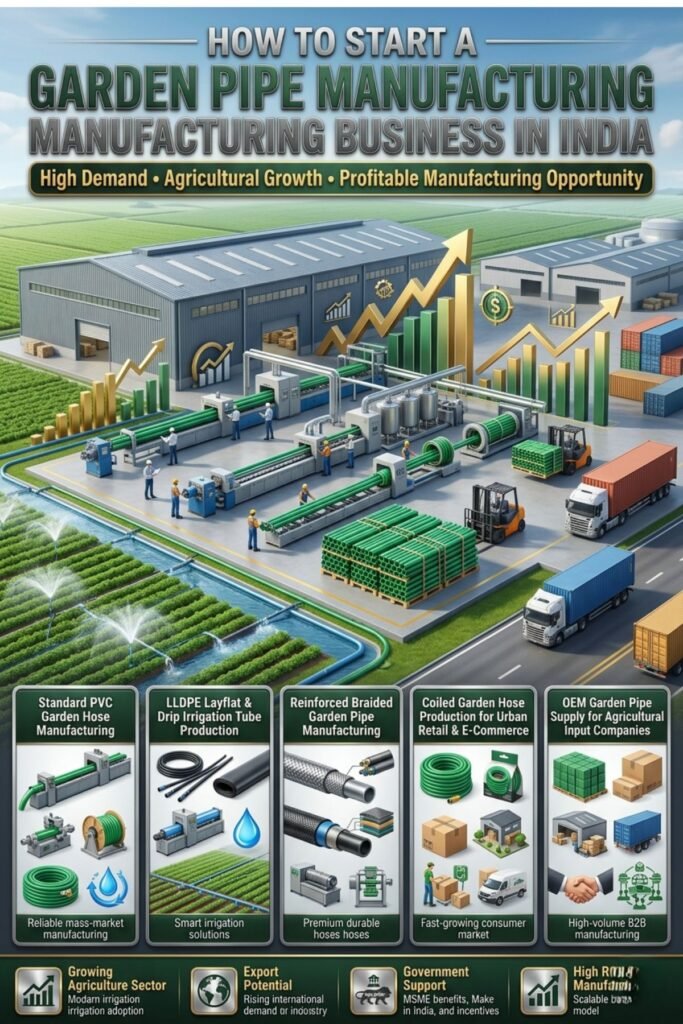
1. Standard PVC Garden Hose Manufacturing
The easiest way to access this market is to produce standard PVC garden hose pipes ranging in diameter from 12mm to 25mm and supply them directly to hardware retailers, agri-input dealers, and online marketplaces. The basic extrusion line using 300-500 kg/day capacity requires an investment of ₹20-30 lakhs (including machinery, mould sets and working capital). Generally, margins are 15–22% gross. This business model works best in markets with strong agri-retail distribution networks or high demand in urban home improvement sectors. Regionally, many small manufacturers have expanded from a single extrusion line to become multi-line manufacturers and succeeded.
2. LLDPE Layflat and Drip Irrigation Tube Production
Firstly, One of the fastest-growing sub segments in the horticulture and farming inputs space is agricultural drip irrigation. Layflat LLDPE hoses and drip laterals are widely utilized in orchards, vegetable farms and in polyhouse cultivation. With PMKSY, a drip irrigation system set up that conforms to BIS standards (IS 13487 for drip systems) allows access to government-subsidised drip irrigation supply chains. The cost of a mid-scale drip tube is from ₹35–55 Lakhs. The important thing is that government schemes for supplying to farmers often help to guarantee a farmer’s offtake, thus mitigating market development costs.
Discover scalable startups tailored to your goals
3. Reinforced Braided Garden Pipe Manufacturing
Reinforced braided PVC hoses use woven polyester or nylon between the PVC layers, making them more expensive than standard garden hoses. Moreover, These pipes are recommended for any high-pressure garden use, car washing and commercial nurseries. Furthermore, The manufacturing process uses PVC extrusion and braiding machines, and the business requires an investment of ₹40–60 lakhs to achieve a production capacity of 200–350 kg per day. As a result, The high price tag for this segment gives an edge to the gross margin of the product at 22-28% and the product is in high demand in the urban markets and exported to the Middle East and Southeast Asia among other markets.
4. Coiled Garden Hose Production for Urban Retail and E-Commerce
The demand for coiled and expandable garden hoses has been booming on ecommerce sites, as apartment gardening and urban balcony farming have become popular. This product is compact, light and comes at much higher price points than garden pipes. The capital investment to install a coiled hose unit is less and is around ₹18–28 lakhs as the machinery required is also less. But product design, packaging and ecommerce listing quality are key drivers for success. Digital commerce practitioners can also use this manufacturing capability and sell direct to consumers, and realise far better than wholesale channel models.
5. OEM Garden Pipe Supply for Agricultural Input Companies
In addition, some major agricultural input brands and irrigation equipment manufacturers outsource the production of garden hoses and drip tubes to MSME vendors. Moreover, Being an OEM supplier for established brands will ease the task of establishing a distribution network. Furthermore, It is the best model for those with BIS certification, consistent production quality and ability to deliver in bulk within the required timeframe. However, The margins in OEM supplies are also narrower – usually 10-16% – but volume stability and advance purchasing from big buyers make this a less dangerous, steady-revenue business for new manufacturers.
Import–Export Opportunity Analysis
India is a more and more competitive exporter of polymer-based garden/irrigation products. The cost advantage of PVC and LLDPE processing, plus improving product quality by domestic manufacturers, is creating export opportunities closed to Chinese suppliers.
As per APEDA (Agricultural and Processed Food Products Export Development Authority) and trade data, exports of agricultural hoses and drip irrigation products from India have grown consistently every year. Major export destinations are the United Arab Emirates (UAE), Kenya, Bangladesh, Sri Lanka and countries in Southeast Asia that are accepting Indian agricultural technologies.
BIS certification, ISO 9001 quality systems and certifications as required in certain markets, such as CE marking for the European market, should be a key consideration for entrepreneurs targeting export markets. Units engaged in export activity also have availabilities duty drawback schemes and import of duty-free machines under EPCG and export credit insurance under ECGC.
During the initial import phase, the project may need to source certain specialized raw materials, such as UV-stabilised PVC compounds and high-performance braiding yarns, from outside the country. But as the size of the unit grows, domestic substitution becomes possible and the cost structure gets better.(Garden Pipe Manufacturing Business in India)
Read the Complete Book Here: Our Books
Indian MSME Success Stories in Garden Pipe Manufacturing
Jain Irrigation Systems Ltd — Jalgaon, Maharashtra
Firstly, Bhavarlal Jain, a founder of Jain Irrigation Systems, started with a small drip irrigation unit in the rural areas of Maharashtra and evolved into one of the largest integrated agri-input companies in India. Moreover, From being a local manufacturer of micro irrigation products, it has grown into a global organisation that exports products to 120 countries. Furthermore, Jain’s model proved that the manufacturing companies that have invested in the innovation of the product, the farmer education and the integration of Government Schemes can scale significantly in the garden and irrigation pipe industry. His advice to new entrepreneurs focuses on three main factors that are difficult to duplicate: quality certification, farmers’ trust, and alignment with government policies.
Finolex Industries Ltd — Pune, Maharashtra
Prakash Chhabria and the Finolex group created a market-leading position in India’s PVC pipe & fitting business by making steady investments in raw material integration and brand-building. The success of Finolex in the agricultural pipe business was due to their understanding that the farm to urban distribution overlap was a natural multi-channel opportunity. Like Finolex, new manufacturers can learn that having ownership of a distribution network in a limited number of geographies before attempting to go national is much more defensible than operating in a wide array of geographies with a thin distribution system.
Captain Polyplast Ltd — Rajkot, Gujarat
The company, called Captain Polyplast, started from a small polymer processing unit in Gujarat and has now expanded to become a well-known supplier of drip irrigation systems and agricultural pipes in India. The key turning point was the promoter team’s request for the government to appoint a supply for subsidised scheme under PMKSY. This story provides a useful reminder: government scheme participation is not only a source of revenue, it is a signal of credibility that opens up institutional buyers, bank credit, and high dollar customer relationships at the same time.
Related Article: Top 4 High Demand Manufacturing Business Ideas in India with Investment and Profit Margin
How NPCS Helps Entrepreneurs Enter This Sector
The quality of the feasibility analysis is key to whether a garden pipe manufacturing business succeeds or fails, for entrepreneurs considering entry. The Niir Project Consultancy Services (NPCS) offers professional consulting services for elaboration of Market Survey cum Detailed Techno-Economic Feasibility Report (DPR) for establishment of new manufacturing unit/business.
We prepare our reports covering all aspects of pre-investment intelligence such as detailed manufacturing processes, Market Research and Market demand analysis, Process flow diagrams, Product mix & capacity information, Machinery information and specifications, Raw material information & specifications, complete Project financials including Profitability analysis etc. The goal is to help the entrepreneur determine the viability, profitability and scalability of the business before investing funds. We have developed garden pipe manufacturing DPRs which provide founders with a clear, defensible investment thesis right from the start, including: Extrusion technology comparison, BIS certification roadmap, Competitive landscape mapping, and Machinery vendor shortlisting.
Key Project Parameters: Garden Pipe Manufacturing Unit (Indicative)
| Parameter | Small Unit | Mid-Scale Unit |
| Initial Investment | ₹15–30 Lakhs | ₹35–65 Lakhs |
| Production Capacity (kg/day) | 200–350 kg | 500–900 kg |
| Land Requirement | 1,500–2,500 sq ft | 4,000–7,000 sq ft |
| Break-Even Period | 18–24 months | 24–36 months |
| Gross Margin Range | 14–20% | 17–26% |
| Primary Raw Material | PVC/LLDPE Resin | PVC/LLDPE + Additives |
| Key Machinery | Single Screw Extruder | Twin Screw + Braiding |
| Manpower Requirement | 8–12 persons | 18–28 persons |
| Target Market | Regional retail/agri | OEM + export + retail |
Note: Figures are indicative and may vary based on location, machinery configuration, and product mix. A detailed DPR is recommended before finalising investment decisions.
Frequently Asked Questions (FAQs)
Q1. How much capital would be required for starting a basic garden pipe manufacturing setup?
A basic single-line PVC garden hose extrusion unit can be set up in a 15-30 lakh capital range including machinery, tooling, raw material inventory and initial working capital. A reinforced or drip irrigation unit may need 35-65 lakh depending on capacity and product complexity. The projects are eligible for MSME loan funding of 75-85% of project cost through scheme mechanisms under CGTMSE and PMEGP, depending on individual eligibility.
Q2. Do garden pipe products need BIS certification?
Yes, several categories of garden and agricultural pipes require certification under relevant IS standards, and institutional buyers and government scheme suppliers strongly prefer such certification. Drip irrigation products must have the appropriate IS 13487 to qualify under PMKSY procurement, which often involves BIS certification. BIS certification also helps boost buyer confidence in the retail market and enable premium pricing.
Q3. What are the key raw materials and are they reliably supplied?
Primary raw materials to be used are PVC resin and LLDPE granules. They are both derived from petrochemicals, which are manufactured on a large scale in India by manufacturers such as Reliance Industries, ONGC Petro-additions (OPAL), and Chemplast Sanmar. Although both materials are easily available in India, their prices depend on crude oil movements. Experienced manufacturers typically rely on pre-buying during price dips, a good supplier relationship management system to mitigate risks.
Q4. Which states of India are considered best for setting up a garden pipe manufacturing unit?
The strong states with the best ecosystem include Gujarat, Maharashtra, Rajasthan, and Tamil Nadu which have proximity to petrochemicals, existing polymer processing cluster networks, well-developed agri-retail distribution and state level MSME incentives. However, Madhya Pradesh, Uttar Pradesh, and Punjab remain viable due to the rising demand for agri-inputs and the ongoing development of industrial infrastructure in these states.
Q5. Can a small setup make good profits selling through e-commerce?
Yes, it is one of the most untapped segments of the market today and one the small manufacturers are making very good profits selling on e-commerce platforms like Amazon, Flipkart, agri e-marketplaces. They are getting 2-3 times the wholesale price of coil hoses, UV-resistant garden pipes and small drip kits. However, good packaging, great product photography, and the capability to manage reviews and response is crucial to sustainable e-commerce revenues. Many small manufacturers have made successful business pivot based on combining wholesale with e-commerce revenue streams.
Q6. How can one get access to government incentives for this business?
Register on the Udyam Portal (udyamregistration.gov.in) and acquire an MSME certificate. This is the entry point to the PMEGP, CGTMSE scheme, as well as state specific incentive programs. Additionally, look for the refinancing facility offered by NABARD for agri input manufacturing by reaching out to them at the state level. It is best to contact a DPIIT recognized startup facilitator or a project consultant who specializes in the MSME schemes to help expedite the application process.
Conclusion: A Resilient Business Opportunity Worth Serious Evaluation
Garden pipe production is at the nexus of India’s two most consistent demand drivers — agriculture and urban consumption. It has easy access to capital, benefits from favorable government policy support, and offers scalable models ranging from local wholesale businesses to OEM supply and exports. If you’re willing to take the time and put in the effort to find quality certification, purchase the right machines, and grow distribution channels, it’s a true sustainable revenue model.
However, the secret to success is to do the preparatory work right. The most useful tool an entrepreneur can use before investing in his/her idea is a well-done techno-economic feasibility report which includes market demand, process selection, financial projections, and competitive positioning. Using the correct equipment and materials, garden pipe making can be a low-cost venture that can grow into a large, profitable industry.