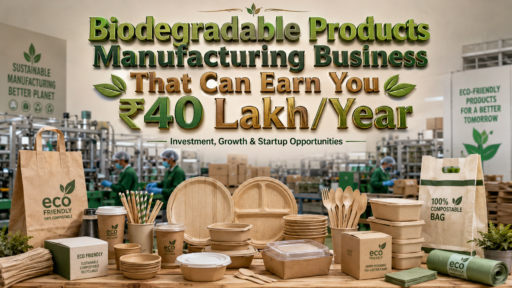


Biodegradable Products Manufacturing Business
The Indian biodegradable products industry is one of the best prospects in the green economy and sustainable business. As there is growing awareness about environmental issues, there are strong regulations on the use of plastics, and there is a growing demand for sustainable alternatives worldwide, this industry is growing at an impressive rate.
The Government of India, along with some international agencies, are also pushing sustainability and renewable solutions. For instance, the government of India has provided an official web portal for the renewable energy sector, and initiatives in this area can be discussed.
https://www.makeinindia.com/sector/renewable-energy
Industries like food delivery, retail, agriculture, and e-commerce are seeing the emergence of products like biodegradable bags, agricultural films, disposable plates, cups, and packaging materials that are quickly taking the place of products derived from plastic.
This is not just a short-term trend; it is a structural change that’s being encouraged by policy, consumer awareness and international environmental commitments.
Get Detailed Insights from This Book: Bioplastics & Biodegradable Products Manufacturing Handbook
Why the Biodegradable Industry is Growing Rapidly
This industry is growing due to the environment and tough regulations.
Every year, India produces a considerable amount of plastic waste which causes immense environmental harm. For this, Government of India has laid down stringent norms in plastic waste management policies and encouraged the use of eco-friendly options.
The government of India offers several schemes for MSMEs that can be accessed via the official website, such as:
Major growth factors are:
- Ban on single-use plastics in India
- Rising demand from hospitality and food delivery sectors
- Upping the requirements for ESG compliance of corporations
- Rising demand for exports from Europe, USA and UAE countries
- In India, low-cost agriculture raw materials are available.
Further support and policy guidance is provided by DPIIT (Department for Promotion of Industry and Internal Trade)
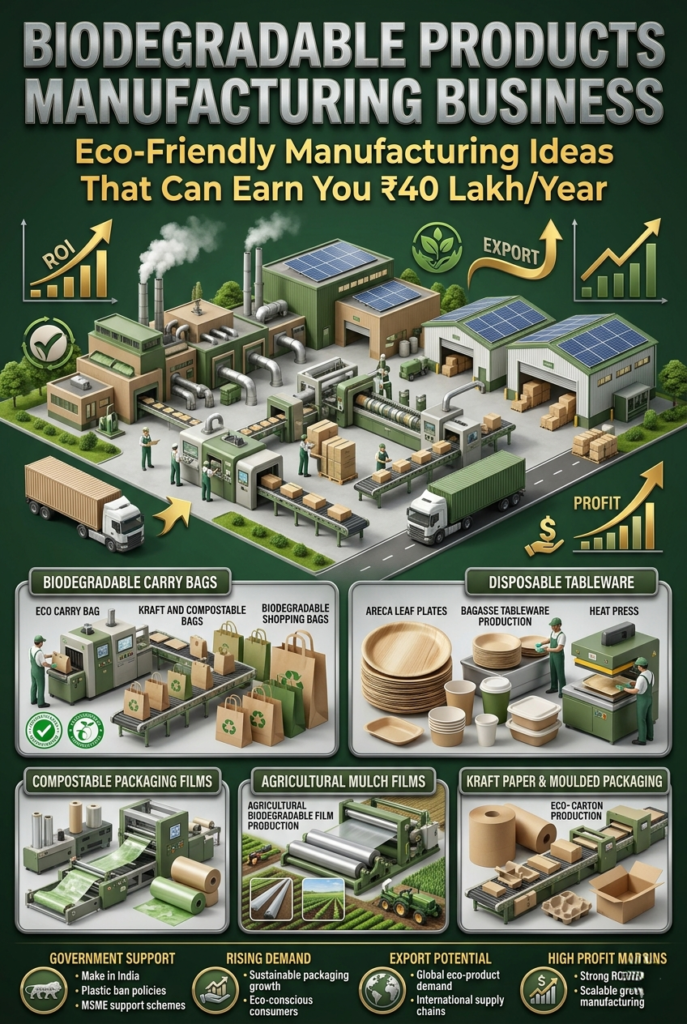
The types of the biodegradable products you can make are:
There are several categories of product in this industry, which gives the entrepreneur the ability to start small, and scale up slowly.
1. Biodegradable Carry Bags
PLA/starch-based material – common material used in retail, grocery industry.
2. Disposable Tableware
Contains cups, bowls and plates made from sugarcane bagasse and areca leaves.
3. Compostable Packaging Films
Appropriate for packaging for food and industries.
4. Agricultural Mulch Films
In farming, used to enhance soil quality and water holding capacities.
5. Kraft Paper & Moulded Packaging
Industrial shipping & ecommerce packaging.
Manufacturers need to adhere to BIS guidelines for quality and compliance:
https://www.bis.gov.in/?lang=hi
Get Detailed Project Report (DPR): Biodegradable Packaging and Bio-based Polymers
Market Demand and Growth Potential
In the hospitality, agriculture, retail and logistics sectors, demand for biodegradables is growing.(Biodegradable Products Manufacturing Business)
Countries like USA, Germany, Japan and UAE are prohibiting plastics with strict measures worldwide, which can create a huge exports opportunity for Indian manufacturers.
India has a strong competitive advantage due to:
- Low manufacturing cost
- A good foundation of agricultural raw materials.
- Skilled labour availability
- How to identify legitimate and illegal export subsidies
The export promotion support is provided by FIEO:
APEDA provides assistance in agricultural export and certification:
Investment and Setup Cost
The investment amount depends on scale of production and types of machines.
- Small Scale Unit: ₹5 Lakh to ₹15 Lakh
- Medium scale unit: ₹25 lakh to ₹1.5 crore
- More than ₹2 crore is considered large scale plant.
Basic machinery required:
- Extrusion machines
- Molding machines
- Cutting and sealing equipment
- Packaging systems
- Raw material processing units
Financial planning and subsidy guidance can be found with NSIC:
Profitability and Revenue Potential
The profits of this business are high because the demand for it is increasing and it is priced high.
- Profit margin: 25% to 60%
- The monthly profit (medium scale) is between ₹2 lakh and ₹4 lakh.
- The profit potential ranges from ₹20 lakh to ₹40 lakh per annum and above.
International pricing benefits can be exploited to realize even greater margins for export-oriented businesses.
Breakeven time: 18 to 36 months depending on size and market penetration.
Build a profitable business with the right idea
Government Support and Subsidies
Indian government is quite enthusiastic about MSME and green manufacturing enterprises.
The following schemes are key:
- PMEGP subsidy up to 25%–35%
- Collateral free loan up to ₹2 crore with CGTMSE.
- State incentives for industry (tax, electricity, land)
- MSME Udyam registration benefits
Official MSME schemes and guidelines:
These schemes help to considerably de-risk and minimize the initial investment.
Export Opportunities in Global Markets
Export is one of the most profitable segments of this industry.
The following international certifications are required:
- EN 13432 (Europe standard)
- ASTM D6400 (USA standard)
- ISO composability certifications
After certification, manufacturer is able to supply to:
- Global supermarket chains
- Food packaging companies
- Retail brands
- E-commerce companies
The export business support and facilitation are facilitated by:
- The Federation of Indian Export Organizations (FIEO)
- Agricultural and Processed Food Products Export Development Authority (APEDA)
Raw Material Advantage in India
India has a natural edge in the production of biodegradable raw materials which brings down the production cost and enhances the competitiveness of the world.
Important raw materials are:
- Sugarcane bagasse (from sugar mills)
- Corn starch (agricultural production)
- Areca palm leaves (southern India)
- Rice husk and jute fibers
This robust farming foundation guarantees sustainability and cost-efficiency.
Related Article: The Green Manufacturing Revolution: Paper Water Bottles, Bioplastics & Biodegradable Products
Role of NPCS (Niir Project Consultancy Services)
The Niir Project Consultancy Services (NPCS) is very helpful to the entrepreneurs to initiate their manufacturing enterprise with success in this sector.
NPCS provides:
- Detailed Project Reports (DPR)
- Market research and feasibility analysis
- Machinery and technology selection guidance
- Cost and profit estimation
- Assistance for bank loans and subsidies
Their reports are commonly referred to when deciding whether to grant a loan, apply for government subsidies and planning when investing. NPCS provides a clearer roadmap for first time entrepreneurs to help mitigate risk prior to investing.
Challenges in the Industry
Although it offers significant growth potential, there are some challenges in this sector:
- High start-up cost of equipment
- Requirements for exporting to other markets
- Existing packaging companies
- The cost of the raw material must be constant.
- The problem of market awareness and adoption issues.
Success requires good planning and technical assistance.
Conclusion
Biodegradable products manufacturing business in India is one of the most lucrative MSME business opportunities with great future potential. Government policies, environmental consciousness, and global demand will drive this industry’s rapid expansion over the next decade.(Biodegradable Products Manufacturing Business)
The investment amount starts from ₹5 lakhs, and the potential for expansion offers entrepreneurs a viable and profitable business opportunity while also helping to protect the environment.
The sector is even more attractive for new investors due to the support provided by the government via various MSME schemes, export promotion agencies and industrial policy frameworks.
Early entry and development of production and export networks will provide a strong long-term competitive edge.
FAQ
Q1. Will biodegradable manufacturing be profitable in India?
Yes, it has a high profit margin because it is highly in demand and supported by the government.
Q2. What is the investment needed?
The minimum investment required for small units is from ₹5 lakh and for large plants it can be above ₹2 crore.
Q3. What is the profit on this business?
Typically, profit margins are between 25% and 60%.
Q4. May I export my biodegradable products?
Yes, there is really good demand in USA, Europe, UAE and Japan.
Q5. Is certification required?
Yes, there are certifications, such as EN 13432 and ASTM D6400, that are required for exports.

We are planning setting up of a biodegradable facility for manufacture of spoons in Bengaluru. Presently we are manufacturing HDPE, PP & PET jars and are having IBM, IM and Blow Moulding machines. Please share information or contact me to discuss further.
Mohan A SATHAVALLI
Vice President
Want to know in detail about manufacturing process, raw material availability, cost of startup settings, marketing strategy etc.