Donkey Farming Business in India
Most businessmen in India consider livestock farming as rearing of cattle, goats or poultry. But, today (and more and more every day), there is a growing interest in forward-thinking MSME investors in donkey farm business ideas as a niche with a high potential for a low competitive approach. The donkey, once considered an informal work animal, is now the key component of several rapidly expanding product categories: high dollar skin care ingredients, pharmaceutical raw materials, animal by-products suitable for export, and organic farming feeds.
India is home to a large number of donkeys in Asia. However, commercial donkey farming is almost non-existent. That’s a genuine opportunity. A well-considered donkey business in India can yield excellent returns in just two to three years with comparatively lesser investment and good government aid available to the right minds when investing in such an industry.
Why the Donkey Farming Sector Is Growing Right Now
The population of donkeys is declining heavily all over the world while the demand for donkey products is on the increase in several industries. This shortage of supply is driving up prices for manufacturers with good quality products available with regularity. With the vast workforce of donkeys in India, mainly in the states of Rajasthan, Gujarat, Uttar Pradesh and Andhra Pradesh, India’s potential to become a major supplier in this category is obvious.
Donkey Milk fetches a remarkable price in the international cosmetic and nutraceutical market. It has a content of high-level lysozyme, lactoferrin and omega-3 fatty acids, which are desirable attributes that the premium skin care brands of Europe and East Asia actively look for. Another high value export product is donkey hide, which is used in the traditional Chinese medicine product known as Ejiao, and is becoming more and more important to China’s manufacturers as the number of donkeys in China have decreased. Also, in India there is a strong domestic market for quality-bred animals because donkeys are still in good working numbers in brick kilns, construction sites and in rural transportation.
The benefit of being the first in the line for organized donkey farming in India is yet to be fully exploited. Entrepreneurs who venture in now will encounter little competition from domestic enterprises and can establish supplier relationships before the competition is stiff.
Get Detailed Project Report (DPR): Donkey Farming: A Profitable Livestock Investment
Government Policies and Schemes Supporting Donkey Farm Entrepreneurs
The Government of India actively promotes the livestock entrepreneurs, including the young ones who are planning to establish donkey farms, through several well-financed programmes. The National Livestock Mission – Entrepreneurship Development Programme (NLM-EDP) under the Department of Animal Husbandry and Dairying (DAHD) is the most relevant programme. According to this scheme, capital subsidy of 50% up to ₹50 lakh is provided for establishing a donkey farm. Eligibility: People, Farmer Producer Organisations (FPOs), Self-Help Groups (SHGs) and Section 8 companies. A direct named inclusion, the donkey breeding farms are explicitly included in NLM-EDP.(Donkey Farming Business in India)
Pointing to this as one of the most accessible government schemes for new entrants in this area, the Press Information Bureau (PIB) confirmed that NLM-EDP is specifically for horse, camel and donkey breeding farms. The NLM portal on Udyam Mitra is available for entrepreneurs to apply and avail project monitoring, documentation of the scheme, etc.
In addition to the NLM, the entrepreneurs can also register their donkey farm as a MSME on the Udyam Registration Portal which is free of paperwork and paperless, and avail collateral free loan under CGTMSE scheme, priority sector loan from banks and interest subsidy. Further, agri-startups can get DPIIT recognition under the Startup India Portal which provides three years exemption from income tax and preference in seeking government tenders.
The subsidy disbursement of the NABARD National Livestock Mission EDEG is available through banks, which is easier for the first time entrepreneurs for export-oriented activities. In the meantime, the export registration system for animal products is handled by the APEDA Animal Products division in the Ministry of Commerce which covers hides and processed milk derivatives.
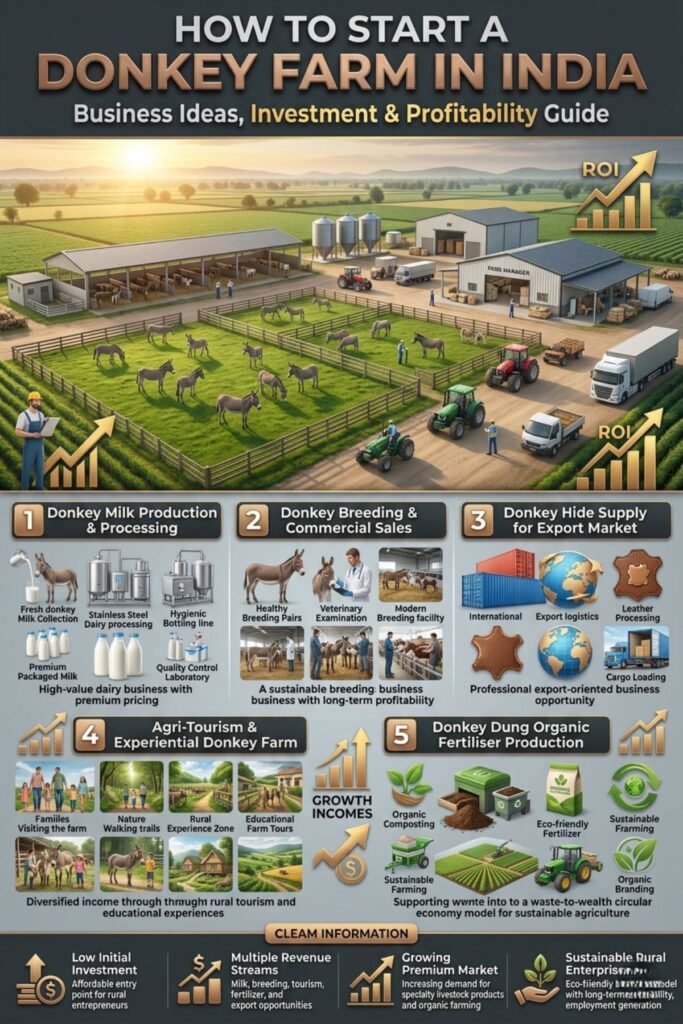
Five Profitable Business Ideas Within Donkey Farming in India
1. Donkey Milk Production and Processing
Donkey milk is one of the best-profit making business ideas in this segment. Premium cosmetics producers from Europe, Japan, and South Korea are increasingly interested in donkey milk more for its distinctive biochemical characteristics, such as high lysozyme, lactoferrin, and essential fatty acid content, which are not found in conventional cow or goat milk.
The demand for this is also increasing in India from Ayurvedic practitioners, organic skin care companies and research institutes engaged in investigating its therapeutic properties. On a small farm (20-30 lactating jennies), one to two litres per animal daily may be produced. Thus with basic cold chain infrastructure and processing equipment (powder/soap) the entrepreneur can become a value added B2B supplier to cosmetic formulator or sell it from his brand.
The prudent entrance strategy is to lock down long-term supply agreements with manufacturers prior to scaling up the herd. The margins are much higher than in traditional farming practices and competition from India is virtually unaffected.(Donkey Farming Business in India)
Related Article: Donkey Milk Business in India: Cost, Profit, Farming Setup & Income Guide
2. Donkey Breeding and Sale for Commercial Use
The demand for working donkeys in India is uniform while the supply chain is chaotic and fragment. Healthy well-built animals are a regular need of brick kilns, construction companies, salt pan owners and rural transport companies all across Rajasthan, Gujarat and Andhra Pradesh. Most are, however, sold to informal traders at irregular prices.
A structured breeding farm that consistently produces healthy animals (with veterinary information and nutritional details) offers a distinct price premium compared to animals sold from traditional fairs. A 50 head farm can be run by a business person and he can sell 20-30 animals, on a regular basis, to earn an income every year.
The business model is simple: buy good-quality breeding stock, run a good feed and health program and develop institutional buyer relationships. Registered farmers have considerably lower reoccurring costs as the government provides assistance in the form of veterinary support through state animal husbandry departments.
3. Donkey Hide Supply for the Export Market
The most important material for Ejiao, a gelatin-based product widely used in traditional Chinese medicine, commands high prices in the market. China’s industrial demand for donkey skin has declined significantly, and suppliers around the world are replacing it with hides. India is well-positioned to fill this gap with its capacity and resources.
There is the opportunity to establish hide collection and primary processing facilities (cleaning, drying and grading) from farms and licensed slaughterhouses in important states for the farmers. The RWR hides will then be sold to Chinese and Southeast Asian processors.
This is a B2B model that mandates export registration by APEDA, handling of animal products and documentary logistics. The margins are positive as the trading of hides is done in USD and thus provides a natural currency hedge. The regulatory journey is not impossible, but it must be taken and the demand is structural instead of cyclical.
4. Agri-Tourism and Experiential Donkey Farm
Agri-tourism is growing rapidly in India’s rural tourism industry, and donkey farming has emerged as a unique and highly photogenic attraction that visitors cannot find on conventional farms. There is a significant revenue potential in weekend or school groups visitors to a peri-urban farm near a Tier 1 or Tier 2 city, especially in Maharashtra, Karnataka, Himachal Pradesh and Rajasthan. Revenue comes from multiple streams, including entry fees, dog and pony sessions, guided farm tours, an on-site café, and on-site sales of donkey milk products and farm stories. Low set-up costs, high spend per head, and novelty factor brings in high social media word of mouth marketing. Businesses that integrate tourism into the production of milk and organic fertilizers are truly diversified businesses, with each business helping the other, which greatly diminishes overall business risk.(Donkey Farming Business in India)
5. Donkey Dung Organic Fertiliser Production
Donkey manure is one of the best organic soil amendments as it contains high levels of nitrogen, and has a great slow-release action, which helps to enhance soil structure over a number of years. The export demand and domestic health awareness has encouraged the growing pace of this organic farming movement in India and the demand for certified organic inputs is outpacing supply.
We collect and process the daily output from donkeys into composted fertiliser and sell it to organic farms, horticulture units, nurseries, and agri-input companies. The extra capital needed for this by-product business is minimal, with composting pits, simple bagging machinery and a small delivery network. The 50 head herd provides several tonnes of compostable material per month. For organic entrepreneurs, pursuing organic certification per the National Programme for Organic Production (NPOP) opens the door to export markets for organic bio-inputs, which introduce a revenue stream from abroad to a local cash-flow positive business.
Import–Export Opportunity Analysis
India has an immediate and structural export opportunity in donkey products. The biggest short-term prospect is donkey hide export, directly contributing to global production of Ejiao. APEDA’s Animal Products division is responsible for the regulation of animal hides and by-products from India for processing and export. Entrepreneurs who set up a compliant documentation and registration process with APEDA, and get their state animal husbandry clearances will have access to the market within 6-12 months of starting operations.
Secondly, donkey milk powder is another big export prospect. The certified donkey milk powder, which complies with GMP processing procedures and the necessary food safety certifications, fetches high prices in the EU cosmetics market. Indian entrepreneurs can achieve this and earn better prices because this is one of the most valuable agri-export products per kilogram when processed using EU-compliant infrastructure. The certification path is a long and hard one to follow, but with clear rules, the margins are more than worth it in the long run.
There are also more and more serious breeders willing to import high quality donkey imported stock on the imports side, especially from the European countries with donkeys with good milk output, or with a high working capacity. Though capital intensive, these imports can create a difference in the quality of the herd, and be able to give a premium price for milk and breeding stock sales in India.
Indian Business Success Stories in Niche Livestock Farming
Amul’s Strategic Move into Camel Milk
Camel milk products launched by Amul, with the leadership of the Gujarat Cooperative Milk Marketing Federation (GCMMF) under its MD R.S. Sodhi, offers the best strategic blueprint for nonconventional livestock commercialization in India. Amul recognized the special nutritional benefits of camel milk, especially for diabetic consumers, and established an extensive procurement network in the pastoral communities of Kutch while also developing a premium consumer brand. The outcome: a new product class that has little competition at home and a high market positioning value given the health aspects. The donkey farm owner must learn that a cooperative or cluster-based aggregation system, a strong health story and institutional reputation can turn a marginal livestock product into a profitable and sustainable business.(Donkey Farming Business in India)
Get Detailed Insights from This Book: Market Research Report on Milk Processing & Dairy Products in India
Rajasthan’s Grassroots Donkey Milk Pilots
In Rajasthan, which has the largest working donkey population, the State Animal Husbandry Department and the Rajasthan Cooperative Dairy Federation (RCDF) conducted pilot programmes on donkey milk collection in the state. Local entrepreneurs’ early pilot projects show that small animal operations with just 15–20 animals can still generate a reasonable monthly income, provided that they establish a strong procurement infrastructure and cold chain. What is more important, these pilots demonstrated the importance of establishing Farmer Producer Organisations (FPOs) for collective bargaining, joint use of processing equipment and joint market access. This is because new entrepreneurs should leverage the already established FPO network in Rajasthan instead of establishing a separate FPO, the synergies are tremendous.
Organic Input Startups: The Organica Biotech Model
Organica Biotech, a Pune based agri-biotech firm, developed a marketable B2B model, where it was providing unconventional products which were organic bio-inputs to its institutional customers (agri-corporates, farmers, exporters) and not retail customers. They show that, when the emphasis is on consistent quality, third-party certification, and direct institutional sales relationships, producers can scale niche organic inputs—such as by-products from alternative animal sources—commercially. The important take home message for the donkey dung fertiliser entrepreneurs is that B2B and institutional sales (organic farms, export-oriented horticulture units, cooperatives) have more predictable cash flows and higher margins than retail distribution, a business they would need to develop from scratch.
How NPCS Can Help You Plan and Launch This Business
NPCS prepares market survey cum detailed techno-economic feasibility report (DPR) for the intending entrepreneur of donkey farming etc industry. Under our complete project evaluation report system, we deal with operation process design, market survey and analysis, product mix and capacity planning, preparation of process flow diagrams, machinery and raw material requirements, and complete project financing, including profitability, break-even, and payback period analysis.(Donkey Farming Business in India)
We seek to provide founders with data backed assurance of feasibility prior to their deploying any capital. Our DPR is suited for a 20 head donkey milk operation, a 100 head breeding farm, or an export-based hide processing unit. A bank, and investors, will rely on and find a professionally drafted DPR by NPCS both useful and sufficient to meet their due diligence needs. Contact us at www.niir.org.
Turn your budget into a successful business plan
Investment and Revenue Estimates: Donkey Farm Business Models in India
| Business Model | Approx. Investment | Est. Annual Revenue | Payback Period |
| Donkey Milk Production (20 Jennies) | ₹3–5 Lakh | ₹6–10 Lakh | 18–24 Months |
| Breeding & Sale Unit (50 Head) | ₹5–8 Lakh | ₹8–12 Lakh | 12–18 Months |
| Hide Collection & Export Unit | ₹4–7 Lakh | ₹10–15 Lakh | 18–30 Months |
| Agri-Tourism Donkey Farm | ₹8–15 Lakh | ₹12–20 Lakh | 24–36 Months |
| Organic Fertiliser (Dung Processing) | ₹1–2 Lakh | ₹2–4 Lakh | 8–12 Months |
Source: NPCS field-based estimates. Figures are indicative. Actual results vary by location, herd size, market linkages, and operational efficiency.
Conclusion: Is A Donkey Farm in India a Worthwhile Venture?
The simple answer is yes – if the entrepreneur treats it as a true business and not merely a gimmick. The Indian domestic market has almost no competition, the government provides strong subsidies, international demand for donkey milk and donkey hides is growing, and India already has a large donkey population—this rare combination does not appear together in most other sectors.
Those most likely to succeed will focus on a single core revenue stream, secure institutional buyers before scaling, and establish their farm with discipline and a long-term outlook. A well-managed donkey farm business in India, established as a full-fledged business concern, will yield steady returns within 2-3 years – and a protected market niche that will only continue to increase in value with each tightening global supply of donkey-based products.
For a full Techno-Economic Feasibility Report outlining the cost structure, market analysis, and financial forecast of a donkey farm in India, it would be advisable to check with NPCS (Niir Project Consultancy Services) prior to investing capital.
Frequently Asked Questions (FAQ)
Q1. How many donkeys should I own for a commercial venture in India?
For commercial operations, a herd size of 20–30 animals provides a good starting point. For milking ventures, you should keep at least 15–20 lactating jennies to ensure an adequate daily yield. A herd size of 30-50 animals works well for breeding ventures. First-time entrepreneurs are strongly encouraged to invest a minimum of funds, develop a minimum of one or two institutional customers and scale the operation as the demand is confirmed.
Q2. Is there demand for donkey milk in India?
A domestic market is growing, through use of donkeys in Ayurveda, natural skincare startup firms, and through research institutes. Demand in the form of export markets for the milk is more mature and has significantly higher return on investment- European cosmetic companies, East Asian pharmaceutical firms. An entrepreneur with a basic processing facility (including refrigeration and powder production capability) who chooses to target export markets rather than domestic retailers initially will earn higher returns in the early years of operation.
Q3. How much land does a donkey farm in India need?
A 20-30 animal herd needs an area of 1-2 acres (which can comprise stabling, open grazing land, fodder area, and space for processing). Donkeys are an extremely sturdy animal; they are capable of living and flourishing in both arid and semi-arid climates. The dry states of Rajasthan, Gujarat, and parts of Maharashtra and Andhra Pradesh offer ideal conditions for breeding donkeys and also have much lower land prices than agricultural areas.
Q4. What government assistance schemes can I avail for donkey farming?
The NLM Entrepreneurship Development Programme (50% capital subsidy for donkey breeding farms up to 50 lakh), an MSME entity with an Udyam Portal certificate qualifies for collateral-free bank loans under the CGTMSE, interest subsidies and priority lending; if the entity obtains DPIIT recognition from Startup India, an entrepreneur gets a three-year income-tax exemption, in addition to state animal husbandry grants and free veterinary help, especially in the States of Rajasthan and Gujarat, with proper registering.
Q5. What are the major risks of a donkey farm?
The key operational risks are veterinary and marketing. Donkeys, if not maintained well, become susceptible to skin diseases, respiratory illnesses and hoof conditions. Without the assurance of having at least one buyer before you even begin to scale up production, the marketing risk can significantly hinder returns, especially early in operation. Signing an institutional sales contract before raising more animals, and retaining an experienced vet on a monthly retainer are ways entrepreneurs can minimize these risks.
Q6. Can a donkey farm be part of other livestock business operations?
Yes, it can, and usually, this results in more resilient cash flow. Integration into goat rearing or an organic farm setup or a horticultural operation will be easier to maintain as the infrastructure, vet assistance and the fodder setup would need to cater to other animals also. Entrepreneurs with additional streams such as a manure disposal venture (using the dung to make organic fertilizers) or an agri-tourism aspect stand a better chance to survive the first few years financially.