Oats Processing Business in India
Why the Oats Business Is Worth Your Attention
Oats have experienced a steady and impressive growth in demand over the last 10 years, more than any other food category. which used to be a fitness freak’s diet staple, have firmly come into the mainstream of Indian kitchens. Oats production is a great business opportunity for entrepreneurs looking for viable business ideas in the food processing industry. This sector has seen a surge in health consciousness, strong domestic demand, expanding overseas markets, and government support. Therefore, businesses and investors should consider it seriously. But before investing, it is good to understand the complete process manufacturers use to turn raw oats into a packaged product.
Related Article: How to Prepare a DPR for Food Processing Unit in India (Project Cost, Profit & Bank Loan Guide)
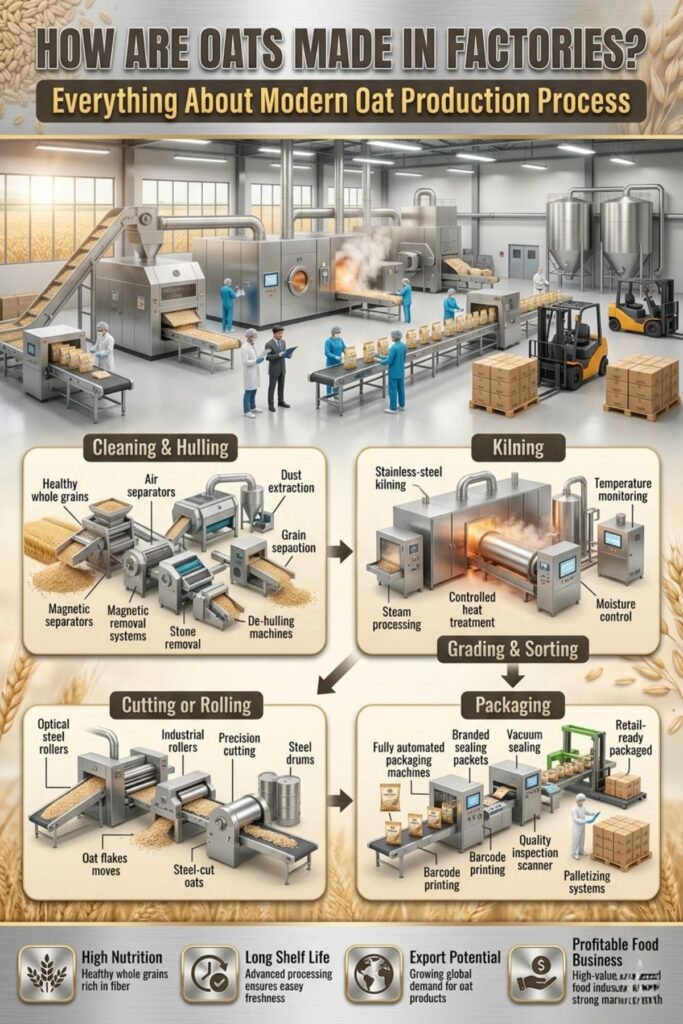
How Oats Are Made: The Manufacturing Process
Oats start as a raw cereal grain from which they are harvested.
Avena sativa plant. Manufacturers carefully sequence the processing steps that transform raw oat grain into rolled, instant, or steel-cut products found on supermarket shelves. Unique machinery and quality control processes are necessary for each stage.
Step 1: Cleaning and Hulling
Straw, chaff, dust and other under-size grains on freshly harvested oats. The first processing step involves cleaning the raw grain using industrial type screens, air classifiers and de-stoners to remove all foreign material. The grain is cleaned and then put into a hulling machine. This equipment will work on this equipment and separate the outer husk (inedible) from the oat groat (edible). The hulling efficiency is very important. Substandard huls cause raw material waste and inconsistency of product.(Oats Processing Business in India)
Step 2: Kilning
The groats are then taken into a kiln, a large industrial oven, to be dried. There are two purposes of Kilning. First, it turns off the lipase enzyme that is naturally found in Oats. This enzyme quickly oxidises the fat in oats, causing them to become rancid within days unless manufacturers kiln them. Second, kilning produces the delicate flavor of the nut which customers expect in good oat products. Operators normally use a temperature of 90°C–120°C during kilning and carefully monitor the process to prevent over-roasting.
Step 3: Grading and Sorting
Killed, the groats are graded by size in grading machines. Steel-cut or rolled oat production is cut off from larger groats. Smaller and broken pieces are usually ground into oat flour or oat bran. Modern processing plants now use optical sorters (machines with cameras) to identify and discard discoloured or damaged groats before further processing.(Oats Processing Business in India)
Step 4: Cutting or Rolling
The next step is a graded groats stage, which is either a cutting or rolling stage based on the target product. Manufacturers cut steel-cut oats into pieces using a series of rotating steel blades on each groat. They steam rolled oats and then press them between heavy steel rollers to create their familiar flake shape. The thickness of the flake is what makes old-fashioned rolled oats or the thinner, quick-cook variety. Manufacturers steam and cut the oats once more when making instant oats, allowing them to cook in less than 2 minutes.
Step 5: Packaging
After processing the oats, manufacturers transport them to automated packaging lines as flakes, flour, bran, or granola mixes. Moisture poses one of the major quality risks to oats, and multilayer pouches or cartons typically protect them from moisture. Suitable sealing and nitrogen flushing can achieve a shelf life of 12 months or more. This is also where many manufacturers fortify with micronutrients like iron, B vitamins or dietary fibre to satisfy the premium segment.
View Full Project Details: Packaging Industry: Bottles, Cans, Cartons & Flexible Packaging
Why the Oats Sector Is a Strong Business Opportunity Right Now
The health food industry in India has grown exponentially. The per capita oat consumption has been increasing as the consumers in the urban region, especially the millennials and health-focused households, have been moving away from sugary breakfast foods. Organised retail expansion and quick-commerce grocery platforms have further driven this growth. Oats are also a versatile product for a variety of purposes, including breakfast cereals, health bars, baked goods, baby food, cosmetics and more. That versatility means that manufacturers have several revenue streams from a single production line.
Indian oat processors enjoy a structural cost-competitive position in comparison to their competitors from Europe and Australia on export. The Indian manufacturers can compete aggressively in the SEA, MEA and Africa markets due to lower labor charges, development of logistics infrastructure and competitive raw materials procurement. In addition, the byproduct of the milling process, oat bran, has high demand from pharmaceutical and nutraceutical companies around the world for another great source of revenue.(Oats Processing Business in India)
Government Policies and Incentives Supporting Oats Manufacturing
The Government of India has introduced various schemes to support food processing entrepreneurs. The Government of India has developed a strong ecosystem for food processing entrepreneurs. It is important to know that there are following programmes for entrepreneurs who are looking to start some ideas based on oats:
Pradhan Mantri Formalisation of Micro Food Processing Enterprises (PM-FME) Scheme provides credit linked subsidy of up to 35% of the project cost for food processing MSMEs. The scheme is relevant to new entrants and applies to oats processing units.
The Production Linked Incentive (PLI) Scheme for Food Processing Industries, set up by Ministry of Food Processing Industries (MoFPI) offer incentives on incremental sales over base year production. As the industry grows, the scheme will also provide additional offtake opportunities for ancillary and upstream businesses, even though its main focus is large manufacturers.
The Credit Guarantee Fund Trust for Micro and Small Enterprises (CGTMSE) is a scheme under the MSME Ministry that allows eligible borrowers to avail financing for working capital and term loans up to ₹5 crore without a security. This is very helpful for those new to the food processing business or whose business may not have fixed asset collateral.
Financial assistance is given to the exporters of processed food for upgrading for quality, packaging, and marketing through the Agricultural and Processed Food Products Export Development Authority (APEDA). Such packaging development and certification is available via these grants for oat product exporters.
Furthermore, the DPIIT Startup India initiative provides tax exemptions, expedient patent applications and access to a dedicated fund-of-funds for SEBI registered VCs to invest in startups, including the development of new oat lines by agri-food processing startups.(Oats Processing Business in India)
Business Ideas in Oats Manufacturing for Entrepreneurs and Startups
1. Rolled Oats and Instant Oats Processing Unit
The most direct and scalable way into the oats industry is a rolled oats processing unit. The equipment includes industrial hullers, kiln dryers, flaking rollers, and automatic packaging machines. An investor can realistically establish a three- or five-tonne-per-day plant with a capital investment of ₹75 lakh to ₹1.5 crore, depending on the level of automation. The company produces rolled oats, quick oats, and instant oats, and it can sell these products under a proprietary brand name, to private-label companies, or through a combination of both channels.
Moreover, the margins are substantially better when the producer develops an online brand directly to the consumer in addition to B2B supply contracts. One of the main reasons for this model’s success is consistency of grain sourcing, because oat quality is dependent on the origin. The procurement arrangement with Haryana or Punjab based traders who procures imported oats from Australia or Canada ensures the stability in quality of raw material.(Oats Processing Business in India)
Get Detailed Insights from This Book: Handbook on Drying, Milling and Production of Cereal Foods (Wheat, Rice, Corn, Oat, Barley and Sorghum Processing Technology)2nd Revised Edition
2. Oat Flour and Oat Bran Production
An ancillary operation of milling oat groats to flour and bran is one with a good high margin in addition to a main flaking operation. The oat flour has become increasingly popular with bakeries, health food companies, baby food producers and home bakers that are looking for a gluten free or high fibre alternative to wheat flour. Oat bran is a great source of beta-glucan, a soluble fibre that clinical studies have proven lowers cholesterol. Pharmaceutical, functional food, and dietary supplement companies also value it as a premium ingredient. The company can build a separate oat flour and bran milling plant at a reasonable cost of ₹40 lakh to ₹60 lakh. In addition, many small processors in India have yet to tap the significant revenue potential from exporting oat bran to European nutraceutical companies.
3. Oat-Based Ready-to-Eat Breakfast Products
The added value products of oats are sold at margins 3-5 times higher than the rolled oats. Consumer brand-oriented entrepreneurs can develop an overnight products business for breakfasts that are ready-to-eat (RTE), such as muesli mixes, over-night oats pouches, flavoured instant oats and granola bars. The model is for less heavy manufacturing investment compared to primary processing, which includes the purchase of rolled oats as raw material and investment in equipment, e.g., blending lines, packaging lines, and brand development. Especially in Tier-1 and Tier-2 cities, where health-conscious consumers are looking for easy-to-prepare, healthy breakfast options. With the online-first approach of the brand strategy and the rapid distribution via quick commerce platforms such as Blinkit and Zepto, new brands can easily get national coverage without investing much in retail distribution.
4. Contract Oats Processing and White-Label Manufacturing
There are a number of large FMCG and health food brands that opt to outsource oat processing instead of investing in their own specific manufacturing plant. A contract processing model – where the entrepreneur develops certified processing capacity and produces the product based on third-party specs – provides the consumer with access to a steady, high-volume offtake without having to go through the process of developing a consumer brand from scratch. It is a good model for the entrepreneurs who are able to get FSSAI, BRC or ISO 22000 food safety certification and Organic certification. These quality certificates open up contracts for top-of-the-line and even export brands. Furthermore, contract manufacturing provides predictable revenues, which help businesses secure bank financing more easily during their early years.
5. Oat-Based Cosmetics and Personal Care Ingredients
Opportunities for using oat actives in cosmetics are emerging, but largely unexploited. Colloidal oatmeal is a finely milled oat powder. The FDA recognizes it as a skin-soothing ingredient used in moisturizers, body washes, and baby care products. Many studies have examined the unique antioxidant properties of oats, known as avenanthramides. As a result, many leading cosmetic companies now use them in their products. Producing cosmetic-grade colloidal oatmeal or oat actives requires specialized milling and extraction equipment. However, these products typically sell for ten to fifteen times the price of food-grade oat flour. A unique opportunity for entrepreneurs with established networks in the personal care sector or the FMCG B2B supply chain.(Oats Processing Business in India)
Import–Export Opportunity Analysis
The cultivation of oats in India is limited and India mainly imports raw oats, mainly from Australia and Canada. The country’s cost-competitive food processing infrastructure does, however, enable Indian manufacturers to process added value on imported raw oats and re-export processed products at good margins. The Gulf Cooperation Council (GCC) countries, Southeast Asia (especially Singapore, Malaysia and Thailand), and Africa are receptive markets for oat-based products like instant oats, muesli, granola and oat flour.
APEDA’s export promotion programmes for processed foods along with the assistance and support provided by the India Brand Equity Foundation (IBEF) in building brands in international markets offer an effective route for small and mid-size Indian oat processors to realize export business. Moreover, India-UAE Comprehensive Economic Partnership Agreement (CEPA) and India-Australia Economic Cooperation and Trade (ECTA) have lowered tariff barriers making Indian food export more competitive in the key markets. Those entrepreneurs whose quality systems (FSSAI, HACCP, BRC) are aligned with the requirements of the importing countries are well prepared and positioned to grab these opportunities.
Indian MSME Success Stories in Oats and Health Food Processing
Kesar Agro Foods – Building Scale Through Private Label
Kesar Agro Foods of Gujarat started with its grain processing facility and gradually developed its capacity in oat and multigrain processing. The company was able to grow while focusing on private label manufacturing of brands it already knew and marketing costs were less. The lesson for new entrepreneurs is that quality certification and a consistent supply of quality can be more important than brand investment in the initial years.
True Elements – The D2C Health Food Model
Sreejith Moolayil and Puru Gupta founded True Elements, one of the most well-known health food brands in India, based on oats and multigrain products. The brand’s success has proved the potential of the digital first distribution, expanding its growth mainly via Amazon, Flipkart and its own website before venturing into modern retail. The founders identified a gap in the market: Indian consumers wanted clean-label products with transparent ingredients, but they weren’t willing to pay premium prices for imported health food products. Their growth story proves the opportunity for well capitalised start-ups in the consumer brand segment in the oats category.
Discover business ideas that actually make money
Slurrp Farm – Functional Baby and Kids Food
Founded by Shauravi Malik and Meghana Narayan, Slurrp Farm managed to grow a highly successful business of millet and oat-based food for babies and kids. Their story highlights an important principle – the oat market overlaps well with the high value baby food segment, where consumers pay substantial premiums for clean, healthy and convenient products. Their story of funding, which ultimately led to buy-out talks with a large FMCG group, shows that there is ample institutional money for the health food business, including oat-based products, when the brand is compelling.(Oats Processing Business in India)
How NPCS Can Help You Evaluate Your Oats Business Project
Here at Niir Project Consultancy Services (NPCS) we can provide Market Survey cum Detailed Techno-Economic Feasibility Reports (DPRs) for aspiring entrepreneurs willing to establish Food Processing Industry like Oat Processing unit, value added oat product manufacturing. These reports encompass every aspect required by a founder to consider investment, including detailed manufacturing process, market survey and analysis, process flow, product mix, process diagram, product, quantity and capacity planning, machinery and equipment details along with suppliers, raw material requirement etc. And complete financial analysis with returns and payback period.
Our goal is to enable an entrepreneur to meticulously analyze feasibility, profitability and sustainability of his future business venture even before releasing the first penny from his bank. Regardless if it is the process for making rolled oats, or the manufacture of oat flour, or developing a customer driven oat product brand; a well prepared DPR is the premier and crucial investment for any founder to make.
Key Data: India Oats Business at a Glance
| Parameter | Estimate / Data Point | Remarks |
| India Oats Market Size | ₹2,500–₹3,000 Crore | Growing at ~15% CAGR |
| Key Raw Material Source | Australia, Canada (Imports) | Haryana traders also supply |
| Min. Investment (Small Unit) | ₹40–₹75 Lakh | Flour/bran milling or RTE |
| Mid-Scale Processing Unit | ₹75 Lakh–₹1.5 Crore | Rolled oats, 3–5 TPD |
| PM-FME Subsidy | Up to 35% of project cost | Credit-linked, FSSAI needed |
| CGTMSE Loan Coverage | Up to ₹5 Crore | Collateral-free term loan |
| Key Export Markets | GCC, SE Asia, Africa | APEDA support available |
| Oat Bran Realisation | ₹80–₹120/kg | High pharma/nutraceutical demand |
| Retail Rolled Oats Price | ₹130–₹200/kg | Branded, urban retail |
| Cosmetic Colloidal Oatmeal | ₹500–₹1,500/kg | Niche, high-margin segment |
Frequently Asked Questions (FAQ)
Q1. What is the total investment required to set up an oats processing unit in India?
The total investment required varies according to the scale and type of product. A small-scale oat flour or oat bran milling unit may cost between 40-60 lakhs to set up. For a mid-scale rolled oats processing unit of 3-5 Tonnes/Day capacity (raw grain), the investment is between 75 lakhs to 1.5 Crores (covering machinery, civil work, working capital). A ready-to-eat product brand with focus on blending & packing can be started with 30-50 lakhs by having lower fixed-asset investment while emphasizing brand & distribution.
Q2. What raw materials are needed, and where can the entrepreneur procure the raw oats in India?
Significant food grade raw oats quantity is not produced in India. The entire quantity of raw oat grain is being imported into India from Australia (major exporter) and Canada. Active commodity traders are located in Delhi, Mumbai, and Ludhiana who would import the raw oats. Farmers in Haryana and Himachal Pradesh cultivate some food-grade oats, but they produce only a very small quantity. In terms of planning for procurement, one needs to account for 30–45-day import shipping time and bond ware housing.
Q3. Do I need a FSSAI registration to manufacture oat product in India?
Yes. Any food manufacturing unit requires a Central License from FSSAI if it falls under annual turnover> 20 crore or export/import activities. Small scale food units will require state license or basic registration depending on the turnover.In addition to an FSSAI license, B2B suppliers and exporters may need ISO 22000, HACCP, or BRC certifications, depending on client requirements. Organic certification can also help businesses command higher price points.
Q4. Which government schemes are available for an oat’s entrepreneur in India?
Key government schemes are: PM-FME Scheme (35% Credit Linked subsidy of the project cost), CGTMSE scheme (collateral-free loans of up to 5 Crores), APEDA scheme for developing export market and PLI schemes (for large scale processing). State government also has its individual scheme for industrial units, some of them in state of Maharashtra, Gujarat, Punjab & Karnataka could potentially benefit food processing units. Contact nearest MSME Development Institute (MSME-DI) for specific scheme details.
Q5. What is the profitability in oats manufacturing in India?
Profitability in oat products ranges widely. Pure rolled oats manufacturing would be giving EBITDA margin around 12-18% at a mid-scale. Value added products like flavoured instant oats, muesli, or granola would yield 25-40%. Sale of oat bran and oat flour to pharmaceutical or functional food companies can yield >30-35% margins depending upon the beta-glucan content and certification. Cosmetic grade colloidal oat meal would be highest profitable category with specialized processing and B2B market.
Q6. Is there export potential for the Indian oat manufacturer?
Yes, absolutely. India’s cost structure can be an advantage over European/Australian manufacturers for exports, especially to GCC countries, Southeast Asia, and African nations. APEDA does support market development, participation and quality upgradation through various schemes. Also, India-UAE CEPA, India-Australia ECTA has made trade easy between the countries. Exporters have to meet regulatory standards for food safety of the respective importing country (e.g. Codix Alimentarius standards, EU food law or relevant GCC standards).
Conclusion: An Untapped Opportunity with Oats
Oats production presents an enticing opportunity by converging increasing consumer demand with the availability of favourable government policy and substantial export potential. Entrepreneurs assessing investment opportunities in this sector must first understand how producers hull, kiln, roll, mill, and package oats. Furthermore, the potential business ideas related to oats are varied enough to accommodate capital investments across the board-ranging from small oat flour operations up to full-scale branded consumer food companies.
Despite the exciting prospects associated with all types of manufacturing investment, every decision must include a thorough assessment of its feasibility prior to execution. Machine choice, raw materials acquisition plan, working capital considerations, and legal adherence are all factors which often spell the difference between success and an expensive failure; precisely where a well-compiled DPR is critical and where NPCS provides immense assistance.(Oats Processing Business in India)