Shellac Market in India: The industry for shellac in India is entering a new phase of global importance, given that the different industrial sectors have started searching for organic, natural, highly efficient, and biodegradable materials.
Shellac is a natural resin secreted by the lac insect and has been employed for confectionery coatings, pharma tablets, cosmetics, wood finishes, and other industrial uses for centuries worldwide.
India happens to be the largest producer and exporter of shellac and lac-based products. The Ministry of Commerce and Industries under the ecosystem of this export is SHEFEXIL (Shellac & Forest Products Export Promotion council).
However, with consumer industries shifting towards clean label bio-based products, the shellac value chain holds massive opportunities for Indian entrepreneurs.
Read Our Project Report: Click Here
Market & Export Overview-Positive Growth and Demand Worldwide
The exports of shellac and lac-based products increased and showed a sustained growth trend over the past years. For the sector as per SHEFEXIL annual reports 2023-24, the following records are available: 2021-22: $84.44 million, 2022-23: $146.35 million, 2023-24: $125.59 million.
The years after the pandemic have seen a boom in shellac exports, and exports sank to the previously established levels in 2023-24 with strong fundamental global demand.
USA tops the list of receiving countries, followed by UAE, Saudi Arabia, Bangladesh, Nigeria, Germany, and other EU countries and MENA region countries.
Such a wide topology allows Indian MSMEs to spread their export markets, in turn minimizing their foreign exchange risk exposures, and tailoring the specification of products to the requirement of the region.
Most-Likely Ventures in the Shellac Market in India
Shellac Market in India: a new market in the flavor of some promising high-margin opportunities exporting training for potential future entrepreneurs.
Food & Confectionery Coatings
Shellac is very well known as a glazing agent for confectionery and as a coating for fruits, being accepted as safe and efficient. MSMEs making hygienically produced self-supporting film-forming confectionery will be able to strike long-term partnerships with confectionery producers and fruit exporters.
Pharmaceutical and Nutraceutical Coatings
Shellac finds increasing acceptance in pharmaceuticals for enteric or protective coating on tablets and capsules. Manufacturers able to supply shellac for such a purpose with controlled viscosity, less heavy metals and controlled dissolution profile will certainly attract such a large long-term high-value client.
A further big plus for the credibility of the startup is establishment of an internal applications lab for coating trials to support this Coating Lab.
Personal Care and Cosmetics
Shellac is a good fixative and film former for different hair sprays. It is widely used in different nail products, mascaras, and other cosmetics. Very effective, shellac is also sustainable and natural, which makes it an excellent option as global cosmetic brands opt for natural and bio-based products.
Wood Finishing and Premium Surface Coatings
Shellac varnish is still the chief choice in high-gloss furniture, restoration, and art finishing because of the warm tone, quick curing, and easy remedial action. Boutique furniture manufacturers and artisans can be presented with high-end flake and polish products.
Industrial and Specialty Grades
Dewaxed, bleached, and solvent-tailored grades of shellac find application in inks, adhesives, and electrical insulation coatings and packaging. These grades are more closely regulated and have a steadier price point which would further increase their margins.
Read More: Top 5 Business Ideas in the Shellac Industry
Manufacturing Process: From Sticklac to High-Grade Shellac
Shellac starts its production with lac insects that alight on specific trees like Kusum, Palash, and Ber. The excreted resin is collected as sticklac, which is first further processed into seedlac and then processed into shellac flakes/buttons.
There is a generalized production line and flow including (but not limited to):
- Crushing and washing of sticklac
- Melting and filtering of seedlac
- Molding flakes or buttons
- Dewaxing and bleaching, if necessary
- Drying and packing
Some materials graded for export are produced against quality control parameters such as viscosity, color index, wax content, acid value, moisture content, microbial load, pesticide and other chemical residues, and heavy metals.
Compliance Requirements
Food Applications
Manufacturers need to comply with E904 formula regulations for food application products, implement HACCP or FSSC 22000, and have hygiene, traceability, and control requirements for overall cleanliness.
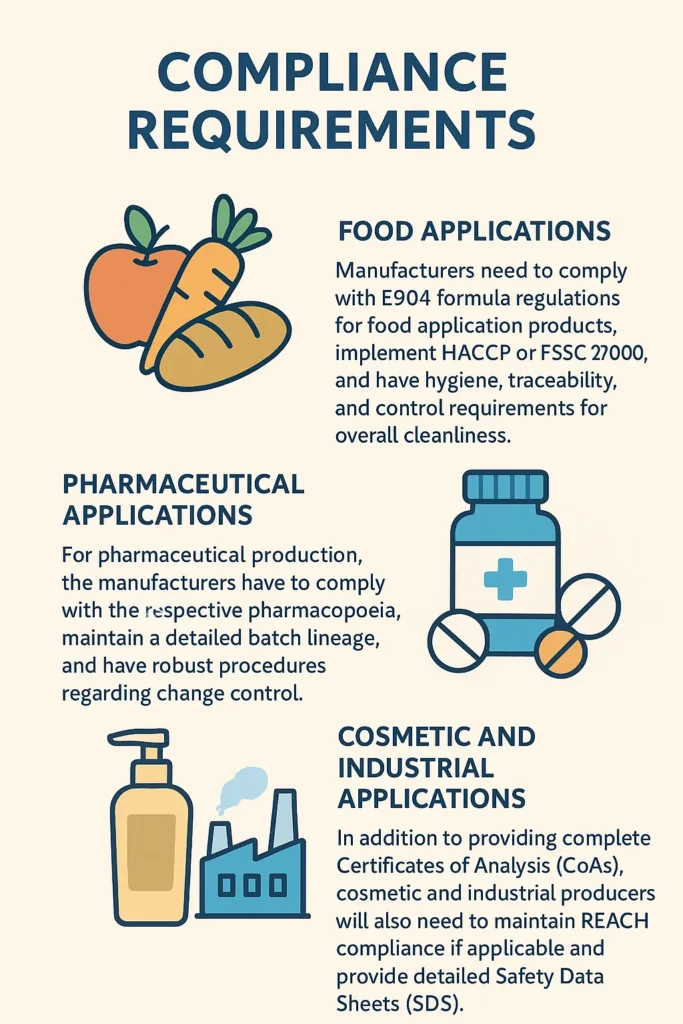
Pharmaceutical Applications
For pharmaceutical production, the manufacturers have to comply with the respective pharmacopoeia, maintain a detailed batch lineage, and have robust procedures regarding change control.
Cosmetic and Industrial Applications
In addition to providing complete Certificates of Analysis (CoAs), cosmetic and industrial producers will also need to maintain REACH compliance if applicable and provide detailed Safety Data Sheets (SDS).
Investment & Feasibility Snapshot
This shellac processing business can start with a minimal setup which would allow more direct scaling to higher grades.
Typical Capex Includes
- Melting tanks, filters, dryers, washers and buttoning machines
- Washing and crushing irrigators
- Dewaxing and bleaching units
- QC workshop tools
- Air handling, dust extraction and safety systems
Read More: Best Profitable Manufacturing & Processing Business Ideas in Jharkhand
Typical Opex Includes
- Seedlac purchases
- Chemicals and filtration aids
- Specialized technicians and QC chemists
- Port-side export logistics at Kolkata, Haldia, Visakhapatnam, and Mundra
Revenue Streams Include
- Food-grade flakes
- Dewaxed grades
- Bleached grades
- Button lac
- Shellac varnishes and concerning formulations
- Lac wax and ancillary by-products
Read Our Book: Click Here
Go-to-Market Strategy for Shellac Startups(Shellac Market in India)
- Identify customer target segment (i.e., food, pharma, personal care or industrial).
- Sample packs and specification sheets to indicate viscosity, color and wax content should be developed.
- Identify potential customers through SHEFEXIL events, export fairs and the digital B2B platform.
- Quality Export SOPs, moisture-proof palletization, and container routines must be developed.
- To raise the profit margins, the marketing of dewaxed/bleached grades would be initiated at intervals of 12-18 months.
Founder’s Mindset: Learning from Business Leaders of India
This is long-term advocacy for ethical brand building that is exemplified by Ratan Tata in repackaging legacy material into contemporary offerings in the marketplace by first-time founding entrepreneurs.
The advocacy for a biodegradable property of shellac is supported by Anand Mahindra’s focus on innovation for sustainability with stakeholder focus.
Improvement in quality with record-keeping has been a ladder by which grassroots LAC entrepreneurs matured their small operations into reliable exporters.
Find the Best Idea for Yourself With our Startup Selector Tool
How NPCS Helps You Start a Shellac Manufacturing Business
Niir Project Consultancy Services (NPCS) includes a total well-methodical consulting service for lac shellac industry setting up. The NPC offers shellac and lac based product units Market Survey-cum-Detailed Techno-Economic Feasibility Reports for purposive use.
NPCS Offers:
- Complete processing guide for making manufacturing
- Marketability and exports demand information
- Schematic representation of factory layout and process flow
- Determination of a product range and processing capacity
- Procurement of equipment (local and foreign)
- Complete projection of the financials and estimation of the profitability
- Strategies for risk management
- Regulations and certifications, coping with implementing
It allows the entrepreneurs to lower their risk while seeking funds to design and operate shellac manufacturing facilities optimally to meet the global competition as well as export market requirements.
FAQs-Shellac Market in India
1.Which sectors fuel the Shellac Market of India?
A.Food, pharmaceuticals, personal care, wood finishing, and acrylics supplied industrial coatings.
2.Does shellac have a consistent export demand?
A.Yes. The shellac market of India enjoys strong and varied export demands from the USA, Europe, the MENA region, and Asia.
3.Is shellac ecologically sustainable?
A.Yes. It is natural, low carbon, and biodegradable that makes shellac ecologically sustainable.
4.What certificates do shellac manufacturers usually have?
A.For food, manufacturers should generally have HACCP or FSSC 22000. For pharmaceuticals and cosmetics, manufacturers usually needed documents for quality control (QC) and/or regulatory compliance together with other industry standard.
5.What is the pathway for new business owners to get into the shellac business?
A.Business owners who want to establish a small processing facility for seedlac and shellac, including the necessary quality systems, could focus on exporting quality systems to that effect. In essence, they can work with NPCS to create financial and technical feasibility studies for that.