
A Tax Reform That Rewrites the Playbook for Indian Business
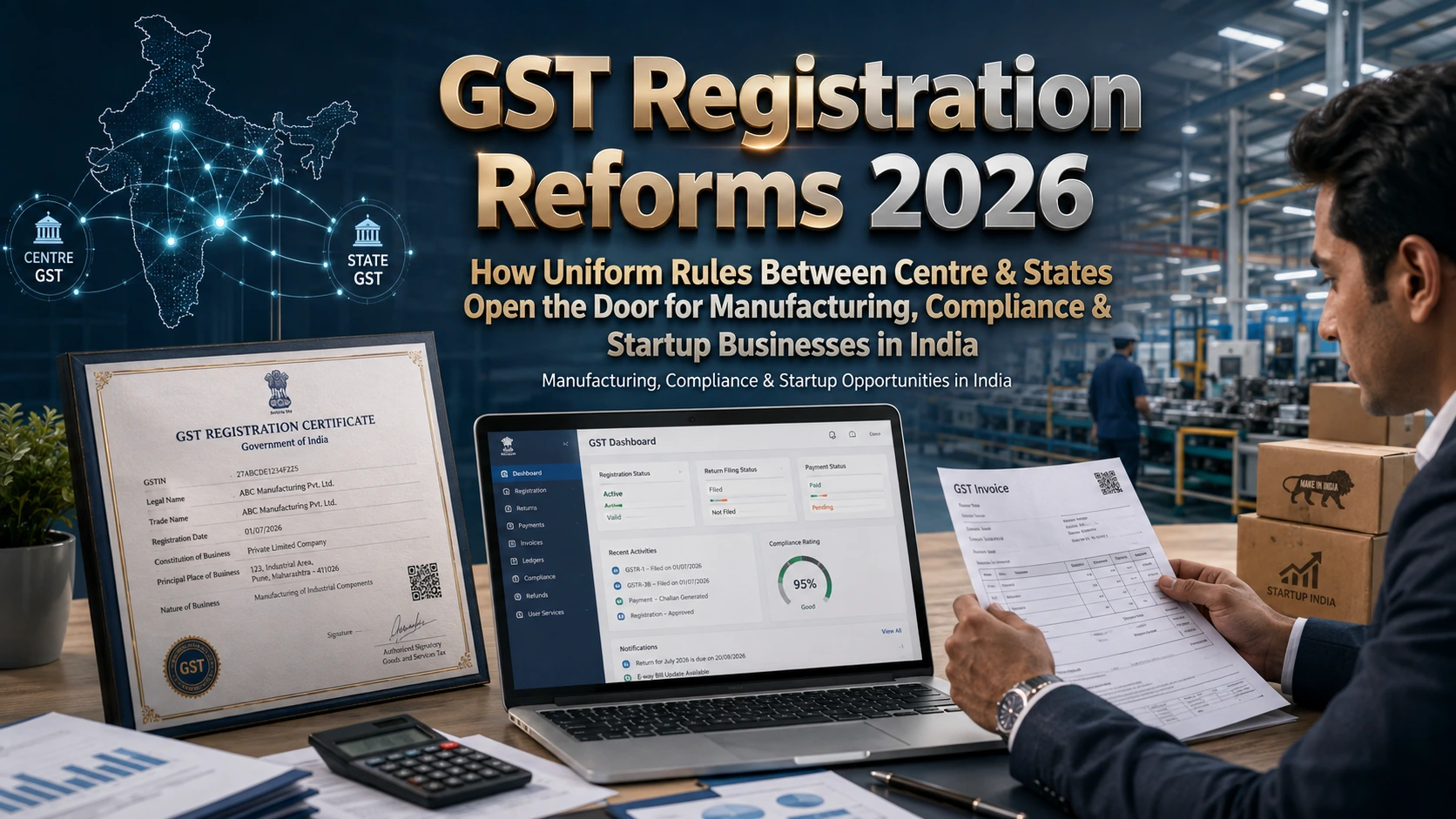
India’s goods and services tax regime is in a crucial phase of its evolution, and it is the second most ambitious indirect tax in the world. The Central government and state tax officials, as reported by Jagran.com on 22nd August 2026, are jointly developing a uniform GST circular that will simplify the GST registration procedure for businesses with an Input Tax Credit (ITC) exceeding ₹2.5 lakh per month. CBIC member (GST) Sanjay Mangal confirmed the move, which seeks to remove the disparity between the central and state GST formations, a factor which has been a headache for larger businesses, manufacturers and multi-state operators for a long time.
This comes on the back of the historic reforms in the Goods and Services Tax (GST) regime launched by Prime Minister Narendra Modi in August 2025, which had already made the registration process quick and seamless for small and low-risk businesses under CGST Rule 14A. The remaining 35 per cent of new GST registrants — mostly mid-to-large businesses — now follow a new standardised registration process that is faster and clearer.
This is more than administrative tidying for entrepreneurs, MSMEs, manufacturers, investors and Startup founders. A streamlined and common registration process for GST simply reduces the cost of conducting business in India and that presents real new revenue potential in many sectors.
Related Article: GST Registration for Manufacturing Units: Documents, Process & Common Rejections
What Recent Reporting Means: Decoding the GST Registration Reform
What Happened
A common document checklist and a common circular for GST registration are under discussion, and tax officers at the Centre and State are even finalizing them, according to a report by Jagran.com and confirmation from senior government officials. The next GST Council meeting, which Finance Minister Nirmala Sitharaman will chair, will follow this circular.
The drive is obvious: There are currently 1.68 crore businesses registered under the Goods and Services Tax (GST). Businesses now make 65 per cent of new signups under the quick-track Route 14A scheme (for businesses with ITC of below ₹2.5 lakh/month). The remaining 35 per cent – the bigger businesses – have got a mixed bag of documents and delays from both central and state GST officers. This non-uniformity leads to uncertainty, compliance expenses and registration delays.
CBIC is also working towards automation of the GST cancellation process and standardisation of de-registration reasons, apart from registration reforms, which further provides businesses with a more predictable and fair set of compliance guidelines.
Why It Matters for Business
Once the government eases the hassle of registration for GST, multiple economic factors are triggered. Manufacturers benefit by quicker availability of ITC, thereby enhancing cash flows. New MSMEs can be made part of the formal economy without incurring higher risk of procedural rejection. Multi-state operators are growing at an increasing pace because of the growth of ecommerce and will enjoy uniformity of document requirements across all different states. The compliance services, advisory, software and document management ecosystem experiences a boom in demand.
Why This Industry Is Growing: The GST Compliance Economy
Now the GST compliance market in India is an economy of its own, with multi-thousands of crores of business transactions that are happening in it. The number of registered businesses has exceeded 1.68 crore, and businesses must file monthly or quarterly. Therefore, the demand for compliance services, technology, advisory and consulting is higher than ever. In 2025–26, the government has been able to consistently collect a huge amount of GST – more than ₹ 2 lakh crore per month, showing the scale of the economic activity that flows through the system.
The new uniform registration guidelines (as mentioned in Jagran.com) will help to fast-track the business formalisation process. The informal sector’s transition to the formal sector, partly due to the ease of registration, is expected to increase the number of GST registrations by 20–25 per cent over the next three years.
This development means more clients for all compliance-related businesses for entrepreneurs. Running a GST consultancy, developing tax software, making stationery and record-keeping products, or training accountants, the regulatory drive is a constant demand.
Government Policies & Incentives Supporting GST-Aligned Businesses
There are several government schemes that directly benefit enterprises that were born out of GST reform:
- GST 2.0 & Rule 14A (CBIC): The Central Board of Indirect Taxes and Customs (CBIC) has operationalised Rule 14A from November 1, 2025, enabling 3-day electronic GST registration for eligible small businesses. This framework directly boosts formal business registration.
- Ministry of MSME Udyam Registration: The Ministry of MSME has linked the Udyam and GST data, making it easy to dual register. The eligibility of benefits under the MSME recognition is now directly linked to registration under the GST regime.
- Startup India Programme (DPIIT): The Department for Promotion of Industry & Internal Trade (DPIIT) recognises tax-tech startups under the Startup India scheme, providing tax exemptions for three years and easier regulatory compliance.
- Digital India Mission: The Digital India Mission accelerates adoption of cloud-based compliance tools, directly benefiting GST software businesses.
- SIDBI MSME Lending: Small Industries Development Bank of India (SIDBI) is offering priority sector loan for MSMEs to the business that provides compliance, professional and technology services to MSMEs.
- National Skill Development Corporation (NSDC): NSDC sponsors GST training programmes for chartered accountants, tax practitioners and small business owners, leading to a demand for GST trainers.
- GSTN Portal & GST Suvidha Providers (GSPs): GST Network (GSTN authorises the private sector providers of API services to the business known as GST Suvidha Providers (GSPs). This means a whole licensed services sector.
- Commerce Ministry’s ONDC (Open Network for Digital Commerce): The ONDC now mandates GST compliance for all registered sellers, expanding the addressable market for GST onboarding service providers.
- Ministry of Finance GST Council: The GST Council issues circulars and clarifications on a regular basis, which automatically becomes advisory demand for businesses.
View Full Project Details: Project Reports & Profiles
Manufacturing Business Ideas Emerging From GST Registration Reform
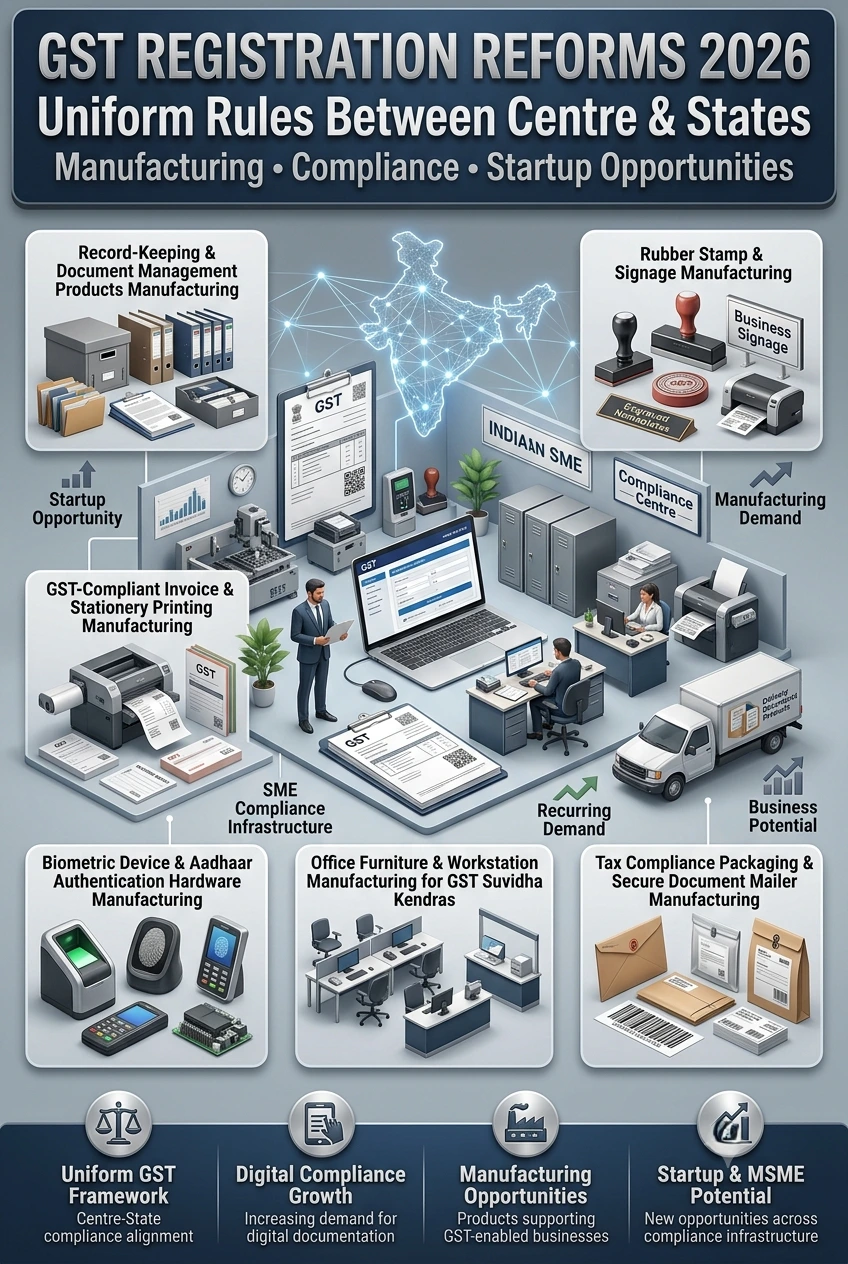
The reform will generate direct and indirect demand chain for a number of manufacturing firms. The number of new medium-sized businesses that register and start operating quickly keeps increasing; thus, demand for the following manufactured products is also increasing rapidly.
1. Record-Keeping & Document Management Products Manufacturing
Evidence in both physical paper and digital format is required for registration of a business for GST. There is a constant demand for quality business document folders, binding products, audit files, index tabs, fireproof storage boxes and archival binders. With the transition to a uniform set of documents in states, there is a uniform need for specific document formats.
Why this emerges from the news: The Jagran.com-covered circular on uniform document requirements for GST registration will drive standardised physical and digital file formats across crores of businesses. Investment: ₹25 lakh – ₹75 lakh. Target: MSME offices, CA firms, tax consultants.
2. Rubber Stamp & Signage Manufacturing
For every new GST Business, the invoice, delivery challan and business correspondence should be printed on the stamps of GSTIN. Lakh of new businesses enter the formal economy every year, generating a constant demand for the low investment, high turnover manufacturing segment.
Investment: ₹5 lakh – ₹20 lakh. Perfect for businessmen in a village. As businesses renew their GST numbers and expand, they are getting demand again.
3. GST-Compliant Invoice & Stationery Printing Manufacturing
Investment: ₹15 lakh – ₹60 lakh. Repeat business with high volume and low margins. Businesses can distribute or sell directly through online B2B platforms
4. Biometric Device & Aadhaar Authentication Hardware Manufacturing
Most states have made the Aadhaar-based biometric verification compulsory for GST registration. GST Suvidha Kendras require the following devices: Biometric scanner, finger print reader, web camera and iris scanner. As the biometric verification programme rolls out from state to state, the need for native biometric hardware is increasing.
Investment: ₹50 lakh – ₹2 crore. Takes part in the Make in India electronics initiative. Able to apply for PLI scheme benefits in electronics manufacturing.
5. Office Furniture & Workstation Manufacturing for GST Suvidha Kendras
The new physical verification and biometric centres in India – the ‘GST Suvidha Kendras (GSKs)’ – provides an institutional demand for ergonomic desks, client seating, document counters, display boards, and privacy screens. This is a government-backed recurring purchase segment where GSKs operate in all major cities and districts.
Investment: ₹30 lakh – ₹1 crore. Long-term revenue is provided by a range of institutional supply contracts with GST departments.
6. Tax Compliance Packaging & Secure Document Mailer Manufacturing
Investment: ₹20 lakh – ₹80 lakh. Specialty packaging comes with security features is priced at a premium over regular envelopes.
Get Detailed Insights from This Book: Handbook on Modern Packaging Industries
Import–Export Opportunity Analysis
Export Markets for Indian GST-Tech Solutions
The GST compliance technology of India has spread to the world. In South Asia (Bangladesh, Sri Lanka, Nepal), Southeast Asia (Vietnam, Indonesia, Philippines) countries are either bringing in GST/VAT regimes or modernizing their existing systems. Indian tax-tech companies with a strong compliance engineering profile are poised to take a bow in these markets as they export their cloud SaaS solutions, advisory and training programs.
The reported drive towards digitisation and automated registration processing further enhances Indian tech companies’ international reputation as creators of real solutions to compliance.
Import Substitution in Compliance Hardware
India is presently importing considerable amounts of biometric scanners, fingerprint authentication equipment and secure printing equipment for printing documents. The GST verification drive and Make in India initiative help domestic manufacturers build a less dependent India. They also create a domestic government market for developing and assembling such hardware. As a result, domestic manufacturers can reduce import dependence and benefit from growing government demand.
Export of CA & Tax Advisory Services
Multinational companies are increasingly looking to chartered accountants and GST consultants from India to establish their presence in India. When authorities complete the uniform registration guidelines, their services will become even more valuable because industries will have billable hours for compliance advisory services under predictable rules.
Indian MSME & Startup Success Stories in the GST Compliance Ecosystem
ClearTax (Defmacro Software Pvt Ltd)
ClearTax was established in 2011 as an income tax filing platform. In 2017, it expanded into a GST compliance platform. It currently supports more than 3,000 large companies and millions of SMEs. Its cloud-based software supports GST return filing, e-invoice generation, and reconciliation. ClearTax is a good example of how a startup can develop a big business out of India’s regulatory compliance needs.
Masters India
Masters India, a GSTN-invited GST Suvidha Provider (GSP), handles over 4% of India’s e-invoices and 8% of e-way bills through its API infrastructure. The company has expanded by developing enterprise-compliant automation features. It claims to have directly tested these features with the digitalisation of GST being implemented at Jagran.com.
Marg ERP (New Delhi)
Smart entrepreneurs start here—find your perfect venture
About NPCS – Niir Project Consultancy Services
If entrepreneurs wish to make the time to capitalize on this opportunity of the reform of the GST regime and realize it as a viable business proposition, NPCS (Niir Project Consultancy Services) provides them with a full range of assistance:
- Detailed Project Reports (DPRs) on GST related businesses such as compliance software, biometric device manufacturing and document management units.
- The research team conducted market research on the Indian tax-tech, compliance services, and MSME formalisation sectors.
- Consultation on expanding the registration of new manufacturing units under the GST regime and conducting feasibility studies for the same. Advise on extension of registration of new manufacturing units under the GST regime and for undertaking feasibility studies.
- Technology Consultancy for businesses establishing GST Suvidha Centre, Biometric Verification infrastructure, Tax Advisory Practice
- Support for MSME loan applications and startup funding rounds in Bank Loan Documentation & Investment Pitch.
All the major nationalized as well as private banks, SIDBI, NABARD, and the Department of MSME in governments of different states in the country accept NPCS project reports.
Business Opportunity at a Glance: Data Table
| Parameter | Details |
| Industry | GST Compliance, Tax Tech, Business Registration Services |
| Market Driver | Centre–State GST Registration Uniformity & GST 2.0 Reforms |
| Investment Range | ₹5 Lakh – ₹2 Crore (depending on scale & tech depth) |
| MSME Opportunity | High – 1.68 crore GST-registered businesses need compliance support |
| Export Potential | SaaS Tax-Tech products exportable to South Asia, Africa, SE Asia |
| Government Support | DPIIT Startup India, SIDBI, MSME Ministry, Digital India Mission |
| Risk Level | Low to Medium – regulatory driven demand is non-cyclical |
| Growth Outlook | Strong – GST collections consistently above ₹2 lakh crore monthly |
Conclusion: The Compliance Economy Is the Growth Economy
The GST registration reform in India is not merely a bureaucratic change, as reported by Jagran.com on August 22, 2026. Instead, it is a comprehensive overhaul of the process. This marks the government’s dedication to removing compliance impairment. Such impairment is stunting formalisation, impeding ITC, and deterring the entry of big businesses. When the Centre and states reach a consensus on a single circular, thousands of medium and large enterprises will register faster. They can then increase production, create more jobs, and purchase more products, including compliance software and physical infrastructure.
As an entrepreneur and MSME founder, it’s now or never. As India is moving towards formalisation, the compliance economy — software, consulting, document management, biometric hardware, training — is growing exponentially. The manufacturing opportunities associated with GST expansion vary widely, remain viable, and sometimes require low investment.
India’s GST system is evolving into a predictable, digitised, and business-friendly framework. Those who position their ventures in alignment with this regulatory direction will find both captive demand and government support. The GST Council meeting that will ratify the uniform circular is a milestone to watch — and act on — now.
Act now. Engage NPCS for a Detailed Project Report, explore CBIC’s GSP licensing, register under Startup India, and position your business at the intersection of India’s largest tax reform and its fastest-growing compliance economy.