
Tata Steel Jharkhand Expansion
A ₹10,000 Crore Signal That Smart Entrepreneurs Cannot Ignore
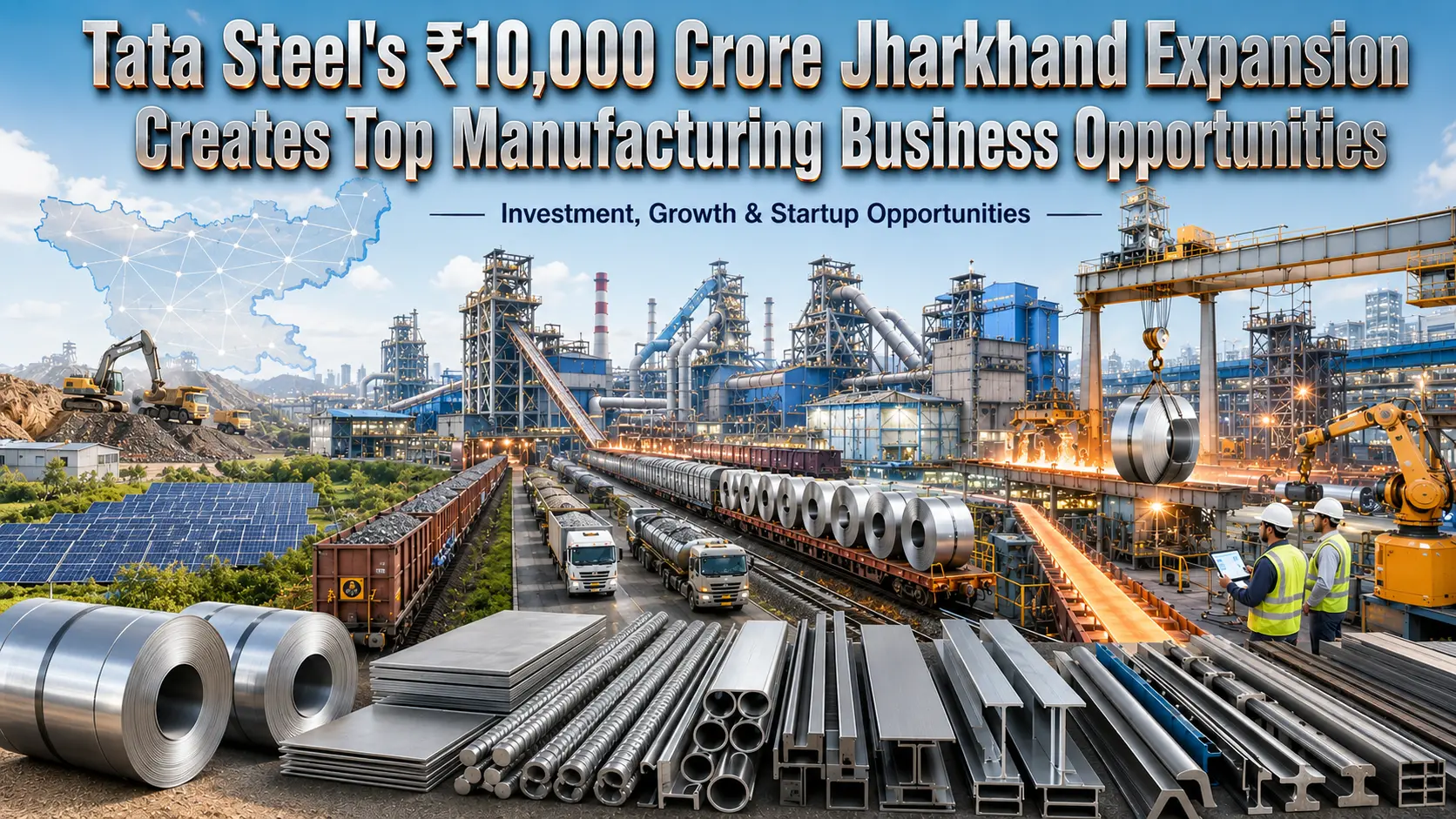
Investment of ₹10,000 crore in one state by India’s biggest steel major is enough to pave the way for the business community. Economic Times quoted Tata Steel saying that it will invest ₹10,000 crore in various projects at its Jharkhand site by 2028 with a view to creating 2,000 direct and indirect jobs and a huge capacity addition of 40 MTPA (million tonnes per annum) in the country.
It’s not just a corporate slogan. It is a big set up for manufacturing entrepreneurs, MSME owners and Startup founders. With each major steel plant development, there is an entire range of ancillary manufacturing needs that emerge, such as precision parts, industrial packaging, specialised fabrication and maintenance.
When you are sitting on the sidelines, this is the time to ask: What manufacturing business can I develop to cater to the growing business of Tata Steel in Jharkhand?
What Recent Economic Times Reporting Means for Indian Manufacturers
The Economic Times report features some of the specific investment split-ups that have huge implications for ancillary manufacturers:
- ₹7,000 crore allocated to HIsarna & Easy Melting Technology, a patented low-carbon iron-making technology that relies upon the absence of coke ovens, sinter plants and pellet plants.
- An investment of ₹2600 crore for expansion of the Tinplate Division, one of India’s most important manufacturing divisions which supplies packaging materials for the food, beverage and industrial packaging industries.
- Rolling mill expansion of Combi Mill, with an investment of ₹1,500 crore, for manufacturing high-value flat steel products for automotive and white goods segment.
These three investment streams will need a new supply base altogether. Tata Steel is not able to construct these projects on its own. It will rely on a network of local and regional manufacturers for raw materials, sub-components, maintenance equipment and fabricated parts.
The Economic Times also indicates that Tata Steel would increase India’s steel capacity from today’s 27.35 MTPA to 40 MTPA, which is a 46% increase. Not an incremental growth. This marks a steel geography transformation in India and Jharkhand is at its very centre.
Related Article: Tata Steel’s 70-80% Shift: 5 Ferro Alloys Startup Opportunities
Why India’s Steel and Ancillary Manufacturing Sector Is Growing
The main driver of growth in India is its infrastructure boom. The National Infrastructure Pipeline (NIP) is consolidating an infrastructure spending of ₹111 lakh crore by 2030. The steel is essential for every highway, bridge, port, airport and metro project. Domestic steel makers are racing to be able to meet this demand before imports do.
Further, the government of India’s Production Linked Incentive (PLI) scheme for specialty steel also provides an incentive to increase capacity. According to
The steel industry is one of the pillars of Make in India and has set a target of 300 million tonnes for production by 2030, almost a treble of current production.
This expansion pattern will generate a need for ancillary manufacturers to make a smart move in proximity to major steel centres in the next few decades. The manufacturing entrepreneurs now make Jharkhand a priority geography, with Tata Steel’s Jamshedpur flagship operations situated in the region.(Tata Steel Jharkhand Expansion)
Government Policies and Incentives Supporting Steel Ancillary Manufacturing
The government has established a strong policy framework for MSMEs to engage in the steel ancillary value chain ecosystem. Important supports include:
1. MSME Ministry Support
The Ministry of MSME provides capital subsidy scheme, technology upgrade fund scheme and cluster development program for ancillary industries in close vicinity of large manufacturing clusters. These schemes can be availed by the entrepreneurs near the Jamshedpur or near the Gamharia by MSME Development Institutes.
2. Startup India Registration Benefits
Startup India, manufacturing will benefit from tax holidays for three years, fast-track patent facility, and expedient environmental clearance among other advantages through Startup India, particularly for metal fabrication and industrial component startups.
3. DPIIT’s Industrial Cluster Incentives
The Industrial Development Program of DPIIT has identified several industrial clusters in Jharkhand. Businesses establishing factories in these clusters enjoy pre-developed land and shared utilities, along with quicker approvals.
4. SIDBI Financing for Steel Ancillaries
SIDBI (Small Industries Development Bank of India) at sidbi.in offers specialized lending facilities with a discount on interest rates for the MSMEs engaged in the supply of large manufacturing units. Loans for Steel ancillary units are available under MSME loan schemes of SIDBI with subvention of interest.
Get Detailed Insights from This Book: Steel and Iron Handbook
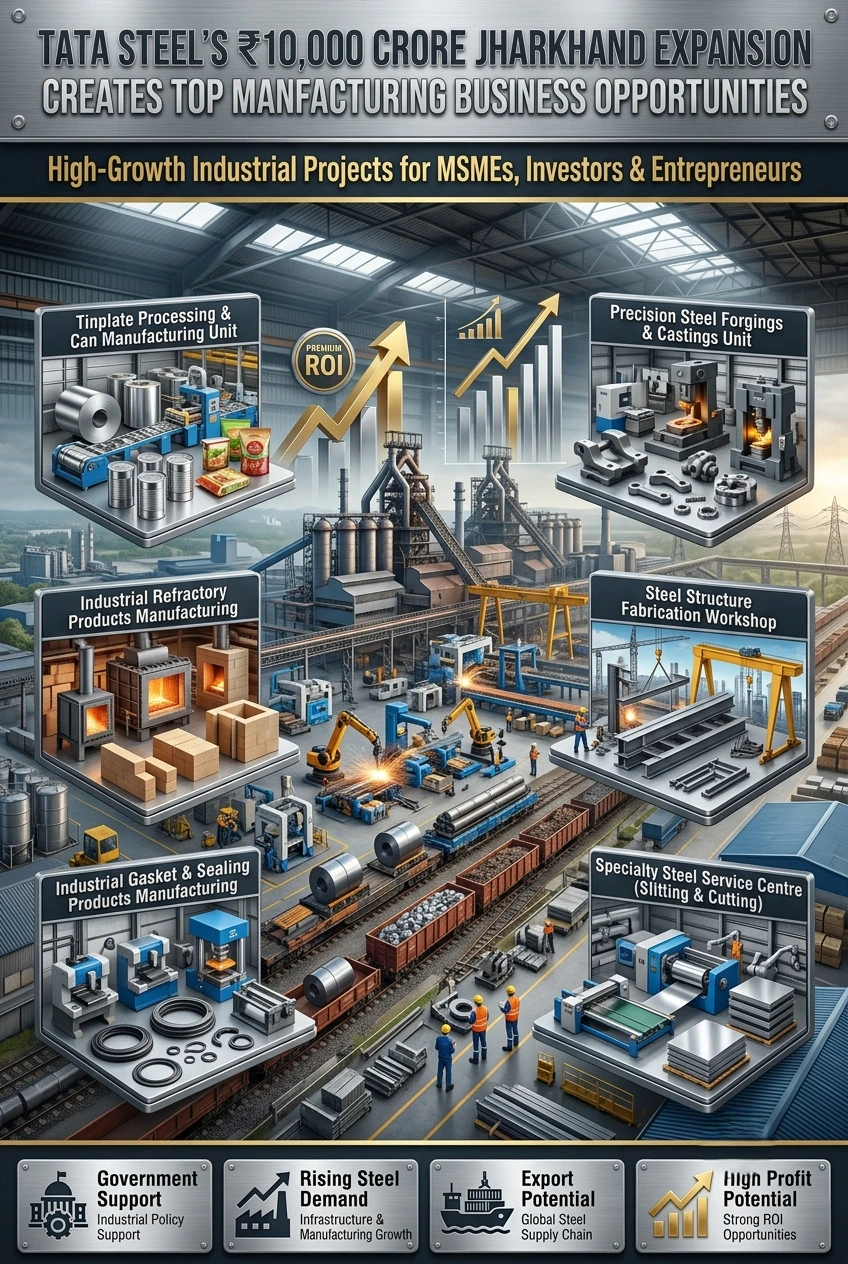
6 Manufacturing Business Ideas Emerging from Tata Steel’s Jharkhand Expansion
1. Tinplate Processing and Can Manufacturing Unit
The ₹2600 crore expansion in the Tata Steel’s Tinplate Division will generate immediate downstream demand. Tinplate is a raw material for food cans, paint containers, aerosol cans and industrial drums. A Tinplate Conversion Unit (Cutting, coating and forming tinplate sheets into finished containers) can be aimed at FMCG Companies, Paint Manufacturers and Chemical Packagers.
Investment capacity: up to ₹5 crore based on the capacity. Important machines: Slitting machine, lacquering machine, Seaming machine.
2. Precision Steel Forgings and Castings Unit
The molten iron is produced by the HIsarna technology, thus supplying forge shops and foundries. A precision forgings unit that is producing flanges, couplings, valves and structural connectors for the maintenance of steel plants can become a captive supplier at Tata Steel’s Jharkhand plants.
The segment requires quality certification but has fairly good order books backed by anchor customers such as Tata Steel with long-term contracts.
3. Industrial Refractory Products Manufacturing
The number of refractory bricks, castable and mortar consumed by every steelmaking furnace, including those used by Tata Steel’s HIsarna furnaces, is tremendous. A refractory products manufacturing unit located close to Jamshedpur is always in the demand list of the Tata Steel and other local steel producers.
India is also a major importer of raw materials for refractories, adding another dimension to the exporters’ import substitution.
Identify high-growth industries before others do
4. Steel Structure Fabrication Workshop
Thousands of tonnes of structural steel fabrication such as beams, trusses, platforms, staircases and equipment support structures are needed for the construction of new HIsarna units, Combi Mills, and Tinplate expansion lines. For a 500–1000 tonne per month structural steel fabrication shop, it can rely entirely on Tata Steel project business in the construction phase and shift gears to maintenance fabrication in the post construction phase.(Tata Steel Jharkhand Expansion)
5. Industrial Gasket and Sealing Products Manufacturing
However, there is also a high value market of low emission steel plants that currently HIsarna type, which are supplied with pressurised applications requiring robust gaskets, seals, packings. Such as the spiral wound gaskets, graphite sheet, PTFE seals manufacturing unit that are extremely premium priced & hardly competing for price by Chinese imports because of the importance of their applications.
6. Specialty Steel Service Centre (Slitting & Cutting)
Tata Steel’s Combi Mill expansion will produce high-value flat steel products that downstream users — automotive tier-2 suppliers, white goods manufacturers, and engineering firms — need cut to precise widths and lengths. A steel service centre with slitting lines, cut-to-length lines, and blanking equipment in Jharkhand can capture this value-added processing margin between the mill and the end-user.
Import–Export Opportunity Analysis
In the latest innovative advancement, Indian steel manufacturers look poised to earn a significant premium following the introduction of Tata Steel’s ground-breaking high-reduction, low-carbon HIsarna technique of steelmaking. Since 2026, high-emissions imported steel will face the European Union’s Carbon Border Adjustment Mechanism (CBAM), a tax-based approach targeting to deprice such imported items, thus giving a global premium to Indian green steel manufactured with methods such as the HIsarna.
Export oriented manufacturers get a chance to produce a whole variety of specialized products – hi strength automotive grades, tinplate for European food products and structural profiles – which get two premiums one of quality and other carbon credits.(Tata Steel Jharkhand Expansion)
Indian steel & engineering exporters can tap export incentives and market-related information provided by CII which plays an important role in promoting exports of steel and engineering goods to Europe, South East Asia & the Middle East.
Indian MSME Success Stories in Steel Ancillary Manufacturing
Precision Engineering MSMEs of Jamshedpur
Jamshedpur’s vendor ecosystem is one of India’s most evolved. They have thousands of MSMEs in Adityapur Industrial Area, whose founders have been supplying precision components, maintenance work and fabricated assemblies to Tata Steel for decades. A number of such firms have today evolved from the level of small single-machine outfits in the 1980s into medium-sized companies with revenues of 100-500 crore annually.
Refractory Manufacturers of Bokaro and Durgapur
The steel belt of Jharkhand and West Bengal supports a cluster of refractory product manufacturers who have evolved alongside steel capacity expansions. Several have graduated from local suppliers to multi-state businesses serving SAIL, JSW, and private steel producers across India.(Tata Steel Jharkhand Expansion)
These success stories share a common thread: early positioning near an expanding steel plant, quality certification investment, and consistent reinvestment into capacity. The current Tata Steel expansion offers a new generation of entrepreneurs the same foundational opportunity.
Get Detailed Project Report (DPR): Steel and Steel Products Manufacturing Guide
About NPCS — Niir Project Consultancy Services
For entrepreneurs planning to enter steel ancillary manufacturing, reliable feasibility data is the starting point. We, at NPCS (Niir Project Consultancy Services), are the top industrial project consultants in India offering comprehensive DPRs (detailed project reports), techno economic viability assessment reports and machinery sourcing consultation. We assist to setup any manufacturing unit.
NPCS has supported thousands of Indian MSME founders in setting up refractory units, fabrication shops, packaging factories, and precision component manufacturing facilities. Their reports cover investment estimates, plant layouts, raw material sourcing, market demand analysis, and financial projections — exactly what a first-time manufacturer needs before approaching a bank or investor.
Whether you are evaluating a tinplate processing unit or a structural steel fabrication workshop, NPCS provides the ground-level data that transforms an opportunity into a viable business plan.
Data Table: Manufacturing Opportunities from Tata Steel’s Jharkhand Expansion
| Business Idea | Tata Steel Link | Investment Range | Export Potential | Demand Trigger |
| Tinplate Processing & Can Mfg | Tinplate Division (₹2,600 Cr) | ₹50L – ₹5 Cr | High (CBAM benefit) | FMCG, paints, chemicals |
| Precision Forgings & Castings | HIsarna molten iron output | ₹1 Cr – ₹10 Cr | Medium | Plant maintenance demand |
| Refractory Products Mfg | Furnace lining for all units | ₹75L – ₹8 Cr | High | Perpetual furnace wear |
| Structural Steel Fabrication | Construction of new units | ₹50L – ₹3 Cr | Low–Medium | Project capex phase |
| Industrial Gaskets & Seals Mfg | HIsarna pressure systems | ₹30L – ₹2 Cr | Medium | Safety-critical demand |
| Steel Service Centre | Combi Mill flat products | ₹2 Cr – ₹15 Cr | Medium | Auto & white goods growth |
FAQ: Manufacturing Businesses Near Tata Steel’s Jharkhand Operations
Q1. Do I need prior experience in the steel industry to start an ancillary manufacturing unit?
Not necessarily. Several ancillary businesses — such as gasket manufacturing, can-making, or service centres — can be started by entrepreneurs with general manufacturing experience and a willingness to invest in technical training and quality certifications. However, refractory and precision forgings require domain expertise or a strong technical co-founder.
Q2. How do I become a vendor to Tata Steel?
Tata Steel uses a proper vendor registration procedure on its procurement portal. Manufacturers should establish their ability to produce, provide quality certifications (at least ISO 9001 certified), and financial strength. Most of the current Tata Steel successful vendors in the initial days used to supply goods/services to Tata Steel’s tier 1 contractors.
Q3. What government schemes can help me finance a steel ancillary unit?
Major incentive schemes The Credit Guarantee Fund Trust for Micro and Small Enterprises (CGTMSE) offers loans without collateral, SIDBI also has MSME loan schemes and TUFS, to loans for procurement of machinery and TUFS loan for purchasing machinery by manufacturing businesses. Incentives at state-level in Jharkhand provide power tariff concessions and capital subsidy for new manufacturing units.
Q4. Is the HIsarna technology expansion a long-term commitment or a one-time project?
Tata Steel’s patented proprietary core technology Hisarna for next generations of steelmaking processes. Rs 7,000 crore investment is a beginning not the end. “Tata Steel looks to build over 50 MT capacity for India at long run,” as per Economic Times – Making Jharkhand indispensable permanently, sustainably.
Q5. Can I export products made for the steel sector?
Absolutely. Refractory products, precision forgings, and specialty steel products all have strong global demand. The EU’s Carbon Border Adjustment Mechanism actually advantages Indian manufacturers supplying to green steel plants, since those products carry lower embedded carbon. Export promotion support is available through government bodies and industry chambers.
Q6. What is the minimum viable scale to start a tinplate processing unit?
A small-scale tinplate slitting and conversion plant with a capital outlay of 50-80 lakh could handle between 50 and 100 tonnes per month of tin plate. Such operations could find the target market in the regional paint manufacturers, small FMCG units and agrichar firms, and not national brand-heavy concerns.
Conclusion: The Window of Opportunity Is Now
Tata Steel’s ₹10,000 crore commitment to Jharkhand — as highlighted by Economic Times — is a rare and durable market signal. It is not a short-term project announcement. It is a multi-year investment programme that will fundamentally reshape the industrial landscape of Jharkhand between now and 2028.
For manufacturing entrepreneurs who act early, the opportunity is asymmetric. The supply chains around a new HIsarna plant, an expanded Tinplate Division, and a Combi Mill are not yet filled. Vendors have not yet been selected. Factory plots near Jamshedpur and Gamharia are still available at pre-boom prices.
Smart founders — supported by government schemes from the Ministry of MSME and DPIIT, and backed by institutions like SIDBI — can position themselves as preferred suppliers before competition arrives.(Tata Steel Jharkhand Expansion)
Economic Times is signalling this opportunity today. Entrepreneurs who respond to this signal with action, not observation, will be the ones building ₹50–500 crore businesses by 2030.
The timing is right. The policy support is in place. The anchor customer has committed. What remains is your decision to act.