Introduction: green energy business opportunities
India’s renewable energy sector is no longer about sustainability – it has become one of the largest industrial growth engines of the decade. With a cumulative installed renewable energy capacity (~207 GW, excluding large hydro) power, India is one of the fastest growing clean energy markets in the world. Solar energy alone is over 135 GW and wind energy is about 54 GW. Biomass, small hydro, and waste to energy are also less developed, suggesting good potential in the future.
As India aims for 500 GW non-fossil fuel-related capacity by 2030, there will be a rapid demand for renewable energy equipment, components, storage systems, and supporting infrastructure. This transformation is presenting great opportunities to entrepreneurs and MSMEs and industrial investors in renewable energy manufacturing.
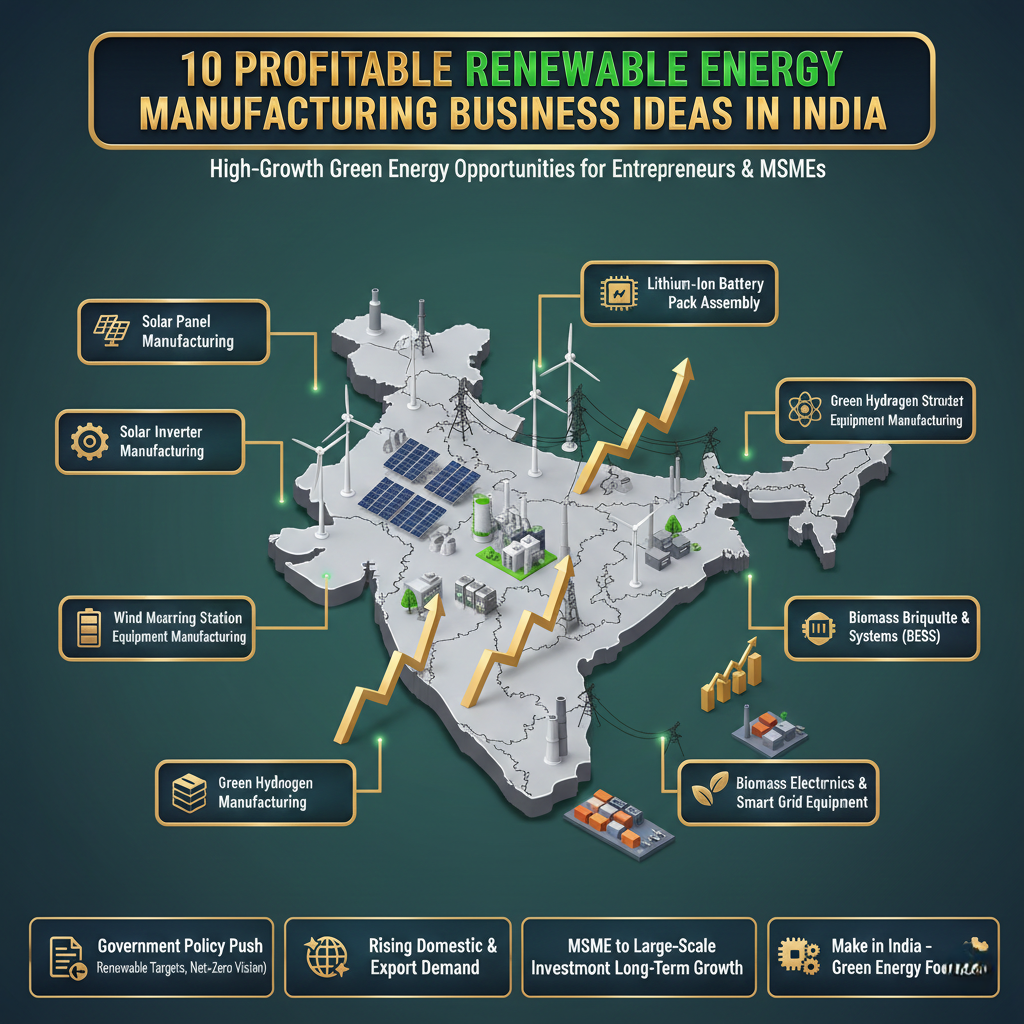
This guide details the best renewable manufacturing business opportunities in India in 2026, and investment insights plus growth potential.
Read More: Solar PV Power and Solar Products Handbook
Why Renewable Energy Manufacturing is High-Growth Industry in India
Several structural issues are helping to spur explosive growth in renewable energy manufacturing:
- Strong government support in the form of PLI schemes and green hydrogen missions
- Increasing demand for electricity from urbanization and industrialization
- Growth of electric vehicles and battery storage
- Import substitution opportunities
- Increasing global demand for clean energy equipment
India still imports a significant part of the solar cells and battery materials as well as advanced renewable components. Domestic production not only helps in reducing dependence on imports but also enhances export competitiveness.
1. Manufacturing of Solar Cells and Solar Modules
Solar energy is the mainstay of India’s renewable capacity but importing modules is a major factor. Establishing integrated manufacturing units, including wafers, cells and modules, can yield strong returns.
Key focus areas include:
- High-efficiency technologies (TOPCon and HJT)
- Vertical Integration: Vertical integration for cost control
- Domestic raw material sourcing
- Export oriented production strategy
With increasing installation in rooftop, ground-mounted and hybrid systems, solar manufacturing is one of the best renewable business opportunities in India in terms of profitability.
2. Wind Turbine and Component Manufacturers
India’s wind energy sector has matured, but repowering of old turbines is making a new demand. There are manufacturing opportunities in blades, towers and nacelles, gearboxes and generators.
Entrepreneurs who operate in advanced composites and precision engineering also could reach out to export markets in Asia and Africa. Wind component manufacturing has a long project lifecycle and recurrent service contracts.
Read More: Solar Power Plant – Manufacturing Plant, Detailed Project Report, Profile, Business Plan, Industry Trends, Market Research, Survey, Manufacturing Process, Machinery, Raw Materials, Feasibility Study, Investment Opportunities, Cost and Revenue
3. Battery Energy Storage Production
As the penetration of renewables increases, stability of the grid requires efficient storage systems. Battery production is turning out to be the key to India’s clean energy strategy.
Opportunities include:
- Manufacturing of Lithium ion cell
- Battery pack assembly
- Battery management systems (BMS)
- Sodium-ion and solid state battery research
- Battery recycling plants
Although capital intensive, this segment provides very high long term returns with the EV growth accelerating across the country.(green energy business opportunities)
4. Green Hydrogen Equipment Manufacturing
Green hydrogen being a strategic sector for India’s energy transition Manufacturing electrolysers, fuel cells, hydrogen compressors and storage systems can place businesses at the forefront of a trillion dollar global opportunity.
This segment requires technical expertise and good partnerships but holds long term global export potential. Early movers are likely to acquire technological advantage and government support.
5. Manufacturing of Biomass and Bio-CNG
Biomass energy plays an important part but is still not used extensively. Manufacturing bioenergy boilers, pellet plants, gasifiers and bio-CNG systems can help turn agricultural waste into profitable energy products.
The attraction of this sector is that it provides:
- Constant feedstock supply in agricultural areas
- Multiple revenue streams (gas, power, fertiliser)
- Government incentives in waste management
Biomass pellet manufacturing is also for industrial heating markets and export demand.
Read More: Renewable Energy Sector, Green Power, Solar Energy, Biofuel, Hydroelectric, Wind, Geothermal, Biomass, Non-conventional Energy, New and Renewable Energy Projects
6. Waste to Energy Equipment Manufacturing
Urban waste generation is rising at a great rate in India. Waste to energy capacity is under its potential creating good industrial scope.
Manufacturing technologies like anaerobic digesters, pyrolysis systems, refuse derived fuel plants can meet both the environmental and energy needs. Revenue sometimes is a combination of tipping fees from municipalities as well as the sale of energy, and that improves project viability.
7. Solar Pumps and Agricultural Renewable Equipment
Agriculture is an energy-intensive industry. Solar pump manufacturing has a great potential in rural area markets.
Products include DC pumps, AC pumps, controllers and mounting structures. Government subsidies and rural electrification schemes are driving adoption, so this is a stable mid-scale manufacturing opportunity.
8. EV Charging Infrastructure Manufacturing:
Growth of electric mobility to complement renewable growth Manufacturing EV chargers, power electronics, inverters, etc., can provide scope for a large-scale industry.
India’s EV adoption across two-wheelers, three-wheelers, buses and passenger cars ensures sustainability in the need for charging infrastructure manufacturing.(green energy business opportunities)
9. Grid Infrastructure and Smart Energy Elements
With renewable capacity of over 200 GW, grid modernization is vital. Manufacturing of transformers, smart meters, flexible AC transmission systems and IoT-enabled grid monitoring devices will witness a growing demand.
Digitalization of power networks provides opportunities for developing both software-based hardware solutions and analytical software systems.
Read More: Top 20 High-Growth Renewable Energy Startups to Launch in India
10. Renewable Energy Recycling and Circular Economy Facilities
The renewable industry will eventually produce huge amounts of e-waste from solar panels and batteries. Setting up recycling facilities for Lithium, Silicon, Silver and Copper ensures long term sustainability.
Circular Economy manufacturing decreases raw material dependency and support of the supply chain.
How to Decide Which Renewable Manufacturing Business to Start
Before investing, entrepreneurs should consider:
- Capital investment requirement
- Technology maturity
- Raw material availability
- Government incentives
- Problems with market demand and scalability
- Export opportunities
Detailed feasibility studies and market analysis are used to reduce risks and to make better decisions in capital allocation.
Read More: Solar Cell Manufacturing in India 2026: Market Size, Investment Cost & Profitability Analysis
Investment Outlook for 2026 and Beyond
India’s renewable energy industry is about to enter a high-growth decade. Solar module manufacturing and EV charging equipment currently have fairly faster returns. Battery manufacturing and hydrogen systems can involve large capital but promise phenomenal long term growth.
Manufacturers that place a premium on quality certification, automation and supply chain integration will outperform competitors. Export readiness is bound to be a critical success factor in the coming years.
Conclusion
The renewable energy growth in India serves as a major industrial transformation which designates itself as one of the most important changes during the 21st century. The clean energy sector now experiences fast growth because its manufacturing ecosystem includes solar panels, wind turbines, batteries, hydrogen systems and smart grid technology.
Entrepreneurs who focus on innovation, quality, supply chain security, and export competitiveness can build scalable and profitable businesses in this sector. India needs factories for sustainable power generation because the renewable revolution extends beyond clean energy production.(green energy business opportunities)
Frequently Asked Questions (FAQ)
Which renewable energy manufacturing segment offers the highest returns?
Solar module manufacturing and EV charging equipment currently provide strong short- to medium-term returns. Battery and hydrogen manufacturing offer higher long-term growth potential.
Is renewable energy manufacturing suitable for MSMEs?
Yes. MSMEs can concentrate their resources on developing specialized components which include mounting structures inverters smart controllers biomass pellets and EV charger assembly.
What are the major risks in renewable energy manufacturing?
Technology changes and raw material price volatility and regulatory shifts constitute the primary dangers. These can be mitigated through diversification and long-term contracts and continuous R&D investment.
How much investment is required to enter this sector?
The required investment varies according to the specific sector. Solar module assembly requires moderate capital while integrated battery or hydrogen equipment manufacturing requires significant investment and advanced technology infrastructure.
Why is 2026 a good time to invest in renewable manufacturing?
India’s renewable energy targets combined with worldwide decarbonization objectives and national industrial policies create stable demand for renewable energy until 2026 which makes this time suitable for investment.