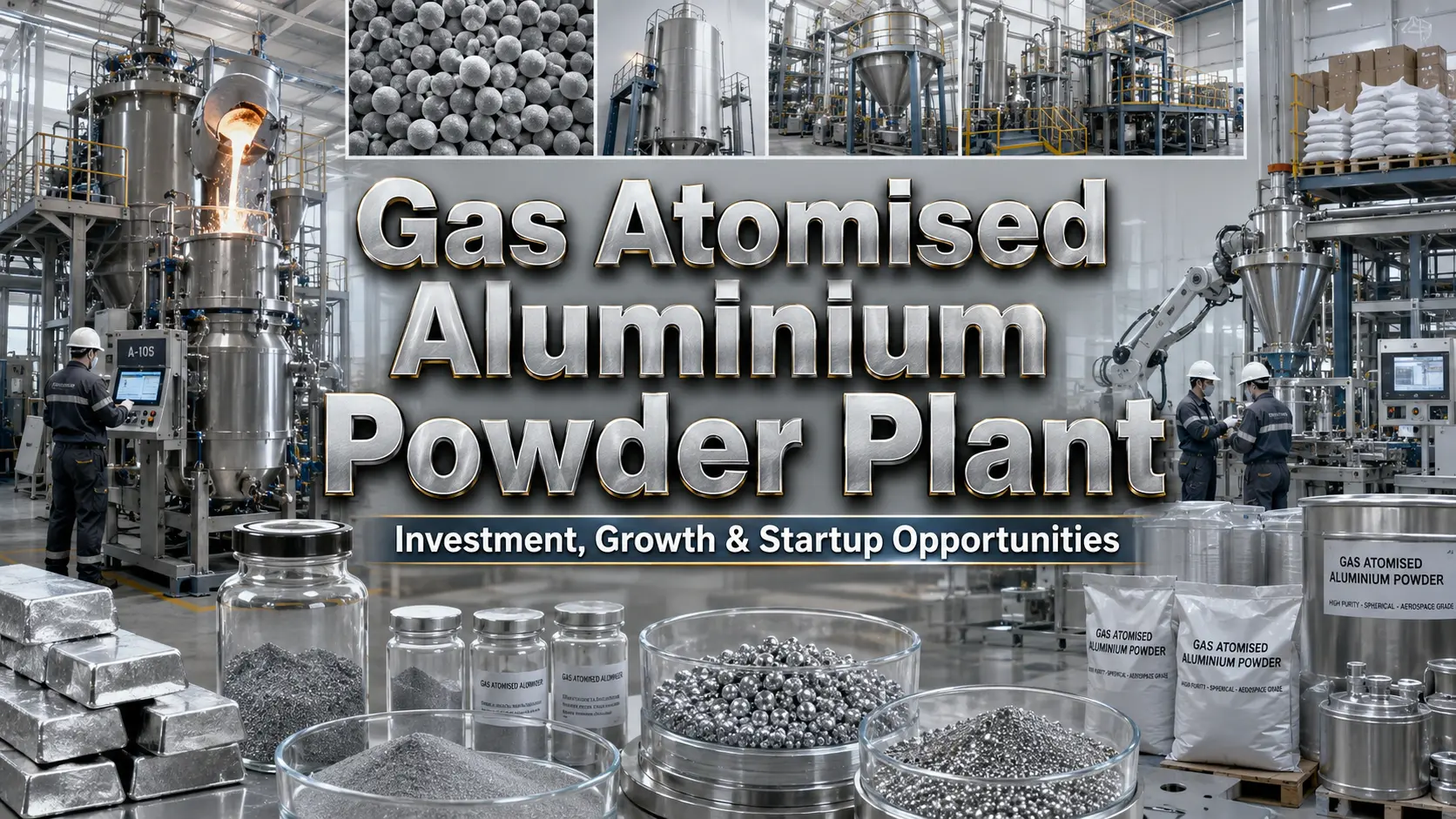

The manufacturing of aluminium powder was a closed club in India with few established players controlling supply. This image is rapidly shifting. India’s first dedicated gas atomised aluminium powder plant has recently been inaugurated by a new joint venture in the Indian state of Odisha, and that is just the latest sign of a broader change of tide in the industry. Gas atomised aluminium powder manufacturing is at a unique crossroads for entrepreneurs looking at new business opportunities, with a significant reliance on imports, increasing domestic demand, and active government support.
It’s time to better understand the timing, what policies can facilitate the entry of new manufacturers in this market, and which business ideas are suitable for new industrial investors. But we also explore real-life success stories in India, the numbers you need before writing a business plan, and trade opportunities. It’s a business that’s worth considering if you’ve been looking for manufacturing business ideas that have real long-term potential.
Why This Aluminium Powder Business Is Growing Fast
Aluminium powder is no longer a ‘boutique’ material. Gas atomisation results in a finer, more spherical and cleaner powder than the older air-atomisation processes. Consequently, this powder is now used in solar cell paste production, aerospace parts, additive manufacturing, and special paints. Currently, India is importing the majority of gas atomised aluminium powder from Europe and China. Domestic gas-atomisation capacity is still low and there is an actual need for new manufacturers to meet it.
The first dedicated gas atomised aluminium powder plant, a joint venture between Runaya and Germany’s ECKART, has recently started production in Jharsuguda, Odisha. The venture is designed to decrease reliance on imports, decrease supply lead times and boost cost competitiveness for Indian manufacturers in several high-growth industries. This one project is evidence of what industry observers have long said: India possesses the bauxite, the smelting ability and the downstream demand. It lacked investment in atomisation technology per se.
But on the other hand, the demand continues to rise at once multiple fronts. Fine aluminium powders are used in lightweight parts for automobiles, thermal interface materials for 5G devices and high-performance computing hardware. Another growth engine is solar manufacturing as the use of aluminium powder pastes can boost the back-surface field of silicon solar cells. So, those who decide to go into this sector aren’t putting money on a single industry of customers. They are supporting a material that is used in the automotive sector, for renewable energy, defence applications and electronics.
Read the Complete Book Here: The Complete Technology Book on Aluminium and Aluminium Products
The global aluminium powder market is estimated to be close to USD 1.98 billion and is predicted to grow at a steady pace to reach nearly USD 2.78 billion in the coming ten years. That’s not break-dancing, sensational growth. However, it’s stable and predictable, and that’s more important to a first-generation manufacturer than a hype cycle. Further, the Asia Pacific region currently consumes about 45% to 55% of the total aluminium powder consumption and India is right in the middle of the growth spurt of this region.
Export Potential Adds a Second Revenue Stream
Apart from the domestic market, the coastal location of Odisha opens up a direct access channel to the buyers of Southeast Asia to the new manufacturers. There are established export markets already available in countries like Bangladesh, Vietnam, Thailand and Indonesia, where the developing manufacturing sector is in need of advanced materials as reliable suppliers at competitive price. To sum up, a plant, which is designed for domestic markets, can switch from domestic to export markets without major changes in the process and without export customers being completely redesigned.
Government Policies and Incentives Supporting New Manufacturers
Bad technology is rarely what leads to the failure of new manufacturers. Typically, however, they are not a success due to the lack of planning, credit facilities and compliance. Luckily, gas atomised aluminium powder production can leverage several support systems that are central or state level, both of which are not specifically aimed at MSMEs, but also at the metals sector as well.
Central Government Schemes Worth Applying For
First: Apply for Udyam Registration with the Ministry of MSME. This single step opens just about all schemes, such as collateral-free loans, certification subsidies, etc. As a result, most entrepreneurs view Udyam Registration as their initial paperwork task, prior to the finalisation of machinery or land.
The loans are then given at ease by banks, which allows Credit Guarantee Trust Fund for Micro and Small Enterprises (CGTMSE) to provide them with a guarantee cover of up to 75% to 85% on loans up to one crore rupees for new industrial units which do not require banks to provide heavy collaterals and, thus, lend with ease. Prime Minister’s Employment Generation Programme (PMEGP) is a scheme that would be worthwhile to consider for very early-stage founders and is available via the government’s online portal.
Moreover, the Ministry of MSME’s Zero Defect Zero Effect (ZED) Certification Scheme recognizes the manufacturers that have implemented quality and sustainability as a core part of their process from the start. Government agencies give preference to certified units in procurement and give higher ratings when they apply for credit. The energy intensive and high precision nature of gas atomisation can be an actual selling point if approached to aerospace and solar customers who scrutinise their supply chain.
Get Detailed Project Report (DPR): Complete Guide to Aluminium Products Manufacturing
Aluminium powder is not specified as a specific category in the Production Linked Incentive scheme. The scheme’s wider ecosystem still plays an important role however. The metal powders used in specialty steel, advanced automotive parts, and battery production are all inputs for a new plant, thus allowing the new plant to become a supplier to these bigger PLI value chains. In fact, investments in PLI linked sectors are already well in excess of two lakh crore rupees and the amount of investment continues to seep through to its component and material suppliers including powder metallurgy units.
Of note, the Ministry of Mines’ non-ferrous metal scrap recycling system also promotes the utilization of recycled feedstock for scrap-based atomized powder producers to reduce production cost of raw materials. The implementation of India’s future Extended Producer Responsibility (EPR) regulations for non-ferrous metals could be more streamlined for new units that design around recycled content, instead of just virgin ingots.
State Government Support: Where to Look
State governments go to great lengths to attract industry, and the package which is strongest is in the metal sectors. Before deciding on your plant location, it is important to research these portals in order to have a significant impact on your project cost.
Developed by IPICOL, Odisha’s aluminium park in Angul offers plug and play infrastructure to the downstream players right on the doorstep of NALCO’s smelting plants and single window clearances via the state’s GO SWIFT portal. The powder unit in Odisha reduces the movement of raw material as well as reduces the logistics cost significantly as the region is already producing almost 72% of the primary aluminium production in India.
Gujarat has a similar model, via its dedicated investment promotion agency iNDEXTb, with land, power, and capital subsidies in its latest industrial policy. Pay attention that the full scheme documents are published directly on the investment portals of both states, so it is always worth to take a quick look before making any investment.
Multiple Business Ideas for Aluminium Powder Entrepreneurs
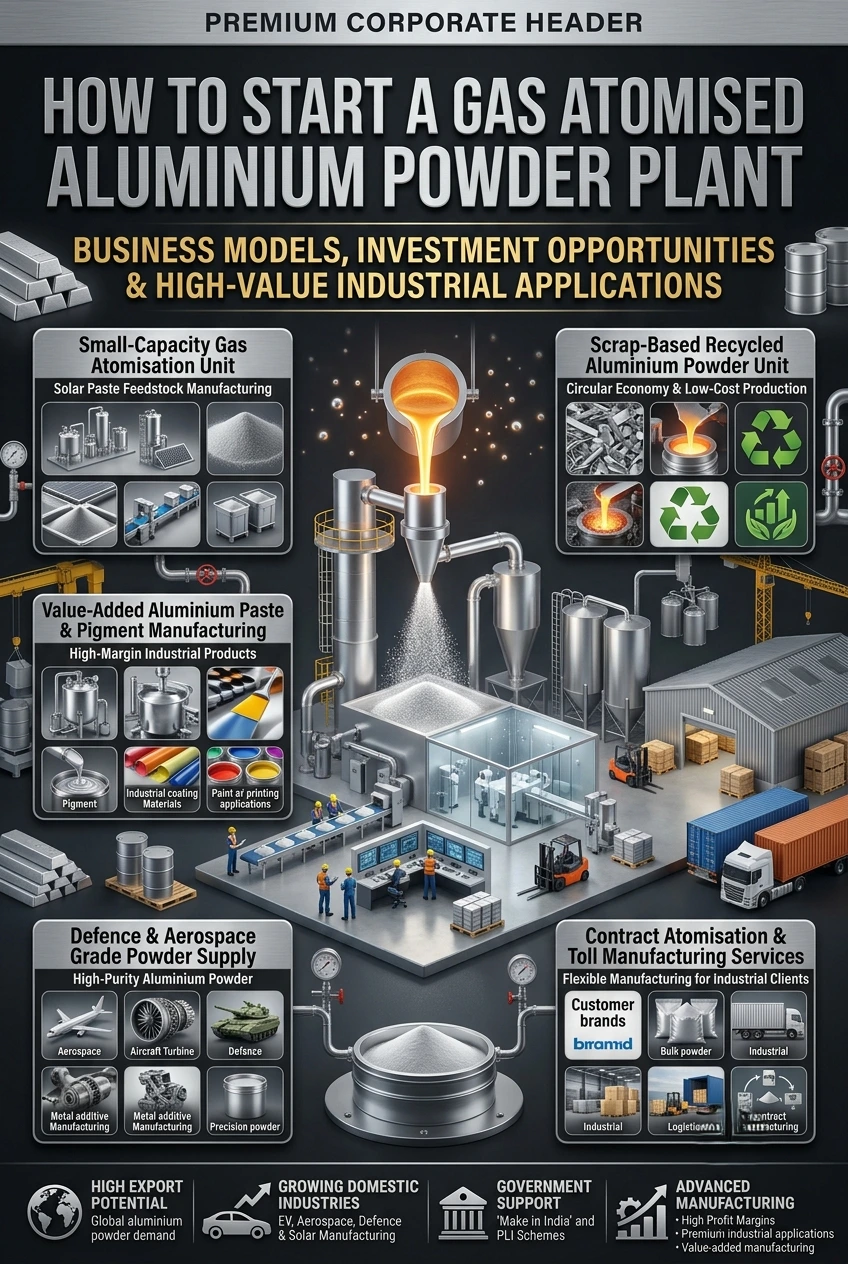
Not all entrepreneurs should go out and invest in an extensive day one gas atomisation plant. There are a number of similar business options where founders can invest in the sector depending on their investing money, risk appetite and technical knowledge.
1. Small-Capacity Gas Atomisation Unit for Solar Paste Feedstock
In order to assist solar cell manufacturers to have a steady and quality-controlled supply of fine spherical aluminium powder for back surface field paste, the following information is provided. A furnace with an inert-gas atomiser capable of a small capacity gas atomisation unit can address this niche customer, rather than going head-to-head in all applications. Under India’s renewable energy drive, the capacity of the solar industry continues to grow and an early supply contract with two or three paste manufacturers can create a stable recurring order book for the founder, rather than a scattergun approach of doing business with open-market buyers. This model encourages founders to invest in quality certification and maintenance of particle size as solar customers are not easily switching suppliers after passing the qualification process.
2. Scrap-Based Recycled Aluminium Powder Unit
India’s thrust on the Extended Producer Responsibility of non-ferrous metals creates a clear opportunity to build a recycling-first powder business. This model uses clean aluminium scrap (e.g. UBC cans, extrusion offcuts and foundry returns) to be processed through a controlled atomisation line, rather than purchasing expensive virgin aluminium ingots. This method has the ability to significantly reduce raw material costs and help the business meet the requirements for ZED certification, which is based on sustainability.It reduces the cost of raw materials in a meaningful way and helps the business to meet the requirements for ZED certification, based on sustainability. In addition, the downstream users in paints and construction chemicals are more likely to choose suppliers that can provide a percentage of recycled content, further bolstering the unit’s message to corporate buyers seeking to be “green.
Choose the right startup backed by real market demand
3. Value-Added Aluminium Paste and Pigment Manufacturing
A founder may choose to add a downstream processing step and make aluminium pastes and pigments that are used in coatings, printing inks and plastic masterbatches. This business idea requires a smaller atomisation setup because manufacturers can use compact mills to powder the material and concentrate their capital investment on milling, blending, and packaging equipment. Paint manufacturers can earn higher margins from paste and pigment production than from selling raw powders because customers are willing to pay more for consistent quality, uniform particle shape, and reliable brand assurance. This concept is appropriate for those founders who are chemistry or process-engineering oriented, and don’t like indulging in heavy metallurgical tasks.
4. Defence and Aerospace Grade Powder Supply Unit
India’s push towards defence manufacturing, along with growing demand from OFs and the private aerospace industry, creates opportunities for entrepreneurs to establish specialized and controlled powder-making facilities designed to meet defence-specific requirements. This route requires more stringent quality control, traceability procedures and waiting time for the vendor approval process. After a unit passes defence qualification, however, order volumes are more likely to be consistent over the following years and margins are more likely to be better than those of open commercial markets. This less frenzied approach to approval may be a worthwhile long-term business opportunity for the founder who has an engineering background or is willing to incorporate a technical partner.
5. Contract Atomisation and Toll Manufacturing Service
Not all companies downstream would like to own atomisation equipment. Processes customer supplied aluminium to aluminium powder in an atomisation unit, on a contract basis, but without ownership of the metal. A major advantage of this model is that the entrepreneur will not have to make significant working capital commitments for purchasing large ingots. Rather, revenue is generated solely from processing fees, machine availability, and quality uniformity. This business idea suits entrepreneurs who want to enter the market with a leaner balance sheet and build strong relationships with colour makers, pigment manufacturers, and paint companies that need reliable, on-demand atomisation capacity.
Import–Export Opportunity Analysis
Aluminium powder exports from India are still at a nascent stage, while the country remains highly dependent on imports, particularly for high-specification gas-atomised grades used in the aerospace, solar, and electronics sectors. Domestic capacity will meet this import reliance over the next few years. The current scenario of gas atomisation plants can enable India realistically to become a net exporter for at least the mid specification product range.
The most immediate opportunity is the Southeast Asian markets on the export side. The countries like Bangladesh, Vietnam, Thailand and Indonesia are building up their own manufacturing centers but do not have huge domestic capacity of aluminium powder. Given that costs of shipping and delivery are lower in India than in Europe or North America, Indian producers can match both price and delivery lead time with the competition. In the meantime, finished aluminium-based paints, pigments and construction products are coming in to the Middle East and African markets which indirectly drives demand again towards the Indian aluminium powder and paste producers who supply these finished goods exporters.
This provides a very real and achievable two-step approach to business for new start-up entrepreneurs. Gain market share first in domestic market; then move to export market, with domestic certification and quality track record as evidence of capability. Then, take advantage of that track record when production starts to settle and quality procedures become established to go to export orders. Attempting to export before the product meets domestic quality standards typically leads to unnecessary conflict with foreign customers who demand documentation and testing results that are consistent.
Related Article: How to Start an Aluminium Billet Plant
Indian MSME Success Stories in Metal and Aluminium Powder
MMP Industries — From a Nagpur Workshop to a Listed Global Supplier
Aluminum powders started from a single-product unit located at Nagpur in Maharashtra with the assistance of a metal powder expert from Belgium, the MMP Industries, over the span of a couple of decades had bloomed from one powder product into a diverse aluminum powders, pastes, conductors and foils producer company and later went for IPO of its shares in National Stock Exchange. The company also became an approved vendor to India’s Ordnance Factories for defence-specification aluminium powders. Its growth path shows a pattern worth studying: start with one well-executed product, invest steadily in research and quality systems, and expand into adjacent product lines only after the core business proves reliable.
Anil Agarwal — From Scrap Trading to Vedanta Resources
His business acumen was forged in Mumbai teenager Anil Agarwal’s teenage scrape for scrap metal. He traded second-hand copper wire and sold it on to Indian companies long before he laid down the first bricks of anything remotely factory-like. He then took over the inefficient Madras Aluminium Co. (which he helped make profitable) to create the genesis of what is now the multinational mining and resources Vedanta Resources group, with aluminium – and gas atomized aluminium powder – interests in India. His story is a reminder that deep operational knowledge of a metal, gained even through humble trading work, can become the base for a large industrial enterprise decades later.
Lesson for New Entrepreneurs
One thing to notice is the parallel between the two stories. The one plant mega production scale, no. Well-understood product, yes. Grown once the basics worked yes. As such the budding gas atomised aluminum powder entrepreneur should approach the marketplace with one well understood application for instance either feedstock for solar pastes, recycled material or a contract atomisation business before branching out into other applications.
Feasibility Planning Before You Invest
Every business idea in this article looks straightforward on paper. In practice, entrepreneurs should carefully analyse plant capacity, machinery selection, raw material sourcing, and financial projections based on the specific requirements of the sector before committing any capital. This is precisely where a proper feasibility study earns its cost many times over.
We at Niir Project Consultancy Services (NPCS) provide professional consulting for the preparation of Market Survey cum Detailed Techno-Economic Feasibility Reports, commonly called DPRs, for entrepreneurs setting up new industries or businesses. Detailed manufacturing methods; market analysis; market demand estimation; process flow diagrams; product and plant capacity and mix; machines and raw material used; 100% detailed project economics and profitability study. Our aim is that the entrepreneurs analyze the economic viability and sustainability of a project prior to launching it not when it fails.
Aluminium Powder Business at a Glance
The table below summarises the core numbers and reference points that a founder should keep handy while preparing a business plan or discussing financing with a bank.
| Parameter | Indicative Detail |
| Global aluminium powder market size | Around USD 1.98 billion, projected to reach close to USD 2.78 billion within the next decade |
| Leading atomisation technology in India today | Air-atomisation currently dominates; gas-atomisation is the newer, higher-value growth segment |
| Asia-Pacific share of global consumption | Roughly 45% to 55% of global aluminium powder demand |
| Odisha’s share of India’s primary aluminium output | Close to 72% of India’s primary aluminium production |
| Typical mean particle size (gas-atomised) | Around 15 microns, tailorable to customer specification |
| Key end-use industries | Solar paste, aerospace, automotive, paints and coatings, pyrotechnics, catalysts, 3D printing |
| CGTMSE collateral-free guarantee cover | Up to 75% to 85% of loan amount for eligible MSEs |
| Udyam Registration requirement | Mandatory prerequisite for CGTMSE, PMEGP, ZED, and most central MSME schemes |
Frequently Asked Questions
1. How much investment does a small gas atomised aluminium powder unit need?
Investment depends heavily on capacity, atomiser technology, and whether you build a greenfield unit or lease existing industrial shed space. Because equipment costs, safety systems, and inert-gas infrastructure vary widely, you should obtain a detailed techno-economic feasibility report for your specific production capacity before finalising the investment amount.
2. Is gas atomisation safer than other aluminium powder production methods?
Gas atomisation, when run under proper inert-gas and dust-control conditions, is a well-established industrial process. However, aluminium powder is combustible in fine form, so every unit must follow strict fire-safety, explosion-venting, and housekeeping protocols regardless of the atomisation method used.
3. Do I need special environmental clearance to start this business?
Yes, most metal powder units need consent from the State Pollution Control Board and may require environmental clearance depending on scale. ZED certification and Extended Producer Responsibility compliance also matter increasingly for units using recycled feedstock.
4. Which state offers the best incentives for this business?
Odisha and Gujarat currently offer strong, metal-sector-specific infrastructure and incentive packages, largely because of their proximity to primary aluminium production. However, several other states also offer general MSME capital subsidies, so it helps to compare policies before finalising a location.
5. Can a new MSME compete with established players like MMP Industries?
Yes, particularly by focusing on a specific niche, such as recycled-content powder, contract atomisation, or a single customer segment like solar paste feedstock, rather than competing across the entire product range from the start.
6. How long does it take to break even in this business?
Break-even timelines vary by business model and capacity utilisation. Contract atomisation units, which need lower working capital, often reach positive cash flow faster than fully integrated units that purchase and hold their own metal inventory. A detailed financial projection remains the most reliable way to estimate this for your specific plan.
Conclusion
The business of producing gas atomised aluminium powder isn’t some kind of speculative punt on an ‘up and coming’ unproven material. It is about linking the solid and existing worldwide demand for this material to a distinct, current and verifiable, lack of domestic capacity in this space. Finally it rests upon the real and, for entrepreneurs at least, quite comforting weight of documented government support via MSME schemes, state led industrial development and a growing and dynamic recycling policy. It is a real, evidenced, opportunity for entrepreneurs considering what to do in manufacturing in India today, the like of which is very difficult to find, the founders that ultimately win in this space will be the prudent ones who start smart and focus relentlessly on quality from day 1 not on ‘hockey stick growth’ projections.(Gas Atomised Aluminium Powder)