Functional food manufacturing in India is entering a phase of structural transformation as nutrition is no longer seen as a basic necessity but as a proactive tool for disease prevention, immunity enhancement, and long-term wellness. The global food industry is rapidly shifting toward health-focused consumption, accelerating demand for functional foods and nutraceutical ingredients. This transition is creating significant opportunities for ingredient manufacturers, startups, and Contract Development and Manufacturing Organizations (CDMOs) across India.
The estimated worth of India’s functional food market by 2030 will be stepping up to USD 25.38 billion with an almost 10% CAGR. The rising disposable income, the increasing secretion of preventive healthcare awareness throughout the world, the export opportunities and all that; therefore, 2026 can be a strategic entry point for businesses looking for scalable and high-margin opportunities.
This article discusses the most promising segments in the ingredients innovation space and outlines why India is poised to lead the next stage of global growth of functional foods.
Read More: Manufacture of Food & Beverages with Project Profiles (3rd Edn.)
Why Functional Foods Are Experiencing Rapid Growth in India
Consumer behaviour in India has changed dramatically in the last decade. Instead of using pharmaceutical treatment as the only treatment after becoming sick, consumers now focus on getting preventive healthcare through nutrition. Products that claim to provide immunity enhancement, gut health, metabolism management, mental focus and beauty-from-the-inside benefits are experiencing mainstream adoption.
Functional food categories, which are growing very rapidly, include:
- Fortified beverages
- Protein bars and sports nutrition.
- Herbal gummies and capsules
- Probiotic dairy alternatives such as
- Plant-based snacks
Regulatory clarity provided by the Food Safety and Standards Authority of India (FSSAI) has further contributed to industry growth by adding the definition of nutraceuticals and health supplements. Simultaneously, government initiatives of the Ministry of Food Processing Industries are helping in developing food processing infrastructure.
India also has the advantages of huge biodiversity, rich medicinal plants, excellent spice production, and low cost of manufacturing. These advantages help the country to serve the domestic as well as export markets effectively.
The Growing Role of CDMO in Nutraceutical Manufacturing
Larger brands of food and supplements are increasingly outsourcing research, formulation and production to their specialized partners. Building in-house R&D and production infrastructure requires a lot of capital and regulatory expertise. As a result, CDMOs have become the crux of the creation of functional ingredient manufacturing.
Modern CDMOs offer:
- Standardization of ingredients
- Enhancement of bioavailability
- Solubility improvement
- Taste masking technologies
- Stability optimization
Crucial is technological innovation. Many botanical extracts have problems in terms of dispersibility and bitterness, which makes it difficult to incorporate into beverages or ready-to-eat foods. Advanced functionalization platforms have now overcome these challenges to allow ingredient manufacturers to charge premium prices.
For startups coming in 2026, it may make sense to develop capabilities in ingredient processing versus finished brand marketing to offer faster scalability and B2B revenue stability.(Functional Food Manufacturing in India)
Read More: Functional Food Based Bakery Products (Bread, Cookies and Biscuits) – Manufacturing Plant, Detailed Project Report, Profile, Business Plan, Industry Trends, Market Research, Survey, Manufacturing Process, Machinery, Raw Materials, Feasibility Study
High Potential Ingredient Manufacturing Opportunities for 2026
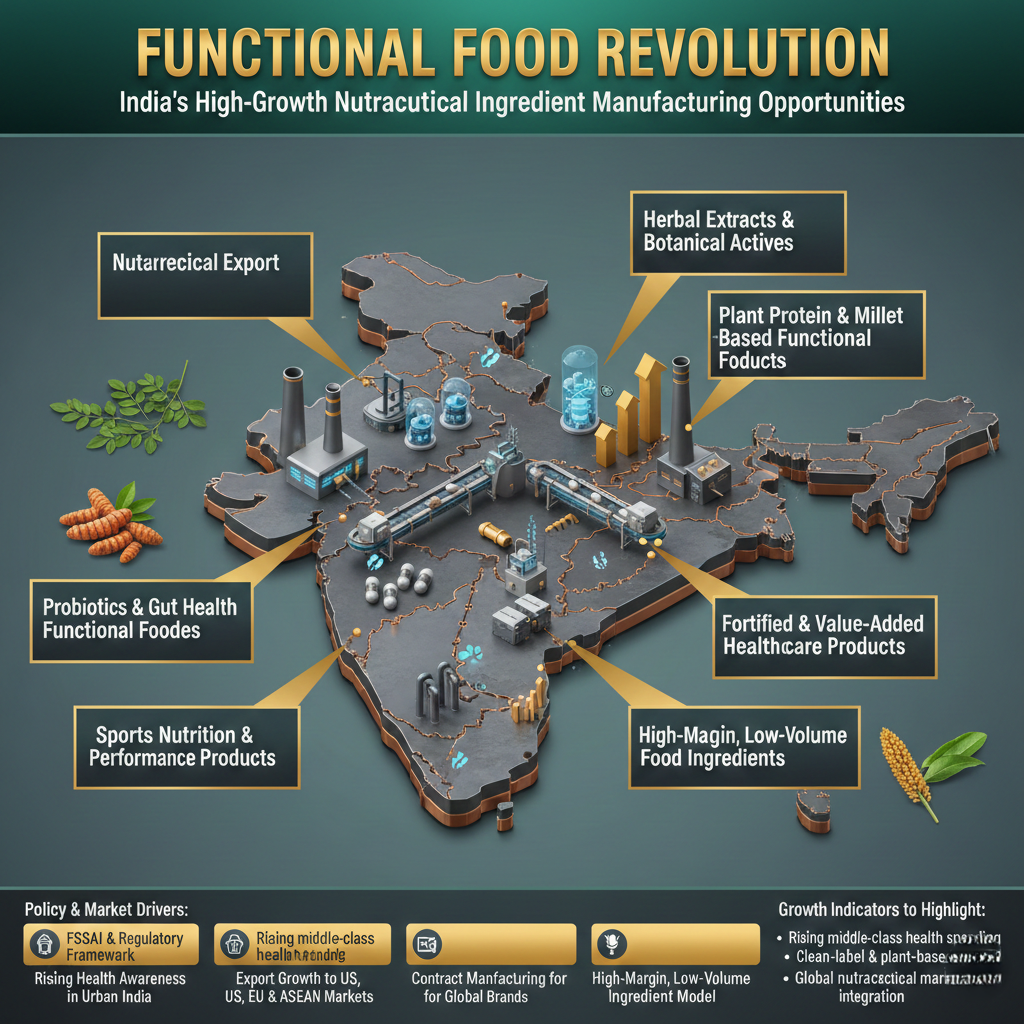
The following are the most promising and scalable segments in India’s functional ingredient ecosystem.
1. Functional Spice Extract Production
India leads in the production of spices in the world and exports oleoresins and standardized extracts on a large scale. Functional spice ingredients include curcumin, gingerol, capsanthin and piperine which are moderately used in immunity, antioxidant and anti-inflammatory formulations.
Why this segment is attractive:
- Strong global export demand
- Better margins than raw spice trading
- Increasing use in functional beverages and supplements
- Limited competition by synthetic substitutes
A unit of nutraceutical grade standardized spice extract with proven concentration of curcuminoid or piperine can attract both domestic and international clients.
2. Solubility Augmented Botanical Ingredients
One of the great bottlenecks in the formulation of functional foods is poor solubility. Many polyphenols and plant extracts settle in the beverages or give undesirable taste profiles.
Some emerging opportunities include:
- Water-dispersible curcumin
- Soluble green tea extracts
- Citrus bioflavonoid blends
- Taste-masked polyphenol complexes
These value-added ingredients are in high demand in sports nutrition, beauty supplements, as well as fortified beverages. Because they overcome formulation issues, they are priced more highly than the conventional extracts.
Startups that are investing in encapsulation, spray drying or nano-emulsion technologies will have a big way of differentiating themselves.
3. Nutraceutical Premix & CDMO Manufacturing
Food and beverage brands have a preference for ready-to-use premixes to cut down on the product development timelines. Instead of sourcing multiple ingredients separately, multiple ingredients, companies trust the services of specialized premix manufacturers.
High demand premix categories are:
- Immunity blend (Vitamin C, Zinc, Curcumin)
- Protein + Probiotic combinations
- Omega fortified beverage bases
- Collagen and beauty nutrition blends
This segment demands moderate capital investment in comparison to extraction facilities and has flexibility with regard to product customization. It is especially appropriate for emerging CDMOs against mid-sized food brands.
Read More: Fruits & Vegetables Powder Manufacturing Business
4. Dispersible Plant Protein Manufacturer
The worldwide shift towards a plant-based nutrition is driving a faster demand for vegan protein ingredients. India’s access to peas, millets, soy, mung beans and chickpeas provides good raw material advantages.
Opportunities include:
- High-solubility pea protein isolates
- Millet Protein concentrates
- Multigrain vegan protein blends
- Ready to Mix Sports Formulations
Plant protein extraction is export-oriented and in line with the clean-label demand of consumers. With the growing sustainability focus in the world, this segment is expected to be resilient in the longer run.
Import Substitution and Export Growth Potential
India continues to import some of the high-grade strains of probiotics, specialty proteins and advanced polyphenol blends. Developing domestic manufacturing may greatly lessen import dependency and enhance supply chain resilience.
At the same time, export markets like United States, Germany, Japan, UAE and Singapore show good demand for clean label functional ingredients. Agencies such as APEDA facilitate agri-export activities and build up the international trade potential.(Functional Food Manufacturing in India)
Since functional ingredients have higher per kilogram margins than conventional food commodities, export-oriented manufacturers can achieve sustainable profitability and foreign exchange growth.
Read More: Export Markets in Oleoresins and Food Additives
Importance of Professional Feasibility Planning
Despite good chances for growth, the functional ingredient industry requires a structured planning for entry. Critical considerations include:
- Technical feasibility
- Machinery selection
- Regulatory compliance
- Capital expenditure Estimation
- Working capital planning
- Market demand validation
Professional feasibility studies and Detailed Project Reports (DPRs) are useful in improving the credibility of funding and also reduce operational risk. Entrepreneurs who invest in the structured pre-project planning are therefore significantly improving their chances of long-term success.
Why 2026 Is a Strategic Entry Window
Several macroeconomic and industry trends come into play in 2026:
- Increasing preventive healthcare awareness
- Expanding middle class consumption
- Strong clean-label global demand
- Advancements in ingredient functionalization
- Increased outsourcing to CDMOs
- Export growth incentives
Unlike short-term food trends, the functional nutrition movement is a long-term structural movement towards health-centric consumption. Companies that can integrate ingredient innovation with cost-effective, scalable manufacturing infrastructure will win high margins and international opportunities.
Read More: From Seed to Success: A Startup’s Guide to Dominating India’s Vegetable Seed Market
Conclusion
India is at a critical inflection point in the functional food ecosystem across the world. With the benefits of biodiversity, manufacturing capabilities, regulation support and alignment of the demand from exports, the country is positioned well to become a global centre for functional ingredients.
For entrepreneurs, CDMOs, nutraceutical startups, 2026 is a strategic year to get into high margin segments like spice extracts, solubility enhanced botanicals, premix manufacturing, and plant protein processing.
Success in this sector will be based not only on timing in the market, but also on differentiation in technology, compliance with the regulations, and professional project planning. Those who are decisive and strategic can build scale businesses which are aligned to the future of health driven nutrition.(Functional Food Manufacturing in India)
Frequently Asked Questions (FAQ)
What are functional foods?
Functional foods are food products that contain ingredients that add additional health benefits to the basic nutrition.
Is functional food industry profitable in India?
Yes. With projected growth of double digits and export demand, it provides higher margins than traditional food manufacturing.
Which segment of ingredients has the most growth potential?
Functional spice extracts, plant proteins, nutraceutical premixes and solubility-enhanced botanical extracts have great growth potential.
What is CDMO in nutraceuticals?
A CDMO is a Contract development and manufacturing organization that develops and manufactures products for other brands.
Is there demand for functional ingredients in the export market?
Yes. North America, Europe and Asia-Pacific markets are actively importing clean label and plant-based nutraceutical ingredients.