
Agri Food Processing Business Ideas in India
Why Agri-Processing Remains India’s Most Resilient Business Frontier
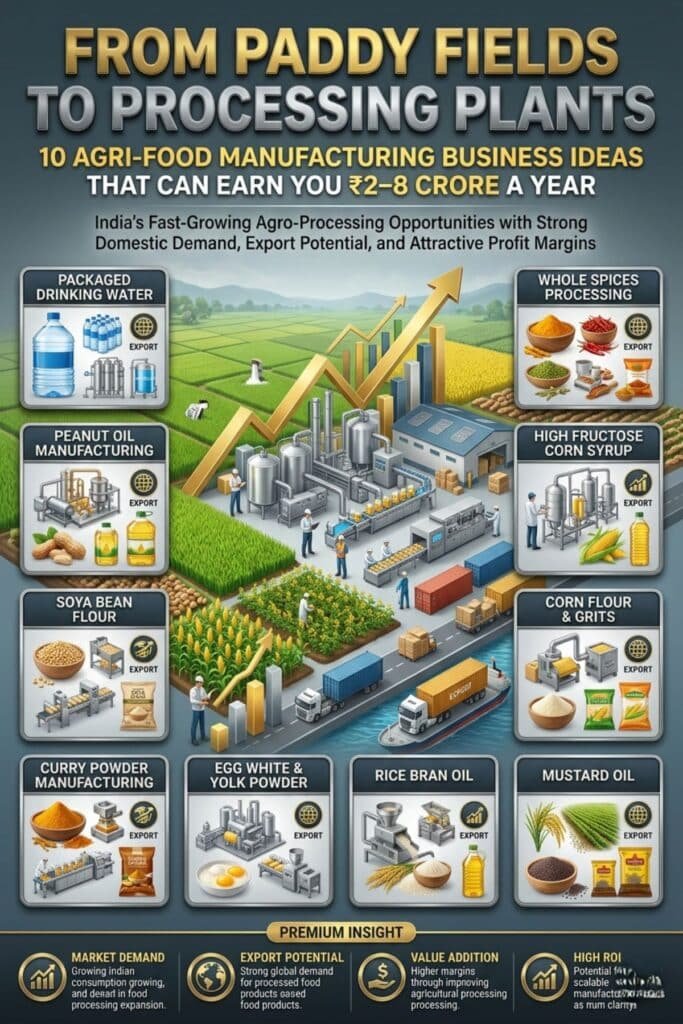
Over the past 20 years, the agri-food sector in India has overcome all economic challenges. Real estate and export-oriented manufacturing have followed the ups and downs of the world economy, but food processing has had an almost unbroken demand curve. The structural drivers are simple: 1.4 billion consumers who are increasingly buying products in packages, a government actively promoting domestic processing and the development of cold-chain facilities.
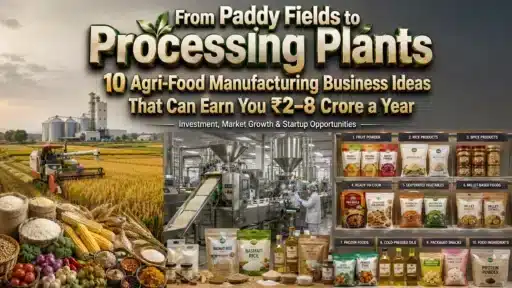
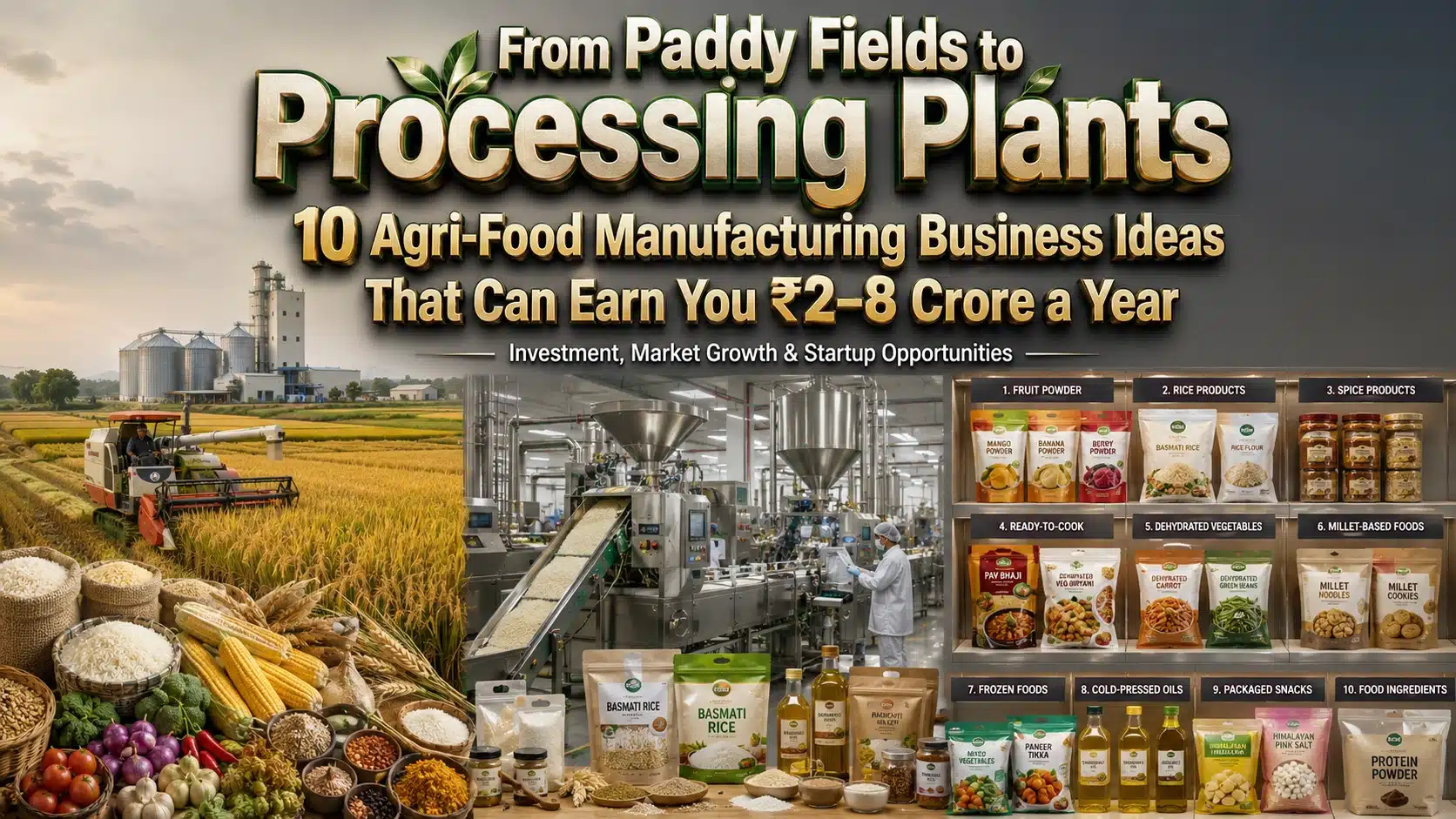
The ten business ideas discussed in this section are a true cross section of this opportunity. They range from various capital needs, technology levels, and target markets. But they have one common trait: they’re meeting a large, growing, and structurally relevant demand.
This bouquet of products is worth considering in a manufacturing initiative that a first-generation entrepreneur or MSME operator wants to invest in the range of ₹25 lakh and ₹10 crore. The system establishes supply chains endogenously, provides access to raw materials across most agro-climatic zones, and expands end markets, including retail, institutional, industrial, and export sectors. Furthermore, the government supports these business ideas, which makes the financial sense even more appealing.
Get Detailed Insights from This Book: The Complete Technology Book on Fruit & Vegetable Processing
Sector Overview: Products at a Glance
One of the most capital-efficient food manufacturing business ideas today is setting up a basic spice-processing unit, where entrepreneurs clean, dry, grind, blend, and package various spices. You can start this business with an investment of just ₹15–25 lakhs.
| Product | Capital | Key Input | Primary Market | Growth 2024–30 |
| Packaged Drinking Water | Low–Medium | Raw Water + Minerals | Retail / Institutional | ~12% CAGR |
| Whole Spices Processing | Low | Raw Spices | Retail / Export / HORECA | ~9% CAGR |
| Peanut Oil | Low–Medium | Groundnut | Retail / Cooking | ~7% CAGR |
| High Fructose Corn Syrup | High | Corn Starch | F&B / Pharma | ~10% CAGR |
| Soya Bean Flour | Medium | Soybeans | Food / Bakery / Feed | ~11% CAGR |
| Corn Flour and Grit | Low–Medium | Maize | Food / Starch / Feed | ~8% CAGR |
| Curry Powder | Low | Spice Blends | Retail / Export | ~10% CAGR |
| Egg White & Yolk Powder | Medium–High | Fresh Eggs | Bakery / Pharma / FMCG | ~13% CAGR |
| Rice Bran Oil (Solvent) | High | Rice Bran | Cooking / Industrial | ~9% CAGR |
| Mustard Oil | Low–Medium | Mustard Seeds | Retail / Pickle / Industrial | ~6% CAGR |
1. Packaged Drinking Water: The Business That Never Runs Dry
The greatest opportunity to enter into producing packaged drinking water is available from packaged drinking water. Within the domestic market, which includes the 500 ml pouch, 1 litre bottle and 20 litre jar, the domestic industry has been increasing at more than 12 percent per year for the past decade. The urban Indian consumer has witnessed a radical transformation from the municipal tap water due to the rising water quality issues in groundwater and increasing health consciousness among the urban population.(Agri Food Processing Business Ideas in India)
Small scale with production capacity of 1000 litres/hour can be set up at a cost of ₹35-60 Lakhs. IS 14543 is a certificate issued by the Bureau of Indian Standards (BIS) for packaged drinking water. All Units are also required to be registered with FSSAI prior to production.
The brand can achieve an excellent gross margin because it produces a 1-litre bottle for approximately ₹4 and sells it for ₹20. Subscription model with 20-litre reusable jar in Tier 2 and Tier 3 cities builds committed and recurring customers. From a single plant, entrepreneurs in Rajasthan, Maharashtra, Telangana and Uttar Pradesh have created units which generate income of ₹2-8 crore annually. In addition, technology threshold is low, so there is short learning curve.
Get Detailed Project Report (DPR): Water Industry Project Profiles
2. Whole Spices Processing: The Invisible Industry Behind Every Indian Kitchen
India produces about 75 per cent of the world’s spices. However, the retail ground spices market is still highly fragmented with regards to processing and packaging. This is the exact place that the opportunity lies. One of the most capital-efficient food manufacturing business ideas today is setting up a basic spice-processing unit, where entrepreneurs clean, dry, grind, blend, and package various spices. You can start this business with an investment of just ₹15–25 lakhs.
The Spices Board of India provides quality certification, marketing development assistance and subsidy schemes for infrastructure to the exporters. The end use markets include retails, HORECA, food processors and international exports.
What MDH Masala has taught us over the years is this; consumers of spices are looking for a consistent product and trust, not taste. The spice business is a sustainable business, and can be scaled up, if an entrepreneur can secure regular supply of raw materials and establish brand name in the region. As the world in the west gets more and more interested in Indian food, it also does not look back, making the export markets even more interesting.
Related Article: Startup Opportunities in Processing Fruits, Pulses, Spices, and Dairy
3. Peanut Oil: The Agrarian Economy’s Quiet Export Champion
The market of groundnut oil is premium in Gujarat, Rajasthan and the southern coastal markets. Known the world over for its low-fat content and high smoke point. Cold-pressed groundnut oil is a more premium item in the wellness market with a price difference of two to three times that of refined oil. The by-product of the oilcake, which is rich in protein, is an animal feed that is an important secondary income stream.(Agri Food Processing Business Ideas in India)
The investment needed for expeller-based unit begins from ₹40-70 lakh. If you plan to handle 10 to 30 MT per day, the cost for solvent extraction increases from ₹1.5 crore to ₹3 crore. Capital subsidy is available from the Ministry of Food Processing Industries (MoFPI) under PMFME and PLI schemes, which further makes the economics compelling for greenfield investors to expand their existing oil mills.
4. High Fructose Corn Syrup: An Industrial Sweetener with a Rapidly Growing Indian Story
The use of High Fructose Corn Syrup (HFCS) is gaining considerable importance as one of the key ingredients in processed food and beverage industry in India. Indian HFCS market is expanding at an around 10% CAGR. The main growth drivers are the expansion of soft drink production, the increased use of liquid sweeteners in the bakery industry and the production of syrups for pharmaceutical use.
The plant setup costs are in the range of ₹8-25 crore depending on the capacity and the returns are proportionate to the investment. There is a competitive moat. After production, the domestic price of HFCS is invaluable to the large beverage companies in times of sucrose price spikes. Further, import substitution is a structural advantage for this food ingredient that few other items have.
5. Soya Bean Flour: The Protein Economy’s Underestimated Opportunity
Food manufacturers are increasingly using soybean flour in bakeries, processed meat production, infant nutrition, sports supplements, and animal feed. The crops grown in Madhya Pradesh, Maharashtra and Rajasthan are the major producers of soybean in India with Indore and Nagpur as the processing centres. The capital investment of a 5-10 MT/day starts from ₹60 lakh to ₹1.5 crore.(Agri Food Processing Business Ideas in India)
The rising vegan and flexitarian trend in Indian cuisine is generating a strong demand locally for which there was no demand five years ago. Meanwhile, export potential in the Middle East, Southeast Asia and Africa remains to grow. Thus, the new entrepreneurs who build processing capacity today can reap both benefits from both demand curves.
Discover business ideas that actually make money
6. Corn Flour and Grit: Maize’s Versatile Processing Dividend
Maize can be dry milled to create corn flour and corn grit. The by-products (germ, bran, husk) are each a marketable product and this is a very efficient utilization of the input crop. Applications include snack foods, brewing adjuncts, industrial starch and animal feed. Maize production in India has been increasing and is now more than 30 million tonnes per year.India has now a deep raw material base for maize production, which is more than 30 million tonnes per year.
One of the easier capital-entry points in grain processing is to establish a dry maize milling unit for 10 MT per day at a cost of ₹50 to 80 lakh. Furthermore, the multipurpose output mix lessens dependence on any individual market to sustain the operators, providing them natural revenue diversification.
Pre-Investment Intelligence: The Role of Feasibility Reports
Structured pre-investment intelligence is extremely useful for entrepreneurs who are dealing with the intricacies of establishing manufacturing units in any of these product lines. NIIR Project Consultancy Services (NPCS) is one of the leading industrial consultancy firms in India for Detailed Project Techno-Economical Feasibility Reports (DPRs) for over 30 years.(Agri Food Processing Business Ideas in India)
An NPCS report will usually include information on manufacturing process design, sources of raw materials, capital expenditure estimates, revenue models, break even analysis, and financial viability ratios such as IRR, NPV and DSCR. A feasibility report is not a luxury to a first-generation manufacturer and is essential to ensure that there is no wasted capital. It’s a risk management tool that has kept so many promoters from expensive miscalculations. A well-prepared DPR is also the main document for bank loan applications.
7. Curry Powder: Blending Tradition into Global Markets
Curry powder is a combination of spice processing, branding and export marketing. In terms of micro enterprises, a blending and packaging unit can function with a turnover ranging from ₹10 to 20 lakh. At the medium enterprise level, the business must obtain a higher-level FSSAI licence and should preferably register for exports with the Spices Board.
The global demand for curry powder is expected to keep increasing steadily till 2030. The UK, U.S., Canada, Australia, UAE and South Africa are some of the major exporting markets. In all these markets, Indian exporters have a natural advantage of authenticity. Moreover, the low capital entry level allows even the small operator to establish a solid export business in 2 to 3 years after going into production.
8. Egg White and Yolk Powder: The High-Value Protein Ingredient the Market Is Asking For
Dried egg products are used in bakeries, pharmaceuticals, sports nutrition, and convenience foods. India has not yet optimised the organised production of dried egg products, despite being the third-largest egg producer in the world. The mix makes for an interesting manufacturing prospect with minimal direct domestic competition.(Agri Food Processing Business Ideas in India)
Egg white powder is being sold at the retail price of Rs 600 to 900 per kg and B2B (bulk) price of Rs 450 to 650 per kg. The industrial spray dryers with processing range of 500 to 2,000 litres per day range from ₹80 lakh to ₹2.5 crore. The 13% CAGR growth is the highest of all ten business ideas that have been discussed in this article. The poultry belt in India is present in Andhra Pradesh, Telangana, Tamil Nadu, Maharashtra, and Punjab where they contribute a concentrated supply of raw material at a competitive price.
Comparative Financial Snapshot: Selected Products
The table below shows a side-by-side comparison of minimum investments, payback period, gross margins and potential for exports for each of the 10 manufacturing segments.
| Product | Min Investment | Breakeven (Months) | Gross Margin | Export Potential |
| Packaged Water | ₹35–60 Lakh | 18–24 | 45–60% | Moderate |
| Spice Grinding | ₹15–25 Lakh | 12–18 | 35–50% | High |
| Peanut Oil | ₹40–70 Lakh | 20–28 | 20–30% | Moderate |
| HFCS | ₹8–25 Crore | 30–42 | 25–35% | Low–Medium |
| Soya Flour | ₹60L–1.5 Cr | 18–24 | 25–40% | High |
| Corn Flour/Grit | ₹50–80 Lakh | 15–20 | 20–30% | Medium |
| Curry Powder | ₹10–20 Lakh | 10–15 | 40–55% | Very High |
| Egg Powder | ₹1–3 Crore | 24–36 | 35–50% | High |
| Rice Bran Oil | ₹2–5 Crore | 24–36 | 22–32% | High |
| Mustard Oil | ₹30–60 Lakh | 18–24 | 18–25% | Medium |
9. Rice Bran Oil: India’s Most Underutilised Edible Oil Opportunity
The annual paddy production in India is around 100-110 MMT with the production of approximately 10-11 MMT of rice bran. But, a large portion of this bran is rapidly deteriorated by lipase enzyme activity. The milling of bran is liable to cause rancidity within hours of milling if it is not stabilised. Operators with the proper infrastructure will find a narrow commercial window filled with a great reward.
Rice bran oil is rich in gamma-oryzanol which is a powerful antioxidant, has a very high smoke point and the light flavour that would be useful for food processing and cooking. Cost of solvent extraction process is ₹2 to 5 crore per unit of 30 to 100 MT bran per day. Geographically, West Bengal, Odisha, Andhra Pradesh, Telangana, Chhattisgarh and Punjab are ideal. If an entrepreneur gets the bran supply contracts from 5 to 10 medium scale rice mills, then he enjoys huge first mover advantage in most of the areas of the state.
10. Mustard Oil: The Eastern Heartland’s Commercial Constant
Mustard oil is a cultural landmark in the Eastern and northern part of India. Its application includes frying, tempering, pickling, hair care, and massage of the body in various parts of the country such as West Bengal, Bihar, Odisha, Jharkhand, Uttar Pradesh and Rajasthan. The preference is a deep-rooted one that results in a structurally robust demand base which has never been undermined by refined oil imports.
Cost for expeller-based unit producing 5-10 MT per day varies from 30-60 Lakh. Over 40% of India’s mustard production is within Rajasthan. The premium for kacchi Ghani(cold pressed) mustard oil is higher and mustard oilcake is a lucrative secondary stream from cattle and goat feed. A successful business model here could be the co-branded contract milling business model, partnering with FMCG brands for white-label production and also establishing its own retail brand.
Regulatory Framework and Government Support
Food processing companies exceeding a certain size need license from FSSAI (Food Safety and Standards Authority of India). Packaged drinking water requires certification also. Business which are exporters should be registered under APEDA, and for spices, should also be registered under Spices Board. Learning about these regulations early on can avoid spending a lot of money to fill the compliance gaps.
The financing offers a wide array of options. Major schemes available for eligible promoters are:
- PMFME: 35% capital subsidy for food processing upgrades by individuals and groups
- PLI Scheme for Food Processing: Targets larger investments in ready-to-eat and processed food categories
- NMEO-Oilseeds: Supports investment in mustard, peanut, and rice bran oil processing
- CGTMSE: Collateral-free loans up to ₹5 crore for eligible MSMEs
The MoFPI website offers the guideline for scheme, the portals of subsidy and approved machinery vendors. That’s the first station to access by the food processing entrepreneur who intend to make an investment of new set or enlargement of the manufacturing unit.
Frequently Asked Questions
Q1: Which business idea here requires the least capital to start?
Curry powder blending and spice grinding units have the lowest entry points. A basic operational unit can be set up for ₹10 to 25 lakh including machinery, initial raw material stock, and working capital. Packaged drinking water units come next, starting around ₹35 to 50 lakhs for a small-capacity plant. Both segments also have short payback periods relative to capital deployed.
Q2: Is FSSAI registration mandatory for all these businesses?
Yes. Any food processing business above a defined turnover threshold must hold an FSSAI Central or State License depending on scale. Basic Registration applies to micro-enterprises with annual turnover below ₹12 lakh. Export-oriented units additionally require APEDA or Spices Board credentials before shipping.
Q3: Can I access bank financing for these units?
Most of these product categories qualify for MSME financing under MUDRA, CGTMSE (collateral-free loans up to ₹5 crore), and SIDBI’s direct lending schemes. A properly prepared techno-economic feasibility report is essential documentation for any bank loan application.
Q4: Which products have the highest export potential?
Curry powder, egg white powder, soya bean flour, and premium cold-pressed groundnut oil represent the strongest export opportunities. The UK, USA, Middle East, and Southeast Asia are the primary export destinations for spice products. Egg powder is increasingly sought by confectionery and bakery industries globally. Additionally, the India brand carries strong authenticity credibility in all these markets.
Q5: What is the biggest challenge in edible oil processing?
Volatile raw material prices and competition from large FMCG brands are the two primary challenges. Experienced operators manage this by maintaining 2 to 3 months of raw material inventory and building long-term procurement agreements with farmer producer organisations (FPOs) or commodity aggregators. Operational cost discipline is therefore as important as market access.
Q6: Do these businesses qualify under MSME classification?
Yes. Most manufacturing operations described in this article — at the entry investment levels referenced — qualify as micro or small enterprises under the revised MSME definition. MSME classification provides access to priority sector lending, government scheme benefits, and procurement preference under state and central government policies.
Conclusion: The Entrepreneur’s Strategic Lens
The ten business ideas examined in this article illustrate what happens when agriculture meets industrial processing — and when domestic demand meets organised supply infrastructure. The fundamental thesis behind each opportunity is the same: India grows the raw materials, India has the market, and the processing step between the two creates value and margin. (Agri Food Processing Business Ideas in India)
The specific intersection of four factors should determine the choice of product: access to raw material supply, proximity to target markets, available infrastructure (power, water, logistics), and your own or your team’s technical competence. A curry powder business in a spice-growing district runs very differently from the same business in an urban suburb. Understanding that difference before signing a lease separates a sustainable business from a failed investment.
India’s manufacturing landscape does not reward enthusiasm alone. However, it consistently rewards those who combine sector knowledge with capital discipline, raw material strategy with brand intent, and entrepreneurial ambition with operational rigour. Each of the ten products in this article has already made millionaires out of small-town promoters who understood this equation. The opportunity unquestionably exists. The question is whether you are ready to turn it into a production line.(Agri Food Processing Business Ideas in India)