
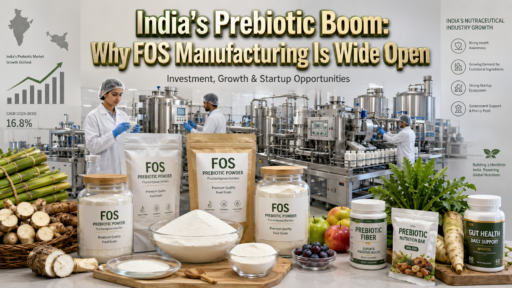


India FOS Manufacturing Business
Fructooligosaccharides (FOS): India imported the majority of FOS from China, Japan and Europe. However, the country already has one of the biggest sugar industries in the world, a surging nutraceutical sector and an increasing demand for gut-health foods among consumers. This unique demand-supply disconnect has allowed for one of the best manufacturing opportunities in the Indian food ingredients sector to develop quietly.
FOS is a prebiotic fiber that is included in infant formula, diabetic foods, clinical nutrition products, protein powders, fortified foods and dietary supplements. Almost all the leading nutrition firms in India use FOS either directly or indirectly but the indigenous production is very low. According to industry estimates, over 80% of the FOS requirement in India has yet to be met through domestic production, thus increasing the reliance on foreign suppliers and logistics.
Why FOS Demand Is Rising in India
As consumers are more concerned with digestion, immunity and metabolic health, the Indian nutraceutical market is expanding at a fast pace. These two terms— “prebiotic” and “gut-health”—show up on the labels of products in many supermarkets, pharmacies and online stores.
FOS can be found in:
- Infant nutrition products
- Protein powders
- Functional dairy products
- Diabetic foods
- Health supplements
- Clinical nutrition formulas
Infant nutrition industry generates a huge demand as almost all the infant products sold in the country are premium products containing imported FOS.
Get Detailed Insights from This Book: Modern Technology Of Milk Processing & Dairy Products (4th Edition)

Why This Manufacturing Opportunity Is Important
This is so attractive because India already has the resources for manufacturing. Sucrose is the major substrate produced for FOS production and India is one of the world’s biggest sugar producers.(India FOS Manufacturing Business)
The sugar production is significant in these areas:
- Maharashtra
- Uttar Pradesh
- Karnataka
There is also an industrial enzyme supplier that supplies the enzyme required for conversion – fructosyltransferase. This will help Indian entrepreneurs avoid being fully reliant on imported technology or imported feedstock.
Secondly, it’s not a lack of competition. India is one of the major importers of FOS as it consumes significant number of FOS annually, but there is hardly any meaningful domestic manufacturer of FOS. Although Indian suppliers are available, their ability to produce consistently and document the product quality is lacking, hence most food companies continue to use importers.
Get Detailed Project Report (DPR): Diabetic Food Manufacturing Business Plan
How FOS Is Manufactured
Enzymatic transfructosylation of sucrose is the most feasible manufacturing process for MSMEs. Sucrose is broken down to fructooligosaccharides using food-grade enzymes under controlled conditions of temperature and pH.
The typical steps of the production process are:
- Sucrose preparation
- Enzymatic conversion
- Filtration and purification
- Demineralization
- Concentration
- Spray drying is used in the case of powder form.
- Packaging
The manufacturing process is technical but not difficult for entrepreneurs if they have a proper project planning and technical guidance.
Investment Required for an FOS Plant
For small-scale FOS manufacturing unit, investment range from ₹ 1.8 crore to 2.5 crore per day for around 100–200 kg/day production capacity. Costs for a medium scale unit with a daily production capacity of 500 kg can range from ₹5 to ₹7 crore, depending on the machinery, utilities, and land purchase cost.(India FOS Manufacturing Business)
The main investments are in:
- Production machinery
- Reaction vessels made of stainless steel
- Filtration systems
- Laboratory equipment
- Civil construction
- Working capital
- Packaging systems
The investment is high, but the market has margins, as there is little competition from the local market and demand is growing.
Identify high-growth industries before others do
Profit Margin and Revenue Potential
Based on industry estimates, gross margins could be as high as 42–35% in stable operations. Net margins, excluding salaries and utilities, interest, and depreciation, can be as high as 18–24% at full production capacity.(India FOS Manufacturing Business)
A medium scale unit working efficiently can earn revenue of more than ₹8-₹9 crore per year depending upon the purity of the product and the customers.
But it’s not only the price difference that works in Favor of the Indian manufacturers; it’s the reliability aspect. Indian food companies are looking for suppliers to offer them more and more of the following:
- Faster delivery
- Technical support
- Stable quality
- Regulatory documentation
- Batch consistency
This will generate long term supply prospects for local manufacturers.
Licences and Registrations Required
There are a number of regulatory registrations and approvals entrepreneurs need to make before going into production.
Important registrations include:
- FSSAI Registration
- Udyam Registration
- APEDA Registration
- The Pollution Control Board NOC
- GST Registration
- Factory Licence
In order to start commercial food production operation, the food ingredient manufacturing company has to meet the strict food safety and food quality standards.
Government Schemes That Can Help Entrepreneurs
There are different Governmental schemes that provide assists to food ingredient manufacturers and MSME projects.
Important schemes include:
- Capital subsidy (PMEGP)
- Collateral-free loans using CGTMSE.
- Food Processing in PLI Scheme
- MSME support schemes
Official portals:
These schemes can take a lot of the financial strain off the shoulders of first-time entrepreneurs.
Related Article: Top 25 Healthcare Business Ideas
Why Entrepreneurs Should Prepare a DPR Before Investing
Entrepreneurs should develop a Detailed Project Report (DPR) before buying any machinery or availing bank loans. A DPR is a document that banks and government agencies use to assess the technical and financial feasibility of a project.
The typical components of a professional DPR consist of:
- Machinery planning
- Raw material analysis
- Financial projections
- Market analysis
- Compliance requirements
- Profitability calculations
India’s premier project reports consultants are NIIR Project Consultancy Services (NPCS).
NPCS has more than 45 years of experience in drawing up techno-economic feasibility reports for food processing, nutraceutical projects, chemical manufacturing projects and industrial manufacturing projects. Entrepreneur India also offers manufacturing project ideas and business reports to entrepreneurs.
When it comes to getting loans, having a professional plan to manage your project can make a huge difference for a first-time business owner.
Sources & References
1. FSSAI — Food Safety and Standards Authority of India
2. Ministry of MSME — PMEGP, Udyam, and MSME Schemes
3. APEDA — Agricultural and Processed Food Products Export Development Authority
4. CGTMSE — Credit Guarantee Fund Trust for Micro and Small Enterprises
5. Ministry of Food Processing Industries (MoFPI) — PLI Scheme
6. Startup India — DPIIT, Government of India
Conclusion
The FOS market is growing at a fast pace in India, while home production is minimal. The nation already has a robust sugar industry, an increasing demand for products that contain better gut health, and government policies that are very conducive to MSMEs. However, the majority of the FOS supplied to Indian food industries are from outside India.
This gives a rare manufacturing opportunity where the demand is already there, and domestic competition is not yet high. By getting into the market early, and emphasizing quality, consistency and technical support, entrepreneurs can create long-term businesses in the booming nutraceutical supply chain in India.
FAQs
For what is FOS primarily used?
The major application areas of FOS are infant formula, protein supplements, diabetic foods, nutraceuticals and digestive health products.
What is the required investment for the setting up of the FOS manufacturing?
The cost of a small unit is from ₹1.8 to ₹2.5 crore and medium scale plant range from ₹5 crore to ₹7 crore.
Will FOS be profitable in India?
Yes. With high demand and limited competition in the domestic market, net margins can be as high as 18–24% at full production.
What is the feedstock for making FOS?
The major raw material for the production of fructooligosaccharides is sucrose.
What are the Government Schemes for FOS Manufacturers?
Manufacturers are supported by a variety of schemes including PMEGP, CGTMSE, PLI for Food Processing and MSME support schemes.
Which government agency can entrepreneurs get registrations and licences from?
Official portals include:
What are the ways in which NPCS can assist entrepreneurs?
NPCS assists the entrepreneurs with the generation of Detailed Project Report, Feasibility Study and Industrial Project Documentation for bank loan and government approval.


