Fruit Waste Processing Business
India loses 30-40% of all the processed fruits. That’s millions of tonnes of mango kernels, pomegranate peels, guava pulp and banana skins dumped in landfills, while poultry farmers spend ₹1.50 lakh crore annually on feed ingredients that they can’t afford to make stable. According to AviNews, an extensive review of broiler nutrition research between 2021 and 2026 has concluded that broiler chicken can be fed as much as 10-20% of the maize and/or soybean meal in the conventional diet with fruit processing wastes without compromising the performance of the birds. At 2% inclusion, pomegranate peel resulted in decrease of abdominal fat, E. coli and an improvement in gut immunity. These are results that are relevant to the commercial world, and not research footnotes.
There has to be someone to pick up, dry, grind, and deliver this material. It could be you.
India’s ₹1.5 Lakh Crore Feed Bill and the Soybean Crisis
According to Mordor Intelligence’s India Poultry Feed Market Report, India Poultry Feed Market is projected to reach a value of around ₹1.50 lakh crore and is expected to grow at 7% CAGR. Feed cost accounts for 65-70% of the total production costs of broilers. During the last three years, the price of maize has varied from ₹18 to ₹32 per kg. Soybean meal is heavily import reliant, with 1.5–2 million tonnes of imports coming from Argentina and Brazil each year.
Each and every every rupee move and each South American drought hits the integrator’s P&L.
The States most vulnerable to this turbulence are the largest producers in India. More than 60% of the commercial broiler production in India is confined to Andhra Pradesh, Telangana, Maharashtra and Tamil Nadu state as per the Department of Animal Husbandry and Dairying Annual Report. These are the same States where the high density of fruit processing units is found, mango in Chittoor, pomegranate in Solapur, banana in Krishnagiri and guava in Allahabad. There is a very close match between the geography of waste and geography of feed demand. However, there is no organised supply chain available. This is the chance.
Get Detailed Insights from This Book: The Complete Book on Managing Food Processing Industry Waste
| State | Key Fruit Clusters | Primary By-Products | Proximity to Poultry Belt |
| Andhra Pradesh | Chittoor, Krishna, Guntur | Mango kernel, tomato pomace | Direct — AP is India’s #2 broiler state |
| Maharashtra | Solapur, Nashik, Ratnagiri | Pomegranate peel, mango kernel | High — Pune, Ahmednagar broiler clusters |
| Tamil Nadu | Krishnagiri, Dindigul, Theni | Banana peel/stem, guava residue | High — Namakkal is India’s poultry capital |
| Uttar Pradesh | Lucknow, Pratapgarh, Allahabad | Guava residue, amla pomace | Medium — Bareilly, Agra poultry zones |
| Karnataka | Tumkur, Hassan, Chikmagalur | Mango kernel, pineapple waste | Medium — Hassan broiler cluster |
| Punjab | Ludhiana, Patiala | Apple pomace (sourced from HP) | High — Punjab is large-scale commercial |
Why This Opportunity Is Bigger Now Than Ever
So, what does convergence of three market forces mean for you?
First, the cost of feed has never been stronger. The poultry input cost data in Financial Express indicates that during the last two years, the feed cost per kg of live weight increased 18-22% for broiler integrators in Andhra Pradesh, but remained constant for the consumer. Any ingredient that reduces feed cost by 5–8% will receive a commercial hearing immediately.
Second, the government’s PM Formalisation of Micro Food Processing Enterprises (PM FME) Scheme is establishing hundreds of new organised fruit processing units in the ODOP clusters. The more processing units there are, the more waste — and there are waste management procedures in the scheme. Processors are on the hunt for buyers. You can be that buyer for close to nothing or no raw material cost.
Thirdly, the inclusion rate guidelines for the ingredients of alternative feeds have been released by the Central Institute of Poultry Nutrition and Training (CIPNAT) in Hyderabad, which provides a technical cover for nutritionists to approve new ingredients. That scientific validation takes away the top buyer concern.
The PMEGP scheme provides margin money subsidy of 25–35% with the assistance of KVIC, the fruit waste processing micro unit can be made attractive for first generation entrepreneur having an investment of ₹5–7 lakh in it.
Setting Up Your Fruit Waste Processing Unit
There are three activities in the setup process, which are collection, processing and quality certification.
Collection & Sourcing: Identify two or 3 fruit processing units within 50 km & negotiate a fixed price off-take. Have a formal agreement with processors to take the waste off your hands and save some money as well — processors pay the disposal fees and take the trash. The cost of raw material is in the range of 0-2/- per kg wet weight.
Processing: Dry → grind → moisture test → bag. The technology is not complex. The main equipment includes a moisture analyser, a semi-automated bagging line, a hammer mill, and a tray dryers/rotary drum dryer.
Space Required: 1,500–3,000 sq ft shed. Most of the Industrial estates in Tier-2 towns near fruit clusters offer 1,000–2,000 square feet spaces at ₹8,000–15,000 per month.
Licences required: Udyam Registration (free, online); FSSAI State Licence for feed ingredients (₹2,000 – 7,500/year); GST; State Pollution Control NOC (Green category, 30 – 45 days).
Team: 4–6 workers for a micro unit producing 10–15 tonnes/month.
Timeline: Registration to first batch: 3–4 months. First profitable month: typically month 8–10 at 60% utilisation.
Choose the right startup backed by real market demand
| Item | Specification | Cost (INR) |
| Tray/Rotary Dryer (1 tonne/day) | Electric/solar-assisted | ₹4,50,000 |
| Hammer Mill Grinder | 500 kg/hour | ₹2,20,000 |
| Moisture Analyser | Lab grade | ₹75,000 |
| Weighing & Bagging System | Semi-automatic | ₹1,10,000 |
| Civil Work / Shed Modification | 2,000 sq ft | ₹3,50,000 |
| Raw Material Stock (1 month) | Wet waste + transport | ₹80,000 |
| Working Capital Buffer | 2 months opex | ₹2,00,000 |
| FSSAI + GST + Registrations | All licences | ₹35,000 |
| Contingency (10%) | — | ₹1,42,000 |
| Total Project Cost | ₹16,62,000 |
The Numbers: What Your Unit Can Actually Earn
The following estimates are based on 70% average utilisation and are subject to change.Payback period is estimated at 16-20 months at 70% average utilisation, and is subject to change.
This is why this margin is sustainable: your raw material costs are close to zero. Consistency and safety certification are more important to feed ingredient buyers (integrators, compound feed manufacturers) than the price. With the two anchor buyers secured, in month three you’ll have a definite revenue, as one integrator will be locked at 6 tonnes/month.
| Scheme | Ministry | Eligibility | Max Benefit | Apply At |
| PMEGP | MoMSME / KVIC | New manufacturing MSME | ₹25 lakh + 25–35% margin subsidy | pmegp.kvic.org.in |
| PM FME | Ministry of Food Processing | Food processing micro-units | ₹10 lakh capital subsidy | mofpi.gov.in/pmfme |
| CGTMSE | MoMSME / SIDBI | MSME loans up to ₹5 crore | 75–85% credit guarantee | cgtmse.in |
| MUDRA Tarun | Finance Ministry | Existing enterprises ₹5–10 lakh | Collateral-free working capital loan | mudra.org.in |
| Stand-Up India | DPIIT | SC/ST, women entrepreneurs | ₹10 lakh–₹1 crore greenfield | standupmitra.in |
| ODOP Cluster Support | MoMSME | Units in One District One Product zones | Infrastructure and marketing grant | msme.gov.in |
The pomegranate processing belt of Solapur, Maharashtra is churning out hundreds of tonnes of peels every day. Santosh Waghmare, entrepreneur, Solapur, Maharashtra: Solapur’s pomegranate processing belt is producing peels in hundreds of tonnes every day. Santosh, who was an agricultural trader earlier, established a peel drying and grinding unit with ₹14 lakh of which ₹6 lakh was his own contribution and the remaining ₹8 lakh was a loan from the PMEGP. He was selling dried pomegranate peel powder to three compound feed manufacturers at ₹18000/t in the city of Pune within 14 months. Annual revenue: ₹38 lakh. His one rule: “If you don’t have an FSSAI number, then you can’t approach any integrator because they are not going to see you. AviNews coverage of alternative feed ingredients.
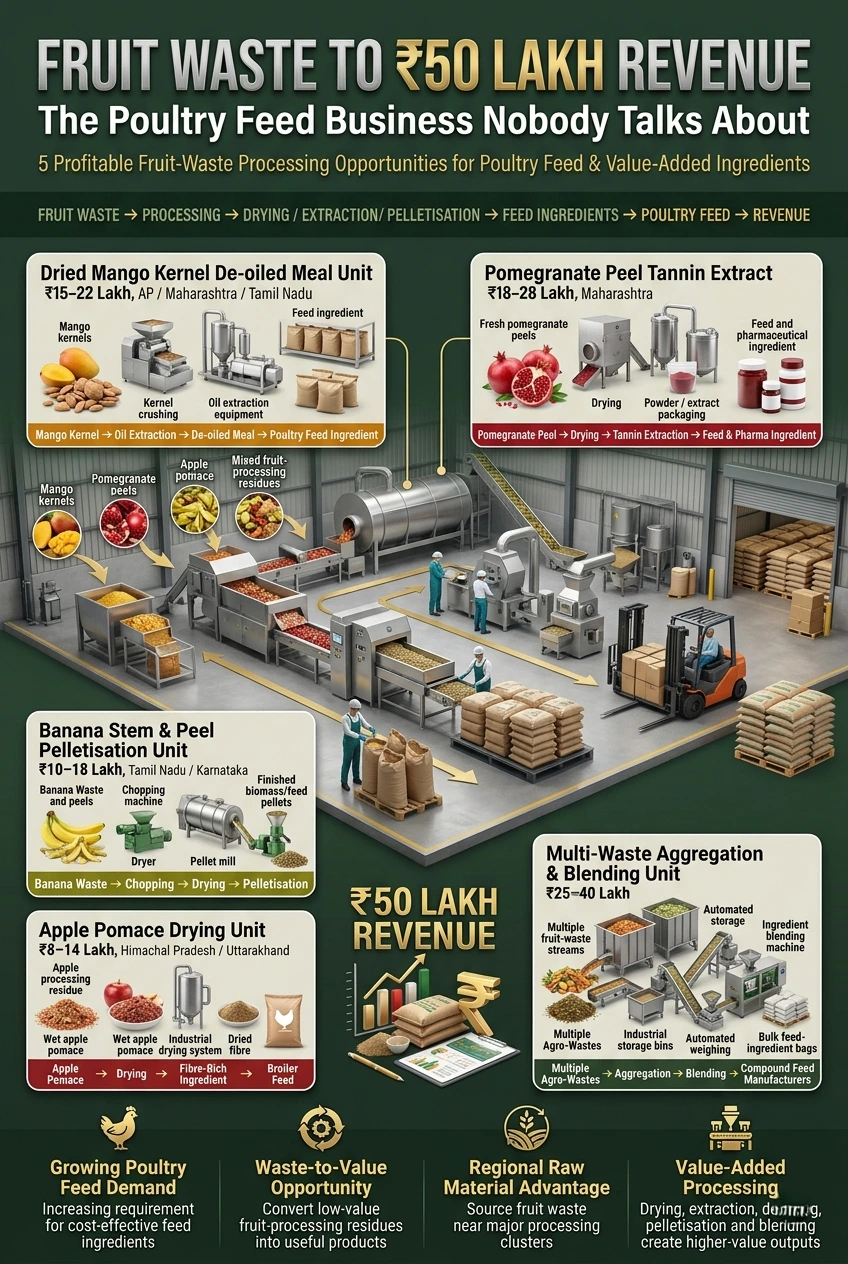
5 Manufacturing Businesses You Can Build From Fruit Waste
Dried Mango Kernel De-oiled Meal Unit ₹15-22 lakh/AP/Maharashtra/Tamil Nadu
Mango kernel de oiled meal is the most valuable ingredient of fruit waste in broiler nutrition chain. De-oiled meal after kernel oil extraction (cosmetics, chocolate coating) remaining crude protein 11–12% and starch 60% is suitable as a substitute of maize at 10–15% inclusion level. The cost of setting up mango kernel oil extraction press plus de oiling line is about ₹15–22 lakh. AP’s Chittoor district produces the highest amount of mango kernel in India where more than 200 processing units are operating during the season. Net margin on de-oiled meal: 22–30%.
Pomegranate Peel Tannin Extract for Feed and Pharma (₹18–28 Lakh, Maharashtra)
Pomegranate peel contains 20–28% tannins — compounds with demonstrated antimicrobial and growth-promoting effects in poultry. A tannin extraction unit converting dried pomegranate peel into concentrated tannin powder commands ₹50,000–80,000 per tonne from both poultry feed manufacturers and herbal extract buyers. Solapur and Nasik have the most concentrated peel supply. Total investment: ₹18–28 lakh including extraction equipment. This business sells into two markets simultaneously — feed and pharmaceuticals — reducing buyer concentration risk. Net margin: 26–34%.
Banana Stem and Peel Pelletisation Unit (₹10–18 Lakh, Tamil Nadu/Karnataka)
Banana peel is nutritionally unsuitable for direct feeding in large quantities but excellent as a pelletised roughage source for cattle and small ruminants — a secondary feed market that is also undersupplied. A banana peel collection, chopping, drying, and pelletisation unit in Krishnagiri or Jalgaon requires ₹10–18 lakh. Pellets sell at ₹8,000–12,000 per tonne. Revenue at 15 tonnes/month: ₹1.2–1.8 lakh. This works well as a first business for an entrepreneur from an agricultural background — the raw material relationships are natural extensions of existing farm networks.
View Full Project Details: Banana Products Manufacturing Business
Apple Pomace Drying Unit for Broiler Feed Fibre (₹8–14 Lakh, Himachal Pradesh/Uttarakhand)
Apple pomace — the pulp, skin, and seed residue left after juice pressing — comes from large-scale apple processing in Himachal Pradesh (Shimla, Kullu, Manali) and Uttarakhand. Dried apple pomace retains 6–8% crude fibre and functions as a gut conditioning agent in broiler diets. The hill state location means lower industrial land cost, lower raw material transport cost, and state-specific industrial incentives from HIMUDA and SIDCUL. Total investment: ₹8–14 lakh. Monthly production at capacity: 8–12 tonnes. Net margin: 18–24%.
Multi-Waste Aggregation and Blending Unit for Compound Feed Manufacturers (₹25–40 Lakh)
The highest-margin play is not processing one waste stream — it is aggregating multiple by-products, blending them to a standardised analytical profile, and supplying compound feed manufacturers as a single-source alternative ingredient supplier. A multi-waste unit in a central location (Pune, Hyderabad, or Bengaluru distribution hub) collects mango kernel, pomegranate peel, guava residue, and tomato pomace from regional sources, runs standardised quality testing, and delivers blended ingredient at ₹16,000–22,000 per tonne. Investment: ₹25–40 lakh. Net margin at full capacity: 24–32%.
Related Article: How to Start a Pectin Manufacturing Business in India
NPCS Can Build Your Project Plan
Before approaching a bank or applying for PMEGP, you need a bankable project report. NIIR Project Consultancy Services (NPCS) publishes detailed techno-economic feasibility studies for agri-waste processing units, poultry feed ingredient manufacturing, and by-product valorisation businesses — available at entrepreneurindia.co. Their reports include machinery specifications, raw material sourcing by state, FSSAI compliance guidance, government scheme eligibility analysis, and financial projections formatted for DIC and bank submissions. For a sector where technical credibility is the first buyer requirement, a well-structured NPCS project report is worth more than any brochure you could print.
The Waste Is Already There. Will You Collect It?
Fruit processing units in Solapur, Chittoor, Krishnagiri, and Lucknow are looking for someone to take their waste. Broiler integrators in Pune, Hyderabad, and Namakkal are looking for ways to cut their feed bill. You can be the bridge between them. Register on Udyam today, visit three fruit processing units this week, and start mapping your waste supply. The capital is financeable. The raw material is free. The market is hungry. What is stopping you?