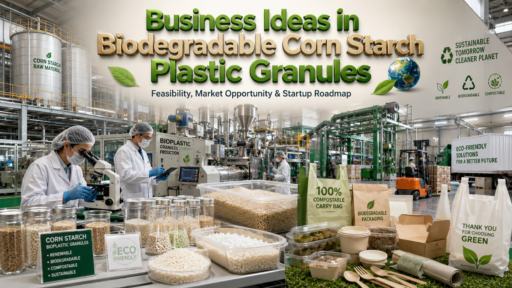


Biodegradable Corn Starch Plastic Granules Manufacturing
In the realm of green manufacturing ideas that are buzzing around in India today, the manufacturing of Bio-degradable corn starch plastic granules is one of the most interesting and not just because of the novelty. That’s not a wild gamble on a not yet proven material. It’s a technically proven product that’s commercially viable, and is situated at the intersection of increasing regulatory pressure, consumer awareness and a structurally changing global packaging industry. Production of plastic waste in India is estimated to be more than 3.5 MT per year, and after the ban on single-use plastics in major categories, the downstream market for bioplastics is no longer a vision but a reality.
Plastic granules made from corn starch, processed in a thermoplastic process with plasticizers such as glycerol and sorbitol, can be used in a variety of applications which replace conventional polyethylene and polypropylene, including carry bags, food service ware, agricultural mulch films, and pharmaceutical blister packs. The product breaks down naturally in composting conditions within 90-180 days and is certified international, such as EN 13432 and ASTM D6400. This is a once-in-a-lifetime opportunity for the MSME Manufacturing Sector in India, with not just a raw material available domestically, but an end product that is export ready and policy support from three government ministries in one stroke.
Why This Industry Makes Sense Right Now
The economics of biodegradable plastics has now changed in a dramatic fashion. Corn starch granules were first brought into the world’s awareness in the early 2000s and were too expensive to be competitive with polymers derived from petroleum. That’s a significant difference that’s come under a microscope. Crude oil feedstock for conventional plastics is both volatile and geopolitically sensitive, whereas corn starch can be sourced from India’s massive agriculture surplus and is a more stable, domestic feedstock. India is a major producer of maize (over 35 million tonnes per annum) and several clusters of starch processing are also available in Maharashtra, Karnataka and Uttar Pradesh to satisfy industrial demand at acceptable prices.
Demand growth for the global bioplastics market will be spurred by the EU’s Single-Use Plastics Directive, the green procurement guidelines in Japan, and US FDA’s efforts to promote sustainable food contact materials, among others, and is expected to reach more than 14% compounded growth rate. The fact that lower labour costs, improving certification infrastructure, and an active pro-green manufacturing push by the government through the Production Linked Incentive (PLI) scheme is giving early Indian exporters a structural edge in this segment. Domestically, the enforcement of the Plastic Waste Management Rules by the Ministry of Environment has placed an immediate demand for replacement due to plastic waste, and not a gradual replacement.
Reference: Ministry of Environment, Forest & Climate Change — Plastic Waste Management | CII — Green Business Centre | FICCI — Sustainability Council
Get Detailed Insights from This Book: Bioplastics & Biodegradable Products Manufacturing Handbook
Government Policies and Incentives
Its policy regime is quite strong. Collateral-free loans of up to ₹2 crore have been made available for green manufacturing projects under the Ministry of MSME’s Credit Guarantee Fund Trust for Micro and Small Enterprises (CGTMSE), removing the greatest hurdle in front of first generation entrepreneurs. The Textile Ministry is running the Technology Upgradation Fund Scheme (TUPS) which is suitably extended to adjacent green industries with capital subsidy of 15% of the cost of the machinery to eligible units.(Biodegradable corn starch plastic)
Startups working on innovative biodegradable formulations are eligible for income tax exemption for three years and expedient patent filing as per DPIIT’s Startup India initiative. The Make in India programme has designated bioplastics and advanced materials as priority sectors and eligible units will benefit from investment promotion measures at the state level such as exemption from stamp duty and electricity tariffs.
The National Action Plan on Climate Change (NAPCC) and the National Policy on Biofuels have also opened up avenues for funding by the National Bank for Agriculture and Rural Development (NABARD) under the scheme of agro-industrial processing. Entrepreneurs can also avail support from National Small Industries Corporation (NSIC) in getting the raw material for their business at concessional terms, as the quality of raw materials is important to ensure consistency during the bioplastic extrusion process.
Multiple Business Ideas for Startups in This Space
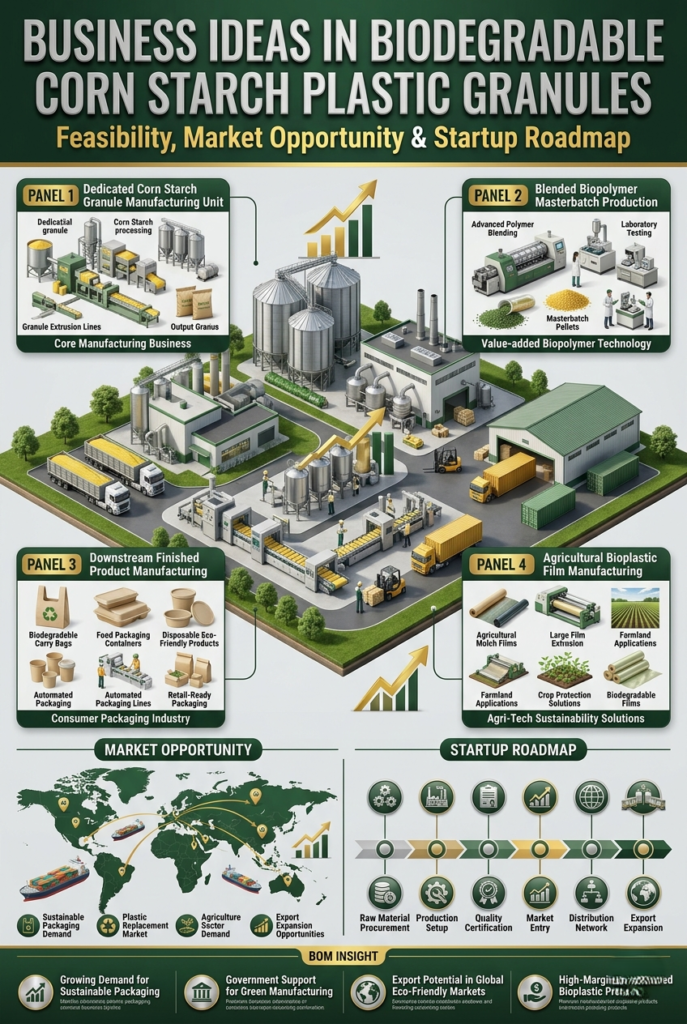
1. Dedicated Corn Starch Granule Manufacturing Unit (Core Production)
The most obvious first step is to open a corn starch polymer base granules production facility, the raw polymer feedstock used by downstream processors. This model is based on the industrial-grade corn starch and biodegradable plasticizers are mixed in a specific ratio in a twin-screw extruder to obtain uniform granules of defined melt flow index and tensile strength. These granules are then sold to converters (those who blow-mould or thermoform the material into a finished product such as a bag, tray or film). Capital cost for an MSME unit producing 500-800 MT per year is between ₹1.8 crore to ₹2.8 crore with 6 months working capital. The margin on granule production (the direct sourcing from the starch processing mills) is 28–35% gross which is one of the healthier margins in the biopolymer manufacturing category.(Biodegradable corn starch plastic)
2. Blended Biopolymer Masterbatch Production
A slightly more technically advanced and more profitable alternative is the production of customised biopolymer masterbatches, or concentrated formulations in which corn starch is mixed with PBAT (polybutylene adipate terephthalate) or PLA (polylactic acid) to impart certain mechanical properties to the material that are desired by industrial buyers. Masterbatch manufacturers use an additional 18–25% margin over the price of the standard granule as they are actually selling application ready materials with the processability parameter. It is a rapidly expanding segment due to the increasing adoption of a hybrid packaging as packaging companies are shifting from pure PLA (brittle) to hybrid material. There is a higher technical entry barrier because it requires an R&D-capable team and proper testing equipment. However, it also creates a much stickier customer relationship, and the business relies on volume driven by supply contracts rather than spot-market pricing.
Related Article: Export-Oriented Plastic Manufacturing Business Ideas in India (High-Demand & Scalable)
3. Downstream Finished Product Manufacturing — Biodegradable Packaging
Entrepreneurs with a greater business-to-business (B2B) integration taste may want to go one step further downstream by producing finished bio-packaging products from corn starch granules, such as carry bags, shrink wraps, seed nursery trays or compostable cutlery. Main advantage of this model is that it has a higher realised revenue per kg of raw material, but it also requires blow-moulding, injection moulding or thermoforming equipment as well as the ability to extrude. A key customer segment comprises modern trade retailers, e-commerce fulfilment businesses, food service brands, and institutional buyers required to make the transition to compostable packaging. Several MSME manufacturers have been able to access underutilized avenues like government procurement in events, airports, defence canteens through GeM (Government e-Marketplace) listing.
4. Agricultural Bioplastic Film Manufacturing
India’s agricultural mulch film market remains structurally underserved and creates a strong value proposition for corn starch-based bioplastics. Due to the burning of conventional PE mulch films after harvest, which causes toxic particulates in the environment, the film is being more regulated with the Plastic Waste Management Rules. Farmers, on the other hand, can plough biodegradable mulch films back into the soil, where they decompose completely without leaving any residue behind. There is strong market demand indicating product–market fit for strawberry, tomato, and watermelon farming in Maharashtra, Punjab, and Karnataka. Manufacturers typically modify standard blown film extrusion processes to produce agricultural films, making the production line technically accessible. Rising startups can benefit from ICAR (Indian Council of Agricultural Research) pilot partnerships and state agriculture department procurement to give them visibility of revenue levels in the early stages of scaling up.(Biodegradable corn starch plastic)
Get Detailed Project Report (DPR): Biodegradable and Eco-Friendly Plastics: Technologies and Application
Import–Export Opportunity Analysis
India’s export potential in this category is much underutilized. The European Union has some of the strictest packaging regulations in the world, as part of its Green Deal and Circular Economy Action Plan, and is actively looking for qualified suppliers in developing markets to lessen the concentration of the supply chain. Such manufacturers who have been certified to EN 13432 can avail this market at 20-30% premium in pricing to the realisations. The Japanese market for importing bioplastic raw material and finished compostable packaging products is several thousands of tonnes per year and Indian exporters can compete with them on price but fulfil the quality criteria expected by the Japanese importers.
The raw materials, mostly imported from China and the USA, are PLA and PBAT, which are a cost pressure for domestic blenders. Structural disadvantages put pure importers at a disadvantage because they must negotiate with foreign mills for starch and then import specialty co-polymers. Pure importers face a structural disadvantage because they must negotiate starch supplies with foreign mills and import specialty co-polymers. It is important to note that the APEDA (Agricultural and Processed Food Products Export Development Authority) is the export facilitation support for the agri-derivative products such as Starch-based materials products, where the bioplastic startups still have a long way to go in utilizing the market development assistance and international buyer connects.
Indian MSME Success Stories Worth Studying
Ecolife Granules Pvt. Ltd. — Maharashtra
Suresh Bhosale is a chemical engineering graduate from the PVC compounding business. He founded Ecolife Granules. It started generating revenue from PVC bag manufacturers in the Bhiwandi packaging cluster. The company supplied corn starch–PBAT blends.
Bhosale’s key strategy was investing in EN 13432 certification. It cost him about ₹12 lakhs at the time. This move attracted European buyers. It also helped him secure export premiums and expand capacity further.
For new business owners, the lesson is simple. Certification investment is not overhead. It is market access infrastructure.
Green Polymers India — Tamil Nadu
Kavitha Rajan is a first-generation woman entrepreneur with experience in the food processing industry. She initially targeted agricultural bioplastic film in the horticulture belts of Tamil Nadu and Andhra Pradesh for Green Polymers India.
Rajan’s strategy was scientific. She conducted trials for 18 months with four progressive farmers before commercialising the product. She also maintained detailed records of the product’s performance in the field. This evidence-based became her go-to tool to sell to state agriculture departments and institutional buyers. The company grew from an initial investment of ₹40 lakh to a multi-crore business in just six years. This growth shows how technical credibility and institutional channel development work together to benefit the company.
Choose the right startup backed by real market demand
BioPackage Solutions — Gujarat
BioPackage Solutions is a new company promoted by Dhruv Mehta. He is a retired salesman from the packaging industry. The company operates downstream of the finished product. It converts granules from other companies into certified compostable carry bags and e-commerce mailers.
Mehta believed the real profit was not in making granules. The value lies in the conversion margin instead. Bag-making machines are easily available on lease. This helps founders with limited capital.
He built early demand through the GeM platform and institutional buyers. Later, he achieved volume at scale. At the Series A stage, he began backward integration. He started building his own granule supply chain. His journey is a textbook example of a series of “seed rounds,” for a fledgling sector.(Biodegradable corn starch plastic)
How NPCS Can Help You Evaluate This Opportunity
Niir Project Consultancy Services (NPCS) offers professional consulting services for preparing a Market Survey cum Detailed Techno Economic Feasibility Report (DPR) for setting up a new industry or business.
Our reports provide comprehensive pre-investment decision support for entrepreneurs interested in corn starch bioplastic manufacturing.
They include detailed manufacturing process flow for both extrusion and compounding operations. They also cover demand and market analysis for domestic and export markets.
We provide process flow diagrams, product mix details, and capacity planning for different granule types and applications.
The report also includes machinery and raw material sourcing information, along with vendor benchmarking.
Complete project financials are covered as well. This includes capital cost breakdown, revenue projections, and working capital estimation.
We also provide profitability analysis, including IRR and payback period calculations.
Our goal is to help entrepreneurs make informed decisions. We ensure a strong, data-driven foundation to assess feasibility, profitability, and scalability before investing capital.(Biodegradable corn starch plastic)
Project Snapshot: Key Parameters at a Glance
| Parameter | Details / Estimates |
| Primary Raw Material | Native corn starch (food-grade or industrial grade) |
| Other Key Inputs | Plasticizers (glycerol, sorbitol), compatibilizers, water |
| Installed Plant Capacity | 500–1,000 MT per annum (small-scale MSME unit) |
| Estimated Project Cost | ₹1.8 Cr – ₹3.5 Cr (land, building, machinery, working capital) |
| Key Machinery | Twin-screw extruder, pelletizer, drying unit, blending system |
| Market Price (Granules) | ₹120 – ₹180 per kg (domestic); ₹150 – ₹220 per kg (export) |
| Gross Margin (approx.) | 28% – 38% depending on product mix and scale |
| End-Use Sectors | Packaging, agriculture film, disposable cutlery, medical |
| Payback Period | Approximately 3–5 years at 70% capacity utilisation |
| Key Export Markets | EU, Japan, South Korea, UAE, USA |
| Applicable Certifications | BIS, IS 17088, EN 13432 (EU), ASTM D6400 (USA) |
Additional reference: BIS – Bureau of Indian Standards (IS 17088: Biodegradable Plastics)
FAQ
Q1. Is it profitable to manufacture biodegradable corn starch plastics?
Yes, the profits of corn starch plastics range between 28 and 38%, depending on the quality of product, efficiency of production and market strategies.
Q2. What are the investments required to setup a corn starch plastic granule plant?
The investment required for small scale MSME unit is in between 1.8 crore to 3.5 crore.
Q3. What are the main raw materials required?
The main raw materials include Corn starch, glycerol, sorbitol, biodegradable additives, water.
Q4. In which industries is biodegradable plastic granules used?
Industries which mainly utilize these products include Packaging, Agriculture, Food Service, Healthcare, E-commerce, Consumer goods.
Q5. Is this business export-oriented?
Yes, the manufacturer can export to European Union, Japan, Korea, North America, U.A.E after having adequate certifications.
Q6. What are the important certifications?
EN 13432, ASTM D6400, BIS standards, ISO certifications are common requirements.
Q7. What is the expected payback period?
The payback period varies from 3-5 years on the capacity utilized and reach of product in market.
Q8. What is the greatest difficulty encountered in this business?
The formulation consistency of the product is most crucial operational challenge.