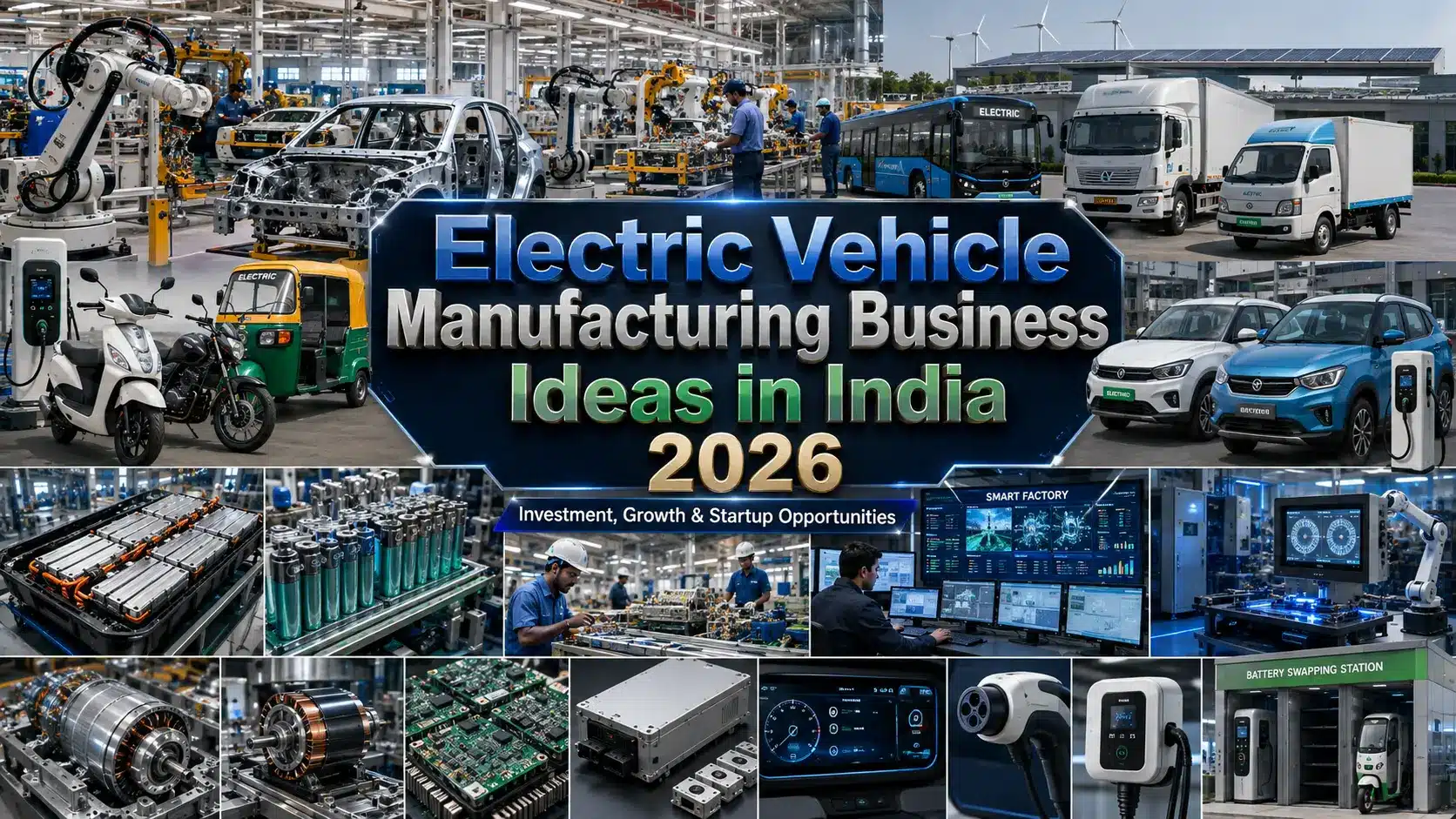

A Complete Guide to EV Components, Battery and Charging Infrastructure Opportunities
Electric vehicles (EVs) are not just a future prospect for India now; it is a goldmine of manufacturing. The national goal of electric vehicle penetration is electrifying a significant portion of vehicles by 2030, coupled with the existing abundance of charging stations, and the Production Linked Incentive (PLI) scheme incentivizing Advanced Chemistry Cells, 2026 is a pivotal year for those eyeing fresh business opportunities in the electric vehicle sector in India. But one thing is quite compelling: India continues to import most of its EV components, particularly lithium-ion battery packs, with each one of those imports therefore being an opportunity to manufacture locally.
Furthermore, This article highlights the most promising EV manufacturing business ideas for startups, MSMEs and investors. These are high stakes, high growth businesses and it’s a game of early custom development and establishing supply relationships that last rather than being in the middle of a battle for consumer brands. It’s not about size of investment, it’s about engineering ability, quality / compliance. There is also useful information on investment, licensing, government support and how to take your idea from ideas to production throughout this article.
One of the largest automotive markets in the world, India is being catalysed towards an electric mobility market that boasts never before seen levels of policy, financial and consumer excitement and support. EVs Two and Three Wheelers were early early adopters but increasingly so are public transportation, delivery services and fleets. This translates to a huge and growing base of business-to-business customers who require high-quality domestic suppliers for the components they need. Those manufacturers who enter early, and establish their quality, will shape the supply chains of the 10 years to come.
Download the Full Guide: Handbook on Electric Vehicles Manufacturing
Why EV Manufacturing Is a High-Growth Opportunity in 2026
Electric mobility is one of the most promising structural developments in India for several reasons. The government is extremely supportive of the shift and the PLI scheme for Advanced Chemistry Cells will encourage local battery manufacturing and lower costs. Fuel prices continue to climb, battery prices continue to drop, and environmental consciousness continues to increase – all of which are driving consumers and fleet operators toward significant electric two-wheelers, three-wheelers and light commercial vehicles.
Import substitution is key for a manufacturer. Localisation of one of its component parts, like battery packs, motor controllers or charging modules, gives rise to a fast-growing B2B market in India, as it gets many such parts imported from other countries. The “China-plus-one” sourcing shift provides export demand in addition to domestic demand.
Top EV Manufacturing Business Ideas in India for 2026
1. Lithium-Ion Battery Pack Assembly
The highest opportunity segment in the EV supply chain is battery pack assembly, which is also the most dependent on the import. Two-wheelers, three-wheelers, and light commercial vehicle manufacturers can be supplied directly with an assembly unit that can assemble imported or domestically produced cells into packs, integrate a battery management system and create a thermal-management solution. The high cost of EVs is due to their batteries, so it is essential to localise even the battery assembly.
Support from PLI and long-term supply contracts for Advanced Chemistry Cells, but requires high level quality control, safety and test facilities. This business is best suited for someone with an electrical or electronics background to help develop the technical credibility needed for this business. Once domestic cell production starts to ramp up, established cell pack assemblers will be first in line to benefit.
Get Detailed Project Report (DPR): Complete Guide to Lithium-Ion Battery Manufacturing
2. EV Charging Station Equipment Manufacturing
Demand for AC and DC charging modules, connectors, cables and charging points is growing rapidly as India’s charging infrastructure is bridging the gap from thousands to hundreds of thousands of charging points for mass adoption. The production of EV charging appliances puts a startup right in the middle of the construction of the clean-mobility infrastructure. This market ranges from home chargers, commercial fast charging stations, and fleet-depot charging stations—with varying specifications and target customer bases.
The scale and potential for exports of this segment is both domestic and quite evident, especially in the convergence of global charging standards. Meeting safety and interoperability requirements and fostering relationships with charge point operators, real estate developers and fleet owners installing charging stations is key to success.
3. Electric Motor and Motor Controller Manufacturing
Electric motors, motor controllers and DC-DC converters are precision products that you can only engineer and produce with process discipline and engineering skills. These parts are at the heart of the vehicle performance and their need increases as more and more EV models are introduced in India. A manufacturer moves into a fast-growing business-to-business market where these import-dependent components can be localised, and where margins will be good over time due to the high entry barriers.
Access Complete Business Plan: Electric Motor Manufacturing Business
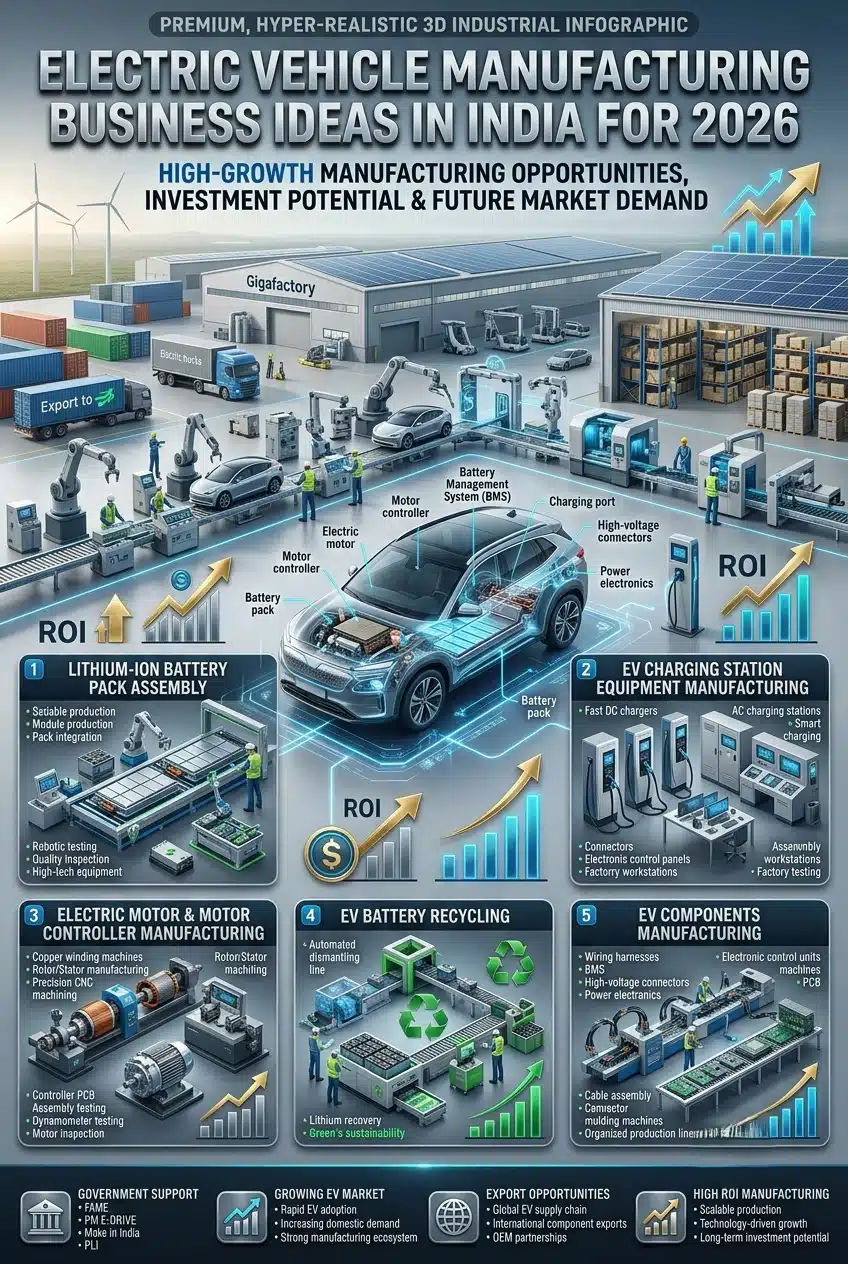
4. EV Battery Recycling
With the first generation of electric-vehicle batteries hitting the end of their battery life, extracting critical minerals like lithium, cobalt and nickel becomes both eco-friendly and profitable in a circular-economy business. The recycling of batteries is a new manufacturing frontier in India, and is now regulated for responsible handling at the end of the life. Recyclers also have advantage of the increasing amount of raw material that they are able to recycle and a significant captive market; they also have access to green financing and an increase in demand by the cell manufacturers for recovered minerals to reduce import dependence.
View Full Project Details: India Lithium-Ion Battery Recycling Market Report
5. EV Components: Wiring Harnesses, BMS and Connectors
There are other smaller, but important parts like wiring harnesses, battery management systems, and high-voltage connectors, which give medium-capital entrepreneurs a potential entry point into the EV market. The products have a steady demand from business to business and for a new manufacturer, they are a good way to build quality reputation and customer base before expanding to larger more capital-intensive assemblies. A lot of the EV suppliers who are successful start here and work up the ladder as they win the trust of the vehicle makers.(EV Manufacturing Business)
Related Article: Top Electric Vehicle Industry Consultants in India: A Complete Guide for Entrepreneurs and Investors
Investment, Licensing and Market Considerations
The investment scale of EV manufacturing ranges from a small scale of component units to a large scale of battery plant. No matter the scale, you will have to get Udyam (MSME) registration, GST registration, a factory licence and pollution control clearance followed by product-specific certifications like BIS and AIS standards. Safety is critical and the technical nature of the sector makes it important to have a detailed feasibility study and a well-structured project report before investing capital.
Market Outlook and Key Success Factors
The outlook for EV manufacturing in India is strongly positive, with electric two- and three-wheelers leading adoption and four-wheelers and commercial fleets following. Therefore, For a new manufacturer, three factors determine success. The first is quality and safety: batteries and electronics are safety-critical, and a single failure can end a young company’s reputation. The second is compliance with evolving standards, which requires staying current with BIS, AIS and testing requirements. The third is relationships, because EV manufacturing is a business-to-business game won by earning the trust of vehicle makers and fleet operators through consistent, on-time delivery.
Moreover, The entrepreneur who manages technical ability along with a disciplined approach and a single niche, rather than attempting to be everything to everybody is most qualified to seize this opportunity as it booms. Concentrating your efforts, one at a time, in the production of this one product, heavily dependent upon imports alone is much safer than flitting around the fringes on a number of other projects.
Steps to Start Your EV Manufacturing Business in India
Steps involved in starting a manufacturing unit Follow these steps. Skipping any step means most first timer entrepreneur gets out of money. Start with market research to check the demand of the product you are going to produce, who are competitors and expected price. Prepare a comprehensive project report/feasibility study to determine total investment, break-even & rate of return on investment Before opening the factory, start with this. This single document determines both your bankability and your clarity of direction.(EV Manufacturing Business)
After your plan is verified, register your company and get a Udyam (MSME) recognition, GST registration and other necessary sectoral permits. Source funds via equity, MSME loans, subsidies or credit guarantee Schemes like CGTMSE. Following that, establish your facility, source and install the machinery, choose your right raw material vendors and construct your vendor network. Lastly, acquire talented manpower, provide training and set up quality-control checks, and devise a market and distribution strategy to tap your target customers.
Explore proven business ideas with high success potential
How NPCS Can Help You Start Your Electric Vehicle Manufacturing Business
Turning a promising idea into a running factory is where most first-time entrepreneurs struggle, and this is exactly where Niir Project Consultancy Services (NPCS) adds value. NPCS is an established industrial consultancy that has supported entrepreneurs, startups, MSMEs and investors for over two decades, helping thousands of people move from concept to commercial production across chemicals, food processing, engineering, electronics and emerging technology sectors.
A new electric vehicle manufacturing project could benefit the most from NPCS’s Market Survey cum Detailed Techno-Economic Feasibility Report. A comprehensive report usually includes a thoroughly analysed manufacturing plan, dedicated market research to determine demand-supply, process flow chart of operations, an optimum product mix, the required plant and machinery with all specifications, a plan for acquiring raw materials and entire project financials along with several year-wise estimates. This is exactly the sort of data your bank will need when applying for finance, and provides you the chance to gauge the project’s feasibility before your bank does.
In addition to the detailed project report, NPCS provide New project identification services, prefeasibility studies, plant and machinery selection, layout designing, technology sourcing and Techni commercial consultation services to set-up an industrial undertaking. Its monthly Entrepreneur India magazine and library of project profiles are useful starting points for comparing opportunities. If you are serious about entering this sector, a professionally prepared DPR from a consultancy like NPCS can significantly reduce startup risk and shorten the path from planning to production. You can explore their reports and services at niir.org.
Frequently Asked Questions (FAQ)
Which EV manufacturing business is most profitable in India?
While manufacturing EV charge equipment or assembly of lithium-ion battery packs are lucrative because of significant imports & rising demand, profitability largely depends on execution quality and contract longevity.
Do I need a large investment to enter EV manufacturing?
Not exactly. There’s the possibility to get into a component business like wiring harness, Connectors, charging accessories etc at a smaller scale but setting up Battery Plants can be capital-intensive. Funding can thus be reduced through government schemes- PLI, CGTMSE, MUDRA.
What government support is available for EV manufacturing?
While production of EVs is also incentivized by PLI scheme for Advanced Chemistry Cells, demand incentives under FAME, policies of states on EV and also schemes designed for MSMEs (including Udyam and Startup India registries under DPIIT).
Is EV battery recycling a good business in 2026?
Yes. Due to surging new EVs on the back of strong consumer uptake, plus a mandate-based regime for handling old, dead EV batteries, it will provide supply chain opportunities for raw materials, good Environmental-Social Governance prospects, and continued end market utility with industry to recycle the contents, very solid proposition for new EV market-based businesses.
References and Useful Government / Institutional Links
The following official government and institutional resources are recommended for further reading on schemes, registrations, incentives and sector data relevant to this manufacturing business in India.
- Invest India – National Investment Promotion Agency – https://www.investindia.gov.in/
- Ministry of Micro, Small & Medium Enterprises (MSME) – https://msme.gov.in/
- Udyam Registration Portal (MSME registration) – https://udyamregistration.gov.in/
- Startup India – DPIIT Recognition – https://www.startupindia.gov.in/
- Department for Promotion of Industry and Internal Trade (DPIIT) – https://dpiit.gov.in/
- Make in India – Government of India – https://www.makeinindia.com/
- Ministry of Heavy Industries (FAME & PLI ACC scheme) – https://heavyindustries.gov.in/
- Ministry of New and Renewable Energy (MNRE) – https://mnre.gov.in/
- Bureau of Indian Standards (BIS) – https://www.bis.gov.in/
- National Single Window System (NSWS) – https://www.nsws.gov.in/
- NIIR Project Consultancy Services (NPCS) – https://www.niir.org/