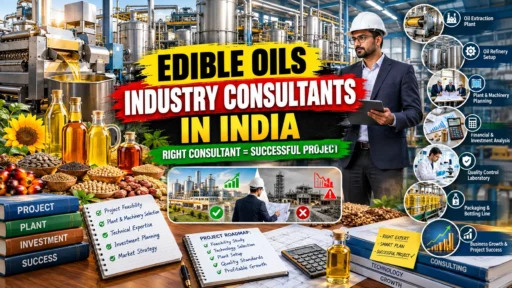


Edible oils is an important and a niche segment of the Indian agricultural industry which is also a food processing industry and industrial manufacturing. Moreover, One of the most capital intensive and policy-driven businesses an entrepreneur can venture into. Establishment of an oil extraction plant, an oil refinery or a cold-pressed oil unit entails much more than just land and machines. In fact, It requires expertise in process engineering, understanding of the regulatory landscape, such as the Food Safety and Standards Authority of India (FSSAI) and Solvent Extraction regulations, and a robust project plan that is economically viable and acceptable to lenders. Therefore, This is why it is one of the initial steps that any serious investor takes when they start searching for the best edible oils industry consultants in India.
The Indian edible oils market demonstrates strong structural fundamentals. For instance, According to IBEF, oilseed production in India has been on a consistent upward trend, with the government targeting 69.7 million tonnes of oilseed output by 2030-31 under the National Mission on Edible Oils – Oilseeds (NMEO-Oilseeds), backed by an outlay of Rs. 10,103 crore. Furthermore, The edible oils market itself is valued at USD 4.39 billion with projections toward USD 6.49 billion over the coming years at a CAGR above 6 percent. As a result, This policy push creates new project opportunities at every scale – from small expeller units to large multi-product refineries.
Therefore, The key to turning any project developer’s idea into a bankable project is the right consultant. Accordingly, This article discusses the role of the best edible oil industry consultant in India, how to assess them, and why the expertise of the expert is more important than their brochure.
What Edible Oils Industry Consultants Do
It is not a generalist who can be a qualified edible oils industry consultant. They possess special expertise in cold pressing, expeller pressing, solvent extraction (using approved n-Hexane, based on the food grade standard), degumming, neutralisation, bleaching and deodorisation (DNBD) methods in the oil extraction and refining processes. They turn this technological wisdom into useful products for the businesses they work with, depending on the project.
The Detailed Project Report (DPR) is at the heart of their work, and it delivers in-depth information regarding the project under consideration. A well-prepared DPR for an edible oils project should include the following information: Manufacturing process flow, specifications and types of equipment and machinery, raw materials used, sourcing and pricing of raw materials, layout and utilities, market research of product demand, and complete financial projections such as break-even analysis, NPV, IRR, and profitability. The DPR helps banks and financial institutions to evaluate the viability of a project before disbursement under the MSME schemes and/or priority sector lending norms.
Get Detailed Project Report (DPR): Edible and Non-Edible Oils Manufacturing Projects
In addition to the DPR, edible oil project consultants provide EPC (Engineering, Procurement and Construction) coordination, process plant design and compliance advisory. All food business operators engaged in the extraction, processing, packaging and distribution of oil have to obtain licences under the Food Safety and Standards Authority of India (FSSAI). Consultants ensure that the plant design is compliant with the requirements of Food Safety and Standards Act, 2006; effluent treatment requirements of State Pollution Control Board and Factories Act requirements for worker safety. From operational scale to institutional funding, this compliance layer cannot be negotiated for any project.
Moreover, skilled edible oils consultant can give suggestions on product mix and capacity planning which ultimately influences profitability. Which plant process should be used for mustard, groundnut, sunflower or rice bran? Should it process imported crude palm oil or work on its own oilseed processing? These decisions are influenced by the availability of raw materials, the demand of the market, the logistics, and the trends of long-term prices in the local area. An experienced edible oils specialist provides practical market insights to all engagements.
Why India Is a High-Growth Market for Edible Oils Projects
India is the world’s largest importer of edible oils. Moreover, Over 60 percent of domestic consumption is met through imports – primarily palm oil from Malaysia and Indonesia, and sunflower oil from Ukraine and Russia. Therefore, This structural import dependence creates a direct government interest in building domestic processing capacity. The Ministry of Food Processing Industries (MoFPI) administers the Production Linked Incentive Scheme for Food Processing (PLISFPI), which links financial incentives to incremental sales for food processing manufacturers including edible oil processors. Exports of agricultural and processed food products by PLISFPI-approved applicants have grown at a CAGR of 13.23 percent, demonstrating the scheme’s effectiveness in stimulating commercial activity.
The Solvent Extractors’ Association of India (SEA), the topmost industry body for vegetable oils comprising more than 875 member organisations, has always been demanding for better processing infra in the country and import substitution. The government had thus responded with a nod of approval for the NMEO-Oilseeds in the amount of Rs. 10,103 crore in funding to cut dependence on imports to about 28 percent of the domestic need by 2030-31 from its current 60-plus per cent. In the context of this endeavour, the development of more than 600 value chain clusters for over 347 districts is planned.
Access Complete Business Plan: Edible Oils in India: Market Research Report & Industry Outlook
Domestic demand conditions are also strong. Every Indian is consuming more than 20 kg of edible oil per year. The food service and quick service restaurant sector is a growing demand driver. Increase is stronger for premium product segments like cold-pressed oils, fortified oils and specialty oils like virgin coconut oil, cold-pressed groundnut oil, and rice bran oil than the commodity segments. This is a premiumisation, which makes it possible to establish project opportunity for smaller, more specialised units besides big commodity refineries.
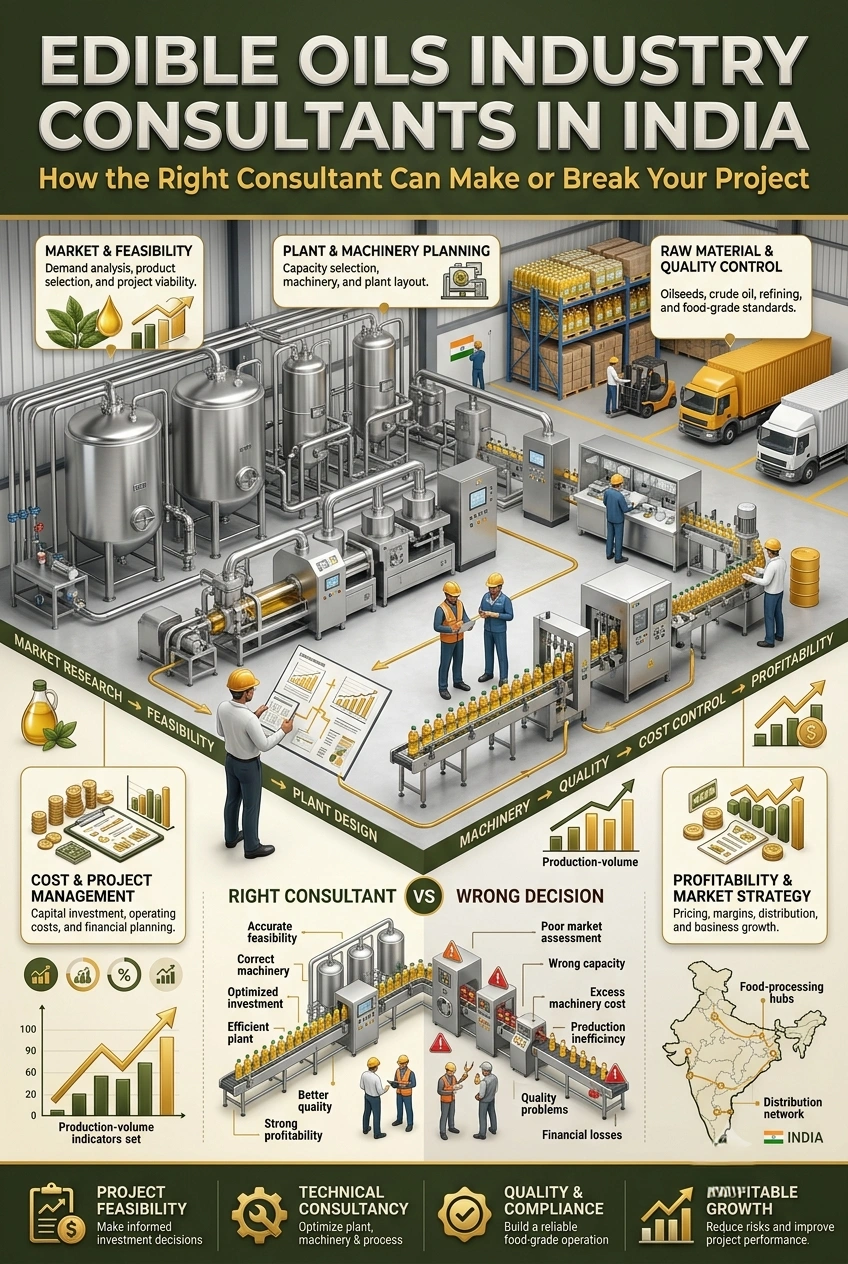
How to Evaluate the Best Edible Oils Industry Consultants in India
The selection of a consultant for an edible oils project can make the difference between a successful or unsuccessful project. Most business owners base their decision on the price or recommendations. But a more systematic investigation shows which consultants are really able to help a project from the initial concept to the commissioning.
First, domain expertise is a prerequisite. Edible oils industry can be divided into several segments – oilseed crushing, solvent extraction, edible oil refining, vanaspati manufacturing, specialty oil processing, and by-products such as de-oiled meal and lecithin. A consultant with proven experience in these sub-sectors provides knowledge and experience. Request DPRs and/or feasibility studies for comparable projects. Audit the consultant’s approach to the technical area – process flows, equipment details and capacity sizing. Warning signs include generic reports that are reused from industry to industry.
The second criterion is DPR and feasibility quality. A bankable DPR is not a fill-in-the-blanks template. It contains primary market research, validated raw material pricing, sourced equipment quotations, and financial projections built on real assumptions. Lenders – whether banks, NBFCs, or government scheme administrators – scrutinise these projections carefully. Consultants who prepare superficial reports often cause project delays when the DPR fails due diligence. Ask specifically whether the consultant has experience preparing DPRs accepted by SIDBI, NABARD, or public sector banks for food sector projects.
Related Article: How to Start an Edible Oil Manufacturing Business
The third criterion is regulatory and compliance knowledge. FSSAI licensing for edible oil businesses requires understanding product-specific standards, hygiene requirements under Schedule 4 of the FSSAI regulations, and labelling norms. Solvent extraction units must additionally comply with the Solvent Extracted Oil, Deoiled Meal and Edible Flour (Control) Order, administered by the Department of Food and Public Distribution. State Pollution Control Boards issue Consent to Establish and Consent to Operate for facilities with specific environmental impacts. A consultant unfamiliar with this regulatory matrix can expose a project to preventable delays or non-compliance risks.
The fourth criterion is engineering and EPC capability. For larger projects above Rs. 5 crore investment, the ability to coordinate engineering design, procurement of plant and machinery, and construction supervision adds substantial value. Process plant consultants and EPC consultants who have executed edible oil refinery or extraction plant commissions bring practical credibility that desktop consultants cannot match. This is particularly relevant for multi-product plants combining extraction, refining, and packaging in one facility.
The fifth criterion is client base and sector breadth. A consultant who has worked across multiple states, product types, and project scales has encountered the commercial and technical problems that any new project is likely to face. Invest India data consistently shows that food processing projects with strong pre-investment feasibility support achieve better funding outcomes and faster implementation timelines. References from past edible oils project clients, across different states and project sizes, provide the most reliable evaluation data. An international client base further signals cross-regulatory experience that strengthens advisory quality.
Role of NPCS in Edible Oils Project Consultancy
Niir Project Consultancy Services (NPCS) established in 1994, is one of the most experienced industrial consultancy companies in India in the field of food processing and edible oils industry, headquartered at Delhi. NPCS delivers over 150,000 successful projects to date in more than 85 countries with over 30 years of active consulting. The entire spectrum of services is at www.niir.org which very few Indian consultancy firms can boast of.
NPCS develops Detailed Project Reports and techno-economic feasibility studies for edible oils and allied manufacturing projects involving every critical aspect of project – manufacturing process engineering, selection of machinery and raw materials, market studies and demand analysis, process flow diagrams, mix of products and capacity planning, project financials, profitability analysis, cash flow projections, break-even analysis etc. They are prepared in a manner that suits the requirements of lenders and meets the compliance standard set by FSSAI. Feasibility reports generated by the SEA include its industry statistics and market pricing data on a regular basis to ensure that the reports are accurate in the real world.
In the edible oils segment in particular, NPCS has served its clients from a broad range of product and plant sizes. M/s. NPCS was engaged by SMV Solovex Private Limited, Jaipur, Rajasthan for a detailed study on establishment of an edible refined edible oil plant. Mr. Umesh Kumar Mahato, Singrauli, Madhya Pradesh had ordered a detailed feasibility study on the production and commercialisation of mustard oil. M/s. NPCS partnered with Ashirwad Enterprises, Aurangabad, Maharashtra on a techno-economic feasibility study in the techno-economic feasibility of cold pressed rice bran oil, a premium product segment with a high and growing market demand.
Get Detailed Insights from This Book: Our Books
M/s. NPCS was commissioned by Mehrin Tech India, Bhavnagar, Gujarat for a feasibility study on the manufacture of refined oil from cotton seed, groundnut and sunflower. M/s. Super Cleaners, Margao, Goa, approached NPCS for providing consultancy services in setting up an Edible Oil Refinery using Crude Palm Oil. M/s. NPCS expertise was utilized to perform feasibility studies for pre-investment of an edible oil refinery to process sunflower oil, groundnut oil and rice bran oil in the city of Secunderabad, Telangana. M/s. N V Soul Engineering Services Pune, Maharashtra, commissioned an all-encompassing market research report on edible oils in India.
M/s. NPCS conducted a feasibility study and market report for Vijaya Roof and Wall Cladding Systems Pvt. Ltd. Mumbai, Maharashtra for coconut oil from copra. M/s. There is also an increasing trade in quality coconut products, with Analytical Lab Services, Chennai and Mr. Krishnamurthy N.S. Coimbatore, both having approached NPCS for detailed project report on plants for virgin coconut oil. M/s. Laxmi Fin Trade Pvt. Ltd, Bhagalpur, Bihar has commissioned a techno-economic feasibility study for a Mustard Oil Plant. M/s. NPCS collaborated with Srinav Oil Extraction Pvt. Ltd. (SOEPL) in Hyderabad, Telangana for the identification of industrial projects and business opportunities in the edible oils value chain.
NPCS has also supported projects on international edible oils. M/s. NPCS was commissioned by Astral Finishing Global Resources Ltd. (AFGRL), Abuja, Nigeria, to undertake a techno-economic feasibility study of an edible oil refinery. M/s. Givanas Industry Nigeria Limited, Lagos, requested a project report for an edible oil refinery on Crude Palm Oil. M/s. NPCS conducted an economic and financial viability study for a soya and palm edible oil refinery. The project was developed for KPG International in Hetauda, Nepal. These engagements demonstrate NPCS’s ability to apply its technical approach across different regulatory environments and raw material bases.
NPCS provides a dedicated project profile catalog for edible oils processing, refining or specialty oil production to the entrepreneurs and project developers on NPCS Edible Oils Project Profiles. This catalog includes mustard oil, groundnut oil, sunflower oil, palm oil refining, rice bran oil, coconut oil, cold pressed oils and related products with their respective process and finance parameters.
Best Edible Oils Industry Consultants in Delhi and Pan-India Landscape
Delhi is the main industrial consultancy center in India. Additionally, There are many boutique management consultancies, process engineering consultancies, and EPC consultants in the capital. Many of them have experience in the food sector. Therefore, Entrepreneurs from North India can benefit from their expertise. This is especially useful for entrepreneurs in Uttar Pradesh, Rajasthan, Haryana, Madhya Pradesh, and Bihar. Moreover, Delhi-based professionals can make site visits and meet entrepreneurs for project discussions. They can also provide follow-up assistance.
The most successful edible oils industry consultants in Delhi ones are those that have a proven track record in food processing feasibility report and have a good capability in providing advisory on FSSAI compliance. For example, Delhi-based NPCS, for instance, is a perfect example of this positioning. Furthermore, Consultants who are aware of industry networks can use industry associations like Indian Vegetable Oil Producers’ Association (IVPA) to get a directory of certified processors and technology providers for sourcing and benchmarking.
Discover scalable startups tailored to your goals
In addition to geography, the edible oils consulting ecosystem in India comprises large multidisciplinary firms, food technology niche players, and individual consultants with prior industry experience.
For instance, For most MSME-scale projects in the Rs. 1 crore range, boutique specialist consultants can offer better value for money. These consultants usually operate with a narrow focus on edible oils. In comparison, large-scale consultancies often have diverse expertise across multiple sectors. Therefore, The most successful process plant consulting companies in India combine process plant design expertise with knowledge of regulatory matters. Most first-time edible oils investors do not realize the importance of this combination. Consequently, They often discover it only after partnering with a less experienced consultant. Additionally, The Invest India portal can also be an effective resource for entrepreneurs. It provides investment information about sectors they are interested in. Furthermore, Entrepreneurs can also compare incentives offered across different States before deciding on the location of their plant.
Edible Oils Consulting Services: Comparison by Type and Best-Fit Client
| Service Type | Primary Deliverable | Key Components | Best-Fit Client |
| Pre-Feasibility Study | Go/No-Go Assessment | Market overview, technology options, rough project cost, preliminary financials | Entrepreneurs at ideation stage evaluating market entry |
| Detailed Project Report (DPR) | Bankable Project Blueprint | Process engineering, machinery specs, raw material sourcing, full financials, FSSAI compliance framework | Promoters seeking term loans, bank financing, or PLI scheme benefits |
| Techno-Economic Feasibility Study (TEFR) | Investment Decision Document | DPR content plus in-depth market research, demand-supply gap analysis, competitive landscape | Institutional investors, NRI investors, large MSME expansions |
| Market Research Report | Industry Intelligence | Demand forecasting, pricing trends, competitive analysis, regulatory landscape | Existing processors seeking expansion, diversification, or export entry |
| EPC Consultancy | Executed Project | Engineering design, procurement support, construction coordination, commissioning assistance | Large projects (Rs. 5 crore+) requiring turnkey or partial-turnkey support |
| Process Plant Consultancy | Plant Design Package | Process flow diagrams, utility design, layout plans, equipment selection and vendor finalisation | Entrepreneurs with capital seeking technical project execution support |
| Compliance and Regulatory Advisory | Licensing Roadmap | FSSAI license guidance, Solvent Extraction Order compliance, PCB consent applications, Factories Act compliance | All project categories; critical for solvent extraction and refinery units |
Conclusion: Practical Next Steps for Edible Oils Entrepreneurs
There are real project opportunities in India’s edible oils industry at different investment levels. Moreover, The industry provides opportunities for both small and large projects. The price of a cold-pressed oil unit has dropped to around Rs. 30 lakh. A refinery and extraction plant can require an investment of around Rs. 20 crore for multiple products.
Additionally, The government provides consistent policy support through NMEO-Oilseeds, PLISFPI, and PMFME. These initiatives create a favourable environment for domestic capacity building. Furthermore, Industry associations also provide valuable support throughout the project life cycle. For instance, The Indian Vegetable Oil Producers’ Association (IVPA) and the Solvent Extractors’ Association of India (SEAI) are useful sources of information. Moreover, They provide updates on policy developments, raw material prices, and industry trends.
Begin by defining your product clearly – the type of oil, the extraction or refining method, target markets, and project scale. Then evaluate potential consultants against their domain experience, DPR quality, regulatory knowledge, and relevant client track record. Additionally, Request a sample DPR or feasibility report before committing to a full engagement. Ultimately, The right consultant will invest time in understanding your specific project before proposing a scope of work.
Furthermore, Niir Project Consultancy Services (NPCS) offers a comprehensive platform for entrepreneurs entering or expanding in the edible oils sector. With over three decades of experience and a dedicated project profile library covering every major oil type at NPCS Edible Oils Project Profiles, NPCS brings the depth of knowledge and breadth of experience that ambitious edible oils projects demand. Therefore, Connect with NPCS at www.niir.org to discuss your project requirements.