In today’s rapidly changing global economy, supply chain resilience is not only a competitive advantage – it’s a matter of survival. Across India’s industrial hubs such as Pune, Surat, Ludhiana and Coimbatore, MSME entrepreneurs are not asking themselves how to grow – they are asking themselves how to survive disruptions. For startups and first-generation business owners, this change represents one of the decade’s best business opportunities: digital supply chain intelligence.
Nearly three-fourths of Indian manufacturers cite trade uncertainty as their primary operational challenge. Freight volatility, raw material shortages and lingering pandemic impacts have revealed an ugly truth: most MSMEs have fragile supply chains, often dependent on a single supplier ecosystem and gut-feel procurement decisions. This gap, however, is not just an issue, it is a business opportunity hiding in plain sight.
Explore This Book: Our Books
Why Supply Chain Digitization is a Billion Dollar Opportunity
India’s MSME sector contributes about 30% GDP, employs more than 110 million people and contributes 45% of the total export. Yet most MSMEs still do procurement, inventory, and logistics on spreadsheets, via phone calls, and through personal relationships. The lack of existing, context-specific, affordable, and digital tools is a structural gap that is ripe for innovation.
Meanwhile, global supply chain management software markets are growing at double digit rates. Demand in general is growing from buyers themselves, i.e. large OEMs, e-commerce giants, as well as export destinations who demand traceability, digital documentation, and ESG compliance. MSMEs that are not able to offer suppliers diversity, compliance records, or real-time visibility of inventory, are at risk of losing premium contracts.
Startups creating tools, platforms and infrastructure to bridge this gap can gain a first-mover advantage and capture a massive, underserved market.
Key Technologies Changing MSME Supply Chains
In order to develop robust supply chains, it is essential to understand the technologies that are driving this change. Durable businesses grow out of actual technological transformation – not trends.
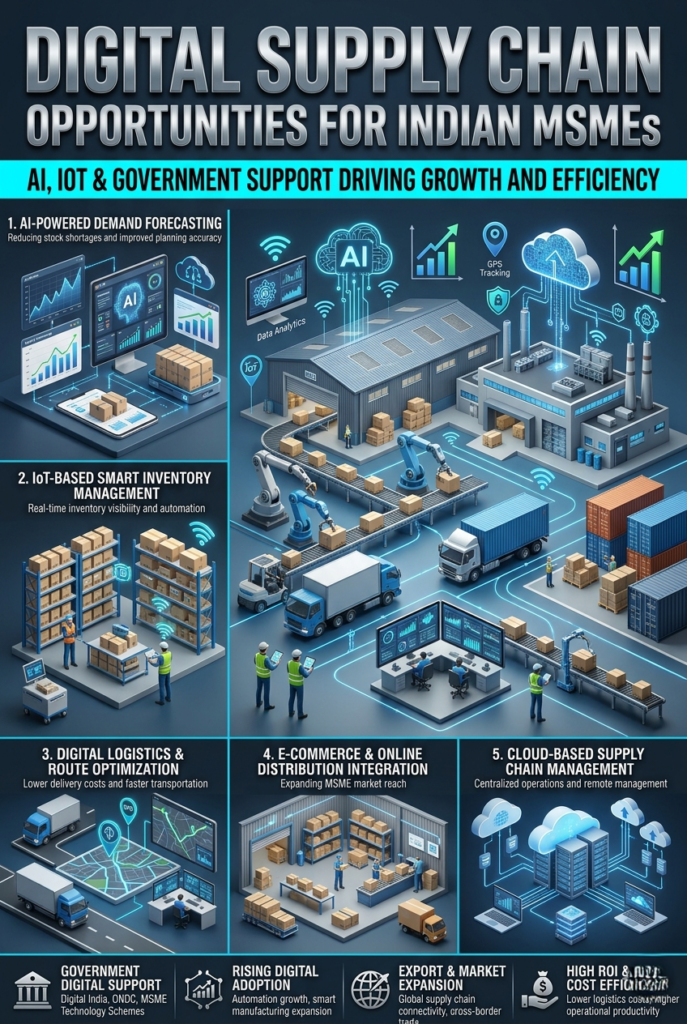
1. Demand Forecasting using Artificial Intelligence
Artificial intelligence substitutes for the old “order what sold last quarter” model. Machine learning algorithms use historical sales data, seasonality, commodity prices, and macroeconomic signals to forecast procurement needs. The advantages for MSMEs include:
- Reduced overstocking
- Increased working capital efficiency
- The lower emergency procurement costs
2. Multi-Tier Supplier Mapping Platforms
These are the platforms that visualize direct and indirect suppliers at tiers. For example, if a chemical supplier in Gujarat closes down, a manufacturer in Rajasthan can find out about other sources very soon and take care of any possible delays in production.
3. Blockchain Based Documentation & Trade Finance
Blockchain provides trust and transparency in cross-border trade by keeping immutable records of quality certifications, declarations of origin and compliance. Export oriented MSMEs can use this as a competitive differentiator.
4. IoT-enabled Inventory & Logistics Tracking
Sensors are used to get live visibility into goods in transit and warehouse stock, linked to ERP systems. Manual reconciliation is also a huge burden and improves operational efficiency.
Get Detailed Project Report (DPR): Business Plans / Project Profiles
8 High-Potential Business Opportunities for Indian MSMEs
Business Idea | Capital Requirement | Revenue Model | Export Potential | Government Support |
Supply Chain Risk Advisory | Low–Medium | Retainer + SaaS | Medium | MSME Ministry Clusters |
Supplier Discovery Platform | Medium | Subscription + Lead Gen | High | DPIIT Startup India |
Digital Trade Documentation | Low | Per-transaction / SaaS | Very High | DGFT Portal Integration |
Inventory Optimization SaaS | Low–Medium | Outcome-linked SaaS | Medium | Digital MSME Scheme |
ESG & Sustainability Services | Low | Certification Fees | Very High | BEE, MoEFCC |
Cold Chain IoT & Logistics | High | Hardware + SaaS | High | PLI Food Processing |
Cluster Procurement Analytics | Medium | Cluster Association Fees | Medium | State IDC Partnerships |
AI Cost Optimization Tools | Medium | SaaS Subscription | High | DPIIT, PLI Sectors |
1. Supply Chain Risk Advisory
Most risk consultancy services are aimed at the large corporates. MSMEs require cheap scenario modelling, alternative sourcing advice, and risk mitigation tools. A hybrid model of consulting + SaaS can be approached for industrial clusters with the help of the Ministry of MSMEs and National Small Industries Corporation.(Digital Supply Chain Opportunities)
2. Supplier Discovery & Alternative Sourcing Platforms
A B2B procurement intelligence marketplace that aggregates verified suppliers with quality ratings and compliance records can be useful for MSMEs, for instance, in reducing costs and diversifying sourcing. Export opportunities, particularly for South East Asia, are important.
Identify high-growth industries before others do
3. Digital Freight & Customs Documentation
Automating HS code classification, duty calculations, shipping bills and Letters of Credit, thousands of hours saved. Integration with the DGFT portal builds a regulatory tailwind for startups.
4. Inventory Optimization-as-a-Service
Cloud-based optimization platforms assist MSMEs in minimizing excess inventory, better utilization of working capital, and outcome-linked pricing models that eliminate up-front cost barriers.
5. ESG & Sustainability Compliance Services
EU and north American buyers require carbon footprint documentation as well as ethical sourcing certifications. MSME exporters in the textiles, leather, chemicals and food sectors can benefit from services that map, document and certify sustainability credentials.
6. Cold Chain Logistics Technology
Agriculture, food processing, pharmaceuticals and dairy industries suffer from poor cold chain infrastructure. IoT sensors and mobile dashboards to reduce food spoilage and increase traceability. Government schemes such as PLI, PM Kisan Sampada yojana are giving extra support.
7. Industrial Clusters: Procurement Analytics
The process of combining purchasing data from different buying groups enables organizations to establish price benchmarks and identify joint procurement possibilities. The organization receives financial support through its partnerships with cluster associations and industrial development corporations. The model can be implemented throughout the entire nation.
8. Cost Optimization Tools Powered by AI
Escalating energy and commodity costs require cost simulation tools in real time. Manufacturers can test different raw materials and supply chain adjustments, which will help them determine optimal pricing methods, that can be incorporated into their quoting systems, which need to maintain operational efficiency.
Government Policies to Support MSME Supply Chain Innovation
- The Startup India Programme provides tax exemptions and patent fast-tracking and fund of funds assistance to startups.
- The Digital MSME Scheme provides financial assistance for businesses to implement cloud computing and ERP systems and Internet of Things technologies.
RoDTEP & PLI Incentives program encourages companies to invest in export-oriented supply chain projects through its compliance-based funding structure.
These schemes have a strong regulatory tailwind that make it easier for startups to scale up, and access government-backed opportunities.(Digital Supply Chain Opportunities)
Related Article: Best Franchise Business in India Under 10 Lakh – Low Investment & High Profit
Lessons to be Learned from Successful Indian MSME Leaders
- Kiran Mazumdar-Shaw (Biocon, Bengaluru): Early attention to reliability and efficiency in the supply chain and vertical integration paved the way for global competitiveness.
- Baba Kalyani (Bharat Forge, Pune): Process digitization and investment in quality systems pave the way to Tier 1 supplier status
- Navin Jindal (Jindal Steel & Power): Procurement intelligence and supplier ecosystem management deliver cost competitiveness, not just production volume.
These examples show that resilient technology-enabled supply chains are a basis for global growth.
Conclusion
The digital supply chain revolution is already taking place in India. MSMEs require affordable and intelligent solutions to survive and grow. Startups that provide AI driven forecasting, multi-tier supplier mapping, digital documentation, IoT visibility, and sustainability compliance, are able to capture a massive market, government support and build long-term scalable business.
The time to act is now – Supply chain intelligence is the next big business frontier for India. For MSME entrepreneurs, this is not just an opportunity, it is an opportunity to turn challenges into quantifiable growth and global competitiveness.(Digital Supply Chain Opportunities)
FAQs for MSME Entrepreneurs
Q1: Do I need a tech background to start a supply chain advisory business?
A1: No. Operational knowledge in manufacturing/ procurement/ logistics is most important. Technology talent can be partnered or hired up.
Q2: How big is the market for MSME Supply chain tools in India?
A2: With more than 63 million MSMEs, a narrow vertical focus will yield thousands of potential clients. The market is massive, fragmented and under-served.
Q3: Common investment for a supply chain SaaS startup?
A3: Lean MVP costs ₹25–75 lakh. Advisory or consulting ventures require much less.
Q4: Are there government grants available?
A4: Yes. DPIIT-recognized startups get access to the Startup India Seed Fund Scheme, Technology Business Incubators, and state MSME programs.
Q5: How to get the first clients?
A5: Start with industrial clusters. A well-connected member, a pilot, produces referrals and case studies.
Q6: What are the export markets that are receptive to Indian supply chain solution?
A6: southeast Asia (Vietnam, Bangladesh, Indonesia), the middle east and east Africa. Indian solutions are cost effective and context related.