

Dialysis Concentrate Manufacturing Plant
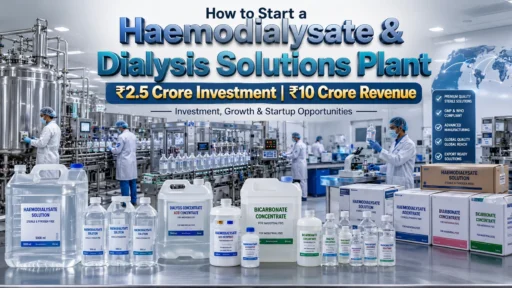
The Indian medical manufacturing industry quietly delivers one of the best consistent stories for creating wealth – and it’s not about vaccines or blockbuster drug products! Dialysis consumables, disinfectants and renal care solutions are a portfolio of business concepts that are perfectly positioned to drive the increasing burden of chronic diseases, and the underpenetrated domestic production with the strong support of the government. These products are the backbone of any dialysis center in India: Haemodiasate Dry Citrate Powder (AWCT/AFCT Part-A), Bicarb Dry Bicarbonate Concentrate (Part-B), Sodium Bicarbonate IP, and disinfectants used in dialysis (Hydrogen Peroxide Solution, Formaldehyde Solution, Sodium Hypochlorite, Citric Acid Powder). But few MSMEs have purposefully expanded into this area. It’s in that space that the opportunity is waiting to be seized.
Why the Dialysis Consumables Sector Rewards Early Movers
A silent killer is taking a toll on the Indian population in a huge way: the chronic kidney disease (CKD) crisis. Haemodialysis is a treatment that millions of patients need several times a week. Different amounts of acid concentrate (Part-A) and bicarbonate concentrate (Part-B) and dialysis disinfectants are used during each session. Demand is not cyclical – it is medically required, it is repeating.
Indian Society of Nephrology reports that the number of the dialysis centres in India has increased signficantly in the last 10 years. Under the Pradhan Mantri National Dialysis Programme, the National Health Mission has been actively purchasing dialysis machines from the local producers, thus building a consistent institutional buyer base.
Moreover, there is a dominant market driver for import substitution. Traditionally, dialysis concentrates have come from Germany, Japan and the USA. When you have equivalent quality products, particularly from domestic supply chains, it is the opportunity to cost and supply chain advantages which are happening right now, and these are priorities for hospital procurement teams.
The Recurring Revenue Logic
This is not a single sale business. Dialysis centres buy the concentrates on a consumable basis, usually on a weekly or bi-weekly basis. This ensures customer retention, regular repeat orders and a stable cash flow after the establishment of supply relations. Within the manufacturing space, the revenue model is more defensible for an MSME than most other manufacturing categories.
Related Article: How to Set Up a Manufacturing Plant for Hemodialysis Dialysate Concentrates and Dialysis Cleaning Chemicals in India
Government Policies and Incentives Supporting This Business
The Ministry of Chemicals and Fertilizers and the Department for Promotion of Industry and Internal Trade (DPIIT) have established a framework which makes medical manufacturing one of the most incentivised sectors for new entrants.
The government provides financial incentives under the Production Linked Incentive (PLI) Scheme for Pharmaceuticals and Medical Devices on incremental sales. Medical Consumables such as dialysis concentrates come under the medical devices sub-category when registered correctly with Central Drugs Standard Control Organisation (CDSCO).
The Credit Guarantee Fund Trust for Micro and Small Enterprises (CGTMSE) is another avenue for credit guarantees for MSMEs, offering collateral-free loans up to ₹2 crore. The Khadi and Village Industries Commission (KVIC) is the executing agency for the PMEGP scheme, which offers subsidy to manufacturing projects in the chemical and medical industry.
Further, MSMEs enjoy benefits of priority sector lending, reduction in the burden of compliance with GST, access to cluster development programmes under the SFURTI and MSME Competitiveness Scheme. These tools can slash the cost and risk for a first-time entrepreneur.
Business Ideas Within Dialysis Concentrates and Medical Solutions
1. Haemodiasate Dry Citrate Powder Manufacturing (AWCT and AFCT Part-A)
Haemodiasate Dry Citrate Powder is the acid concentrate part required for haemodialysis. The dilution ratios differ between AWCT formulations and AFCT formulations: AWCT is used with certain machine configurations and has a 1:34:1.83 ratio, whereas AFCT has a 1:32.75:1.25 ratio and is used with different machine configurations. It is desirable to have both variants produced in the same facility so that there will be flexibility for meeting a larger market without a large duplication of capital. The total project cost to set up a manufacturing set up with annual capacity of 500 to 800 metric tonnes is in the range of ₹1.8-2.5 crore comprising of Plant, Machinery, Quality lab and working capital. margins are good for those producers that are consistent in their product quality and are ISO 13485 or equivalent certified, a requirement of most hospital chains.
2. Bicarb Dry Bicarbonate Concentrate Production (Part-B — AWCT and AFCT)
Part B or bicarbonate is also an important part of dialysis. Compared to liquid bicarbonate concentrates, the dry powder format is also more commercially appealing from a long-term storage and transportation point of view, and, being non-refrigerated, it also reduces the expenses associated with refrigeration. The two major machine formats that are supported are: bicarb-AWCT, bicarb-AFCT The new player in this market can go straight to hospital groups and dialysis chains for institutional supply contracts with the majority of them preferring single sourcing for supplying both Part-A and Part-B. For an MSME, this integration benefit could be crucial in the market and a differentiating factor.
Explore This Book: Handbook On Chemical Industries (Alcohol Based)
3. Ready-Mix Liquid Concentrate Production (AWC, AWCD, AFC)
Centres that do not want to use dry powder reconstitution prefer to use liquid concentrates, such as AWC (1:34:1.83), AWCD (1:34:1.83) and AFC (1:32.75:1.25). The cost of transport is more expensive for liquids, but preferences differ from region to region. Liquid concentrates have a higher demand in South India and among metro hospitals chains, in tier-2 and tier-3 markets there is a higher preference for dry formats. Creating both formats increases the amount of market addresses. For existing producers, this option offers an attractive way to scale up existing dry powder facilities because they can easily install a dedicated liquid line at a low additional cost.(Dialysis Concentrate Manufacturing Plant)

4. Sodium Bicarbonate IP and SBSC Combination Pack Manufacturing
SBSC (sodium bicarbonate IP 600gm + 235gm NaCl) and SB 650 (sodium bicarbonate IP 650gm) are common dialysis products used in the pharmacy and are used in large quantities. They have a well-established regulatory pathway in Indian Pharmacopoeia. One of the lower risk ways for an entrepreneur to enter the dialysis supply chain is to have a dedicated line for pharmaceutical manufacturing exposure. The unit economics are good, the batch size is reasonable, and the demand is stable in institutions. With typical institutional pricing, a facility with a production capacity of 1.5–2 million units per year can achieve an annual revenue in the range of ₹3–5 crore for both SKUs.
Get Detailed Project Report (DPR): Sodium Bicarbonate from Soda Ash
5. Dialysis Disinfectant and Chemical Solutions Plant
All dialysis machines need to be disinfected between dialysis sessions. The machine maintenance and disinfection portfolio consists of Diatro-Sterile, Diatro-Clean, Hydrogen Peroxide Solution, Formaldehyde Solution, Vinegar Solution, Sodium Hypochlorite and Citric Acid Powder. This segment is light on domestic manufacturing. Dialysis centres generally purchase these chemicals from commercial industrial suppliers, whose products often lack the consistent quality and reliability required for dialysis applications. If a manufacturer markets such solutions specifically for dialysis use, with the proper testing certifications and hospital-grade packaging, they can realize high-priced sales and develop good supply relationships. The investment level is not that high in comparison to concentrates manufacturing, and the regulatory path is not as complicated as with concentrates.(Dialysis Concentrate Manufacturing Plant)
Import–Export Opportunity Analysis
Germany, Japan, and China currently export high-purity dialysis concentrates, with China and Japan accounting for the majority of imports. The import dependence provides a direct domestic production opportunity, particularly for entrepreneurs capable of supplying good quality products at lower per-unit cost to the global market.
On the export side, Indian manufacturers with an ISO 13485 certification and who adhere to the international pharmacopoeia standards can tap the markets of Southeast Asia, Africa and the Middle East, areas where the capacity of dialysis has been rapidly expanding but domestic production has been minimal. The Pharmaceuticals Export Promotion Council of India (Pharmexcil) has been actively assisting MSMEs in the medical consumables category in terms of market development assistance and export facilitation services.
Presently, Bangladesh, Sri Lanka, Nepal, and some African countries purchase dialysis products at prices that the domestic Indian manufacturer can offer that are cheaper without compromising on the quality. Export revenue can be 20-35% of the total income in the first 3 years of operation for an MSME with GMP based infrastructure and CDSCO licence.(Dialysis Concentrate Manufacturing Plant)
Indian MSME Success Stories in Medical Manufacturing
Hemant Kothari — Fresenius Kabi India (Pune)
With the technical expertise of its global group Fresenius, Fresenius Kabi India has proved that India can emerge as a hub for production of dialysis consumables and IV solutions. For MSME entrepreneurs, the key learning is the company’s commitment to quality rather than scale in institutional selling and establishing long-term relationships with government hospitals and corporate chains before scale. The lesson: credibility comes before volume in the institution.
BPL Medical Technologies (Bengaluru)
BPL Medical has expanded from medical devices to clinical consumables, by capitalizing on its brand reputation with hospital procurement. They entered into the dialysis adjacent market not out of sheer cold market moves, but because they had a current base of customers. The story of this case is further proof for a new MSME that it’s worthwhile to begin with one hospital group as an anchor client and grow its business geographically from there.
Baxter India — Ahmedabad Operations
Baxter is a multinational with MSME-sized supply partners for a number of its component inputs through its its Ahmedabad manufacturing facilities. Indian suppliers to Baxter in the dialysis solutions segment have proven that they can attract international institutional customers with a domestic production that meets quality standards. Many of these supplier MSMEs are now self-exporting to the markets in Africa and the Gulf.
Find high-return business ideas based on your budget & ROI
How NPCS Supports Entrepreneurs Entering This Sector
We at Niir Project Consultancy Services (NPCS) are professional consultants for preparing a Market Survey cum Detailed Techno-Economic Feasibility Reports (DPRs) for establishing a new business or industry. All our reports for dialysis concentrate manufacturing and medical solutions manufacturing include detailed manufacturing processes, market research and demand analysis, process flow diagrams, product mix and capacity planning, machinery and raw material sourcing details, project financials and profitability analysis. We are trying to assist the entrepreneur to consider feasibility, profitability and sustainability of the business project before investing in it. Consultants at NPCS for entrepreneurs usually have questions on regulatory compliance pathways under the CDSCO, quality benchmarking, and optimal configuration of their plant.(Dialysis Concentrate Manufacturing Plant)
Market and Project Data: Dialysis Concentrates and Medical Solutions
| Product / Business | Approx. Project Cost (₹) | Est. Annual Revenue (₹) | Key Market |
| Haemodiasate Dry Citrate Powder (AWCT/AFCT Part-A) | 1.8 – 2.5 Crore | 5 – 8 Crore | Hospital Chains, Dialysis Centres |
| Bicarb Dry Bicarbonate Concentrate (Part-B) | 1.2 – 2.0 Crore | 3 – 6 Crore | Multi-speciality Hospitals |
| Liquid Concentrates (AWC, AWCD, AFC) | 2.0 – 3.0 Crore | 6 – 10 Crore | Metro & Tier-1 Markets |
| Sodium Bicarbonate IP (SBSC, SB 650) | 80 Lakh – 1.5 Crore | 3 – 5 Crore | Pharmacy, Dialysis Units |
| Dialysis Disinfectants & Cleaners | 60 Lakh – 1.2 Crore | 2 – 4 Crore | All Dialysis Centres Nationally |
| Citric Acid Powder (Dialysis Grade) | 50 – 80 Lakh | 1.5 – 3 Crore | Export + Domestic |
Note: Figures are indicative based on industry benchmarks. Actual costs depend on plant location, capacity, and regulatory compliance requirements.
Frequently Asked Questions (FAQ)
Q1. A new entrepreneur wants to manufacture dialysis concentrates in India, what are all the required licenses for him?
Manufacturers must obtain a drug manufacturing licence from the State Drug Controller in accordance with the Drugs and Cosmetics Act, 1940. In addition, they must register medical devices and drug products with the Central Drugs Standard Control Organization (CDSCO). While not required by law, the ISO 13485 certification is almost a prerequisite for institutional supply to hospital chains and for certification for export.
Q2. How much is the minimum investment required to set up a small-scale dialysis concentrate manufacturing plant?
An entrepreneur can establish a single-product-focused unit, such as a dry citrate powder production unit (Part-A), with a total project cost ranging from ₹80 lakh to ₹1.5 crore, including expenses for land, building, plant and machinery, laboratory equipment, and initial working capital. For a multi-product facility for both part A and B, one would need to spend ₹2-3 crore per facility.
Q3. In India, who are the main consumers of these?
The key institutional buyers are multi-speciality hospital chains, standalone dialysis chains (such as NephroPlus and DaVita India), government hospitals under NHM dialysis programmes and large corporate hospital groups. Smaller cities’ independent nephrology clinics and dialysis units are secondary buyers.
Q4. Are dialysis concentrates, which can be produced in India, exportable?
Yes, significantly. Dialysis concentrates are in active importation in Southeast Asia (Bangladesh, Sri Lanka, Myanmar), Middle East (UAE, Saudi Arabia, Oman) and sub-Saharan Africa. The Indian producers who have GMP and competitive pricing have good export value proposition. Pharmexcil offers export facilitation service to eligible manufacturers.
Q5. Is there a government subsidy available for such a manufacturing plant for MSME entrepreneurs?
Yes. The subsidy support provided by PMEGP ranges from 15 to 35%, subject to category and location. CGTMSE offers collateral-free credit guarantees. In certain states such as Gujarat, Maharashtra and Telangana, the government provides power tariff concessions and capital subsidies for pharmaceutical/medical manufacturing units at the state level.
Q6. The time it usually takes to get a dialysis concentration plant up and running from scratch.
The realistic time frame between land acquisition and first commercial supply is 18-30 months. This involves civil construction, machinery installation, quality validation, regulatory approval and initial institutional empanelment. This time is shortened if the entrepreneur acquires an existing facility or an existing shell.
Conclusion: A Sector That Rewards Prepared Entrepreneurs
The dialysis concentrates and medical solutions manufacturing sector does not reward impatience, but it rewards preparation. Regulatory compliance is non-negotiable, quality certification is a market entry condition, and institutional relationships take time to build. However, once established, this business delivers something rare in Indian manufacturing: predictable, recurring, medically mandated demand. The combination of import substitution momentum, government scheme support, and a structurally growing patient population makes this one of the most defensible MSME manufacturing opportunities available today. Entrepreneurs who invest in understanding the regulatory pathway, securing the right technical partnerships, and targeting the right institutional buyers early will find this sector rewarding both financially and operationally.
For detailed project reports, financial feasibility studies, and market analysis on dialysis concentrate manufacturing, visit Make in India — Medical Devices for sector promotion resources and Ministry of MSME for scheme eligibility and application support.