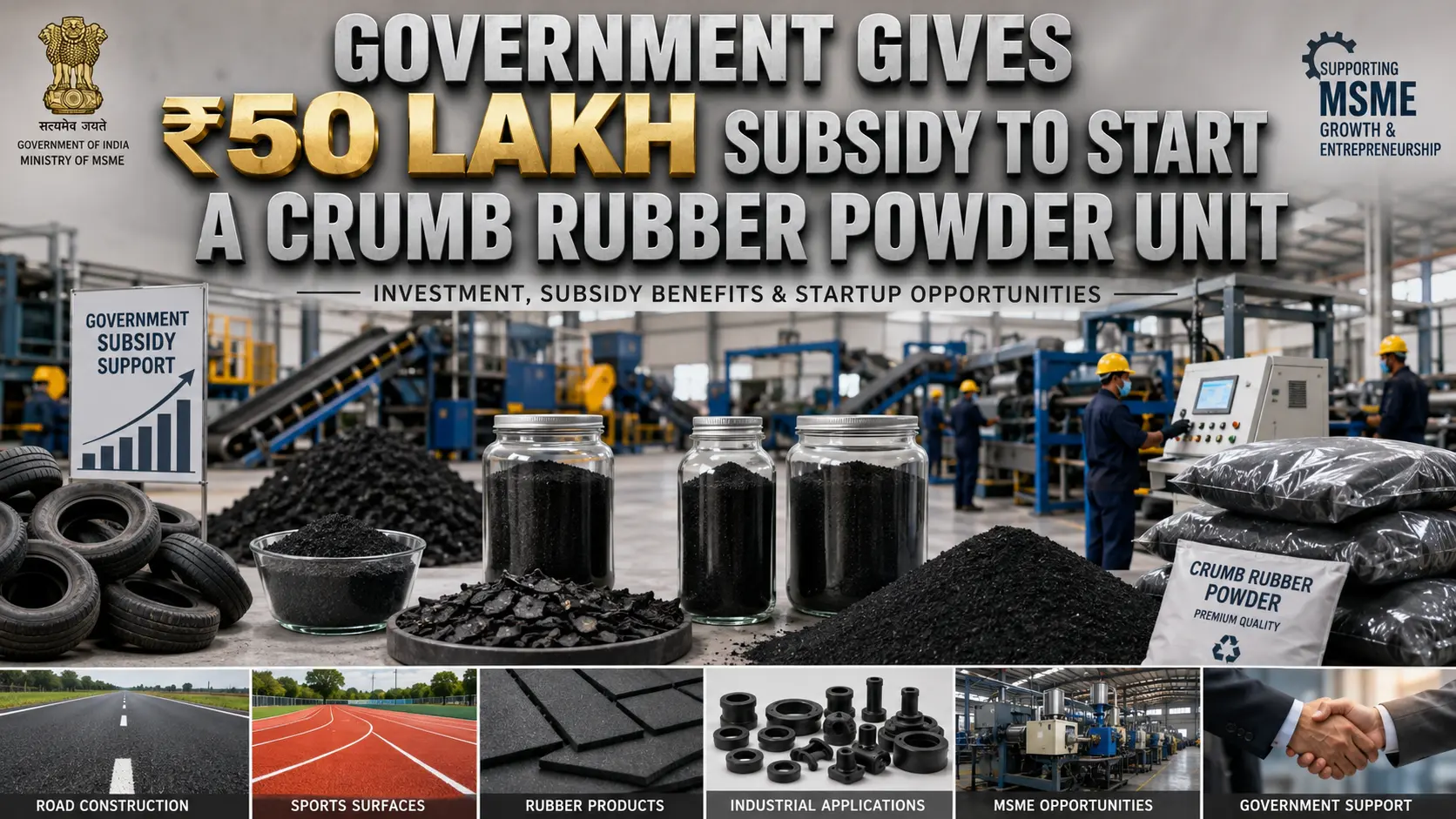

Crumb Rubber Powder Manufacturing Unit
A Business Idea That Deserves More Attention
Every few years, an important raw material appears, both in terms of environmental need and industrial use, and smart entrepreneurs get it in the first place. This is what crumb rubber powder is now! A crumb rubber powder manufacturing unit ticks almost every box a serious MSME investor would look for — consistent supply of raw materials, rising demand for the product by end-users, good export potential and — most crucially — direct government support up to ₹50 lakh in subsidy support.
However, most small manufacturers ignore it. Many continue to pursue the saturated sectors and this niche is still not well penetrated in India. This article examines the whole picture – market opportunity, government incentives, actionable project models and the true numbers of a business.
Why the Crumb Rubber Powder Sector Is Growing Fast
As per data cited by the Central Pollution Control Board (CPCB), India is producing more than 1.1 million metric tonnes (MT) of end-of-life tyres (ELTs) annually. In the past, these tyres were illegally dumped in landfills or burned, causing significant environmental problems. Today, regulatory and market pressure are working together to find a way to change this waste stream into a stream of high value manufacturing.
Shredding, granulating and fine milling end-of-life tyres has given rise to a commercially proven product: crumb rubber powder which is finding numerous applications in the construction, sports surface, ancillary automotive, road laying (rubberised bitumen) and waterproofing membrane sectors. The demand for rubberised asphalt is growing rapidly, due to India’s huge road infrastructure programmes.
Moreover, the Bureau of Indian Standards (BIS) has prescribed quality criteria for the use of crumb rubber in road construction and hence, there is no longer a discretionary demand — it is a specification level criterion. This type of policy-induced demand is a good barrier of defense for an MSME business owner.
Get Detailed Insights from This Book: The Complete Book on Rubber Processing and Compounding Technology
Export Demand Is Equally Compelling
Crumb rubber powder is highly sought after in Europe, South-East Asia and the Middle East for applications such as synthetic turf, playground surfaces and automotive rubber. Indian producers who produce mesh sizes that meet the international standards (usually 20 to 80 mesh) may be able to avail of these export avenues at prices that are premium to international prices. The Agricultural and Processed Food Products Export Development Authority (APEDA) as well as the various trade bodies for polymers have identified rubber recycling products as an emerging category for MSMEs in India to export.
Government Policies and Incentives Supporting New Entrepreneurs
The Indian government has created a multi-level support system for MSMEs with recycling focus. There is a real, structured and available subsidy opportunity; it is there, but entrepreneurs just don’t know where to look.
MSME Credit Linked Capital Subsidy Scheme (CLCSS)
The CLCSS programme, run by the Ministry of MSME, provides capital subsidy of up to ₹1 crore or 15% of the cost of plant and machinery investment, whichever is less, under the CLCSS. In the case of a crumb rubber powder unit, this equates to a cost saving on basic processing equipment.
Technology Upgradation Fund Scheme (TUFS) and State-Level Support
There are also state MSME schemes that provide extra capital subsidies of 20–35% by several state governments, mainly Maharashtra, Gujarat, Tamil Nadu and Rajasthan. Moreover, The overall subsidy benefit for the medium sized units is often much more than Rs. 50 lakh when added up with central schemes. Businessmen should contact their respective State Industries Department / District Industries Centre (DIC), to chart out the benefits available in the respective States.
Extended Producer Responsibility (EPR) for Tyres
The Ministry of Environment, Forest and Climate Change (MoEFCC) has introduced EPR for tyre manufacturers. This allows producers to ensure that a certain percentage of their tyre production is collected and recycled on an annual basis. This provides a system of supplying structured feedstock to crumb rubber processors – tyre companies can no longer avoid, by choice, supplying tyres to registered recyclers. In the case of a new unit, this could be an arrangement for the raw material supply, which would eliminate a large part of the risk of procurement.
Make in India and Zero-Effect Zero-Defect (ZED) Certification
ZED Certified Units through ZED Certification Scheme of Ministry of MSME are eligible for extra subsidy layers and preference in government procurement. This is especially applicable to the crumb rubber powder units that supply to public road projects or government approved sports infrastructure projects.
Multiple Business Ideas for Startup Entrepreneurs in Crumb Rubber Powder
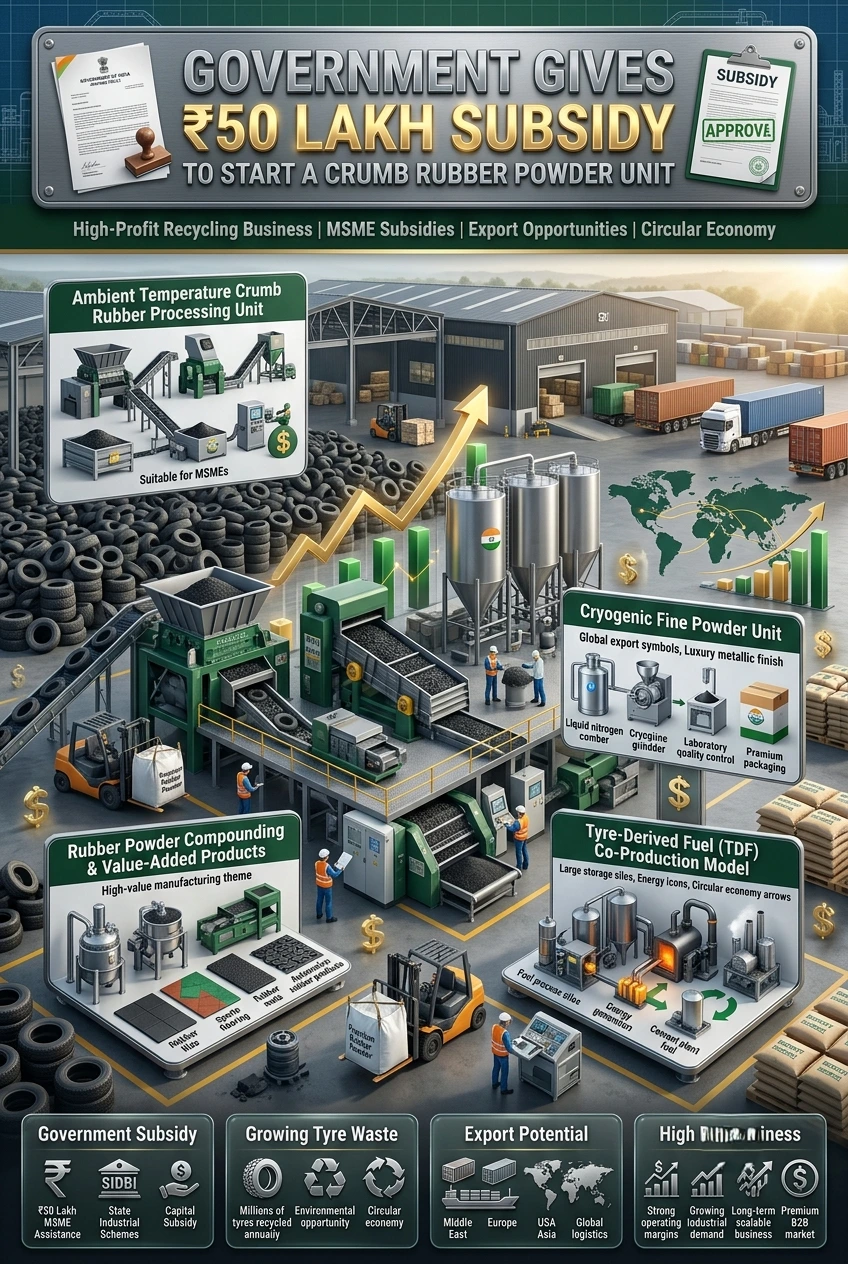
1. Ambient Temperature Crumb Rubber Processing Unit
An ambient temperature processing unit is generally the best start point for an entrepreneur getting into the business for the first time, because it uses less capital. Furthermore, In this methodology, old tyres are mechanically shredded and are further granulated in a progressive manner by a series of progressive size reduction steps and separated from the steel wire and fibre using magnetic separators and air classifiers. Finally, The end product is crumbing rubber 1-10mm granule size or powder 20-40 mesh.
It is the best model for the entrepreneurs who have ₹75 lakh to ₹1.5 crore budget for plant and machinery. Moreover, The capacity is generally in the range of 500kg to 2 tonne per hour based on the set up of the equipment. Crucially, the main markets are those of fabricators of playground surfaces, rubberised bitumen contractors and suppliers of construction aggregates. Furthermore, Ambient systems have lower energy costs and lower resolutions than the cryogenic systems. In addition, This specification has high local demand for the entrepreneurs engaged in the road construction industry and basic moulded rubber goods manufacturing.
Get Detailed Project Report (DPR): Setup Industry Of Crumb Rubber Powder from Waste Tyre (with Shredding Process)
2. Cryogenic Fine Powder Unit for Premium Export Markets
The cryogenic processing unit is a machine which freezes tyre rubber using liquid nitrogen to a very low temperature and then fine-mills it. Consequently, This process yields a uniform, even particle surface, while avoiding degradation of the rubber fibre, which is essential for many premium applications like sports synthetic turf infill, automotive seals, specialty waterproofing compounds etc. Furthermore, The price of the cryogenic crumb rubber is 40-60% higher than the product produced at ambient temperature, both in the domestic market and in the export market.
The initial funding for this business proposition tends to be higher, usually around Rs 3-6 crore to set up an entire production facility, but the resultant EBIDTA margins can be as high as 28-35 percent (especially for units targeting exports). Furthermore, Experienced entrepreneurs have leveraged a letter of intent from an importer in the European region or the Gulf to get banks to open credit lines under MSME schemes, before the facility is actually commissioned. Additionally, Support and buyer matching is available from FIEO (Federation of Indian Export Organisations) for just such emergent manufactured goods.
3. Rubber Powder Compounding and Value-Added Products Unit
A vertically integrated model is more interested in manufacturing crumb rubber powder into rubber compound sheets, moulded tiles, speed breakers, anti-vibration pads or gym rubber floor rolls than in selling raw crumb rubber powder. This business venture involves a much larger value chain and buffers the entrepreneur from price fluctuations of raw rubber.(Crumb Rubber Powder Manufacturing Unit)
The cost of a combined powder + compounding machine ranges from ₹1.5 crore to ₹3.5 crore. Moreover, The value-added products sell for a much higher price per unit of crumb rubber. For example, A kilo of crumb rubber powder can cost ₹28-40 per kg whereas a gym floor tile created from crumb rubber powder can push costs up to ₹120-180 per kg equivalent. Furthermore, The rubber flooring market is also witnessing an increase in the number of projects in urban infrastructure, and various institutional buyers such as schools, hospitals, government offices, are requiring rubber flooring under BIS standards, creating a well-defined procurement channel for MSME suppliers.
4. Tyre-Derived Fuel (TDF) Co-Production Model
A sophisticated processing unit can process the material flow in such a way that the crumb rubber powder and tyre derived fuel (TDF) (high calorific value industrial fuel) are produced side by side. Furthermore, In the tyre shredding process, the non-rubber components, such as the steel and fibre, are separated, while the substandard rubber components not suitable for powder can be processed into cement kiln TDF pellets or chips, industrial boilers TDF pellets or chips.
This co-production model brings the near-zero waste raw material utilisation, which enhances the EPR compliance standing and lowers operational expenses. Furthermore, The entrepreneur has a strong secondary market as the cement industry and Power Plant owners are active buyers of TDF in India. Moreover, From a project finance point of view, the multi-revenue structure is more positive for lenders, and can lead to improved project finance terms.
Related Article: How to Start a Crumb Rubber Powder Plant: ₹1.5 Crore Investment, ₹6 Crore Revenue
Import–Export Opportunity Analysis for New Startups
Currently, India supplies crumb rubber powder to various countries such as UAE, UK, Germany and some countries in ASEAN. However, the penetration of exports is still very low as compared to the country’s processing capacity. The main reason is CONSISTENCY: tight mesh size uniformity, low moisture and certified steel free product is required by foreign buyers. If Indian MSME invest in the package (moisture-proof big bag) which is aligned with the international standards, they can sell the fine mesh powder at $650–900 per metric tonne FOB.
India is currently importing specialty synthetic rubber products where crumb rubber powder can be used to replace at least 30-40% of specialty rubber products at lower cost if it is processed to fine mesh. The prospect is strong for an import substituting player to market its product to automotive component manufacturers and polymer compounders.(Crumb Rubber Powder Manufacturing Unit)
The Directorate General of Foreign Trade (DGFT) offers support for trade in the form of export incentives provided under the Remission of Duties and Taxes on Exported Products (RoDTEP) scheme. A duty and tax rebate is available for exporters of crumb rubber powder that boosts margins for exporters by 2-4 percentage points.
Indian MSME Success Stories in the Crumb Rubber Sector
Elgin Rubber Industries, Kolkata
Elgin Rubber Industries is one of the more documented examples of an MSME that developed a profitable rubber recycling operation that involved ambient processing coupled with end product manufacturing. Moreover, The promoter group chose to break out of the raw crumb rubber business early on and turn the business around to finished rubber flooring and moulded goods. Furthermore, The vertical integration move was to safeguard margins when crumb rubber spot prices were volatile. Therefore, Their advice to novices: The raw powder business is the starting point, not the finishing line.
Geofabrics Australasia India Operations and Regional Analogues
Major companies from across the world are dominating the market of synthetic turf infill while a few companies from the manufacturing hubs of Gujarat and Rajasthan have emerged as the authorized suppliers to the synthetic turf installers for the sports projects undertaken by the state government. Furthermore, These entrepreneurs obtained their first contracts from the GeM (Government e-Marketplace) listing and MSME registration. In addition, The key selling points of their product was that it was fast to deliver and they could supply the mesh required for each project that was not possible in larger plants to manufacture to custom specification. Therefore, The take-home message is that being agile and flexible on specification is a genuine asset for an MSME when compared to larger, less agile MSMEs.
Rubberised Bitumen Suppliers to NHAI Projects
Small MSME rubber processing units have been able to secure a stable revenue source by supplying crumb rubber powder to the approved rubber processing vendors of the National Highways Authority of India (NHAI) across Madhya Pradesh, Haryana and Maharashtra. The Central Road Research Institute (CRRI) has approved the rubberised bitumen mix designs which require a specific crumb rubber mesh size. Consequently, Those who went through the certification process early in their business, despite postponing commercial production, are now enjoying long-term offtake contracts with bitumen suppliers, as per BIS and CRRI quality approval. Moreover, Their decision rationale is that the certification cost represents a one-time investment that will generate repeat institutional business, ultimately delivering returns that far exceed the initial certification expense.(Crumb Rubber Powder Manufacturing Unit)
Professional Feasibility Support from NPCS
At Niir Project Consultancy Services (NPCS), we provide professional Market Survey-cum-Detailed Techno-Economic Feasibility Reports (DPRs) to help establish new industries and businesses. Our reports contain all the information about the manufacturing processes, market research and demand analysis, process flow diagrams, product mix and capacity planning, machinery and raw material details, project financials with profitability analysis, etc. We help business owners assess whether their business ideas are viable, profitable, and sustainable before they invest.
In the case of a crumb rubber powder unit specifically, our DPRs include ambient vs cryogenic process selection, raw material sourcing under the EPR frameworks, subsidy eligibility mapping across central and state schemes, detailed financial projections such as payback period, internal rate of return, and break-even analysis. When entrepreneurs request a DPR before they visit a bank or investor, they tend to see their loans approved more quickly and in a better negotiating position with equipment suppliers.
Choose the right startup backed by real market demand
Market and Project Data Reference Table
| Parameter | Ambient Unit (Small) | Ambient Unit (Medium) | Cryogenic Unit (Export) |
| Project Investment | ₹75 L – ₹1.5 Cr | ₹1.5 Cr – ₹3 Cr | ₹3 Cr – ₹6 Cr |
| Capacity (Tonnes/Month) | 30 – 60 MT | 60 – 150 MT | 100 – 300 MT |
| Product Mesh Range | 1–10 mm granule | 20–40 mesh powder | 40–80 mesh fine powder |
| Realisation per KG | ₹24 – ₹32 | ₹30 – ₹40 | ₹48 – ₹75 (export) |
| EBITDA Margin | 18–22% | 22–28% | 28–35% |
| Subsidy Benefit (Indicative) | ₹12 – ₹18 Lakh | ₹20 – ₹35 Lakh | ₹35 – ₹50 Lakh |
| Payback Period | 3.5 – 4.5 Years | 3 – 4 Years | 2.5 – 3.5 Years |
| Primary Market | Road construction, tiles | Moulded goods, flooring | Synthetic turf, auto exports |
FAQ: Crumb Rubber Powder Manufacturing Unit
1. What is the minimum investment to start a crumb rubber powder unit?
Small scale ambient processing unit can be setup for an investment of 75 lakh to 1.25 crore which includes site development, plant & machinery, two months working capital and initial regulatory clearances. Govt subsidies under CLCSS & State schemes would further reduce the net capital investment to 15-35% depending on the state of operation.
2. How does the ₹50 lakh subsidy benefit work in practice?
The ₹50 lakh figure represents the maximum cumulative benefit that businesses can receive by combining central schemes (CLCSS: up to ₹15 lakh), state-level MSME capital subsidies (typically covering 20–35% of eligible plant costs), and interest subvention benefits offered through SIDBI-routed credit. Entrepreneurs must apply through their District Industries Centre (DIC) and register their unit on the Udyam portal before receiving the disbursement.
3. Where does the raw material (end-of-life tyres) come from?
Raw tyre supply comes from multiple channels: tyre dealers, automobile service workshops, municipal solid waste contractors, and increasingly through EPR-registered tyre collection networks. Under the EPR framework mandated by MoEFCC, tyre manufacturers must channel collected ELTs to registered processors. A new unit can formally apply to become an EPR-compliant processor, which opens a structured and guaranteed feedstock channel.
4. What are the key quality certifications required for commercial supply?
At the minimum for domestic road construction material supply, CRRI-approved mesh sizes and BIS specifications need to be provided. The supplier to overseas market usually need the ISO 9001 quality management certification and mesh test reports from authorised labs. When exporting synthetic turf infill materials for FIFA-quality sports projects, turf installers may need to implement the FIFA Quality Programme. However, crumb rubber powder manufacturers should comply with the particle size and contaminant level requirements specified in the supply contract.
5. Is this business viable in Tier-2 and Tier-3 cities?
Absolutely — and in many cases, Tier-2 and Tier-3 locations offer cost advantages in land, labour, and local authority processing. The key prerequisite is access to a reliable ELT supply chain within a 150–200 km radius and reasonable road connectivity for outbound dispatch. States like Rajasthan, Madhya Pradesh, and Telangana have active MSME clusters where crumb rubber units operate profitably with lower fixed costs than metro-adjacent locations.
6. Can a first-generation entrepreneur enter this business without a polymer or rubber background?
Yes. The processing technology is mechanical and well-documented. Multiple equipment suppliers in India (concentrated in Gujarat and Punjab) offer turnkey plant installation with operator training included. What a first-generation entrepreneur genuinely needs is a clear understanding of end-market specifications, a practical DPR with accurate financial projections, and early engagement with at least two or three potential buyers before plant commissioning. NPCS structures its feasibility reports to cover all these elements and help entrepreneurs avoid the most common pre-launch mistakes.
Conclusion: A Sustainable Business That Rewards Early Movers
The crumb rubber powder sector sits at a rare convergence of policy push, environmental compliance demand, infrastructure growth, and export potential. Government subsidies worth up to ₹50 lakh are available — but only to entrepreneurs who proactively navigate the application process through the right MSME channels.
This is not a speculative business idea. The raw material stream is growing. Moreover, End-use demand is backed by regulatory mandates. Export markets offer premium pricing for quality-consistent product. And the government has deliberately designed support structures to enable exactly this kind of sustainable industrial investment.(Crumb Rubber Powder Manufacturing Unit)
The entrepreneurs who move in the next 12–18 months — before the sector attracts larger capital and competition intensifies — will be the ones who build durable, profitable businesses in this space. The window is open. The question is simply whether you will act on it.
References: Ministry of MSME | MoEFCC | DGFT | FIEO | ZED Certification