CLCSS Subsidy for Agro Processing
The majority of the subsidy schemes listed on this platform are targeted at new unit entrepreneurs. What CLCS does is tailor-made for an existing agro-processing unit that has operated for a couple of years with basic machinery, is falling behind the game with poor machines, and requires to upgrade the plant and machinery.
This is a more typical one than it sounds. It is a technology upgradation problem if a rice mill runs on an older huller, spice mill run on an equipment which can’t produce the fineness demanded by the retail buyers or an oil expeller unit with equipment which does not give a satisfactory oil recovery, as compared to the modern types.It is a technology upgradation problem if a rice mill uses an old huller, spice mill uses an equipment which cannot produce a fine product as demanded by the retail buyers or an oil expeller unit with equipment which does not give satisfactory oil recovery as compared with the modern type.
Under CLCS, eligible plant and machinery can be availed with a 15% capital subsidy (maximum of ₹15 lakh) which is directly credited to the loan account and credited directly into the account of the machine, hence reducing the payable loan amount.
How CLCSS Works — and Why It Is Different From PMEGP
CLCSS offers an upfront capital subsidy of 15% of the institutional finance for the modernisation of plant and machinery, capped at ₹15 lakh, irrespective of the size of the plant and machinery investment. The subsidy limit remains at ₹15 lakh even if the total investment in machinery is increased by the unit to ₹1 crore.The cap of subsidy is not being increased beyond ₹15 lakh irrespective of the amount of investment in machinery by the unit. The scheme includes 51 sub-sectors and products across a variety of small-scale manufacturing and agro-processing sub-sectors, some of which are added to the scheme’s list regularly by the scheme’s Technical Sub-Committee and Governing and Technology Approval Board in accordance with new technologies that are approved.
Whereas, CLCSS is limited to those units that have been in operation, and seek to bring about modernization of certain machinery, and it is not intended for new businesses. However, new units may apply, but only where the technology being installed has been approved by the technical board of the scheme – in practice, the most relevant for an agro-processing unit that has been operating for a couple of years and is ready to commit to an investment in a specific piece of machinery that could make a significant improvement in output, quality or yield.
A loan from a bank, scheduled co-operative bank, regional rural bank, state finance corporation or any nodal agencies of the scheme, including SIDBI and NABARD is a must. The subsidy is not a stand-alone grant; it is administered on top of institutional finance; the application process takes place through the lending bank and not directly with the entrepreneur.
Download the Full Guide: Profitable Agro Based Projects with Project Profiles
Why Agro-Processing Units Are Particularly Good Candidates
In a DPR, the case for upgradation is easier to make in some categories than in others, due to the direct relationship between output differences and old versus new technology in agro-processing, such as percentage of oil yield, percentage of milling recovery, accuracy of grading, or efficiency of drying.
The three patterns that keep emerging for agro-processing units contemplating CLCSS are highlighted below. It’s a unit that’s outgrown its capability and requires more productive equipment to accept new orders that it’s currently rejected. Secondly is a unit that has been producing lower quality product, cleaner grading, finer grinding, better moisture control, and not achieving the top dollar market because of its lower quality product. Third, a unit experiencing an increase in raw material prices with a need for improved recovery or yield so as to maintain the price they can charge.
1. Rice Mill Modernisation
The rice mill with an outmoded huller-based technology generally has a lower head rice recovery rate (percentage of unbroken, whole rice recovered from rice paddy) than modern rubber-roll shellers and multi-stage polishing machines. Upgrading milling, grading, and colour sorting equipment to current-generation technology can significantly improve rice recovery and premium-grade output, which fetches better prices.
So, for a rice mill with a daily capacity of a few tonnes, the difference in a few percentages of improved recovery becomes a significant increase in annual revenues, a compelling argument in the cost-benefit part of the CLCSS application — the cost of subsidy and loans will be recovered from the increased yield over a calculable payback period.
Read the Complete Book Here: Handbook on Rice Cultivation and Processing
2. Edible Oil Expeller and Filtration Upgradation
Older expeller units tend to leave a significant amount of oil in the cake (the solid part after oil extraction), resulting in a loss of yield. The newer expellers and filtration systems provide higher extraction efficiency, and sediment-free oils are also important for retail customers who are looking for clear, well-filtered, cold-pressed or filtered oils as opposed to the cloudier oils produced by older systems.
In the case of units processing mustard, groundnut, sesame or coconut, an expeller and filtration upgrade will directly solve the yield problem (more oil per tonne of seed) and the quality problem (current retail expectations met) and hence is one of the simpler cases of upgrading to be justified.
Get Detailed Project Report (DPR): Complete Guide to Edible Oils Manufacturing
3. Spice Grinding and Colour-Sorting Upgradation
An existing spice processing unit with a set of older grinding machines may not be able to give the particle size and colour uniformity demanded by a branded retail packer or may lack colour sorting and moisture testing machines which are now routine in the export trade and for dealing with organised retail packs.
Upgrading an existing unit to cryogenic or low-heat grinding technology helps retain volatile oils and colour levels better than traditional grinding. Additionally, installing colour-sorting and moisture-testing equipment qualifies as a CLCSS-eligible technology upgrade. These improvements enable the unit to access high-end buyers, including organised retailers and export-oriented spice traders, who may currently exclude it.
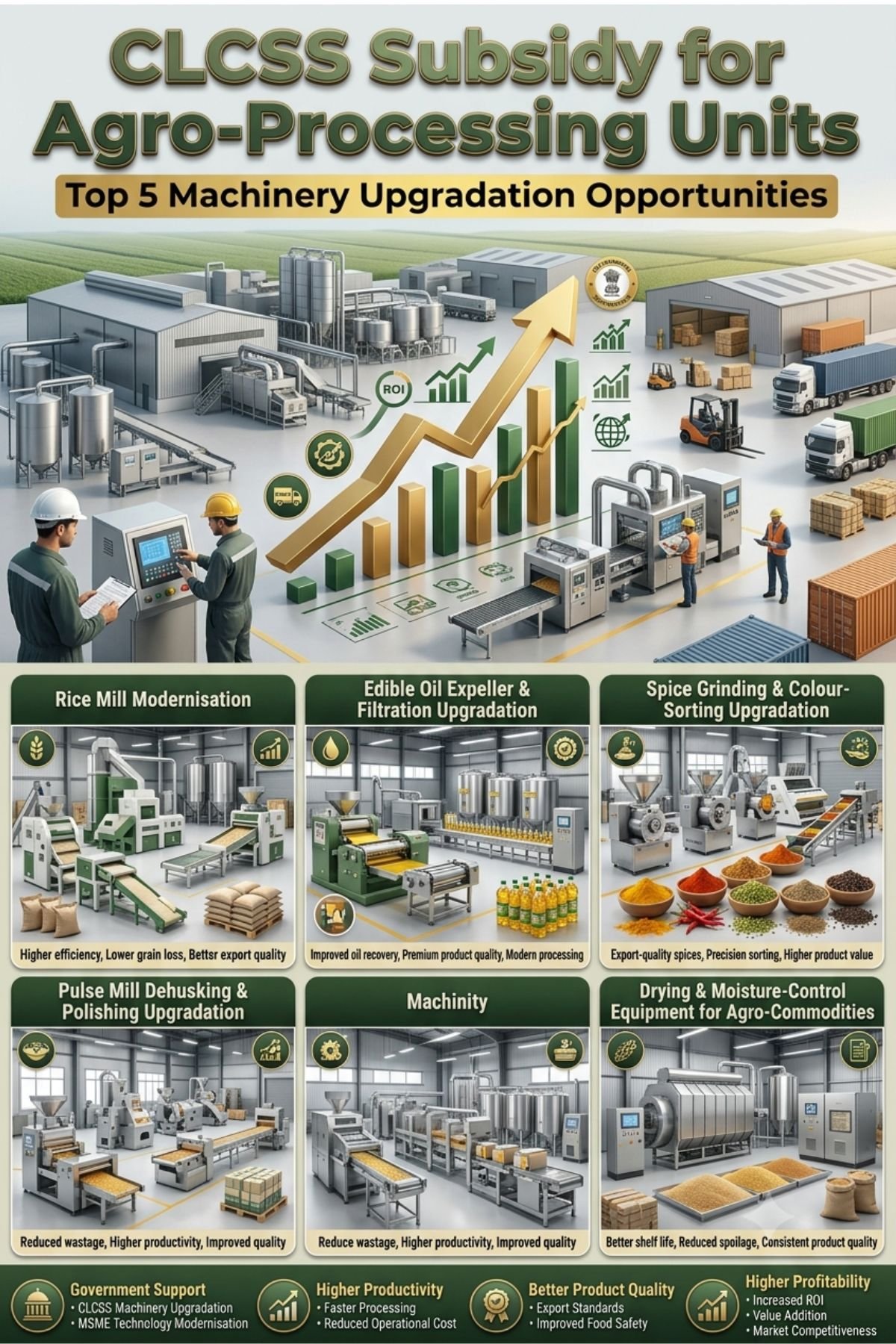
4. Pulse Mill Dehusking and Polishing Upgradation
So, older mills often dehusk grain less efficiently, producing broken or partially dehulled grain that manufacturers sell at lower prices than good-quality, wholesome dal. A dehusking/polishing upgrade will enhance quality grade output increases, thus realisation per tonne dehusking/polishing.
It is also common in this category to combine an upgrade in the equipment with the installation of a grading line not provided in the original setup, so that the mill can provide several quality grades of output at different price levels, instead of a single undifferentiated grade at an average price.
5. Drying and Moisture-Control Equipment for Agro-Commodities
The majority of small agro-processing units, including those that process spices, pulses, grains and dehydrated vegetables, are operational in open sun drying methods, which are weather-dependent, and have a varying moisture content, an issue that tends to be a quality problem and is becoming important for both domestic organic retail market and international export market, where moisture content is becoming a specification part of the buying contract.
The technology change for mechanical dryers with moisture control, which improves the reliability of the unit’s operations and solves a problem that limits the unit’s ability to maintain product consistency and hold its delivery schedule due to the weather, is another technology change that is eligible for CLCSS and has a measurable impact on the type of business the unit can work for and secure.
Identify high-growth industries before others do
NPCS Insight
The most compelling CLCSS applications can measure the impact of the upgrade – the increased recovery rate, reduced rejection, new quality grades that can be achieved – in a way that can be directly correlated to a dollar figure in the DPR’s financial projections. In addition to the project cost and means-of-finance required in the lending bank’s CLCS application, NPCS includes this cost-benefit framing.
CLCSS Subsidy Mechanics
| Element | Detail |
| Subsidy rate | 15% of eligible plant and machinery cost |
| Maximum subsidy | ₹15 lakh, regardless of total machinery cost |
| Loan ceiling for calculation | Up to ₹1 crore (subsidy capped at 15% of this or ₹15 lakh, whichever is lower) |
| Eligible applicants | Existing SSI/MSME units upgrading machinery; new units with GTAB-approved technology |
| Application route | Through the lending bank (nodal agencies include SIDBI, NABARD) |
| Subsidy application | Credited directly to the loan account, reducing payable balance |
Agro-Processing Upgrades and Their Typical Benefit
| Upgrade | Typical Benefit | Affected Product |
| Rubber-roll sheller & colour sorter (rice mill) | Improved head rice recovery, premium grading | Rice |
| Modern expeller & filtration system | Higher oil yield, clearer filtered output | Mustard, groundnut, sesame, coconut oil |
| Cryogenic/low-heat grinder & colour sorter | Better fineness, colour retention, export readiness | Spices and spice blends |
| Upgraded dehusker, polisher & grader | Higher premium-grade output share | Pulses (dal) |
| Mechanical dryer with moisture control | Consistent moisture content, weather independence | Spices, pulses, dehydrated vegetables |
PMFME vs CLCSS for Agro-Processing Units
| Aspect | PMFME | CLCSS |
| Target | New or existing micro food processing units | Existing units upgrading machinery/technology |
| Subsidy rate | 35% of eligible project cost | 15% of eligible plant & machinery cost |
| Subsidy cap | ₹10 lakh per individual unit | ₹15 lakh, regardless of machinery cost |
| Best fit | Formalising/establishing a processing unit | Modernising specific machinery in a running unit |
Building the Cost-Benefit Case for an Upgrade
A CLCS application is fundamentally a cost-benefit analysis. It identifies a measurable limitation in the existing equipment. It then shows the expected improvement from addressing that limitation. The application should also quantify the expected gains in yield, quality, or output within a reasonable period.
This is not an application for a new unit. Instead, it relies on operational data from the existing unit. This data establishes a clear basis for evaluating the upgrade’s benefits. Key figures may include current recovery rates, rejection percentages, and production volumes.
The Niir Project Consultancy Services prepares CLCSS applications based on the existing operations of the agro-processing unit. The application includes the required “before” and “after” scenarios. It also covers the usual project cost, means of finance, and loan repayment projections for submission to the lending bank.
Related Article: India’s Agro Processing Gap: The Rs. 25,000 Cr Opportunity Now
Who Should Be Looking at CLCSS
CLCSS is a suitable scheme for an agro-processing entrepreneur with a unit already in operation, who has identified the need for specific machinery which is causing him loss of yield, loss of quality or loss of contract and intends to raise a bank loan to overcome the problem. This is not a scheme for establishing a new unit from scratch, such as under the PMEGP or PMFME scheme. Moreover, applicants cannot avail of this scheme without obtaining an institutional loan.
For units that match this profile, the 15 per cent subsidy (up to ₹15 lakh) on new machinery, along with the resulting yield improvement, makes the upgrade much more appealing, especially when businesses consider both benefits together.
Frequently Asked Questions
A brand new agro-processing unit, can it apply for CLCSS?
Although new units can apply, only where the technology being installed has first been approved by the scheme’s Governing and Technology Approval Board. CLCSS is, in practice, much more commonly used by existing units that are upgrading specific equipment than new units.
Do the 15% subsidy apply to the loan or machinery value?
The purchase price of eligible plant and machinery, not the amount of loan disbursed. After this, the subsidy limit has been capped at ₹15 lakh, irrespective of its cost.
Is there any possibility of using CLCSS in conjunction with PMFME/PMEGP in the same unit?
Most schemes do not permit combining on the same machinery purchase and generally these schemes are targeting different situations: PMFME/PMEGP for setting up or formalising a unit; and CLCSS for upgrading machinery in an existing unit. A unit that received PMFME support for machinery investment could, after a few years of operation, submit an individual application for CLCSS to upgrade its machinery.
Subsidy is paid directly or offset against the loan?
Instead of paying the subsidy amount directly to the entrepreneur, the lender credits it to the subsidy account, which is linked to the loan account, and reduces the outstanding payable amount.
What information is required for an application for a CLCSS loan, in addition to what is required for a regular loan application?
The application additionally requires standard loan documentation and a clear technical case for the upgrade. Applicants should provide specifications of the existing machinery, details of the proposed new machinery, and a quantified comparison of the expected operational improvements in yield, quality, and capacity. This information helps lenders assess the cost benefits and repayment potential of the upgrade.
What support is available to an agro-processing unit for submitting an application for a CLCSS?
Sources and Further Reading
ClearTax – What is Credit Linked Capital Subsidy Scheme (CLCSS): cleartax.in
IndiaFilings – Credit Linked Capital Subsidy Scheme Guidelines: indiafilings.com
MY MSME – CLCSS Application Form and Salient Features: my.msme.gov.in
Agri Processing Business Ideas: Market Analysis: entrepreneurindia.co