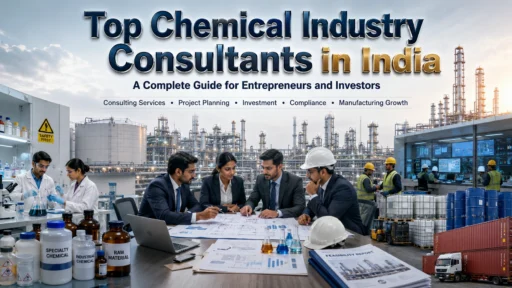


Chemical Industry Consultants in India
The chemical industry in India is growing faster than most other manufacturing industries and it’s attracting a new generation of entrepreneurs. Establishing a chemical plant, however, is not the same as starting a trading business. It requires licenses, safety clearances, the necessary machinery, and a financial plan that will pass a banker’s muster before the first foundation stone is laid.
This is where chemical industry consultants in India come in. They develop a business concept into a bankable project, with feasibility data, process flow diagrams and realistic market numbers. From building a specialty chemical unit to a polymer compounding plant to a simple inorganic chemical plant, the proper consultant can save you months of trial and error and several lakhs of rupees in unnecessary errors along the way.
The first search that many entrepreneurs perform is “top 10 chemical industry consultants in India”. But a ranked list usually doesn’t tell the whole story. It’s more important to match the consultant’s type to your project’s stage than to simply go for a number off a list. This guide discusses what these are, how to shortlist the finest chemical industry consultants in India and the role of an established firm like NPCS in this regard.
Read the Complete Book Here: Handbook On Chemical Industries (Alcohol Based)
What Chemical Industry Consultants Actually Do
Chemical consulting encompasses a lot more than first time entrepreneurs think. A consultant is not only to write a report, but the consultant is to cover the entire process of sourcing raw materials to the day the plant begins commercial production. This encompasses technical assessment, cost estimation, market validation and regulatory guidance as a single advisory relationship. Of course, the extent of scope differs in proportion to the size of the project, but the reasoning remains the same in each category.
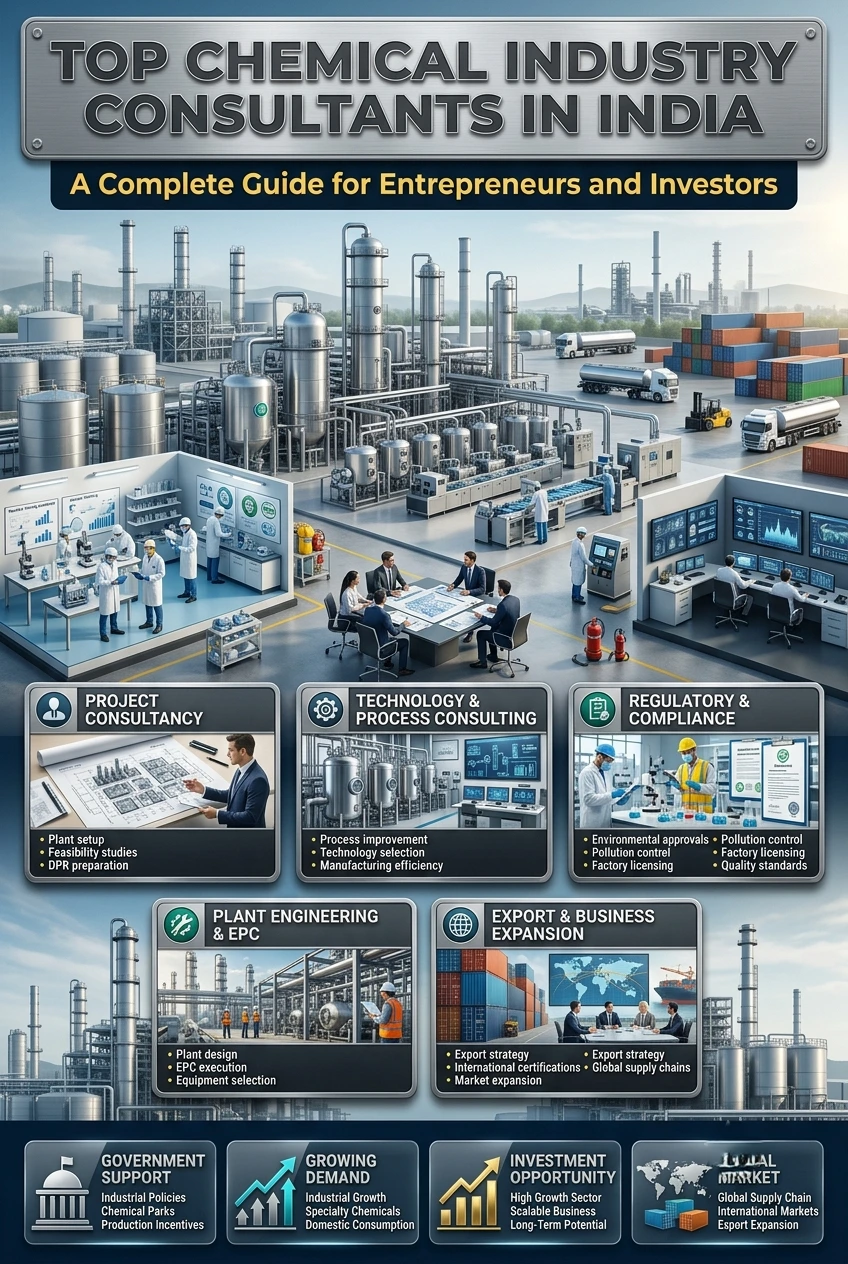
Feasibility Study and DPR Preparation
The most important output that an entrepreneur expects is a Detailed Project Report also known as a DPR. The DPR details every stage of the manufacturing process, the specifications of the machines and raw materials, the production mix, how capacity is to be planned, the manpower requirements, and complete project finance, including the cost of the project, how the project is to be financed, profitability projections, and a break-even analysis. This document is very important to banks and financial institutions before they approve a term loan and if this document is inaccurate, it will impact the project’s funding. Even if the underlying concept is deemed sound, a weak DPR can take many months to be disbursed.
Process Engineering and Plant Design
Apart from paper work, chemical plant consultants also assist in process flow design, equipment selection and layout. Process engineering consultants investigate reaction kinetics, utility demands, effluent generation and safety distances between units. They determine the efficiency or maintenance headache of a plant in the first year of their operation. Process design also minimizes waste of energy and raw materials over time, increasing the overall project economics and decreasing payback time.
Regulatory and Compliance Support
The chemical industry in India is subject to several regulatory checks, such as the approvals by Pollution Control Board (PCB) of the state, approvals under the Factory Act, and quality standards set by the Bureau of Indian Standards (BIS). A chemical consultant in India, familiar with these approval chains can save your project weeks. This is no longer an option – missing one clearance can postpone commissioning for up to a year. It plays a key role in ensuring a successful project implementation, especially in units that work with hazardous or reactive chemicals.
View Full Project Details: Chemicals, Biotechnology, Enzymes, Bio Fertilizer, Vermiculture, Vermicompost Chemical & Allied Industries and Alcohol Projects
Why India Has Become a Hotspot for Chemical Consulting
Over the past several years, chemical consulting has come into the spotlight for several reasons. The schemes by the government like PLI have also brought in fresh investments in the domestic manufacturing sector along with the overall Make in India drive. Import substitution is another good motivator as India continues to import significant portion of petrochemical intermediates and specialty inputs, providing opportunity for local producers to fill the void. At the same time, growing domestic demand in pharmaceuticals, personal care, agriculture and construction continues to support growth in the demand for both bulk and specialty chemicals. Consequently, new capacity is now being approached by first generation entrepreneurs as well as established manufacturers with chemical consultants to validate the new capacity, instead of making assumptions.
According to Invest India, the chemicals industry now accounts for nearly 1.5 percent of India’s GDP, and it is receiving policy support through various initiatives, such as Petroleum, Chemicals and Petrochemicals Investment Regions (PCPIR) supported by Invest India, the national body for investment facilitation under the Ministry of Commerce and Industry. According to industry estimates released by the India Brand Equity Foundation, India ranks among the world’s largest producers of dyes, pigments and agrochemicals, and specialty chemicals are the fastest growing sub-segment of the industry. This scale of opportunity is what is making the demand for top chemical industry consultants in India grow by the quarter.
Specialty Chemicals and Export Demand
There is a strong pull-on consulting demand for specialty chemicals, in particular. The products used in personal care, agrochemicals, construction chemicals, electronics and other applications generally enjoy higher margins than bulk commodity chemicals, but are also more likely to be subject to higher production and quality requirements. Businesses that are going into this field are almost always required to hire a consultant with export compliance and process engineering experience because a significant proportion of the specialty chemical production is eventually exported to markets in Asia, Europe and North America.
How to Identify the Best Chemical Industry Consultants in India
Not any company which identifies itself as a chemical consultant is capable of delivering a bankable project. When considering which chemical plant consultant to sign a mandate with, entrepreneurs should look at a short list of chemical plant consultants and apply a few practical standards to their analysis over and above marketing claims and testimonials found on their websites.
Sector-Specific Technical Expertise
With pattern recognition that a generalist can’t match, a consultant who works in dozens of chemical sub-sectors across the board, from organic to inorganic chemicals to polymers to agrochemicals. Request sample projects they have worked on in the past, and see if they have any professionals on their team who have a true chemical engineering background and not just MBA consultants.
A Verifiable DPR and Feasibility Track Record
The top chemical industry consultants in India have an extensive and proven portfolio of DPRs and feasibility studies by chemical category. While volume is not a measure of quality, a consultant with a history of successfully leading bank appraisals, subsidy applications and investor due diligence will know the ins and outs of where the standard templates fall short—particularly in the area of realistic capacity utilization and raw material price volatility.
In-House Process and Plant Engineering Capability
Some companies delegate the technical aspect of a report and only work on the financial forecast. Process plant consultants who have their own engineering staff can, on the other hand, confirm the selection of the machinery, the utility loads and plant layout, which will usually yield a more realistic and defensible project cost, as opposed to a number plucked from a previously set industry average.
Regulatory Fluency Across BIS, Pollution Control, and Factory Laws
A person knowledgeable about the requirements of the Bureau of Indian Standards, the Pollution Control Board procedures of the respective state and the Factory Act can identify compliance issues early in the project planning process. This one thing can make or break a project, making it a nightmare to roll out or turning it into a grinding halt for months because of an unnecessary clearance problem that only became apparent after machines were ordered.
Find the most profitable startup for your investment range
Depth and Diversity of Client Base
Last but not least, examine the variety of the clientele. Some EPC consultants and boutique management consulting firms in India might not be able to package their fees and reports in an MSME budget. An incubator that serves both first timers and existing manufacturers typically provides more flexible engagements and timeframes.
Chemical Plant Consultants, EPC Consultants, and Boutique Firms: Knowing the Difference
This is not a one-size-fits-all business and the various consultants can be mistaken as each other. Process engineering consultants are primarily concerned with technical design – reactors, distillation columns, utilities, and safety systems. EPC consultants take the role of building as a whole, often combining the design services with the procurement of equipment and civil construction under a single turnkey contract. The plants executed by many of the EPC firms which are engaged in large chemical and petrochemical projects are also considered as the best engineering consultants in India.
Unlike India’s large management consulting firms, however, boutique firms focus more on strategy, market entry and business planning versus hands-on engineering. Some of the smaller companies work with large multinational companies assessing the Indian chemicals market, just as international consulting companies talk of the chemicals practices that they have in India. Between these two worlds, are the feasibility and DPR focused consultancies like NPCS, who help perform techno-economic analysis but can also provide project documentation in an MSME friendly manner that can be taken directly to the bank or financial institution. As with selecting the right firm in the right category, selecting the right category for your project stage is equally important and many successful projects involve more than one type of consultant at various stages.
What a Quality Chemical Project DPR Should Include
Chemical consulting will be the heart of most consulting projects, so it’s wise to understand what a helpful DPR actually would look like before you hire it. The opening of a strong report should be an honest evaluation of the market – not an optimistic sales forecast that the promoter would like to see, but the actual demand and supply gaps and realistic pricing. It should be a detailed description of the entire manufacturing process step by step, and a list of the machinery, including their capacity, make and approximate cost rather than a generic list of what they are.
The sourcing details of raw materials are also important, especially in the context of chemical projects where fluctuations in input costs can impact profitability. The financial section should include cost of the project, how the project will be financed, the working capital required, profitability projections and break-even analysis, all with clearly stated assumptions, so the banker or investor can review the reasoning, and not just the numbers. If the report either misses one of these elements or does not include it, it is worth asking the consultant why.
Our Work with Chemical Industry Clients
The depth of our work across the chemical industry is perhaps best illustrated not through credentials, but through the clients who have trusted us with some of their most consequential decisions.
Our engagement with inorganic and basic chemicals has been extensive and varied. M/s. Amar Aqua Chemicals in Bareilly approached us to prepare a detailed project report on a sulphuric acid plant using the contact process with recovery systems — the kind of report that had to satisfy both technical scrutiny and the requirements of bank financing. Around the same period, M/s. Hetal Pharma Chem of Mumbai commissioned a feasibility report on sodium hydrosulphite production targeting the textile and pulp bleaching industries, while M/s. SSK Enterprises required a pre-feasibility assessment for caustic soda flakes. M/s. SHINIE IMPEX in Delhi engaged us for a detailed project report on di-calcium phosphate, M/s. Corasun Agro Pvt Ltd in Ahmednagar for zinc sulphate, and M/s. Prism Hotels and Resorts in Bharuch for a project report on potassium permanganate. Mr. Pragat Goyal from Kutch came to us with plans for a sodium percarbonate manufacturing unit aimed at the detergent and oxygen bleaching market — a technically specific brief that required careful cost modelling. M/s. Kutch Potash Pvt Ltd of Ahmedabad brought us an equally precise assignment: a feasibility report on boric acid production for industrial, pharmaceutical, and insecticide applications. M/s. Sri Subramanian Chemicals in Salem had us prepare a plant setup report for magnesium sulphate heptahydrate spanning agriculture, pharma, and industrial use — a product with very different quality standards across those three markets. For M/s. TRBEX IMPEX PVT LTD in Ludhiana, we put together a comprehensive project report on sodium cyanide production for gold mining and chemical synthesis applications, and M/s. Indian Potash Limited in Coimbatore retained us for a techno-economic feasibility covering three chemistries simultaneously — citric acid, acetic anhydride, and furfuryl alcohol. M/s. Rgcon Itm of Visakhapatnam commissioned a combined project report that included caustic soda flakes alongside other industrial products.
The chlor-alkali and chlorine derivative space has been a recurring area of work. M/s. The Dharamsi Morarji Chemical Co. Ltd. in Bharuch — a recognised name in the Indian chemicals industry — engaged us on two separate projects: one on sodium borohydride via the trimethyl borate route, and another on a sulphuric acid plant that also covered chlorosulphonic acid and oleum manufacture. M/s. RV Ecoinfra Consultancy Private Limited from Hyderabad needed a techno-economic feasibility for sodium hypochlorite, while Mr. Dhruv Kocha in Mumbai came to us for an assessment of sodium chlorite liquid production. Mr. Avinash Shinde in Bharuch commissioned a project report on 3-chloropivaloyl chloride — a niche intermediate with a narrow but well-defined customer base. We prepared sodium borohydride project reports for two separate clients: M/s. The Dharamsi Morarji Chemical Co. Ltd. and M/s. KCC Infra Private Limited in Jaipur, each approaching the same compound from different commercial angles.
Our polymer and resin practice has drawn some of the more technically demanding assignments. Thermax Limited’s Chemical Division in Bharuch — a client that returned to us multiple times — engaged us on polyacrylamide, acrylate resins and emulsions, polyurethane prepolymer, and epoxy resins across separate project feasibility studies. Similarly, M/s. Kejriwal Geotech Pvt. Ltd. of Surat brought us four distinct assignments covering epoxy resin, sulphamic acid, dicalcium phosphate, and chloromethane — reflecting a client working through a systematic evaluation of chemical manufacturing options. Thermax’s Chemical Division also engaged us separately for a feasibility study on absorbent polymers and water-based emulsions, and M/s. Focus Polymers & Emulsion Ltd. in Bhagwanpur, Uttarakhand, commissioned a project investment report for industrial-use water-based emulsions. M/s. Crest Speciality Resins Private Limited in Kheda had us assess hexamethoxymethyl melamine resin (HMMM) — a crosslinking agent used in coatings and adhesives — while M/s. Kinny Fiberglass in Ajmer wanted a feasibility report for unsaturated polyester resins. For M/s. Sar Denim Pvt Ltd. in Anantapur, the brief was a technical and financial feasibility on biodegradable plastic polymer, and M/s. Asbak A in Kerala engaged us to evaluate nano resin composite materials for innovative applications.
Chlorinated derivatives formed another category of recurring engagements. On chlorinated polyvinyl chloride (CPVC) alone, we produced separate project reports for M/s. Mahavir Enterprises in Jalandhar and M/s. Nandi Irrigation Systems Limited in Hyderabad — different clients, different geographies, both recognising an opportunity in a product with growing plumbing and industrial piping demand. Chlorinated paraffin wax saw similar multi-client interest: M/s. Bihani Manufacturing Company Pvt. Ltd. in Bhiwadi, M/s. Excell Industries in Bhiwandi, and M/s. Rajdhani Sales Corporation in Delhi each commissioned separate studies, which in itself reflects the scale of inquiry this product has attracted from entrepreneurs across India. M/s. Eklingjee Polymers Pvt. Ltd. in Alwar brought us a report on calcium and zinc stabilisers for pipe and foamboard applications, and M/s. Mettlesome & Generies Pvt. Ltd. in Kolkata had us prepare a bankable project report on the same product category.
In the rubber sector, our work has covered both natural and synthetic variants, and both primary production and waste recovery. M/s. Saraswati Industrial Management in Vadodara retained us for a bankable project report on reclaim rubber, while M/s. Sambhav Enterprises and M/s. K. K Textiles — both in Surat — independently commissioned project reports on butyl rubber manufacture, reflecting active industrial interest in synthetic rubber production along the Gujarat corridor. M/s. Anton Seals in Coimbatore came with a more specialised need: a feasibility study on downhole seals for the oil and gas sector made from synthetic rubber, requiring both material science understanding and knowledge of oilfield standards.
Activated carbon has been one of the most consistently active product areas in our chemical practice, drawing clients from across India and from varied feedstocks. M/s. Indsil Hydro Power & Manganese Ltd in Coimbatore commissioned a market research report to understand the commercial landscape before making investment decisions. M/s. Sri Mahasakthi Mills Private Limited in Coimbatore and M/s. Valeo India Private Limited in Chennai each came to us for techno-economic feasibility studies focused on coconut shell as feedstock, and Dr. Varunkumar S from IIT Madras engaged us for a technical and financial feasibility on the same route — reflecting both industry and academic interest in the same process pathway. Mr. Raghavendra Jakandi in Hospet worked through a study covering three raw materials simultaneously — rice husk, sawdust, and coconut shell. M/s. Pawan Casting Meghalaya Pvt. Ltd. in Byrnihat commissioned a pre-feasibility on activated charcoal from bamboo, as did M/s. R and R Industry in Aizawl, Mizoram, and M/s. Rinawma Ralte in Aizawl — all three in the Northeast, where bamboo availability makes the economics particularly interesting. M/s. Wasera Farms OPC Private Limited in Chandrapur, M/s. Torr Energy Systems Pvt. Ltd. in Noida, Mr. Ritesh Kumar Garwal in Gurgaon, and M/s. Vandana Global Ltd. in Raipur each engaged us on charcoal or activated carbon projects from various biomass sources.
The agrochemicals and fertiliser segment represents one of our stronger areas of repeat engagement. M/s. Rich Phytocare Private Limited — with manufacturing operations in Chennai and Bodinayakanur in Tamil Nadu — has engaged us on multiple projects spanning market research for gel NPK fertilisers, a comprehensive market study for liquid fertilisers, and an industrial project report on potassium schoenite. Mr. Rajendra Dave in Ahmedabad came to us for an NPK water-soluble fertiliser manufacturing report, while M/s. Jaikisan Agrotech India Pvt. Ltd. in Chhatrapati Sambhaji Nagar commissioned a technical and financial feasibility on water-soluble NPK fertilisers specifically for horticulture and agriculture. Mr. Abhishek Goyal from Agra engaged us for both an NPK fertiliser feasibility and a separate study on a dual-feed distillery to produce bioethanol. M/s. Rounak Polychem Pvt. Ltd. in Indore retained us for a water-soluble fertiliser blend study focused on drip irrigation compatibility, and M/s. Omkar Fertilisers Pvt. Ltd. in Hyderabad had us prepare project reports on both magnesium sulphate and zinc sulphate — two products that are technically straightforward but require careful market positioning in the fertiliser-grade segment.
Our work in organic intermediates and solvents has spanned both bulk and speciality products. M/s. Trinas Chemicals Private Limited in Hyderabad engaged us for a project report on ethyl and butyl acetate, while Mr. Brijesh — also in Hyderabad — came to us separately for a bankable project report on ethyl acetate, bringing their own investment brief to the same chemistry. M/s. Bhanwarlal Jhanwar & Sons in Mumbai commissioned two separate project reports on ethylene oxide derivatives — one from diethanolamine (DEA) and another from monoethanolamine (MEA) — a pair of assignments that required careful process differentiation. M/s. Kanoria Chemicals & Industries Ltd. in Ankleshwar, Gujarat, a company with established credentials in the chemicals industry, came to us for an investment report on acetaldoxime. M/s. Nuberg Engineering Limited in Noida engaged us for two separate methanol-related studies — one on methanol from coal and another on methanol from biowaste — projects that reflect the transition happening within the Indian chemicals sector toward lower-carbon feedstocks. M/s. IMARC Services Private Limited in Noida and Mr. D V Vardhan in Warangal each independently commissioned project reports on sodium silicate production, the former using silica and soda ash as inputs and the latter focusing on rice husk ash as a renewable raw material.
The specialty and fine chemicals segment brought us some of our more technically focused engagements. M/s. SPR Oncocare Pvt Ltd. in Bangalore approached us to evaluate the economics of potassium iodide production and, in a related follow-up study, the feasibility of producing iodine granules — both products that sit at the intersection of chemistry and regulated pharmaceutical supply chains. M/s. Atlas Petrochemicals in Ahmedabad commissioned a feasibility study on calcium gluconate, a product with applications in both food and pharmaceutical sectors. M/s. Universal Performance Chemicals Pvt. Ltd. in New Delhi retained us for a project report on calcium bromide, used extensively in oilfield and completion fluid applications. Mr. Josephraj Puthotta in Chennai had us evaluate the investment potential of linear alkyl benzene sulphonic acid (LABSA) — the primary feedstock for detergent manufacturing. M/s. NU-Horizen Metchem Pvt. Ltd. in Chikkantapur, Karnataka, commissioned a feasibility study on calcium carbide, a cornerstone industrial chemical with downstream use in acetylene and PVC production. M/s. Acechemie Zynk Energy Limited in Valsad prepared for a project on active zinc oxide recovery from zinc ash and EAF dust, and M/s. R.R. Ferro Alloys Pvt. Ltd. in Korba commissioned a study on sodium and ammonium molybdate production.
In dyes, inks, and related surface chemicals, M/s. Maadan Chemicals in Madurai engaged us for a flexographic ink investment report, Mr. Muhammed Shah in Kerala commissioned a technical and financial feasibility on screen inks and roller inks, and M/s. Nicholas Pigments & Inks in Kanpur came to us for a pre-feasibility study on dicyandiamide (DCDA), a versatile intermediate used in resins, flame retardants, and surface treatment chemicals. Mr. Mayank Raipuria in Pune brought us a project report on high-temperature aluminium-based paint, and M/s. Pharma Force Lab Unit II in Paonta Sahib commissioned a detailed project report on ready-mix coating powder.
In industrial adhesives and waxes, M/s. Neha Overseas of Mumbai engaged us for a project report on hot melt adhesives — a product with growing application across packaging, woodworking, and assembly industries. M/s. P.N. Trading Co. in Yamunanagar and M/s. Axi Lam Pvt. Ltd. in Sabarkantha both commissioned independent feasibility reports on industrial adhesives of the Fevicol type, while Mr. Ajay Khajanchi in Ghaziabad had us assess the commercial viability of a paraffin wax manufacturing unit.
Our compressed biogas and bioethanol practice has grown considerably in recent years, reflecting the direction of policy and investment in India’s energy chemicals space. Mr. Manoj Chappidi in Andhra Pradesh commissioned a techno-economic project report on compressed biogas, as did M/s. Ogni Esco Private Limited in Hyderabad and M/s. Shri Shyam ISPAT (India) Private Limited in Raipur — each bringing slightly different feedstock and scale considerations. Mr. Kaushikkumar M Patel in Surat engaged us for a detailed feasibility on CBG production from cattle dung, Napier grass, and organic waste, an assignment that demanded working across multiple input streams with different yield profiles. On the ethanol side, M/s. Ranjeet Singh Gumtala in Amritsar commissioned a feasibility study on producing ethanol as bio-fuel from broken rice, and M/s. K Raheja Realty Pvt Ltd in Mumbai retained us for a project report on a dual-feed distillery producing ethanol from multiple feedstocks — a more flexible plant configuration suited to feedstock price volatility.
If you are evaluating a chemical manufacturing project and need a credible, technically grounded project report, feasibility study, or market research — whether for a basic inorganic, a specialty intermediate, a polymer, or an emerging green chemistry opportunity — we would be glad to discuss how we can support your plans. You are welcome to reach out to us directly through the website.
Role of NPCS in Chemical Project Consultancy
Niir Project Consultancy Services (NPCS) has been in business in India since 1994 and chemicals, covering all organic, inorganic and specialty chemicals are one of its major practice areas. NPCS develops Detailed Project Reports and Techno-economic Feasibility Studies which include selection of manufacturing process, machinery and materials procurement, product mix and capacity planning, process flow diagram and detailed project financials with profitability and break-even analysis. All the services provided by the firm can be read at niir.org.
The difference between this type of consultancy and anything that is a pure engineering company or a boutique strategy shop is the amount of available project intelligence that is ready to go. For those considering a new venture into chemical manufacturing, entrepreneurs can browse through NPCS’s chemical project profiles and reports on organic and inorganic chemical manufacturing, and then use these as a reference point before ordering a customized DPR that is based on their specific product and production capacity.
NPCS has a proven history in delivering over 150,000 project reports and feasibility studies worldwide in over 85 countries covering manufacturing industries including chemicals over the last 30 years. There are two practical reasons for this scale. Firstly, the firm has probably already done the research on a product category similar to the one a new entrepreneur is thinking about, so it saves him a lot of time in the research process. Second, the fact that there’s a big base of repeat customers indicates that banks and financial firms in India are already quite familiar with the documentation format and financial modeling methodology, which can facilitate the loan appraisal instead of making it more complicated. This blend of chemical industry expertise and financial documentation experience is something to consider when hiring chemical industry consultants in India.
Related Article: India’s Chemical Industry Growth to $255 Billion: Best Business Opportunities for Startups and MSMEs
Best Chemical Industry Consultants in Delhi and Across India
Delhi has long functioned as a base for India’s industrial consultancy and business advisory ecosystem, partly because it sits close to policy-making bodies and partly because it has historically hosted publishing houses that track manufacturing and MSME trends closely. Entrepreneurs searching for the best chemical industry consultants in Delhi will find firms offering everything from statutory compliance filing to full-scale DPR preparation under one roof.
That said, location matters less today than it did a decade ago. Most reputable India consultancy firms now serve clients remotely, using video consultations and digital document sharing to manage projects across states without any loss in quality. What still matters is whether the firm behaves like a genuine, pan-India consultancy firm with exposure across multiple states, rather than one limited to a single state’s regulatory environment. A consultant familiar with clearance processes in Gujarat, Maharashtra, Tamil Nadu, and Rajasthan, for instance, brings far more practical value to a chemical project than one who has only ever worked within Delhi-NCR.
Chemical Consulting Services at a Glance
The table below summarizes how different categories of chemical consultants typically position their services. It should help entrepreneurs match their current project stage to the right kind of expertise before signing any consulting agreement.
| Consultant Type | Core Focus | Typical Deliverable | Best Suited For |
| DPR & Feasibility Consultants (e.g., NPCS) | Techno-economic feasibility, financial modeling | Detailed Project Report, feasibility study | First-generation entrepreneurs, bank loan applicants |
| Process Engineering Consultants | Process design, plant layout, safety systems | Process flow diagrams, equipment specifications | Existing manufacturers scaling capacity |
| EPC Consultants | Design, procurement, and construction | Turnkey plant commissioning | Large capex, greenfield chemical plants |
| Boutique Management Consulting Firms | Market strategy, entry planning | Market study, strategic roadmap | Multinational entrants, large corporates |
| Regulatory & Compliance Specialists | BIS, Pollution Control Board, Factory Act | Licenses, statutory clearances | All chemical manufacturers, any scale |
Frequently Asked Questions
What does a chemical industry consultant in India typically charge for a DPR?
Pricing will change based on the complexity and size of a DPR, and how much modeling is required. The vast majority of consultants will not have a standard fee but quote each DPR based on the amount of technical detail involved and how many rounds of feedback you can expect included in the process. Consider requesting a breakdown of the DPR process before soliciting quotes.
How is a process consultant different from an EPC consultant?
A process consultant is responsible for designing the process, along with verifying the feasibility of the technology. An EPC consultant is concerned with building and operating the plant, which will include procuring and construction. Many projects use a process consultant first and bring in an EPC partner once the design is finalized.
Can a chemical industry consultant help with bank loan approval?
Yes. A well-structured DPR with realistic financial projections is often the single most important document in a term loan application. Some consultants specialise in bank appraisals and procedures, which can significantly improve approval times and reduce queries during the appraisal process.
Do I need a different consultant for specialty chemicals versus bulk chemicals?
Doesn’t have to, but the consultant ought to have done projects for your sub-sector. Specialty chemicals require more sophisticated process control, usually smaller volumes, and requires more comprehensive export documentation than bulk commodities, for example.
Is it necessary to hire a Delhi-based consultant if my plant is in another state?
No, since they offer pan-India services and understand the state requirements of various Pollution Control Board, Factory Act, etc irrespective of where the head office or registered office is located.
What documents or information should I prepare before approaching a chemical consultant?
Prioritize product, required capacity, and budget prior to meeting the consultant. At this point, you may receive direction in areas such as machinery choices, raw material suppliers, and feasible capacity utilization.
Conclusion
Choosing among the top chemical industry consultants in India is less about picking the biggest name and more about matching a firm’s strengths to your project’s stage and scale. A first-generation entrepreneur evaluating a modest specialty chemical unit needs different support than an established manufacturer scaling up petrochemical intermediates. What matters across both cases is verifiable sector experience, in-house technical capability, and a documentation style that banks and regulators already trust.
Firms like NPCS, with three decades of chemical-sector DPR experience, sit alongside process engineering specialists and EPC consultants as part of a broader ecosystem that entrepreneurs can draw on at different stages of a project. The right first step is usually a direct conversation about your specific product and capacity, rather than a generic proposal that treats every chemical project the same way.
Additional Reference Sources
Department of Chemicals and Petrochemicals, Government of India — chemicals.gov.in
Invest India (National Investment Promotion & Facilitation Agency) — investindia.gov.in
India Brand Equity Foundation (IBEF) — ibef.org
Ministry of Micro, Small & Medium Enterprises — msme.gov.in
Federation of Indian Chambers of Commerce and Industry (FICCI) — ficci.in
Confederation of Indian Industry (CII) — cii.in
Bureau of Indian Standards (BIS) — bis.gov.in