Chemical Export Business Ideas
Most first-time entrepreneurs are of the opinion that exports start when a foreign buyer places an order. In chemical manufacturing, the exports start much earlier. They begin with the design of the plant, process discipline, raw material selection, quality control philosophy and documentation systems. If a unit is not capable of consistent batches, stable impurity profiles and audit ready records then it does not have a real export business. It only has domestic operation with occasional and higher risk overseas shipment.
This is why Ministry of Chemicals & Fertilizers considers chemicals as a strategic sector. Chemicals are involved in food security, healthcare, water treatment, infrastructure, textiles and nearly every manufacturing value chain. Strengthening this sector is not just about how much is produced but also about how good, safe and globally competitive it can be.
India’s output of chemical industry now exceeds to Rs.15 lakh crore and has been growing at more than 11 percent CAGR in recent years. For new entrepreneurs, this growth assures that the demand is broad based. However, the real opportunity lies not in bulk commodities, but in export grade and application specific manufacturing.
Read More: Handbook On Chemical Industries (Alcohol Based)
Why Export Potential in Chemicals is Mostly a Quality Story
In trade on a global scale, commodity chemicals are exported when producers are the cheapest. Specialty and downstream products are exported when producers are the most reliable. MSMEs are hardly at the scale to win cost wars against the multinational giants. What they can win on is consistency and documentation as well as application performance.
In reality, a few non-negotiable fundamentals are what export buyers seek:
- Batch to batch consistency – over long supply cycles
- Clear Specifications and impurity control
- Traceability and documentation preparation
- Confidence that the supplier will not change formulations quietly
Once a chemical product has been approved in a customer’s process, it is risky to change suppliers, and costly. This generates repeat demands for disciplined manufacturers and insures margins even on MSME scale.
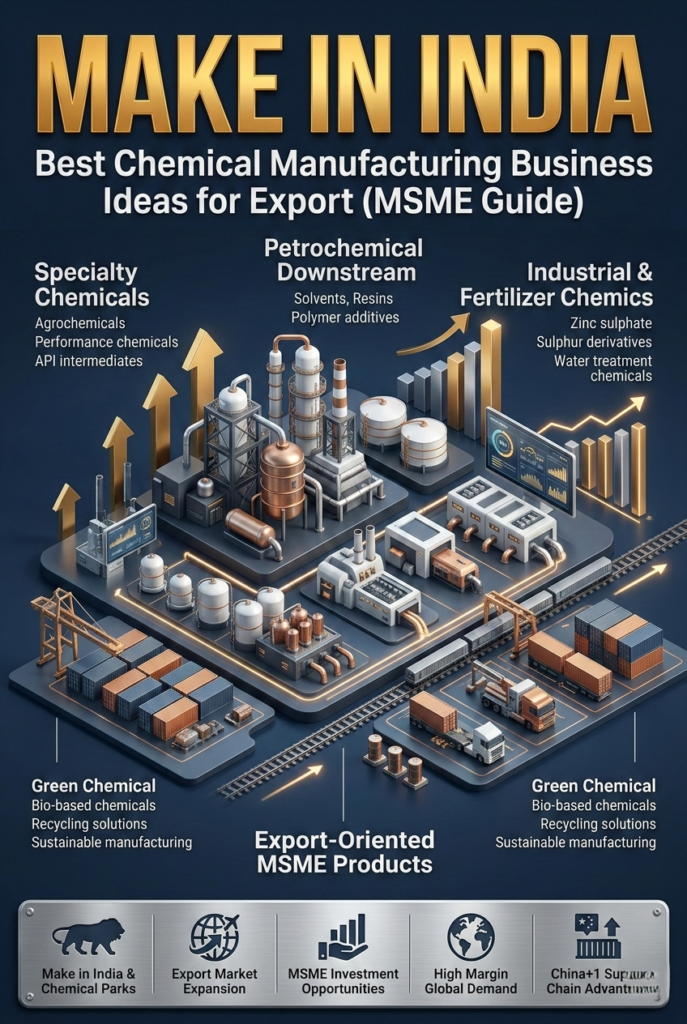
Where MSMEs Can Fit in the Chemical Value Chain
The chemical industry is usually talked about as a singular industry, however it is actually made up of several layers. Bulk alkali chemicals represent bulk of the volume and are extremely scale driven. Competing in it requires capital on a massive scale and feedstock integration.
Organic chemicals, specialty inorganics, formulations and downstream conversions are a more realistic entry point for MSMEs. These segments evoke process control and application knowledge as rewards instead of just gross tonnage.
For first-time entrepreneurs the take-away is simple:
Do not begin with largest volumes. Start where discipline makes for differentiation.
Export Oriented Chemical Projects for New entrepreneurs
Polymer Compounding, Polymer Performance Masterbatches
India is a huge producer of polymers, but the MSMEs don’t have to manufacture polymers to develop export businesses. The opportunity is in polymer compounding – the process of turning base polymers into application-ready grades such as UV-stabilized compounds, impact-modifying blends, flame-retardant materials and specialty masterbatches.
This segment exports well because approbations are sticky. Once a compound grade is qualified in a customer’s production line, change of supplier is avoided, except failing. Profitability here is more a matter of formulation expertise and quality assurance than scale.(Chemical Export Business Ideas)
Read More: Modern Technology of Industrial Chemicals
Textile Processing Auxiliary Chemicals and Finishing Chemicals
Textile processors are under constant pressure to minimize defects and rework. Chemicals that stabilize processing have, therefore, a strong value. MSMEs can produce auxiliaries like dispersants, levelling agents, fixing agent, silicone softeners and sequestering agents.
Export buyers like to have suppliers who deliver:
- Stable shade and fastness performance
- Minimal batch variation
- Technical support at the time of trials
When these conditions are satisfied pricing pressure decreases and long-term relationships develop.
Construction Chemicals, Industrial Adhesives
Infrastructure development in emerging markets has led to the emergence of steady demand for construction chemicals. Products such as waterproofing emulsions, tile adhesives, repair mortars, grouts, and epoxy systems can be exported provided that packaging stability and shelf life are controlled.
In this segment, the exporters are not selling a chemical drum. They are selling better durability, less leakage and better bonding. MSMEs documenting application performance and ensuring consistency can scale through distributors and private labels.(Chemical Export Business Ideas)
Water Treatment Chemicals and Effluent Treatment Chemicals
Water treatment demand is structural and worldwide. MSMEs can get into this space by manufacturing some treatment chemicals and blends where concentration control and impurity limits are critical.
Export success here is based on three things:
- Predictable performance
- Standardized packaging that is safe
- Long-term supply reliability.
Once approved, customers tend to place repeat orders with infrequent renegotiation.
Read More: Project Reports & Profiles
High-Purity Inorganic Salts and Grades of Application
Inorganic chemicals are frequently sold as commodities, but a number of export markets are demanding application-specific grades. Industries such as ceramics, glass, detergents, and specialty manufacturing are salt users that Favor salts with controlled moisture, particle size, and impurities.
MSMEs which design plants around filtration, drying and QA systems can export these products successfully without necessarily being the largest producers.
Why Chemical Clusters are Better for Export Success
Export competitiveness is determined not only by the quality of the products but also by the support from the ecosystem. Petroleum, Chemicals and Petrochemicals Investment Regions (PCPIRs) provide common infrastructure, access to reliable utilities, skilled human resources and improved connectivity in terms of logistics.
For first time entrepreneurs, clusters silently save on hidden costs regarding sourcing, utilities, compliance and transportation. These advantages enhance the reliability of exports, without promoting extra effort for the promoter.
Insights from the Industrial Leaders of India
The growth of Reliance Industries under Mukesh Ambani is a great example of how value is captured by moving closer to applications, not just making raw materials. The lesson for MSMEs is not scale, but rather value chain positioning.
Similarly, Aditya Birla Group under Kumar Mangalam Birla is an example of disciplined capacity building and quality leadership. The success of Nirma, started by Karsanbhai Patel, validates the fact that constant implementation and understanding of the market is more important than complexity.(Chemical Export Business Ideas)
Read More: Profitable Small-Scale Chemical Manufacturing Business Opportunities in India (MSME Guide)
Role of the Niir Project Consultancy Services NPCS
Export-oriented chemical developments fail to succeed because of poor choice of product, underestimated compliance costs and unrealistic working capital assumptions. NPCS helps entrepreneurs by preparing Market Survey cum Detailed Techno-Economic Feasibility Reports, giving an evaluation of the manufacturing process, market demand, capacity planning, and financial viability before investing in it.
This feasibility-first approach helps in converting the ideas in export into an execution-ready industrial project.
Read More: Top High-Growth Chemical Manufacturing Businesses New Entrepreneurs Can Start
Closing Perspective
Make in India export success in chemicals is not built on shortcuts. It is built on systems, discipline, and long-term thinking. Entrepreneurs who choose the right products, invest early in quality control, leverage industrial ecosystems, and plan finances conservatively can build export-ready chemical businesses even at MSME scale.
Frequently Asked Questions
Which chemical projects are most suitable for first-time exporters?
Downstream and application-oriented projects such as polymer compounding, textile auxiliaries, construction chemicals, water treatment solutions, and specialty blends.
What makes a chemical product exportable in practice?
Consistency, documentation readiness, compliance with standards, and repeatable performance.
Should exports be targeted from day one?
A strong domestic base stabilizes cash flow. Exports should scale once quality systems mature.
How important are clusters for export success?
Clusters significantly improve logistics efficiency and operational reliability.
What is the biggest financial risk in chemical exports?
Working capital stress due to longer credit cycles and inventory requirements.