Introduction: Why Base Chemicals Matter More Than Ever
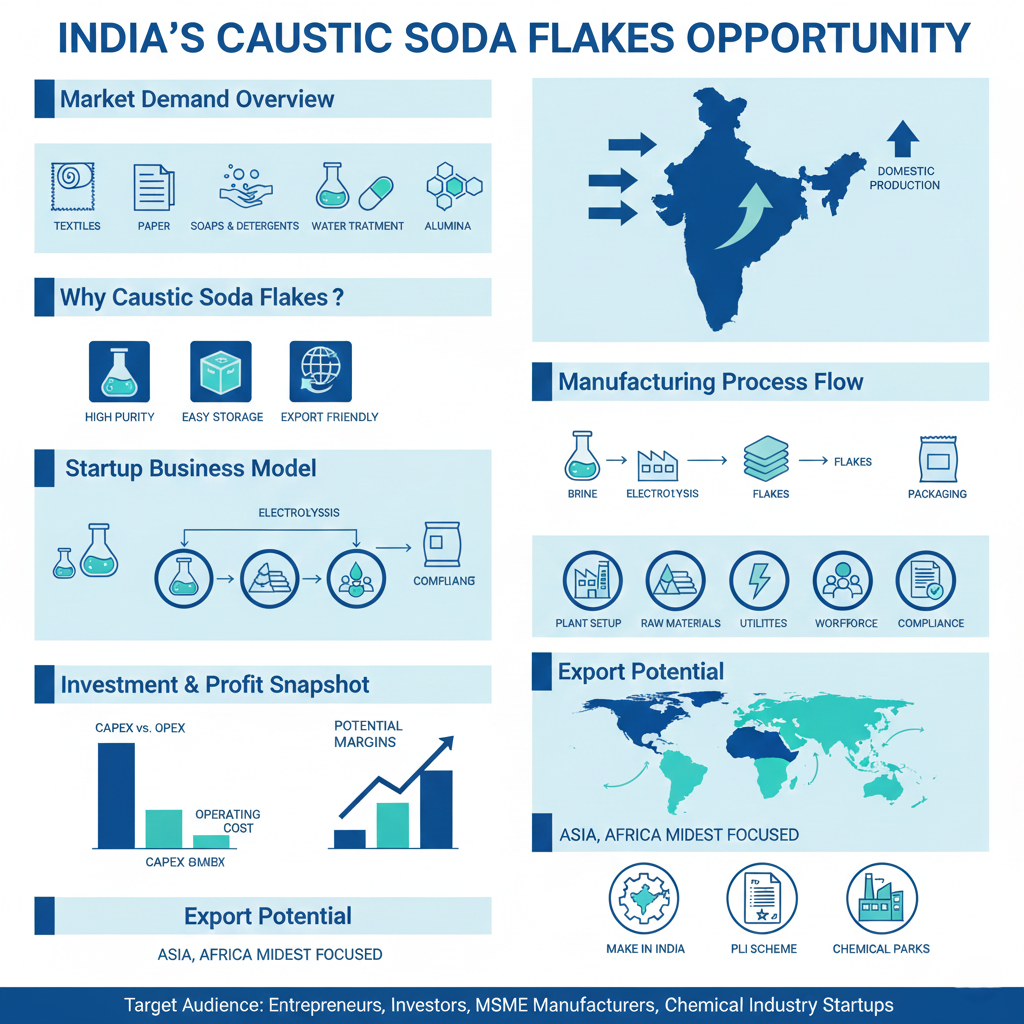
Caustic Soda Flakes India is a high-demand chemical with applications across multiple industries, making it a profitable business opportunity. Whenever industrial investment cycles revive, media often highlights infrastructure, steel, or power—but the real driver behind these expansions is base industrial chemicals like caustic soda flakes. These chemicals are essential for sectors such as paper & pulp, soaps & detergents, textiles, and water treatment, and their demand remains steady even during short-term market fluctuations.
Caustic soda flakes might not be the first chemical that comes to mind when considering media attention, but they are certainly among the most important ones as they are used in almost all sectors like paper & pulp, soaps and detergents, textiles, alumina, petroleum refining, water treatment, pharmaceuticals, and food processing. To make it even more interesting, caustic soda flakes are positioned as an excellent opportunity for manufacturers in India who are looking for a product with high volume, repeat consumption, and a market that is structurally embedded.
This paper provides a comprehensive analysis of the caustic soda flakes manufacturing industry by studying it from a feasibility and investor perspective—market demand, import substitution potential, manufacturing economics, machinery requirements, profitability drivers, and scalable startup models are the areas covered—all this using SEO focused, founder friendly insights.
1. Caustic Soda Flakes Market Demand: A Structural Advantage
Among the various chemicals, caustic soda comes under the category of base chemicals and thus is a necessary chemical for companies in all economic cycles and industries. Besides the specialty chemicals that depend on the occurrence and demand of a niche market, the demand for caustic soda is wide and extensive.
Key Demand Drivers:
- Paper & pulp manufacturing
- Soaps and detergents
- Textile processing and dyeing
- Water and wastewater treatment plants
- Oil refining and petrochemicals
- Alumina and metal processing
- Food processing and cleaning applications
Why Flakes Instead of Liquid Caustic?
Caustic soda flakes are favored due to their logistical and commercial benefits:
- More extended shelf life
- Storage and transport are more accessible
- Handling risk is lower than liquid lye
- Preferred by small and medium-sized enterprises (SMEs) and regional industrial clusters
This lets flakes to be a product that is led by distribution, opening up avenues for new manufacturers and packers to meet regional demand in an efficient manner.
caustic soda flakes market, sodium hydroxide demand, industrial chemicals India, base chemicals business
Read More: Caustic Soda – Manufacturing Plant, Detailed Project Report, Profile, Business Plan, Industry Trends, Market Research, Survey, Manufacturing Process, Machinery, Raw Materials, Feasibility Study, Investment Opportunities, Cost and Revenue, Plant Economics
2. Import Substitution Opportunity in Caustic Soda Flakes
Due to the long period of tight supply, unstable power costs, and plant shutdowns, India imports caustic soda flakes, which will give rise to a considerable import substitution opportunity for local players.
Why Import Substitution Works Here:
- Buyers prefer local suppliers for quicker delivery
- Freight and container costs impact landed prices
- Currency fluctuations affect the import economy
- SMEs are looking for smaller, flexible supply contracts
Instead of cutting imports entirely, the new firms that have been successful are selling themselves as trustworthy suppliers in certain regions and, in this way, are meeting the demand during the periods of supply shortage.
Export Potential as a Balancing Lever
Export sales will not be the main revenue source, but they can bring different benefits such as:
- Better usage of capacity
- Protection from domestic price swings
- Assurance of plant’s long life in the market
import substitution chemicals, caustic soda flakes export, chemical manufacturing India
Read More: Top 20 Chemical Imports to India in 2025: A Strategic Guide for Entrepreneurs and Startups
3. Capex Revival and the Chemical Multiplier Effect
The industrial capex revival takes place then the consumption of chemicals in the downstream sectors also rises—the consumption here being a case of “new factory, power plant, refinery, or utility demanding caustic soda”.
Demand Linkages Focused on Capex:
- Infrastructure → surface treatment & utilities
- Oil & gas → refining and chemical processing
- Power plants → water treatment chemicals
- Capital goods → sustained factory operations
Caustic soda flakes thus become a long life industrial product with a counter-cyclical nature.
4. Manufacturing Process: From Chlor‑Alkali to Flakes
The caustic soda flakes manufacturing is not only a chemical reaction but rather a utility-driven business.
Core Manufacturing Steps:
- Brine preparation and purification
- Electrolysis (chlor‑alkali process)
- Evaporation and concentration
- Flaking or prilling
- Packing and dispatch
Critical Co‑Products:
- Chlorine gas
- Hydrogen gas
Poorly planned chlorine evacuation might lead to safety and shutdown risks for plant operations. The winning players are those who manage to monetize coproducents through sufficient use or long-term offtake contracts.
caustic soda manufacturing process, chlor alkali plant, sodium hydroxide flakes production
Read More: Caustic Soda Lye – Manufacturing Plant, Detailed Project Report, Profile, Business Plan, Industry Trends, Market Research, Survey, Manufacturing Process, Machinery, Raw Materials, Feasibility Study, Investment Opportunities, Cost and Revenue, Plant Layout
5. Machinery and Plant Investment Blocks
Founders should not only buy the equipment but also plan according to process blocks. The most important plant sections are:
Major Plant Sections:
- Brine preparation system
- Electrolyzers and rectifiers
- Evaporation system
- Flaking/prilling unit
- Packing and warehousing
- EHS and pollution control systems
Decision-making must focus on the combined aspects of energy efficiency, safety, and automation.
6. Unit Economics and Profitability Drivers
The price of caustic soda in the market is not the main factor in determining profitability, but rather the control of operations.
Key Profit Drivers:
- Electricity cost per ton the (largest factor)
- Co‑product monetization
- Capacity utilization rate
- Packing and logistics efficiency
- Working capital management
Plant management in difficult economic times concentrates on cost cutting and stability rather than speculative pricing.
caustic soda unit economics, chemical plant profitability, sodium hydroxide cost structure
7. Alternative Business Models for Entrepreneurs
7.1 Caustic Soda Flakes Packing & Distribution
- Low capex
- Quick market entry
- Good for novice entrepreneurs
7.2 Captive Consumption Model
- Connected with soap, textile, or water treatment units
- Hardens margin control
7.3 Chlorine‑Linked Integration Model
- Best long-term economics
- Needs downstream chlorine planning
8. Lessons from India’s Industrial Leaders
- Reliance Industries: Integration mitigates volatility
- Aditya Birla Group: Operational excellence conquers commodities
- DCM Shriram: Utilities discipline guarantees cash flow
The simple conclusion for MSMEs is that process control, integration, and distribution are more effective than aggressive expansion.
Read More: SODA ASH (Na2CO3) – Manufacturing Plant, Detailed Project Report, Profile, Business Plan, Industry Trends, Market Research, Survey, Manufacturing Process, Machinery, Raw Materials, Feasibility Study, Investment Opportunities, Cost and Revenue
9. Role of NPCS in Project Feasibility
Niir Project Consultancy Services (NPCS) is the leader in Market Survey cum Detailed Techno Economic Feasibility Reports (DPRs) for the chemicals industry.
The scope of our reports includes:
- Market Demand and Pricing Analysis
- Manufacturing Process and Flow Diagrams
- Machinery and Raw Material Planning
- Project Cost and Financial Projections
- Profitability and Break-Even Analysis
A well-prepared DPR avoids huge errors regarding the size of the plant, location, utilities, and co-product handling.
10. Regulatory and Policy Reference
The entrepreneurs must keep themselves in sync with the guidelines of the Department of Chemicals and Petrochemicals, Government of India regarding compliance and policy updating.
FAQs: Caustic Soda Flakes Business
Is caustic soda flakes a beginner-friendly product?
Yes, either with proper technical support or by starting with the distribution.
What is the main factor determining the margins?
Electricity cost and the utilization rate of the plant.
Is it necessary to export?
No. Exports should complement—not rule—the business.
Read More: How to Launch a Profitable Methanol-Based Chemical Unit
Conclusion: A Long‑Life Industrial Opportunity
The caustic soda flakes business does not represent the case of a trendy startup—it is the case of a structural manufacturing opportunity. The demand goes up with the expansion of capital expenditures and stays stable even in the tough times. With strong utilities planning, co product monetization, and disciplined operations as the foundational elements, it turns into a long term cash generating industrial asset.
If the entrepreneurs are on the lookout for the high demand chemical manufacturing opportunities in India, among the options available, caustic soda flakes is still the most practical, scalable, and ready for import substitution business.
caustic soda flakes business, sodium hydroxide manufacturing India, chemical startup ideas, industrial chemicals demand