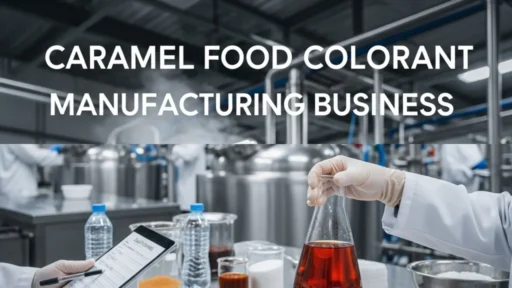


Caramel Food Colorant Manufacturing: Food industries at a global level heavily depend on taste, aroma, and visual appeal. Caramel food color is one of the most common natural colorants. This includes improving the appearance of products, including use in various bakery items, colas, sauces, confectionery, pasteurized dairy products, and even pharmaceuticals and cosmetics.
The processed food sector in India keeps growing rapidly. The limited domestic production of colorants with increasing consumer demand for safe and natural ingredients, coupled with strong governmental policy support, make manufacture of caramel colorant in India a promising startup opportunity.
Read Our Project Report: Click Here
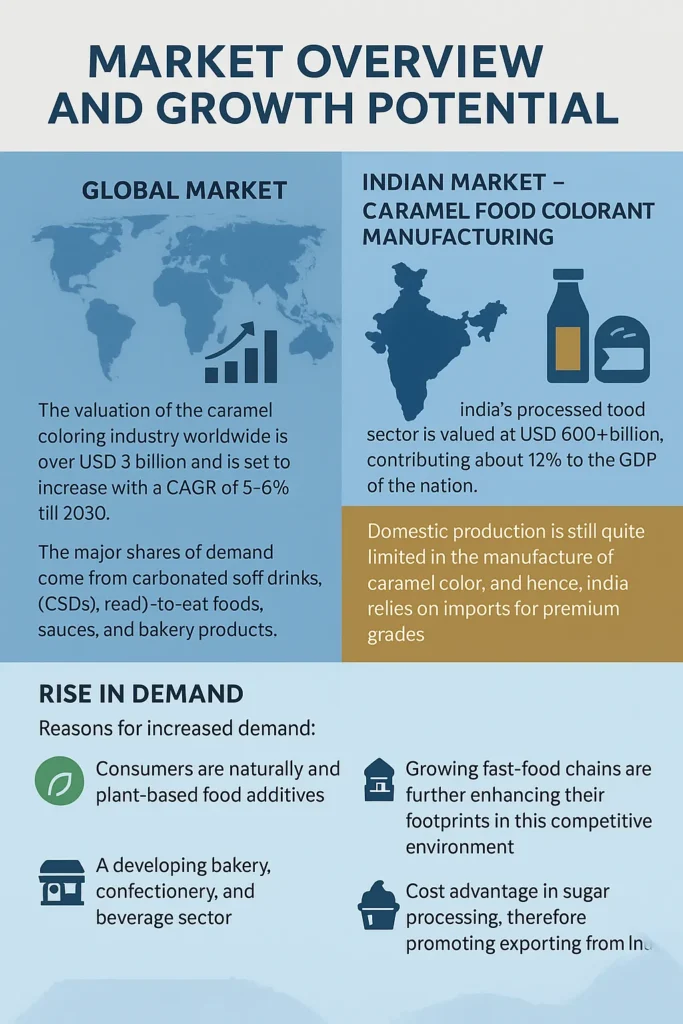
Market Overview and Growth Potential
Global Market
The valuation of the caramel coloring industry worldwide is over USD 3 billion and is set to increase with a CAGR of 5-6% till 2030.
The major shares of demand come from carbonated soft drinks (CSDs), ready-to-eat foods, sauces, and bakery products.
Indian Market-Caramel Food Colorant Manufacturing
India’s processed food sector is valued at USD 600+ billion, contributing about 12% to the GDP of the nation.
Packaged food and beverages are growing at about 10-12% per year, hence increasing the demand for caramel-based ingredients.
Domestic production is still quite limited in the manufacture of caramel color, and hence, India relies on imports for premium grades.
Rise in Demand
Reasons for increased demand:
- Consumers are naturally and plant-based food additives.
- Growing fast-food chains are further enhancing their footprints in this competitive environment.
- A developing bakery, confectionery, and beverage sector.
- Cost advantage in sugar processing, therefore promoting exporting from India.
Manufacturing Method of Caramel Food Color
Caramel colors are produced by heating carbohydrates such as sucrose, glucose, or corn syrup at controlled temperature and pH so that it forms the right color while avoiding bitterness.
Basic Steps
- Select sugars food grade
- Heat to 120-180°C
- Add food-use acids and alkalis
- Allow controlled Maillard reaction to develop color
- Cool to stop the reaction
- Filter-clean and adjust viscosity, color strength, and pH
- Pack in food-grade containers.
This complete process demands meticulous control over temperature and pH in order to ensure safe production and consistent quality.
Types of Caramel Color
There are 4 types of caramel color:
- Plain Caramel (E150a): Contains neither ammonia nor sulfite; used moreover widely in beverages. Common amongst the noncomplex caramels.
- Caustic Sulfite Caramel: E150b This gives the reddish-brown color of caramel.
- Ammonia Caramel: E150c This is mainly used for bakery and sauces.
- Ammonia-sulfite Caramel: E150d The darkest color of caramel; used more widely in colas.
Read Our Book: Click Here
Raw Material and Machinery
Raw Material
The main materials used in manufacturing caramel include:
- Food-grade sugar (corn syrup, cane sugar)
- Food-grade acids and alkalis
- Clean, treated water
- Packaging material, such as HDPE/PET drums
Machinery
A standard plant consists of:
- Stainless steel reactors with temperature control.
- Heat exchangers and condensers
- Filtration units
- Standardization tanks
- Packaging and bottling equipment
Industrial Applications
One of the major applications of caramel is to create visual appeal and consistency.
It finds application in:
- Beverages Cooked with colas and flavoring drinks;
- Pastries and confectionery (cakes, chocolates, candies);
- Sauces and seasonings (soy, BBQ);
- Dairy Products (ice cream, pudding);
- Pharmaceuticals (syrups, tablets);
- Cosmetics (shades of cream and shampoo).
This diversified wide range of applications offers several channels for revenue generation for manufacturers.
Read More: Sugar Candy Manufacturing Business. Production of Soft & Hard Boiled Candy
Emerging Opportunities with Upcoming Projects
India would like to attract USD 10 billion in food-processing investments during 2027 through PLI schemes, Mega Food Parks, and other initiatives.
Such growth will open opportunities for caramel manufacturers to:
- Supply new soft-drink bottling plants
- Collaborate with food processors focusing on exports
- Produce clean-label and organic caramel variants
- Provide specialty grades for pharma and cosmetics
These markets would create demand for both bulk and niche caramel products.
Read More: PM Kisan Samriddhi Kendras: A Retail Opportunity for Agri-Start-Ups in India
Import-Export Insights and Entrepreneurial Opportunities
India already exports USD 4-5 billion worths of sugar and related products. However, exports of caramel color have remained very limited thus opening up a new door of opportunity in exports, especially to African and Asian countries.
Since India imports specialty caramel products for premium beverages, setting up local manufacturing can substitute imports and offer cost benefits.
Proposed Startup Ideas
- Organic E150a Caramel for Clean-label Brands
- Syrup units focused on international markets of caramel
- Pharma-grade caramel having super purity
- Ready-to-use caramel paste for bakeries
Moderate investment would therefore be required for starting up these categories but would promise high potential.
Success Stories of Indian Business Tycoons
Commercial titans who changes from the Indian food and beverage milieu give useful lessons include:
Mukesh Ambani (Reliance)- moved from petrochemicals into retail and food noncommodities.
Adi Godrej (Godrej Group)- made brand reach across consumer and food categories.
Roadsong- established a great distribution model for a strong beverage brand.
Varun Beverages (RJ Corp) became India’s largest bottler of PepsiCo, thereby signifying scale in the market.
Their paths characterized how one could achieve success in the long run through diversification and innovation.
Business Opportunities for Startups
- Caramel manufacturing is a diverse field with many ways of growth such as:
- Supply to bakeries and beverage companies
- Create focused export units
- Private-label caramel products
- Mix with natural pigments such as beetroot and turmeric
- Sustainable clean-label caramel production
These concepts help the businesses cater to both mass and premium markets.
Read More: MSME Business List for Startups, Project Opportunities, Business Ideas
Conclusion-Caramel Food Colorant Manufacturing
Caramel color manufacturing transforms simple sugar into a high-value ingredient that is demanded by most industries.
This sector has low raw material barriers, high demand, great scope for import substitution, increased policy support, and good scope for exports, which makes it ideal for startups.
With good planning and guidance from experts, caramel color plants can be established to give good profits within the Indian markets and also internationally.
Find the Best Idea for Yourself With our Startup Selector Tool
How NPCS Can Help You in Caramel Food Colorant Manufacturing
The Niir Project Consultancy Services NPCS has been helping entrepreneurs establish new industries with the aid of Market Survey cum Detailed Techno-Economic Feasibility Reports DPR.
These reports cover in detail each step of the manufacturing process and offer insights on market analysis, flow charts, raw materials and machinery, product-mix and capacity, as well as predicting financial outcomes and profits. NPCS offers aid to entrepreneurs in establishing the feasibility study, as well as funding and the possibility of smooth scaling of the business.
FAQs-Caramel Food Colorant Manufacturing
1) What industries consume Caramel Color the most?
A. The industries which consume Caramel Color in the highest quantities are Beverage, Bakery, Confectionery, Sauces, Dairy, Pharma, and Cosmetics.
2) What are the most important raw materials?
A. Sugar in the form of food grade cane sugar or glucose syrup.
3) What kind of caramel is used in soft drinks?
A. Ammonia sulfite caramel (E150d).
4) Is there a potential for export-Caramel Food Colorant Manufacturing?
A. Yes. There is a great need in developing countries in Asia and Africa.
5) What makes this a great business opportunity?
A. The demand is strong and the market is mostly unchallenged. The investment for production is reasonable.