
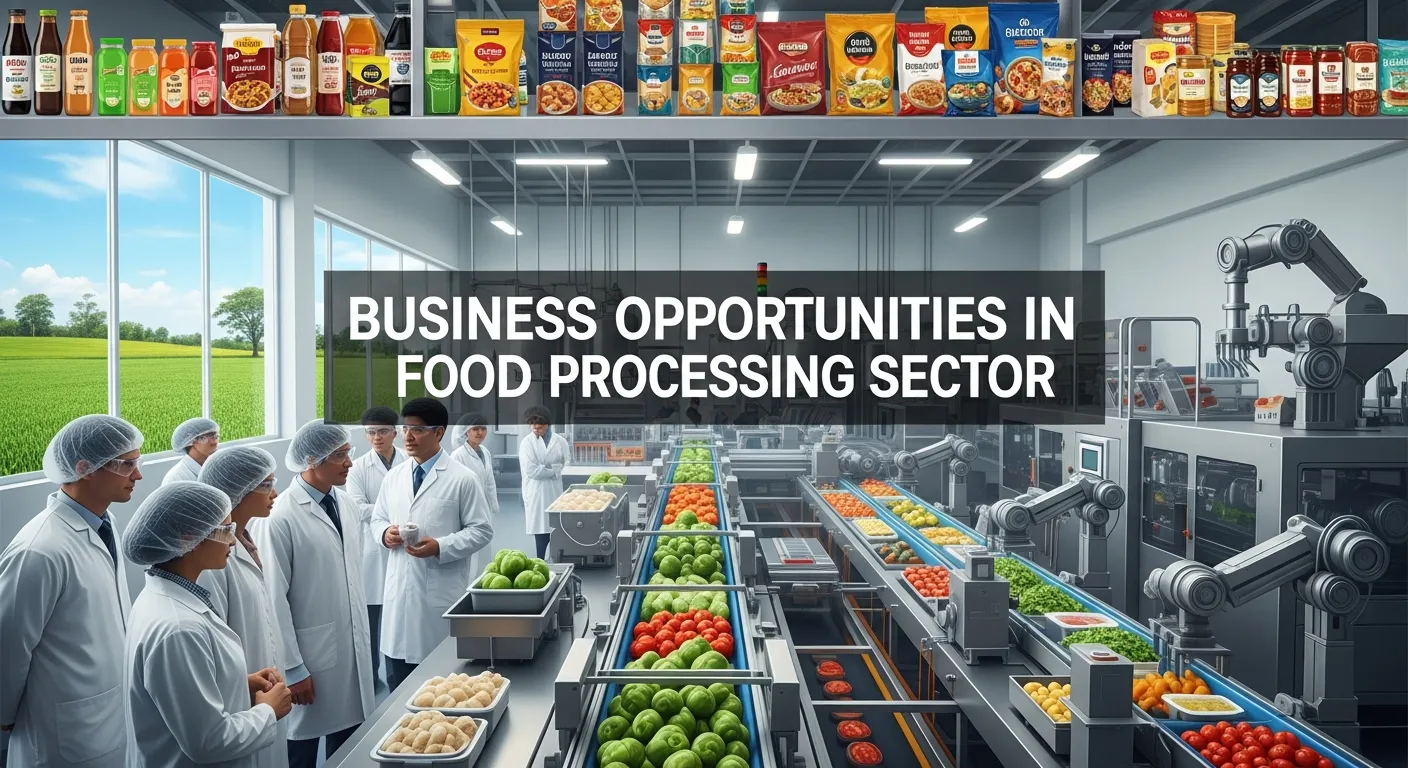

Food Processing: There has never been a time when the nation’s attention has been focused on the food industry in India as it has been recently. India has moved from a one-industry nation dependent on agriculture to a more modern global outlook.
The 2024-2025 MFPI Annual Report indicates that the industry is growing at a double-digit rate, outpacing the agriculture sector average of over 6.5 percent over the past decade.
Food processing employs over 6.9 million people, as the industry has been able to maintain self-sufficiency and global food sustainability. The nation has also achieved global food sustainability and self-sufficiency.
There are opportunities for entrepreneurs in that the country is one of the world’s largest producers of milk, pulses and onions, and the second largest producer of various fruits and vegetables.
With the right help, their aspirations to become globally recognized have a chance to become a reality as Indian food processing and packaging businesses are set to be the next global food brands.
Read More: 55 Most Profitable Micro, Small, Medium Scale Food Processing (Processed Food)
Overview of Food Industry in India
- Growth Rate: 6.55% CAGR (2014-2023)
- Contribution: 7.93% VAT of manufacturing industry and 8.45% VAT of agriculture
- Employment: 22.96 Lakh in registered units; 4.65 Lakh in small businesses
- Exports: USD 46.43 billion for FY 2023-24
- Foreign Direct Investment Inflow: $7.22 billion (2014-2024)
It is clear that India’s food industry has already become one of the leading drivers of the economy.
Start-Up Food Processors
High Demand Overseas
There is no dearth of desire for Indian cuisine in the international market. Spices, ready meals and fruit products are gold mines and have much better profit margins than raw exports.
Government Support
There is 100% FDI, subsidized GST (0-5%) and generous support under PMKSY, PLISFPI and PMFME schemes.
Read Our Project Report: Click Here
Domestic Demand is Increasing
Due to the high level of urbanization, the emerging middle class is eager to buy ready-made and instant foods.
Increasing Entrepreneurship
In both urban and rural areas, there is a rich supply of work in bakeries, spice processing and fruit processing.

Government Programs to Support Growth
PM Kisan Sampada Yojana (PMKSY)
PM Kisan Sampada Yojana provides support for construction of Mega Food Parks, development of Cold Chains and creation of Agro-Processing Clusters. Added value and food waste will also be reduced. Shared facilities reduce infrastructure costs for new businesses.
PMFME
It provides 35% subsidy for the formalization of Micro Food Processing Enterprises. It supports the One District One Product (ODOP) initiative. Connecting with start-ups for local crops such as mango pulp or millet is beneficial.
Read More: Food Processing Sector Growth Opportunities for the Food Processing Industry in India
Incentive linked to PLISFPI Production
- Funds are provided to start-ups to increase exports and sales.
- It focuses on dairy products, seafood, healthy foods and fruits.
- Startup Edge: Manufacturing options available for export.
Nivesh Bandhu Portal
- It provides a single access point for the entire ecosystem of investors and start-ups.
- It provides details of raw material zones, some protected agricultural groups and markets for exports.
- Startup Edge: Helps new business owners connect with relevant stakeholders.
The Most Promising Business Enterprises in the Next 5 Years (2025-2030)
Processing of Cereals and Grains
- Estimated profit: $10.9 billion. (2023–2024)
- Trends: Gluten-free millet flour, rice flour and enriched rice.
- Positives: Millet snacks, instant fortified rice, fortified wheat.
Spices and Oleoresins
- Estimated Profit: $4.7 billion
- Trends: Essential oils, organic extracts.
- Positives: Oleoresin from chili, extracts from turmeric, spices in a healthy diet.
Fruits and Vegetables
- Estimated Profit: $1.15 billion.
- Trends: Dehydration of fruits and vegetables, freeze-drying, exotic juices.
- Positives: Exotic tropical juices, dried garlic, onion, tomato powders.
Read Our Book: Click Here
Meat and Seafood
- Estimated Revenue: Over $10 billion.
- Trends: Cook ready-made meat, frozen and also certified for halal.
- Positives: Frozen seafood (shrimp, snacks) and halal modular meat.
Sugar, Cocoa and Confectionery
- Estimated Profit: $3.29 billion.
- Trends: Organic jaggeries and sugar free.
- Positives: Sweeteners, jaggery-based candies, cocoa chocolate.
Milk and Honey
- Estimated profit: $625 million.
- Trends: High-protein foods that are lactose-free.
- Pros: Dairy honey, protein-rich milk powder and organic honey.
Get Detailed Insights from This Book: The Complete Book on Beekeeping and Honey Processing
The Difference Between Import and Export: A New Business Opportunity
- India’s food imports are worth nearly $31.7 billion.
- It allows startups to address this gap with local production.
- Edible oils: import value of 15 billion dollars, introduction of sunflower or mustard oil extraction.
- Cocoa: import value of 512 million dollars, production of local chocolates and cocoa powder.
- Imports of craft beverages and vinegars of USD 1.5 billion — Establish craft beverages and vinegar production.
- NABARD credit and MoFPI schemes can help with increased import substitution and accelerated growth.
Read More: Food Processing Business Ideas
Positive Results of Startups
- LT Foods (Daawat): Initially a small company, now a global rice exporter.
- Paper Ship: Created and sent overseas fresh shots of Indian beverages.
- MDH & Everest: Known worldwide for their spices due to their quality and smart marketing.
- Key lesson: Government schemes and smart export marketing can come from small beginnings.
How NPCS Helps Entrepreneurs with Business Development
Niir Project Consultancy Services (NPCS) turnkey business strategists help transition ideas into operational businesses. They help in the preparation of Detailed Project Reports (DPR) and allocate relevant components like market size, raw materials, technology, machinery and finance to their respective sections.
The team guides entrepreneurs to the highest opportunities under MFPI and NABARD schemes. With the right help, food startups are able to eliminate uncertainties, improve planning and accelerate growth.
Basic Actions Needed to Start
- Do Market Research – use Nivesh Bandhu MoFPI portal along with business indices.
- Choose a Product with Consistent Demand in the Market – focus on the categories of food, spices and dairy products.
- Submit Scheme Applications – PMKSY, PLISFPI and PMFME are readily available.
- Incorporating the Latest Technology – Buy storage equipment, cold storage and sophisticated processing systems.
- Get certified for export in FSSAI, ISO and HACCP.
- Create a unique brand and focus on international marketing.
- Get detailed project reports and project delivery collaborations from NPCS.
Find the Best Idea for Yourself With our Startup Selector Tool
Conclusion
Food processing in India is still in its early stages and with strong government support, a growth rate of 6.55% and significant foreign demand, the country seems poised for a surge.
Branding in the processing and packaging of cereals and food products based on cereals, ground spices, seafood and dairy products is already possible. With adequate finance, supporting technology and continuous innovation, even the smallest unit in an industry can become a multinational corporation.
India is a hub of opportunity. With farms in development and a world hungry for food, it’s ready.
Frequently Asked Questions
1.What makes food processing in India so attractive?
A. India has abundant raw materials and a growing international market for processed foods.
2.What government programs help support the startup ecosystem in this sector?
A. New units can avail subsidized loans and grant programs of PMKSY, PMFME and PLISFPI.
3.Which food products have the highest processing profitability?
A. Processed millet, spices, dairy products, seafood and fruit.
4.In what ways can I secure funding for my food project?
A. With a well-prepared project plan and detailed plans, you can apply for NABARD loan and funding from MoFPI.