Biomanufacturing Business Ideas in India
A big change in the Indian industry just occurred. An accelerating surge in biomanufacturing investments, policy changes and startups have been being reported by the Economic Times and it is indicative of a structural shift and not just a seasonal spike. Economic Times has been reporting on the Government of India’s flagship Biopharma SHAKTI project for the past couple of months, which is supported by a Rs. 250 crore investment. The Economic Times, during these past few months has published news on the flagship project SHAKTI launched by the Government of India, along with investing 250 crore as a part of the same. This allocation of 10,000 crore from Budget 2026-27 for the 5-year term would lead to a vacuum within the supply chain, that start-ups, agile start-ups and MSMEs can fill very quickly.
India’s bioeconomy has been pegged at US$195.3 billion in 2025 and the sector comprises close to 5% of the total GDP. The government has recently announced a goal of $300 billion by 2030. This is not a vision on paper; this is a live mission, tenders, grant windows and incubation slots are open now.
As an entrepreneur or MSME operator or even a first-time entrepreneur, the question is not if biomanufacturing is a genuine chance. Every week or so, as the question reads on the page of the Economic Times, it’s easy to say: Who will build the companies that will ride this wave?
This analysis guides you through the latest market signals, 5 actionable business models, what government schemes you need to be aware of, export corridors and real MSME examples – everything you need to get from idea to launch.
Get Detailed Project Report (DPR): Pharmaceutical Manufacturing Project Report
What Recent Economic Times Reporting Means for Founders
The Economic Times has featured India’s bioeconomy throughout the years as the next big thing in India after IT, and it was no surprise when the Union Budget 2026-27 came out. ET’s industry correspondent reported that the Biopharma SHAKTI scheme – a Rs. The 10,000-crore national initiative will specifically support production of biologics, manufacturing of biosimilars and establishment of bio-foundry infrastructure all over the country.(Biomanufacturing Business Ideas in India)
In practice, that market signal translates to the following:
- Contract Biomanufacturing will get a boost in gear: Large pharma players will seek to outsource their fermentation, downstream processing and fill-finish to mid-sized Indian vendors.
- The demand for bio-based chemicals is structural: Textiles to adhesives to personal care are all sectors subject to regulatory pressure to switch from petrochemicals. Multi-year contracts could be available for biomanufacturers that provide drop-in substitutes.
- Domestic manufacturers get immediate captive market, as government procurement prefers Indian manufacturers due to PLI and SHAKTI scheme rules.
- Exports are opening up: European Union is also pushing the EU’s own Biotech Act and is looking to phase out the supply chains from China and Indian companies that are at the right stage to be GMP-certified can benefit from a major revenue stream from EU exports by 2027.
ET Market Signal — June 2026
Biotech startups in India crossed the milestone of 12,000 and the DPIIT inked an unprecedented MoU with Thermo Fisher Scientific to provide advisory, technology access and investor connect to 500+ biotech startups. This is the first time in the industrial history of India when support for infrastructure is provided at such an unprecedented scale. Anyone who enters the game now will be less likely to have competition and more likely to have access to grants than anyone who waits.
The sector’s compound strength is also supported by the data tracking done by the Economic Times, with India accounting for 44% of global Abbreviated New Drug Applications (ANDAs), 1,400+ WHO-compliant manufacturing plants and 35% of the world’s biosimilar production, before the SHAKTI funds are deployed. Get the latest investment and policy updates in the Economic Times Biotech Coverage.
Discover scalable startups tailored to your goals
Why the Biomanufacturing Industry Is Growing So Rapidly
The biomanufacturing landscape is about to see some one-in-a-million opportunities for newcomers, as three macro trends combine.
a. Policy Momentum Is Unprecedented
This was a prelude to the Union Cabinet approving BioE3 Policy (Biotechnology for Economy, Environment, and Employment) in August 2024. Since then, the government has announced the establishment of National Bio foundry Networks, Bio-AI Hubs, and BioE3 Centres, all of which are physical assets to help ease the capital costs faced by startups. The pilot scale equipment is available to a founder who has a biomanufacturing idea for the first time without the need of constructing a greenfield facility.
b. Demand Is Outpacing Domestic Supply
Bio-based enzymes, specialty fermentation products, and the raw materials for precision biotherapeutic applications are imported massively in India. The import substitution opportunity due to SHAKTI focus on domestic production of biologics is worth crores of rupees in a year. According to Economic Times industry reports, the pharmaceutical industry is actively looking for domestic biomanufacturing partners to reduce the risk in their supply chains.
c. The Export Window Is Wide Open
Global biosimilars market is expected to touch $100 billion by 2030. India currently manufactures 35% of the global supply of biosimilars at a much lower price compared to US or European manufacturers. In fact, Invest India’s Biotechnology Sector Report says that applications for biotech parks are already picking up pace in the Southern states such as Karnataka, Telangana and Tamil Nadu and are gaining pace in the Northern India fast.
4. Government Policies and Incentives for Biomanufacturing Startups
The biomanufacturing startup support ecosystem is now more complete than ever. The following are the most important schemes that any founder should be aware of: Start your registration journey from Startup India and discover MSME support from MSME Ministry India.
Biopharma SHAKTI (Budget 2026-27)
A five-year, Rs. A Rs 10,000 crore scheme to support domestic production of biologics and biosimilars. Offers capital subsidy, access to technology and export facilitation support. We will prioritize startups that develop biosimilar pipelines, cell therapy products, or microbial fermentation platforms.(Biomanufacturing Business Ideas in India)
Related Article: Biopharma SHAKTI Scheme Explained: ₹10,000 Crore Government Push for Biologics Manufacturing
BioE3 Policy — BioE3 Centres
Develops a national infrastructure programme for Bio-AI Hubs and Biofoundry Centres (Mulankur). These centres will be open for startups to use pilot scale bioreactors, downstream processing equipment and regulatory grade testing facilities on a shared access basis, significantly decreasing CapEx.
BIRAC BIPP & EIR Programme
Biotechnology Industry Partnership Programme (BIPP) provides a non-dilutive grant to biotech firms that are scaling up towards commercialisation. BIRAC’s unique and underutilized instrument is the Entrepreneur-in-Residence (EIR) program to support individuals interested in establishing biotech enterprises but lacking salary during early-stage development.
PLI Scheme for Pharmaceuticals
Fermentation based API and biologics are included in the scheme of Production Linked Incentive. New sales over a base year are eligible for 10-20% cash incentives. To a startup that becomes a success. This will cost 50 crores per annum in incremental biologic API sales, which works out to Rs. The direct government incentives are 5-10 crore.(Biomanufacturing Business Ideas in India)
DPIIT Recognition & Tax Benefits
DPIIT-recognised startups in biomanufacturing enjoy three years of income tax exemption, ESOP tax deferral, and simplified winding-up provisions. Register at DPIIT Startup India Portal to begin the recognition process.
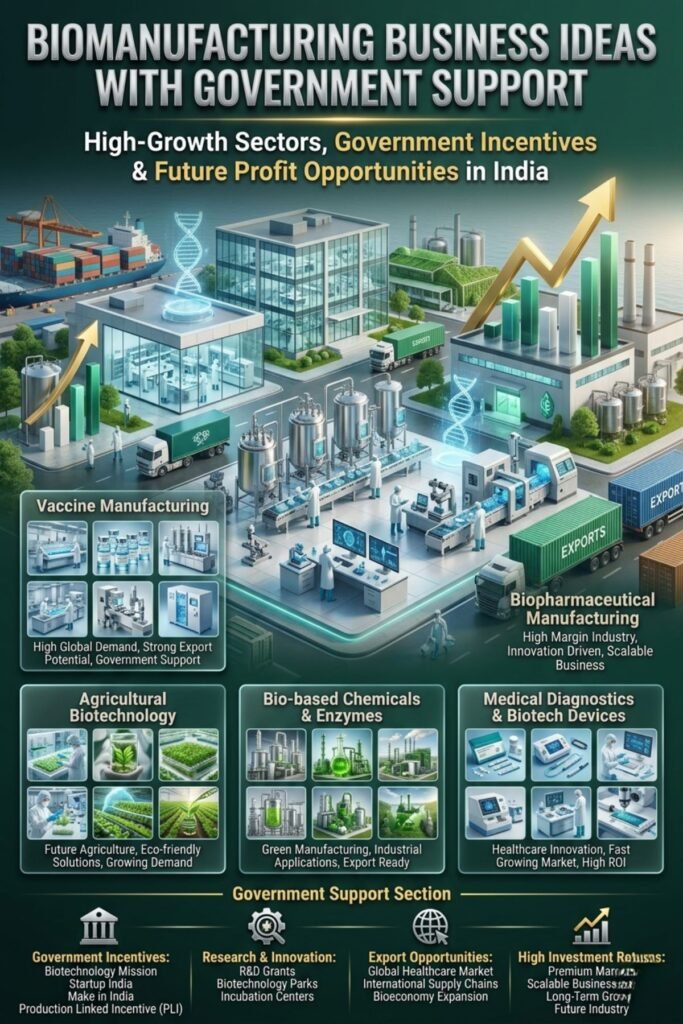
5. Five Biomanufacturing Business Ideas for Indian Startups in 2026
These are ideas that spring right off the policy and market signals underscored by Economic Times and government data. They all respond to one of the specific supply gaps that the SHAKTI initiative and the BioE3 policy help to address.
Idea 1 — Contract Microbial Fermentation Services
It’s the market that’s calling for it: Small and mid-sized pharma and nutraceutical companies require fermentation capacity for enzyme production, probiotic manufacturing and antibiotic precursor — but don’t want to invest in building their own facilities. This will be part of what the BioE3 Centres will eventually deliver, with the private contract fermentation market having years of demand to satisfy.
Business model: a 500 – 2000 litre pilot-scale fermentation facility with 6 – 18-month contracts for CMO services. Per-litre batch charges and downstream processing fees revenue.
Capital requirement: Rs. The required equipment costs ₹1.5–4 crore, and BIRAC BIPP grants can cover up to 50% of the project cost.
The first customer acquisition is with Hyderabad and Baddi-based manufacturers of target API which import fermentation-derived intermediates.(Biomanufacturing Business Ideas in India)
Idea 2 — Bio-Based Industrial Enzymes for Textile and Paper Industries
What the market needs: Gujarat, Tamil Nadu and Maharashtra-based textile mills spend thousands of crores importing industrial enzymes for fabric manufacturing and paper de-inking, which include cellulases, amylases, proteases, etc. BioE3 policy makes it clear that bio-based chemicals and enzymes are a priority sector and thus grant money goes to the one who enters the sector.
R&D strategy: innovation of microbial strains producing enzymes with local raw material (agricultural waste) as the feedstock. Make direct sales to textile clusters and paper mills on volume contract.
Product competitiveness: 30-40% less expensive than imported enzyme products from Europe. DPIIT recognition allows PLI benefits for the incremental domestic sale.
Natural export markets include the textile markets in Southeast Asia, especially Bangladesh and Vietnam, where mills are looking for enzyme alternatives, too.
Get Detailed Insights from This Book: The Complete Technology Book on Pulp & Paper Industries
Idea 3 — Precision Biotherapeutic CDMO for Biosimilar Startups
What the market requires: India has 12,000+ biotech startups, but majority of them do not have GMP certified manufacturing capability. They need the plant, they have the IP. The Economic Times has reported on the rising pipeline of registrations of biosimilars, and they will all require the assistance of contract development and manufacturing organisation (CDMO).(Biomanufacturing Business Ideas in India)
Business model: Set up a GMP certificated biologics manufacturing plant with mammalian cell culture equipment. Provide development services (cell line development, process optimisation), clinical supply manufacturing and commercial scale-up.
The Minimum viable scale: 500-1000 litres bioreactor suite with downstream purification — cost ~ Rs. Cost of the scheme: Rs 8-15 crore, which is also to be funded partly by the capital subsidy under SHAKTI scheme.
Market size: India’s biosimilar CDMO market is projected to grow at 22% CAGR through 2030.
Idea 4 — Smart Protein and Functional Food Ingredient Manufacturing
The market calls for: Global food giants from India are looking for functional proteins from fermentation such as yeast extract, single cell proteins, meat replacement from mycoprotein and precision-fermented dairy proteins. BioE3 is based on six policy themes, and ‘smart proteins’ is one of them, with dedicated grant windows until 2026.
Business model: A fermentation-based protein concentrate facility producing customised functional protein ingredients for food manufacturers, sports nutrition brands, and hospital nutrition companies.
Revenue model: Rs. The premium fermentation derived protein concentrates cost Rs. 800–1,200/kg whereas soy derived protein concentrates cost Rs. 600–900/kg. Commodity plant proteins price range is 200-300 per kg.(Biomanufacturing Business Ideas in India)
The market potential is on the decline due to efforts by the EU and UK to cut soy imports and search for fermentation derived substitutes. The export corridor is opened with APEDA certification. For more information on export support from APEDA, Government of India.
Idea 5 — Bio-Based Polylactic Acid (PLA) and Biodegradable Packaging Materials
The need of the hour: India’s Extended Producer Responsibility (EPR) and Single Use Plastic bans have led the market to demand for biodegradable alternatives. The most popular replacement is PLA, which is produced by microbial fermentation of sugarcane and maize. India is now moving towards building large PLA facilities but the ancillary processing, compounding and conversion business, which supplies the SME packaging sector is wide open.
Company Business Model: PLA compounding and conversion business. The company buys PLA resin from large-scale manufacturers and converts it into pellets, films, and moulded packaging for FMCG and e-commerce customers.
Capital requirement: Rs. Relatively low CapEx (biomanufacturing) as fermentation step outsourced; 2-5 crore in extrusion and moulding equipment.
The Market signal from ET highlights India’s growing sustainable packaging market, while a surge in compliance with EPR further reinforces this trend, as reported by ET in 2026.
Import–Export Opportunity Analysis
Biomanufacturing is one of the most under realised business opportunities in India. The landscape is like this:
Export Corridors — What India Can Ship
- Regulatory Consulting for Biosimilars and Biologic APIs to regulated markets (US FDA, EU EMA, ANVISA-Brazil)
- Technical assistance to South Asia and the Middle East for industrial enzymes produced by fermentation.
- The use of bio-based polymer granules and PLA compounds to EU sustainable packaging mandates
- Protein concentrates to Japan, South Korea and Australia
Import Substitution Targets — What India Should Stop Buying
- Speciality fermentation media (currently as much as 60-70% imported from US and Germany)
- CHO and HEK cell culture supplements for biologic manufacturing have been developed.
- Industrial enzyme concentrates with high purity for textile and paper industries.
The DGFT (Directorate General of Foreign Trade) offers export incentive guidance for biotech products in particular. Refer to latest details of scheme at DGFT, Govt of India.
Indian MSME and Startup Success Stories in Biomanufacturing
Biocon — From Enzymes to Global Biosimilars
The Biocon company was founded in 1978 by the initial appearance in Bangalore as a small manufacturer of enzymes. Today, it is one of the biggest biosimilar manufacturers in the world, providing insulin and trastuzumab to more than 120 countries. The lesson for MSMEs: If they specialise on one fermentation application and apply GMP discipline, over time they achieve the global scale. Biocon’s model is the right business model for the 1st time entrepreneurs today who are availed support by BIRAC in early-stage model – Enzyme Contract Manufacturing.(Biomanufacturing Business Ideas in India)
Serum Institute — Scale Through Manufacturing Focus
Growth to become the world’s largest vaccine manufacturer by volume has been achieved by Serum Institute through continued expansion of fermentation capacity and constant efforts towards manufacturing cost reduction. It proves that the key to creating the competitive advantage in biomanufacturing is not only scientific but also operational in nature. A well-run Rs. The fermentation unit is only at 5 crore which can be realistically scaled up to Rs. in 2026. In compliance with the GMP and export certification from Day One, 100 crores in revenue would be generated in 7 years.
Praj Industries — Industrial Biotechnology at MSME Scale
Pune-based Praj Industries is a good example that how an MSME can create a business worth Rs. With a focus on fermentation process engineering, the company’s 3,000+ crore industrial biotechnology business. Instead of fighting over product IP, Praj constructs and runs fermentation plants for others, a pure-play contract model which, in the era of bioeconomy, has been extensively discussed by Economic Times.
About NPCS — Your Biomanufacturing Business Partner
NIIR Project Consultancy Services (NPCS) is a pioneer in providing industrial consultancy services in India for the emerging biomanufacturing sector with more than 45 years of experience. Be it a microbial fermentation plant, a biosimilar CDMO or bio-based chemicals plant, NPCS gives you end-to-end feasibility reports, project profiles, plant layouts and market research that is customized to the regulatory and infrastructure landscape of India.(Biomanufacturing Business Ideas in India)
NPCS project reports are intended to be a bank finance ready project report, for applying to BIRAC and due diligence by private equity investors. NPCS offers the analytical infrastructure needed to transform idea to bankable project in weeks as opposed to months — before the opportunity of biomanufacturing is even realized, let alone taken advantage of.
Biomanufacturing Business Opportunity Data Snapshot — India 2026
| Business Segment | Market Size | Key Scheme | Capital Range | Export Potential |
| Contract Fermentation Services | Rs. 8,000+ Cr | BIRAC BIPP | Rs. 1.5–4 Cr | Medium |
| Industrial Bio-Enzymes | Rs. 5,000+ Cr | BioE3 / PLI | Rs. 2–6 Cr | High |
| Biosimilar CDMO | Rs. 15,000+ Cr | Biopharma SHAKTI | Rs. 8–15 Cr | Very High |
| Smart Protein Ingredients | Rs. 3,500+ Cr | BioE3 Smart Proteins | Rs. 3–8 Cr | High |
| PLA Compounding & Packaging | Rs. 6,000+ Cr | EPR / MSME Loans | Rs. 2–5 Cr | Medium-High |
Sources: BIRAC India Bioeconomy Report 2026, Invest India, Budget 2026-27, Economic Times Industry Desk
Frequently Asked Questions — Biomanufacturing Startups
Q: Do I need a science degree to start a biomanufacturing business?
No, you don’t need a personal science degree, but your founding team should have at least one domain expert, such as a microbiologist, biochemical engineer, or bioprocess technologist, to provide the knowledge you will need. Technology oriented co-founders and business-oriented founders are commonly found together and the business-oriented founders lead the many successful biomanufacturing MSMEs. Technically qualified people can attend the BIRAC’s EIR programme to develop their business skills, while business-oriented persons can understand the technical landscape through NPCS project reports.
Q: The minimum investment required for a fermentation-based business in India is Rs. 20,000/-.
A: You can invest in a micro-scale contract fermentation unit, and this facility will start functioning immediately. 1.5–2 crore if you avail the shared infrastructure in BioE3 Centres or DBT bio incubators. We keep the founder’s equity requirement at around 30–50% of eligible project costs with the remaining cost covered by the Biopharma SHAKTI capital subsidy and BIRAC BIPP grants.
Q: Which state in India has a good biomanufacturing ecosystem?
A: Karnataka (Bangalore), Telangana (Hyderabad), Tamil Nadu (Chennai/Coimbatore), Maharashtra (Pune/Mumbai) and gradually Uttar Pradesh (Noida/Lucknow) have the most vibrant biotech park infrastructure, BIRAC incubator networks, and skilled talent pool. Odisha has launched a Rs. It has a Biotechnology umbrella scheme of 1,113 crore for five years and is becoming an attractive low-cost destination.
Q: To apply for BIRAC grants for a biomanufacturing start-up, you must follow the online application process.
A: Firstly, register your company under the Startup India recognition programme by DPIIT. After that apply to the BIRAC BIPP or BIRAC SBIRI schemes as per the stage of R&D. Look out for the Bio-AI Mulankur Hubs on the DBT-BIRAC rolling call for infrastructure grants as per BioE3 policy. The amount of grants ranges from Rs. 25 lakhs to Rs. That ranges from 50 crore to the programme.
Q: Can products be made using biomanufacturing be exported and how do I begin?
A: Yes – the PLI scheme encourages exports by offering incentives for additional production beyond domestic demand. Pharmaceutical exports will require WHO-GMP certification. FSSAI certificate and APEDA registration are mandatory for exports of food and nutraceuticals. Guidance for Foreign Trade Policy of biotech products is available on the latest in the DGFT website. Most export-oriented biomanufacturing start-ups target completing GMP audits within 24–36 months of their startup. Majority of export oriented biomanufacturing startup is targeting to get GMP audit within 24-36 months of startup.
Q: What is Economic Times’ coverage of biomanufacturing, and why is it important for founder to follow it?
A: Economic Times has the most up to date industry desk for biotech, pharma, and industrial manufacturing in India. It publishes news about policy announcements, funding rounds and regulatory developments, giving founders a head start in making decisions ahead of their rivals. Founders have a competitive advantage over the market when they can be reading the economic times biomanufacturing and biotech coverage weekly, rather than waiting months for organizations to issue formal research reports.
Conclusion: The Biomanufacturing Window Is Open — Act Before It Crowds
Over the past year, the market signal of Economic Times has become the most pronounced. India’s biomanufacturing industry is not in a speculative pre-growth phase but it is in a state of scale-up with a supportive Rs. A policy framework that provides explicit infrastructure support, grants and export support for new entrants, 12,000+ active biotech startups and 10,000 crores in government funds.
This analysis is not theoretical, but based on 5 business ideas. They all address a proven supply gap, have a government incentive, and address an existing customer base. The question that arises is not whether the market is real — The Economic Times, Invest India and BIRAC have validated it. The issue is if you’ll be in before it gets full.
BioE3 Centres will scale over a period of time. The Bio-AI Hub rolling call is set to end in June 2026. The SHAKTI capital subsidy windows are competitive. The first-mover advantage in biomanufacturing is a reality given that the time taken to commission a plant is 18-36 months; companies that act now will have plants up and running by 2028-2030 when demand for these products is expected to ramp up as a result of policy decisions.(Biomanufacturing Business Ideas in India)
The 21st century industrial revolution is biotechnology based — and India, as Economic Times reports regularly, is poised to be the frontrunner. The visionaries who see this trend now and act accordingly will shape the bioeconomy of India in the coming decade.