Sugarcane Bagasse Products
Sugarcane Bagasse as India’s Most Abundant Agro-Industrial Waste
Bagasse is the fibre left behind after the extraction of juice from sugarcane; it is about 30% of the weight of cane. India produces around 340 million tonnes of sugarcane per year, of which around 100 million tonnes is bagasse. In most cases, the burning of bagasse in cogeneration boilers to generate steam and electricity for the sugar mill has been a traditional practice. Cogeneration is also important, but only utilises a proportion of the bagasse, leaving millions available for higher value uses.
The business proposition for the manufacturing with bagasse is very strong – it is almost a free raw material (or can be obtained at Rs. The mill gate price of bagasse is 200-500 per tonne, the domestic and export market is growing, and the policy support of Make in India, National Biofuel Policy and plastic ban that directly affects the bagasse disposable tableware manufacturers. In this article, top 10 product opportunities from sugarcane bagasse are discussed.
The Bagasse Composition and Product Possibilities
The cellulose, hemicellulose, lignin, and other components of sugarcane bagasse are around 45%, 25%, 25%, and 5% respectively. It is a versatile raw material for paper and boards, biofuels, chemicals and moulded products, due to its lignocellulosic composition. Freshly pressed bagasse has usually 45–55% moisture content and this should be taken into consideration in the processing economics. The calorific value of dry bagasse (at 12-15% moisture content) is 4200 – 4500 kcal/kg which is equivalent to low grade coal.
Get Detailed Insights from This Book: The Complete Book on Sugarcane Processing and By-Products of Molasses (with Analysis of Sugar, Syrup and Molasses)
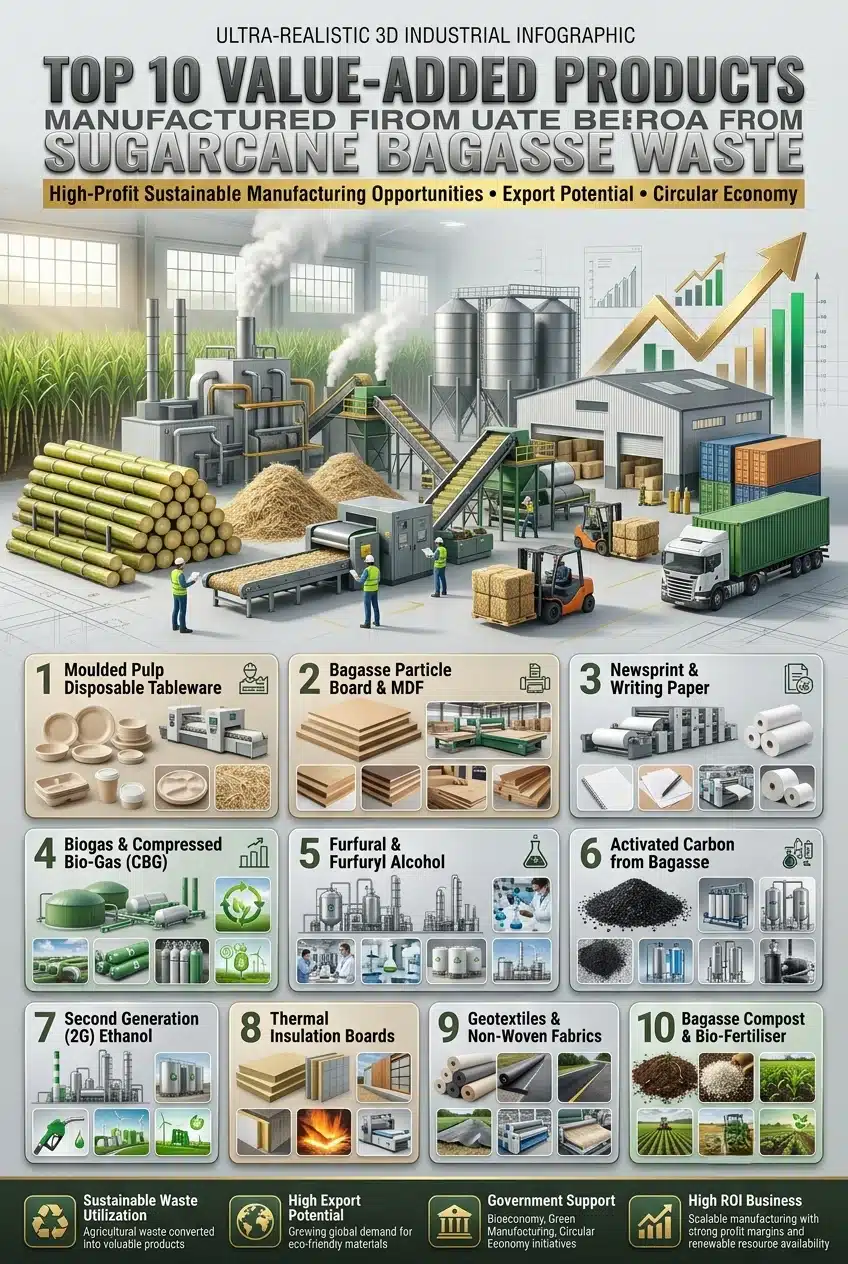
Top 10 Products from Sugarcane Bagasse
1. Moulded Pulp Disposable Tableware
The most recent product to come in large amounts from bagasse is the moulded tableware, such as plates, trays, bowls, cups and clamshell boxes, that’s the fastest growing bagasse product in the world. These products are 100% compostable, microwave safe, oil proof and 100% substitute for plastic and pharmocol tableware, made by using bagasse as raw material, pulping, forming in heat pressing and drying. The changes in demand that India introduced in 2022 with the ban on single use plastics and the implementation of extended producer responsibility (EPR) have created a structural shift towards bagasse tableware. Retailers and food service companies from Europe have a strong demand for exports. The investment cost for 10 TPD tableware plant is in the range of Rs. 1–3 crore. The price of the sale is determined as follows: 8-25 per piece depending on size and grade.(Sugarcane Bagasse Products
2. Bagasse Particle Board and MDF
In combination with urea-formaldehyde or MDI binder and hot-pressed, bagasse fibres can be used to make particle boards and medium density fibreboards (MDF) that have similar properties to wood-based boards. Bagasse boards are termite-proof, have consistent density throughout and are cost-competitive. Wood panels are widely used in construction and furniture industries in India and short supply of wood and dependence on imports leads to good domestic market opportunities for bagasse boards. In a 10,000 m³/year bagasse board plant about Rs. is required. 3–6 crore investment.
3. Newsprint and Writing Paper
Bagasse is one of the major non-wood fibres for paper production in the world. Bagasse is the major raw material employed in a number of large paper mills in India, such as Ballarpur Industries, Century Pulp and Paper. Specialty papers such as tissue paper, cardboard and food-grade packaging board with bagasse pulp are the opportunity for MSME entrepreneurs. The starting cost of a small bagasse pulping and tissue paper unit is Rs. 2–5 crore.(Sugarcane Bagasse Products)
4. Biogas and Compressed Bio-Gas (CBG)
The most suitable feedstocks for biogas digesters are wet bagasse and bagasse press mud (filter cake during juice clarification). Satat Scheme of the government provides financial support for Compressed Bio-Gas plants and guarantees the offtake through the oil marketing companies. The cost of a 1 tonne/day CBG plant (with the input being around 20-30 tonnes of wet biomass) is Rs. It generates 4-8 crore and has a population of 4-8 lakh. The annual income from CBG is estimated at 1.5-2.5 crores and digestate as organic manure.
5. Furfural and Furfuryl Alcohol
Processing bagasse hemicellulose with dilute acid under pressure and elevated temperature converts pentosan sugars (xylose and arabinose) into furfural, a valuable chemical intermediate. Industries utilize furfural in the production of solvents, flavour compounds, pharmaceuticals, and polymers. India is presently importing the majority of its furfural from China. Domestic production of furfural from bagasse hemicellulose streams would be a true opportunity for import substitution with good industrial demand. Investment: Rs. 3–8 crore.
Related Article: Bio-Based Chemical Business Idea: Furfural Plant Cost, Profit and Market Demand in India
6. Activated Carbon from Bagasse
Because bagasse contains cellulose and hemicellulose, enzymes can break it down into fermentable sugars, which microorganisms then ferment into ethanol. The surface area of coconut shell activated carbon and rice husk activated carbon is higher, but bagasse activated carbon is competitive when used for lower specification water treatment applications and in the raw material cost. Investment: Rs. 60–150 lakh.(Sugarcane Bagasse Products)
Discover business ideas that actually make money
7. Ethanol (Second Generation / 2G)
Because bagasse contains cellulose and hemicellulose, enzymes can break it down into fermentable sugars, which microorganisms then ferment into ethanol. The Indian Ethanol Blended Petrol (EBP) initiative strongly promotes 2G ethanol plants based on bagasse. Praj Industries and Indian Oil Corporation have set up 2G plants with the use of bagasse. For investors who have invested in large scale (Rs.) This is the highest value chemical product of sugarcane bagasse with a value of 50+ crores.
8. Thermal Insulation Boards
Bagasse fibre when blended with mineral binders or cement yields lightweight thermal insulation boards for use in cold storage, poultry farms and in building envelope insulation. These boards are fire resistant, bio-degradable when it comes time for disposal and cost competitive with the synthetic foam insulation. A small insulation board unit starts at Rs. 50–100 lakh.
9. Geotextiles and Non-Woven Fabrics
Bagasse fibres can form needle-punched non-woven geotextile fabrics for use in soil erosion control, road construction sub-layers, and agricultural mulching. For environmentally sensitive construction projects, engineers and designers prefer geotextiles with natural fibre content. The investment for needle-punch non-woven line begins from Rs. 1.5–3 crore.(Sugarcane Bagasse Products)
10. Bagasse Compost and Bio-Fertiliser
We blend bagasse with press mud and spent wash biogas digestate to produce a high-quality organic fertiliser with excellent soil-conditioning properties. As India’s organic farming area is expanding and the price of chemical fertiliser is increasing, sugarcane waste’s quality compost is fetching Rs. 4,000–8,000 per tonne in retail markets. The amount of investment required in a composting unit located near the sugar mill is very little (Rs. It enables the creation of a closed-loop waste management system and is in the range of 15–40 lakh.
View Full Project Details: Sugarcane Industry Waste Utilization Guide
Investment Overview and Market Data
| Product | Investment (Rs.) | Market Price | Key Buyers |
| Moulded Tableware | 1–3 crore | Rs. 8–25 per piece | QSR chains, Exporters |
| Particle Board / MDF | 3–6 crore | Rs. 12,000–22,000/m³ | Furniture, Construction |
| Newsprint / Paper | 2–5 crore | Rs. 35,000–55,000/MT | Publishers, Packers |
| Biogas / CBG | 4–8 crore | Rs. 54/kg CBG | Oil Marketing Companies |
| Furfural | 3–8 crore | Rs. 80,000–1,20,000/MT | Chemicals, Pharma |
| Activated Carbon | 60–150 lakh | Rs. 50,000–1,20,000/MT | Water Treatment |
| 2G Ethanol | 50+ crore | Rs. 65–68/litre | OMC Blending Programme |
| Organic Compost | 15–40 lakh | Rs. 4,000–8,000/MT | Organic Farmers, Nurseries |
Policy Environment and Growth Drivers
The bagasse product sector benefits from multiple policy tailwinds. The single-use plastic ban directly drives demand for bagasse tableware. Ethanol blending Programme (EBP), aimed to reach 20 per cent ethanol blend by 2025, will create demand for the 2G ethanol (produced from bagasse). The ‘Make in India‘ scheme has led to the domestic manufacture of particleboard and paper to minimise imports. The governments of states namely UP, Maharashtra, Karnataka, and Tamil Nadu are encouraging entrepreneurs to set up agro-waste-based plants at a short distance of sugar mill clusters.(Sugarcane Bagasse Products)
Frequently Asked Questions (FAQ)
Q1. Is bagasse available year-round for a manufacturing unit?
The availability of raw sugarcane for crushing is limited (October-April in many areas) but dry bagasse can be stocked in mills throughout the year. Business persons can tie up supply contract for stocks bagasse with 2-3 sugar mills in advance, assuring raw material availability for 12 months. Quality can be preserved in the stacked and baled bagasse for 6-8 months with efficient moisture control.
Q2. What certifications are required for bagasse tableware exports?
For European markets: OK Compost / Din Certco composability certification. For the US: BPI certification. 3-6 month for FSSAI & FDA cert; This adds up to Rs 5 – Rs 15 Lakh but helps increase premium prices for export. Any food-contact product must have FDA/FSSAI food-contact certification.
Q3. What is the key challenge in bagasse particle board manufacturing?
Quality Factors the Single most important factor of quality for bagasse is moisture. Bagasse must have less than 3 percent moisture content before pressing to have desired board density and strength. Delamination and blistering of the board will result from incorrect drying. Without the use of a dryer, operation is impossible.
Q4. How does the Satat Scheme benefit bagasse CBG producers?
The Satat Scheme provides oil marketing companies (IOC, BPCL, HPCL) as guaranteed offtake buyers for CBG at government-notified prices. This removes market risk for producers and provides the revenue certainty needed for bank financing. Capital subsidy under the scheme is also available.
Q5. What are the best states for bagasse-based manufacturing?
In the states of Uttar Pradesh (India’s largest cane growing state), Maharashtra, Karnataka, Tamil Nadu and Gujarat, we have found high surplus of bagasse close to the clusters of the established sugar mills. Besides strong logistics, these states also possess skilled MSME cluster, supported by state-level incentives on agro-processing.
Q6. Can a small entrepreneur start with a 1 TPD bagasse tableware unit?
Yes, a 1-2 TPD capacity bagasse moulded tableware unit can be set up within the cost of Rs. 50-80 lakhs, for a plant using manual or semi-automatic presses. Starting on a small scale enables businesses to capture the market and improve quality, and they can later expand the scale of operations. India also has number of machinery suppliers who offer tableware manufacturing lines.
How NPCS Helps Entrepreneurs Enter This Sector
At Niir Project Consultancy Services (NPCS), we provide professional consulting for Market Survey cum Detailed Techno-Economic Feasibility Reports (DPRs) for setting up sugarcane bagasse-based product manufacturing businesses. Our reports cover the complete manufacturing process, market demand analysis, process flow diagrams, plant layout, machinery and raw material sourcing, and full financial projections with profitability analysis.
For entrepreneurs looking to enter waste-based manufacturing, NPCS project reports give you the technical and financial foundation to approach banks, investors, and government agencies with confidence. Visit www.niir.org to explore our full library of waste-based project reports.
Key References and Useful Links
- Ministry of MSME — Government of India
- Make in India — Official Portal
- DPIIT — Department for Promotion of Industry
- APEDA — Agricultural Export Development
- NPCS — Waste-Based Project Reports
- Ministry of Environment, Forest and Climate Change
Conclusion: The Business Case for Sugarcane Bagasse Manufacturing
With 100 million tonnes of bagasse generated annually by India’s sugar industry, and growing demand for sustainable substitutes for plastic, wood, and coal, the bagasse opportunity is both large and urgent. Entrepreneurs who enter moulded tableware, particle board, or biogas production today are positioning for markets that are expanding rapidly while raw material supply is abundant and inexpensive.
Entrepreneurs who move early into waste-based manufacturing secure raw material relationships, buyer networks, and regulatory approvals that latecomers find difficult to replicate. The best time to act on these business ideas is before the sector becomes crowded — and for most waste streams profiled here, that window is still open.