The best manufacturing business in India 2026 is emerging as a major opportunity as the country enters a decisive cycle of industrial growth. Fuelled by renewable energy expansion, infrastructure modernization, rising healthcare demand, and increasing domestic consumption, India’s manufacturing ecosystem is creating one of the strongest investment environments in a decade.
However, success in manufacturing is not about chasing naturally trends and subsidies. It is dependent on the proper choice of the project, validation of demand, proper structuring of finances and aligning with the national growth priorities.
This professional guide discusses how to select the best manufacturing business in india 2026, which sectors are having good long term potential, how to structure a bankable project.
Read More: Medical Devices & Disposables Industry in India (Disposable Plastic Syringes, Disposable Mask & Gloves, Blood Bags, X-Ray, Ultrasound, ECG, Pacemakers, IV Fluid Sets and Other Devices) Market Analysis, Trends & Opportunities, Growth Drivers, SWOT Analys
Why Project Selection Decides the Success of Manufacturing
Manufacturing is capital intensive. Once land, machinery and workforce have been committed, decisions made become costly to reverse and risky. Many first time entrepreneurs fail not due to the sector being weak, but due to them:
- Overestimated demand
- Installed excess production capacity.
- Ignored working capital cycles
- Unsuccessful at validating buyer commitments
- Underestimated regulatory requirements
The appropriate manufacturing project must show:
- Stable and repeatable demand
- Institutional or Industrial Buyer Linkage
- Potential of import substitution
- Predictable margins
- Scalability in production capability
A well structured Detailed Project Report (DPR) greatly enhances funding approval prospects and also reduces operational risk.
India’s High-Growing Manufacturing Sectors (2026)
Some of the most promising sectors with economic priorities that are aligned with the Indian economy are listed below.
1. Power & Energy Manufacturing Equipment
The infrastructure projects together with renewable energy initiatives in India create continuous requirements for electrical and fabricated equipment. Policy initiatives from the Ministry of Power continue to drive the grid modernization and renewable capacity expansion initiatives.
Promising segments include:
- Electrical Control Panels And Switchgear Assemblies
- Solar mounting structures
- Cable trays and earthing systems
- Enclosures for battery and inverters
- Substation fabrication components
Why this sector works in 2026:
- Long-term renewable energy targets
- Procurement backed by infrastructure
- Institutional buyers (EPC contractors, utilities)
- Import substitution opportunities
Margins are stable with quality and compliance standards followed. Projects in this segment also enjoy favourable financing because of the asset-backed operation.
Read More: Food Flavours Technology Handbook
2. Healthcare & Medical Consumables Manufacturing
Healthcare demand is quite robust in times of economic slowdowns. Continuous growing hospitals and diagnostics ensures recurring procurement cycle. Policy direction from the Ministry of Health and Family Welfare provides support for domestic manufacturing of medical products.
High-demand areas of products:
- Syringes and IV sets
- Medical gloves
- Diagnostic plasticware
- Hospital furniture made of stainless steel
- Disposable surgical kits
Why healthcare manufacturing is attractive:
- Essential, non-cyclical demand
- Export potential
- Institutional contracts
- Predictable repeat orders
However, regulatory approvals, sterilization standards, and quality certifications are required. Compliance is not negotiable in this sector.
3. FMCG & Food Processing Manufacturing
Food processing and FMCG manufacturing benefit from patterns of consumption on a day-to-day basis. Unlike heavy industrial products, these products are rapidly passed through retail and wholesale networks.
The ministry of food processing industries and taking active steps to encourage value-added processing to reduce wastage and increase export.
Profitable segments are:
- Dehydrated fruits and vegetables
- Spice processing and blending
- Ready-to-cook ingredients
- Eco-friendly and flexible packaging
Advantages:
- Faster cash flow cycles
- Domestic and export markets
- Brand building opportunities
- MSME friendly entry barriers
Success requires supply chain management, packaging innovation and quality consistency.
Read More: Project Reports & Profiles
4. Specialty Chemicals & Industrial Material
India continues to import high value specialty chemicals. As industries grow, domestic production is taking off under policy direction of the Department for Promotion of Industry and Internal Trade.
High-potential segments:
- Performance additives
- Specialty industrial chemicals (including specialty chemicals)
- Argo chemicals and micro-nutrients
- Chemical intermediates
Benefits:
- Multi-industry demand
- “Strong margins”
- Export potential
- Import substitution advantage
Compliance requirements are tight but the profit can be huge if on the right end.
How to Organize a Bankable Manufacturing Project
Selecting the right sector is only the first step. Execution and financial structuring is what makes a long-term success.
- Define Optimal production capacity
Do not over-install machinery on the basis of optimistic projections. The system should start from basic capacity utilization of 60 to 70 percent and then develop its full operational capacity.
- Validate Buyer Demand
Secure:
- Letters of Intent (LOIs)
- Institutional discussions in their purchase
- Distributor agreements
Confirmed demand enhances credibility in funding.
- Plan Working Capital Carefully
Profitability in manufacturing is often far more affected by the efficiency of working capital than on gross margins. Evaluate:
- Raw material cycle
- Inventory holding period
- Credit terms to buyers
- Payment cycles
Cash flow sustainability is important when a loan is being approved.
- Prepare Detailed Project Report (DPR)
A strong DPR should include:
- Market demand analysis
- Technical feasibility
- Machinery specifications
- Cost estimates
- Break-even analysis
- Debt servicing projections
Banks prefer realistic assumptions to aggressive ones.
Read More: 43 Best Small Scale Manufacturing Business Ideas with High ROI
Financing Your Manufacturing Business in India
Lenders like to see projects that have:
- Long-term demand visibility
- Institutional or infrastructure linkage
- Asset-backed investments
- Strong contribution from a promoter
- Predictable cash flow
Sectors such as energy equipment, healthcare consumables, food processing and specialty chemicals often have a better response to financing because of structural demand stability.
A professionally prepared DPR all but improves the probability of approval.
Common Errors To Be Avoided in Manufacturing
1.Choosing a project on the basis of subsidy alone
2.Overestimating the demand growth
3.Disregarding regulatory approvals
4.Underestimating of working capital requirements
5.Entering highly saturated product categories without differentiation
Manufacturing success in 2026 will reward discipline and not speculation.
Why 2026 Is a Strategic Time To Enter
India’s industrial growth is being aided by:
- Renewable energy targets
- Modification of the infrastructure
- The capacity expansion of healthcare services
- Growing domestic consumption
- Strengthening export markets
The manufacturing ecosystem is slowly moving towards self-reliance and import substitution. Entrepreneurs that tailor their projects to structural drivers of demand are more likely to build sustainable and scalable factories.
The next decade will be favourable for manufacturers with a combination of feasibility analysis, disciplined capital deployment, compliance readiness and long term demand clarity.
Read More: 10 New Manufacturing Business Opportunities in India for Startups and MSMEs
Final Thoughts
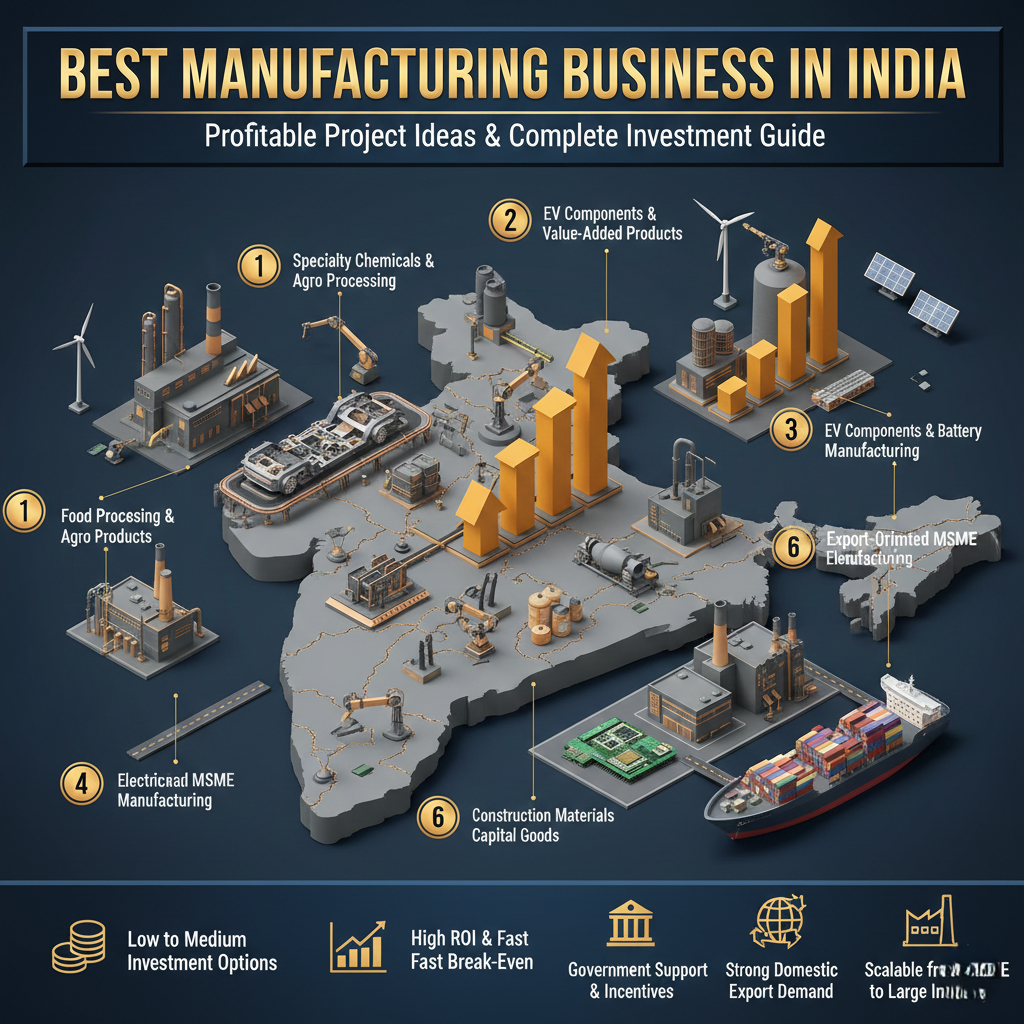
The selection process for the top manufacturing business in India during 2026 needs strategic planning and financial control together with a complete understanding of structural growth industries. Power equipment, healthcare manufacturing, food processing, and specialty chemicals require feasibility analysis and practical execution planning to achieve their full potential.
Manufacturing needs people to develop their work through taking time and creating detailed plans and executing all parts of their work with exact detail. The upcoming industrial growth period in India will benefit entrepreneurs who focus on essential business aspects instead of current market trends.
Frequently Asked Questions
Which manufacturing business is most profitable in India in 2026?
Power equipment, healthcare consumables, food processing, and specialty chemicals show strong long-term demand and policy alignment.
How much capital is required to start a manufacturing unit?
Small MSME projects may begin from ₹50 lakhs, while mid-sized plants can require ₹5–20 crores depending on sector and scale.
Is manufacturing a good business in India right now?
Yes, provided the project is selected based on demand validation, realistic projections, and proper financial structuring.
Do banks finance new manufacturing businesses?
Yes. Banks finance viable projects backed by detailed feasibility reports, promoter contribution, and stable sector outlook.
What is the biggest mistake new manufacturers make?
Installing excess capacity without confirmed buyers and ignoring working capital planning.