Introduction
India is rapidly emerging as a global hub for electric vehicles and electronics, and battery and semiconductor chemicals manufacturing in India is becoming a critical industry for this transformation.
To overcome this obstacle, the Indian Government has initiated the National Critical Mineral Mission, which focuses on securing, processing, and supporting the local supply chain of lithium, cobalt, nickel, rare earths, and semiconductor-grade chemicals. This change in policy will greatly benefit Indian startups and entrepreneurs by providing them with opportunities to invest in the domestic sectors of processing, refining, and specialty chemical manufacturing in the long run.
Read Our Book: Click Here
Market Landscape: India’s Import Dependence in Battery & Semiconductor Chemicals
India continues to rely on Australia and Chile for the import of lithium, the Democratic Republic of Congo for cobalt, and Indonesia for nickel. A majority of the semiconductor-grade chemicals (photoresists, ultra-pure solvents and etchants) are also imports from East Asia.(Battery and Semiconductor Chemicals Manufacturing in India)
There are expectations that the Evs and other Semiconductor technologies sector will grow exponentially by the year 2030, and with it the need for battery-grade chemicals and these other critical rare minerals. The National Critical Mineral Mission aims to enable the localization of these resources in India.
EV battery manufacturing involves lithium, cobalt, nickel, rare earth, and high-purity chemical procurement. This composition indicates a strong demand for vertical integration within the supply chain. In India, the opportunity for domestic supply is vertical integration for lithium, cobalt, and nickel, while rare earth and high-purity chemicals continue to be imported(battery-grade chemicals).
Read More: Manufacturing Lithium-Ion and Lead-Acid Batteries
Growth Drivers for Semiconductor and Battery Chemicals
Factors such as acceptance and the resultant demand from each of these industries dictate the lithium supply chain:
The most critical factor is the rapid growth of India’s EV market. It is predicted to expand at a staggering 40% CAGR until 2030. This places heightened lithium, cobalt, and nickel supply requirements on the battery supply chain(strategic minerals).
The second factor is Microprocessor and semiconductor reliant hardware. Construction of such hardware requires microprocessor manufacturing. This manufacturing incentivization requires a domestic supply of ultra-pure chemicals for microprocessor manufacturing.
The third pillar of support for the growth of this supply chain is the construction of infrastructure for renewable energy.…. More renewable energy (solar and wind) facilities mean a higher needed supply of rare earth. Storage for energy also requires battery supply.
India’s demand for imported lithium has been high. It is to exceed 250,000 tonnes of lithium carbonate equivalent by 2030. Cobalt’s demand is also high and projection to 30,000 tonnes. Nickel is to be similarly with expanded EV adoption(EV battery raw materials).
Support and Methods of Processing Critical Minerals & Chemicals
As a startup, knowing potential processing methods is crucial:
- Lithium Processing: Lithium hydroxide and carbonate is produced after calcining spodumene ore, leaching it with sulfuric acid, and then conversion. In extraction from brine, there is solar evaporation, followed by a chemical conversion.
- Cobalt Processing: Cobalt is gained as a by product from mining copper and nickel, and is then refined through solvent extraction, precipitation, producing cobalt sulfate that is battery cathodes(Critical Minerals & Chemicals).
- Nickel Processing: From sulfide ores, nickel sulfates is produced by smelting and refining, and that is used for EV batteries and other industries.
- Semiconductor Chemicals: Ultra-pure hydrochloric acid, hydrogen peroxide and photoresists, are used with advanced purification, distillation and cleanroom manufacturing standards.
Capital, advanced technology and a stringent code of environmental and safety standards are a requirement for every process.(Battery and Semiconductor Chemicals Manufacturing in India)
Read Our Project Report: Click Here
Opportunities for Entrepreneurs
Starting businesses in this space can fulfill numerous needs and demands:
- Lithium refining and battery chemical manufacturing.
- Recovery of lithium, cobalt, and nickel from used lithium-ion batteries through recycling.
- Manufacture of high-purity solvents and etchants.
- Specialty and battery-grade chemicals can be exported(Critical Minerals & Chemicals).
- For technology transfer and capacity building, collaborate with partners from other countries.
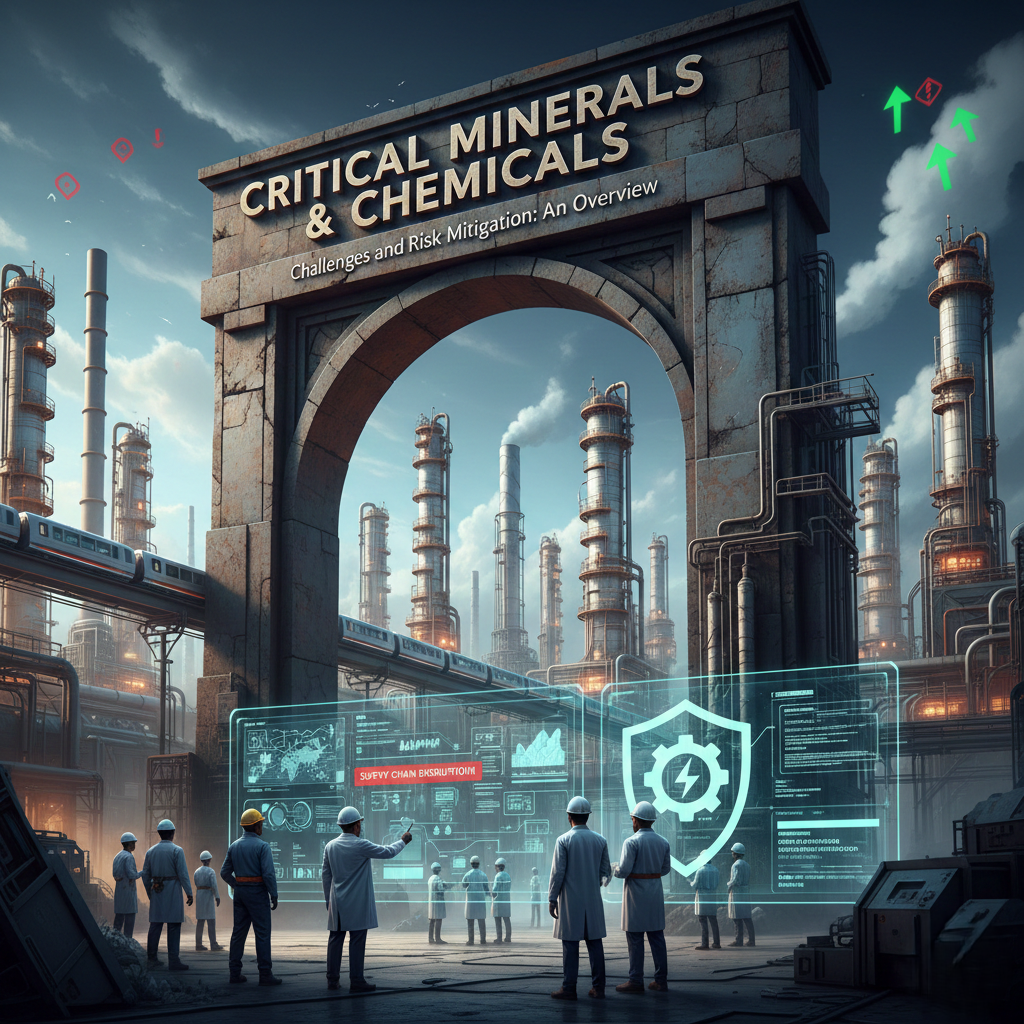
Challenges and Risk Mitigation: An Overview-Critical Minerals & Chemicals
The sector is complex and relies on significant capital. Start-ups encounter challenges like high initial capital, technological and supply chain barriers, and environmental challenges. The industry is capital intensive because of technological barriers.
To address these challenges, entrepreneurs may(EV battery raw materials):
- Take advantage of the government subsidies and support offered through the National Critical Mineral Mission.
- Enter into partnerships with international mining and chemical corporations.
- Fund the adoption of advanced sustainable technologies, such as bio-leaching and the use of green solvents-Critical Minerals & Chemicals.
- Pursue downstream diversification, such as manufacturing cathodes and anodes, as it allows for greater profit margins.
Read More: Beyond China+1 Strategy: Why India Is the Next Manufacturing Destination
NPCS Support for Entrepreneurs
Niir Project Consultancy Services enables entrepreneurs to identify and assess opportunities in the critical minerals and semiconductor chemicals sector. NPCS delivers a combination of Market Survey and Detailed Techno-Economic Feasibility Reports, which focus on the manufacturing processes and sourcing of the raw materials, the layout of the plants, and the financials.
With the guidance of NPCS, start-ups are able to evaluate prospects, lessening the risks, and are able to invest wisely, in line with the technological self-reliant goals of India.
Find the Best Idea for Yourself With our Startup Selector Tool
Summation-Critical Minerals & Chemicals
The self-reliance of India with respect to semiconductor and battery production hinges critically on the domestic supply of specialty chemicals and critical minerals.
The domestic production of battery-grade lithium, cobalt, nickel, and semiconductor chemicals, particularly specialty chemicals, and battery-grade lithium, will allow start-ups to leverage significant government incentives, a growing domestic market, and export opportunities(Critical Minerals & Chemicals).
Frequently Asked Questions-Critical Minerals & Chemicals
1. What are critical minerals, and why are they important for India?
A. Minerals like lithium, cobalt, nickel, and other rare earths are important for technologies like EV batteries, semiconductors, and renewable energy. These are therefore critical for India’s self-reliant industry-Critical Minerals & Chemicals.
2. Can startups also enter the semiconductor chemical industry?
A. Certainly. With the right tech and investment, startups are able to develop the high-purity chemicals, solvents, and etchants necessary for the fabrication of semiconductors.
3. What government support is available for startups in this sector?
A.Under the National Critical Mineral Mission, the government offers value addition to domestically processed minerals to the State and entrepreneurial promotion of processed minerals to the State(Critical Minerals & Chemicals).
4. Are there export opportunities for battery-grade chemicals from India?
A.Absolutely. With the global demand for EV batteries and clean energy, India is well positioned to export battery-grade lithium hydroxide, cobalt sulfate, nickel sulfate(strategic minerals), and other chemicals for semiconductors to the emerging markets in Europe, Asia, and Africa.(Battery and Semiconductor Chemicals Manufacturing in India)
5. What are the challenges here?
A.There are multiple challenges faced in the startup phase of critical minerals and chemicals in this sector. Some of the main include heavy investment, high variety of the required technologies, environmental regulation expectations, as well as challenges in finding and securing consistent sources of the needed primary materials.