Baby Care Products Market
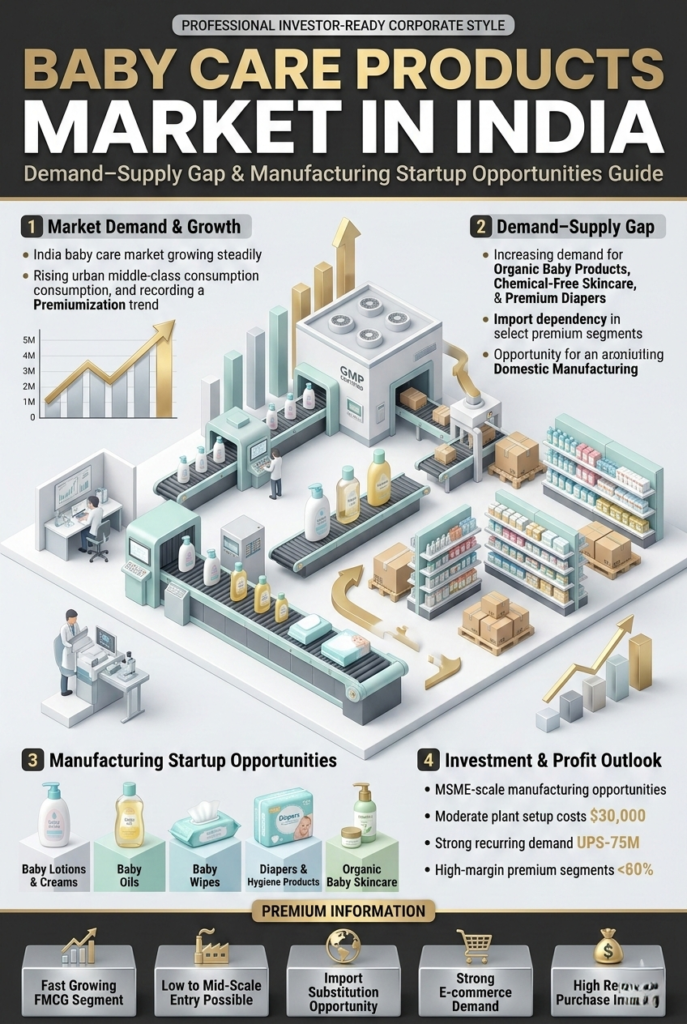
India’s baby care business is poised to go through a strong growth phase. Over the next five years, it is likely that the sector will grow fast, owing to rising disposable income, urban lifestyles, and rising awareness amongst parents about baby safety and hygiene. Entrepreneurs and investors are looking more at baby care manufacturing as one of the best bet sectors in India’s FMCG ecosystem.
As per the recent market projections, it is expected that the Indian baby care products market will grow by almost USD 40.84 billion in the period from 2025 to 2030, with an impressive CAGR of about 24.3%. This swift growth is being propelled by a huge child population, digital shopping habits, and a shift towards premium and safer baby products.
For the startups and MSMEs, the greatest opportunity is not just to sell baby products but to manufacture them in India, especially in the segments where India is still import-dependent.
Read More: Our Books
India Growing Baby Care Market
India has one of the highest number of children in the world. Nearly 24% of the population are younger than the age of 14, which leaves a huge and steady base of consumers looking for baby products.
The baby care market of India is broadly segmented into:
- Baby diapers and hygienic products
- Baby food and nutrition
- Baby skincare products and toiletries
- Baby wipes and hygiene accessories
- Baby apparel and other accessories
Among these, diapers, wipes, and nutrition products for babies are experiencing the fastest growth, due to the growing hygiene awareness and the changing parenting habits.
Urban parents are now seeking the use of safe ingredients, dermatologic tested products and convenience packaging, which is changing the baby care industry from basic hygiene items to trust-based premium products.(Baby Care Products Market )
Shift Towards Online Baby Care Shopping
The primary trend which currently drives the industry development of online shopping.
About 66 percent of Indian urban households now select online shopping as their preferred method to buy baby care products. The current purchasing trend shows a significant transformation from past years when people bought most items through pharmacies and supermarkets.
E-commerce platforms and D2C brands have made it easier for parents to find out more about new baby products, read ingredient lists, and compare safety claims before buying a product.
This shift is creating huge opportunities for new brands and contract manufacturers that can get products to market in a short amount of time and scale through digital distribution.
Read More: Baby & Adult Diapers & Sanitary Pads – Manufacturing Plant, Detailed Project Report, Profile, Business Plan, Industry Trends, Market Research, Survey, Manufacturing Process, Machinery, Raw Materials, Feasibility Study,Investment Opportunities,Plant Layout
Demand – Supply Gap in Baby Care Manufacturing
Despite the enormous market demand, India is still heavily dependent on imports of some baby care products and raw materials.
The largest gaps are where diapers, hygiene materials and special baby nutrition products are concerned.
1. Diaper Manufacturing Gap
Disposable baby diapers are among the highest volume products in the industry. However, India still imports large diaper variants or important raw materials used in manufacturing.
Key components necessary in the production of the diaper are:
- Super Absorbent Polymer (SAP)
- Nonwoven fabric
- Elastic bands
- Adhesives
- Breathable films
Out of all these materials, SAP (Super Absorbent Polymer) is the most important material as it is responsible for absorbing and locking the moisture.
For years, India relied heavily on imported SAP which raised the cost of production and supply risks. However, domestic production of SAP is now starting to scale and this could lead to the domestic diaper manufacturing ecosystem strengthening considerably.
For entrepreneurs, this was good news as domestic diaper conversion plants could prove more profitable and sustainable over the next few years.(Baby Care Products Market )
Read More: Project Reports & Profiles
2. Baby Wipes; Nonwoven Products
Baby wipes are another category with increasing growth because they are used several times a day and have high repeat purchase rates.
There are three main components needed in manufacturing baby wipes:
- Spun lace or spun melt nonwoven fabric
- Safe to apply to skin lotion formulation
- Hygienic packaging systems
India is slowly growing in the nonwoven fabric manufacturing capacity, but there is more space for more conversion units with the capacity to manufacture wipes for multiple brands.
This presents a large opportunity for contract manufacturing companies that provide wipes to private label brands, e-commerce companies, and hospitals.
3. Nutrition for Infants and Toddlers
Another major segment of the baby care market is baby nutrition.
However, this category is highly regulated in India, particularly for products for infants below two years. Strict regulations apply to the promotion and labelling of products for the infant population.
Large multinational companies dominate the infant formula market but there is still good potential for startups in areas including:
- Toddler cereals
- Organic baby foods
- Fruit and vegetable purees
- Nutritional snacks for young children
Clean-label and natural ingredients products are especially rising in popularity among modern parents.
Read More: 50 Successful MSME Business Ideas in India (2025 Edition)
Market Players in the Indian Baby Care Market
The baby care industry in India is very competitive and comprised of both multinationals and successful domestic brands.
Some of the major players are:
Multinational companies
- Johnson & Johnson
- Procter & Gamble
- Kimberly-Clark
- Nestlé
- Unilever
- Unicharm
Indian companies
- Dabur
- Himalaya Drug Company
- Honasa Consumer (Mama earth)
- Patanjali
These companies dominate the organized market of retail. However, the growth of online platforms has made it easier for new brands and manufacturers to enter the market, thanks to their rapid growth.
Why 2026 to 2030 Is the Best Time for Startups in Baby Care
Several structural trends make the next five years perfect for creating a baby care manufacturing startup in India.
Rising Demand
India has a young population, which guarantees that there will be continuous demand for baby products.
Even as the number of births gradually falls, there are still very large numbers of children, which underpins a long-term growth of the industry.
Increasing Regulations for Quality
Government regulations are promoting greater standards of product quality and safety. While this increased the barriers to entry, this has a beneficial effect on organized manufactures who can comply with the requirements.
Production of Raw Materials Locally
Domestic production of some basic raw materials such as SAP, and nonwoven fabrics is slowly rising. This will reduce dependence on imports and increase cost efficiency of the Indian manufacturers.(Baby Care Products Market )
Read More: Top Most Profitable Business Ideas for the Next 10 Years
Profitable Baby Care Manufacturing Opportunities
Entrepreneurs seeking to get into this sector should focus on products with high repeat purchase and scalable production models.
Some of the most promising opportunities are as follows:
Baby Wipes Manufacturing
Baby wipes factories can sell products to various brands via private label contracts. This business model offers the advantage that manufacturers can produce large volumes, without spending much on branding.
Diaper Conversion Plants
Regional diaper manufacturing units can cater to the local markets in a much more efficient manner because of the reduction of logistics costs and quicker product availability.
Baby Skin Care Manufacture
Products such as baby lotions, rash creams, shampoos and body washes have high profit margins when used with a dermatologically tested formulation.
Clean-Label Baby Food
Parents are now more choosing natural, preservative-free baby foods. Startups with an organic or minimally-processed foods focus can develop strong brand loyalty.
Key Factors to Success in Baby Care Manufacturing
Starting a baby care manufacturing business requires more than just determining market demand.
Successful companies concentrate on:
- Strict quality control systems
- Safe and certified ingredients
- Hygienic production facilities
- compliance with regulatory standards
- Reliable supply chains
Because of direct consequences of baby products on infant health, trust and product safety are the most important competitive advantages.
Conclusion
The Indian baby care products market is projected to grow enormously by 2026 to 2030. Rising incomes, digital commerce and increased awareness around infant health are changing the industry into a premium and safety-driven market.
At the same time, India continues to exist in large supply gaps of diaper materials, baby wipes and specialised nutrition products. This presents a strong opportunity for manufacturing-focused startups to be built by entrepreneurs to serve both local brands and the international market.
With the right combination of quality manufacturing, regulatory compliance, and excellent distribution strategies, new businesses can successfully enter this growing sector and capture a share of one of India’s fastest-growing consumer segments.(Baby Care Products Market )
FAQ – Baby Care Products Market in India
- How large is baby care market in India?
The Indian baby care products market is likely to grow by about USD 40.84 billion in the period 2025-2030 and is one of the fastest growing segments in the FMCG industry.
- Why is the baby wipes market so fast growing?
Baby wipes are used very frequently throughout the day and are considered to be convenient and hygienic. Their high repeat purchase rate make them one of the fastest growing categories in baby care industry.
- Is diaper making a profit in India?
Yes, diaper manufacturing is potentially profitable because of high demand and repeat use. However, success is reliant upon efficient supply chains, quality raw materials, and competitive pricing.
- Can baby care industry in India be entered by startups?
Yes. The growth of e-commerce together with private label brands has created new business opportunities for startups to enter the baby care market through their own production or through contract manufacturing or by developing specialized baby products.