Aluminium Billet Plant
A business-oriented, feasibility-based approach to the aluminium billet business, which is one of the most lucrative manufacturing ventures in the industrial sector today in India for entrepreneurs.
The core of the aluminium extrusion industry in India is Aluminium Billet, and the process of converting aluminium scrap into billets is fast emerging as one of the most viable business options for new business startups. A billet is the raw material for every window frame, door section, electrical busbar and automotive part.
India’s builders, auto makers, and electrical firms require a consistent source of billets and recycled scrap provide a more economical and expeditious way to meet this demand than bauxite mining and a primary production smelter. A first-time entrepreneur will find this low capital entry business idea to be supported by government and the fact that it has got a growing market.
In this article, I will take you through the opportunity, policy support that enables it, and specific business models that can be studied before you invest capital.
Get Detailed Project Report (DPR): Aluminium & Aluminium Downstream Projects
Why the Aluminium Billet Business Is Growing Fast
The consumption of aluminium in India continues to grow and secondary producers are providing a substantial amount of it. The secondary (recycled) market currently accounts for about 35-40 per cent of India’s total aluminium consumption, and the percentage is increasing as the volume of scrap becomes more significant as the aluminium consuming industries in the country grow. That’s a worthwhile indicator for those who are thinking about the business ideas category.
Recycled billets are cheaper to produce, and require significantly less energy to produce. Therefore, profit margins in this type of business are generally higher than what many people think.
Automotive and Construction Push Demand Higher
Today, automobile part manufacturers are increasingly turning to re-used aluminium if they can. The lightweight parts save fuel and recycled billets are also meeting that need, without the price of primary metal. The automotive market is already the biggest consumer of aluminium, with the growing use of lightweight products for better fuel efficiency and to comply with emission regulations.
At the same time, there is a demand for billets from a construction company to be used for extrusion, such as window frames, railings, structural parts, etc. This demand will not go down anytime soon as India is constructing more houses and other infrastructure.
Recycling Saves Energy and Cuts Cost
Not only is recycling aluminium cheaper. It also is much more environmentally friendly than bauxite ore mining and smelting. Only 5% of the energy is used in recycling compared with the energy used to make primary aluminium, and if the alloys are well processed, they can be as good as primary metal for much of industry.
This efficiency directly improves margins for billet manufacturers as energy costs are significant in the production process. Therefore, new players will still be able to offer competitive prices while maintaining profit margins.
But quality of raw materials is still a challenge. In secondary foundries, the rejection rate of billets due to impurities in the scrap input has been reported as 20-25 percent in both India and Brazil. As a result, any serious competitor will have to invest in the sorting of the scrap as well as pre-treatment, rather than melting capacity. It’s this where trained founders get a real advantage over informal players.
The Profitability Logic Behind This Business
Secondary billet manufacturing is profitable from a simple cost basis viewpoint, because the price difference between primary and recycled aluminium remains high and relatively stable. A billet maker purchases scrap, rather than bauxite or alumina, and completely avoids the most capital intensive and energy intensive part of the value chain.
This is because a well-run unit can charge a lower charge on its billets than the primary-metal based competitors, without compromising on margins. Furthermore, having billets to supply to buyers like extrusion units and component manufacturers on a continuous basis means that a manufacturer with a quality assurance program can build a repeat and contract base of revenue as opposed to relying on one-off spot sales. This is what makes this business appealing to lenders and investors as well.
Government Policies and Incentives Supporting This Business
If you’re a new business owner, you won’t know there’s so much support for this business idea already out there. The Central and State governments have created a comprehensive safety net of registration facilities, credit guarantees, and prudence for MSME manufacturing units. If you know how these work correctly, you can save lakhs on your job!
MSME Registration and Credit Support
Registration in Udyam is compulsory for all aluminium billet unit as majority of benefits are available on this registration. The process is free, digital and takes just a few minutes at the Udyam Registration Portal. On being registered, a unit is eligible for the Credit Guarantee Fund Scheme (CGTMSE) for collateral-free loans and for the Prime Minister’s Employment Generation Programme (PMEGP) to avail the capital subsidy on new manufacturing projects.
All the information about the complete scheme is available on the website of the Ministry of MSME. Besides, the Credit Linked Capital Subsidy Scheme (CLCSS) supports the technology upgradation of existing small units for billet casting.
Read the Complete Book Here: The Complete Technology Book on Aluminium and Aluminium Products
EPR Rules Are Reshaping Scrap Supply
A huge change in the regulatory landscape is happening now. Amended hazardous waste rules have introduced a new EPR framework for non-ferrous metal scrap and this is the introduction of a structured recycling system of aluminium, copper, zinc and their alloys. The compliance regime involves the requirement for registration, the introduction of recycling targets and digital tracking, together with a tradable EPR certificate regime.
This has implications directly for a new billet manufacturer, as producers will have to rely on certified recyclers to meet their obligations. In this way, formal and registered billet units are likely to receive regular and guaranteed supplies of scrap, something that informal scrap dealers cannot do. The Central Pollution Control Board has the registration information.
Import Duty and Trade Policy Support
There are also very favourable trade policies for the sourcing of raw materials. Historically India has kept a low basic customs duty on scraps, of 2.5 per cent, and this was done to encourage the domestic recycling industries. The Ministry of Mines has now recommended removing this duty altogether, to ensure secondary producers get easier access to raw material, since the secondary industry depends heavily on imported scrap. With this recommendation, billet manufacturing costs may decline even more. Founders should track updates through the Department for Promotion of Industry and Internal Trade (DPIIT) and the Ministry of Mines portals.
State-Level Industrial Incentives
In addition to central schemes, state governments also have their own industrial promotion policies which include power tariff concessions, stamp duty exemptions and capital subsidies.
Rajasthan hosts a large secondary aluminium cluster around Jaipur, and units there can apply through RIICO, the state industrial development body. Gujarat offers similar benefits through its investor facilitation portal, iNDEXTb, particularly useful for units near Ahmedabad and Rajkot. Tamil Nadu supports manufacturing investment through Guidance Tamil Nadu, while Uttar Pradesh entrepreneurs can access the state’s MSME support portal for schemes such as ZED certification and the Vishwakarma Yojna. Always confirm current subsidy percentages directly with the relevant state department before finalising your project location.
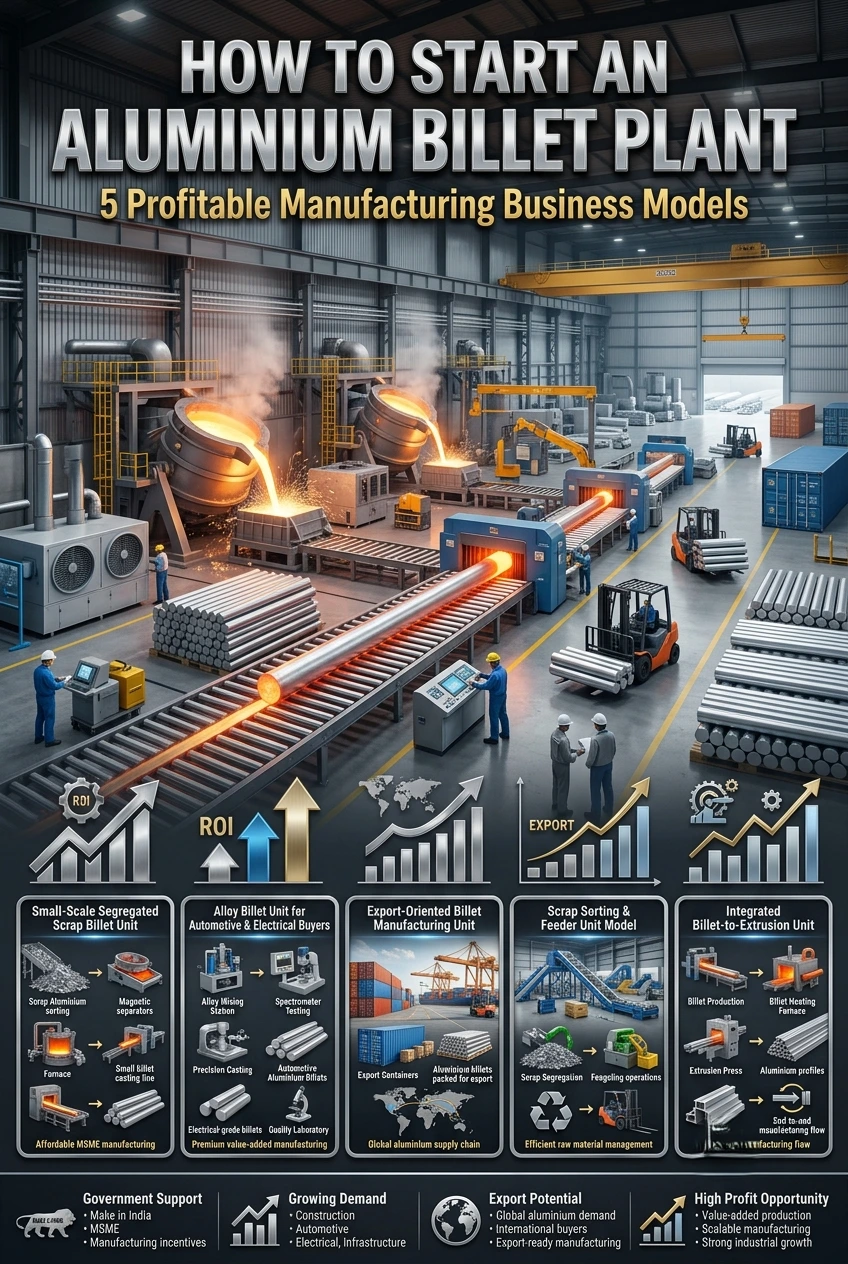
Multiple Business Ideas for Startups in Aluminium Billet Manufacturing
This sector isn’t a single business. There are a number of different models, each with its own amount of risk and capital outlay. Below are some practical thoughts that may help you consider the feasibility of a project before you get too far in your plan.
Small-Scale Segregated Scrap Billet Unit
A founder with limited capital can begin by investing in a small unit of a induction furnace that can melt pre-sorted and clean aluminium scrap like extrusion off-cuts, machining turnings, and turn out standard size billets. Input material is relatively pure; thus the cost of heavy pre-treatment equipment is avoided in this model. The local door-window fabricators and extrusion units become regular customers because they require the regular supply of billets nearby their units. This is a great concept for the first-generation entrepreneur who doesn’t require a big loan to get into the business. In the long term, profits can be used to upgrade mixed-scrap processing in a manner that will increase capacity and margin.
Alloy Billet Unit for Automotive and Electrical Buyers
A more specialized business model centers on manufacturing specific types of aluminium alloys, like 6063 or 6061, for auto and electrical component manufacturers. This will require spectrometer quality testing and increased process control; however, it will provide a legitimate price premium over undifferentiated billets. Smaller informal players cannot ensure documented alloy compositions and consistent mechanical properties, a desire that is growing among automotive OEMs and tier suppliers. As a result, if the startup invests in the initial testing equipment and quality certification, they can secure long-term contracts for supplies. This is especially effective in neighbourhoods that is near an automotive hub in Pune, Chennai or the Delhi NCR belt.
Export-Oriented Billet Manufacturing Unit
With India’s high import demand for scrap and increase in the demand for low carbon secondary metal in the world, an export-oriented billet unit is indeed a real opportunity. This model requires being close to a port, good quality documentation, and adherence to international scrap-grading codes. In Southeast Asia and the Middle East, buyers are seeking out secondary aluminium suppliers that are dependable, while primary suppliers are having trouble keeping up. An entrepreneur who establishes export connections at an early stage, say, at trade fairs or industry associations, can thus enjoy higher margins than are available for the domestic market. It is suitable for entrepreneurs who have a little more capital to invest in their business and have some experience in export papers.
Turn your budget into a successful business plan
Scrap Sorting and Feeder Unit Model
Not all entrepreneurs need to operate a furnace. A lower risk entry point is a scrap collection, sorting and grading unit to provide clean, segregated aluminium scrap to the local billet manufacturers. The model requires a smaller capital investment and less technical complexity compared to melting operations but addresses a severe industry constraint: uniform, uniform quality feedstock. The new EPR rules are forcing producers to turn to certified recyclers, and a well-managed sorting facility may enter into supply contracts with major billet manufacturers or with producers who want to achieve EPR compliance. This concept can be either a complete business or a part of a larger billet manufacturing plant at a later stage.
Integrated Billet-to-Extrusion Unit
If the founder has more capital resources, an integrated unit that casts billets and directly extrudes them to the finished profiles can give him the best margin. The middle man is not needed, because the same facility is producing both the billet and the finished aluminium profile – whether for window frames, railings or industrial profiles. The value addition per tonne is significantly increased and there is a lower risk of price fluctuations for billets as machines are used to make metal. The concept is appropriate for those with some experience promoting extrusions, or for the business that is already producing extrusions and wants to take a step back in production of scrap-based billets.
Import–Export Opportunity Analysis
This industry is influenced more than most would think by trade flows. With the demand for aluminium scrap, the collection of the same has not kept pace in the country and hence the country imports a significant amount of aluminium scrap. Today the secondary aluminium industry accounts for almost 40% of India’s aluminium supply with 20% domestic and 80% imported aluminium scrap.
This dependence is a risk and an opportunity for new manufacturers. On the other hand, the fluctuations in the currency and the volatility of the world’s scrap prices directly influence the input prices. However, it also implies that there is a market for actual and honest scrap collection at home, which can only be filled by organised players.
The same is true for import sourcing. Both industry bodies and policy makers have identified issues with low grade scrap flowing into the country and are currently examining the grade standards and duty regime. Tighter quality requirements will be to the advantage of manufacturers that have established a disciplined sorting and testing operation, and a new entrant will need to monitor this closely as they are likely to become more competitive with those who choose the cheapest scrap grade.
Related Article: Aluminium Alloy Manufacturing Business Is Booming in India: 6 Profitable Business ideas for MSMEs, Manufacturers, and Export Entrepreneurs
On export side, India has a low consumption per capita of aluminium indicating ample growth potential before it becomes a scrap constrained country. The national demand for aluminium in India is expected to reach about 8.3 million tonnes by the end of the decade from the current level of 5.3 million tonnes. This means secondary producers with a solid process discipline now have the opportunity to continue to claim a larger share of that growth for both domestic and export sales of low-carbon recycled metal. The Aluminium Association of India keeps a close watch on these trade patterns and releases updates that can be followed before finalisation of a project report.
Indian MSME Success Stories in Aluminium Recycling
Real entrepreneurs have proven this model at scale, and their journeys offer valuable lessons for new entrepreneurs.
Gravita India — From Small Recycler to Global Player
Rajat Agrawal’s Gravita India began as a small metal recycling business in Jaipur. Over the decades, the company expanded from lead recycling into aluminium and plastic recycling and later entered the turnkey recycling sector. Today, it is a listed, internationally active recycler with a strong record of export excellence. The message to new entrepreneurs is clear: start with the right approach, build strong process capabilities in one metal segment, and expand into other recycling areas once the main metal line becomes profitable.
Metenere Limited — Specialised Alloy and Billet Manufacturing
Raman Gupta founded Metenere Limited, and the company grew into a major producer of aluminium and lead alloys. While producing alloy ingot and billet, Metenere also invested on the subsequent production using continuous casting, cold rolling and aluminium foil through acquisition. The progression of their capacity demonstrates how a manufacturer using scrap as a raw material and operating a billet casting can further advance to produce higher value added flat rolled products.
Both founders started as first-generation entrepreneurs in a scrap-based metals business, and both scaled by prioritising quality, compliance, and steady reinvestment. New founders entering this business ideas space today have far more government support available than either company did at launch.
The Common Decision Pattern Worth Copying
Looking across both journeys, a clear pattern emerges. Neither founder chased every metal or every product line from day one. Instead, each has deepened its process controls for narrow segments first, established buying patterns and buying in a limited range of alloys, with few downstream integrations; then expanded product mix or geographies. As a startup, a person assessing that business for today’s market would take significance from the staging above; perhaps even above first investment.
About NPCS — Feasibility Support for New Entrepreneurs
Setting up an aluminium billet manufacturing unit is not a decision to make on assumptions. Detailed technical and financial groundwork matters, since machinery cost, alloy selection, and market positioning all affect long-term profitability.
At Niir Project Consultancy Services (NPCS), we help entrepreneurs prepare Market Survey cum Detailed Techno-Economic Feasibility Reports (DPRs) for setting up new industries and businesses. Our reports include manufacturing process details, market research and demand analysis, process flow diagrams, product mix and capacity planning, machinery and raw material specifications, and complete project financials with profitability analysis. Our objective stays simple: help entrepreneurs evaluate feasibility, profitability, and long-term scalability before committing capital.
Aluminium Billet Business at a Glance
The table below summarises key data points relevant to anyone evaluating this business idea.
| Parameter | Details |
| India Aluminium Scrap Market Size | Around USD 3.8 billion, projected to reach USD 11.2 billion at a CAGR of roughly 10.9 percent |
| Secondary Aluminium Share of Supply | Approximately 35–40 percent of India’s total aluminium supply |
| Domestic vs Imported Scrap Split | Roughly 20 percent domestic, 80 percent imported |
| Billet Rejection Rate (Impure Scrap) | 20–25 percent in secondary foundries due to scrap impurities |
| Basic Customs Duty on Aluminium Scrap | 2.5 percent, currently under review for possible removal |
| Projected National Aluminium Demand | Rising from about 5.3 million tonnes to nearly 8.3 million tonnes |
| Key Secondary Aluminium Clusters | Jaipur (Rajasthan); Ahmedabad, Rajkot, Surat (Gujarat); Pune, Mumbai (Maharashtra); Chennai, Coimbatore (Tamil Nadu); Agra, Kanpur, Moradabad (Uttar Pradesh) |
Frequently Asked Questions
How much capital does a small aluminium billet unit need to start?
Small segregated-scrap billet plant a small induction furnace needs relatively modest capital outlay but this varies with sizes of equipment. If the plant uses larger furnace the capital required rises rapidly. A thorough report on the project will supply you with a fairly precise amount.
Is Udyam registration compulsory before applying for government schemes?
Yes. Majority of the benefits such as CGTMSE credit guarantee, PMEGP subsidies and so on would mandatorily need an active Udyam registration to become applicable. Registration is absolutely free and it’s 100% online by signing up on the Udyam portal.
What raw material quality issues should a new manufacturer expect?
Impure or mixed scrap causes rejection during casting. Therefore, new units should invest early in sorting and pre-treatment, rather than assuming any scrap grade will work directly in the furnace.
Do the new EPR rules for non-ferrous scrap affect small billet manufacturers?
Yes, indirectly. Producers now need certified recyclers to meet their recycling targets, and this creates fresh demand for properly registered and compliant scrap processors and billet units.
Which locations suit an aluminium billet business best?
Established clusters such as Jaipur, Ahmedabad, Pune, and Chennai offer existing scrap supply chains and buyer networks, which reduces early-stage sourcing risk for a new unit.
Can a billet manufacturing unit also export its product?
Yes. Rising global demand for recycled aluminium, combined with India’s strong scrap import base, gives export-focused billet units a genuine growth path, provided quality documentation meets international buyer standards.
Conclusion
Aluminium billet manufacturing from scrap sits at a genuinely attractive point right now. Demand keeps rising across automotive, construction, and electrical sectors, while government policy, from MSME credit schemes to new EPR compliance rules, keeps pushing more support toward organised, registered recyclers.
For a first-generation entrepreneur exploring solid business ideas in the manufacturing sector, this business offers a rare combination: manageable entry capital, strong policy backing, and a market that is not slowing down. The founders who succeed will be the ones who take scrap quality, compliance, and process discipline seriously from day one, rather than treating this as a quick commodity trade.